
The First Republic of Armenia (1918–1920)
On 28 May 1918, days after Armenian forces halted an Ottoman advance at Sardarapat, leaders in Yerevan declared an independent republic. It inherited a ruined territory crowded with refugees and survivors of the genocide, and it lasted only until December 1920. Yet in that short time it built a government, wrote laws, opened a university and gave twentieth-century Armenians the model of statehood they returned to in 1991.
- Author
- Armat Editorial Team
- Updated
- Reading time
- 9 min read
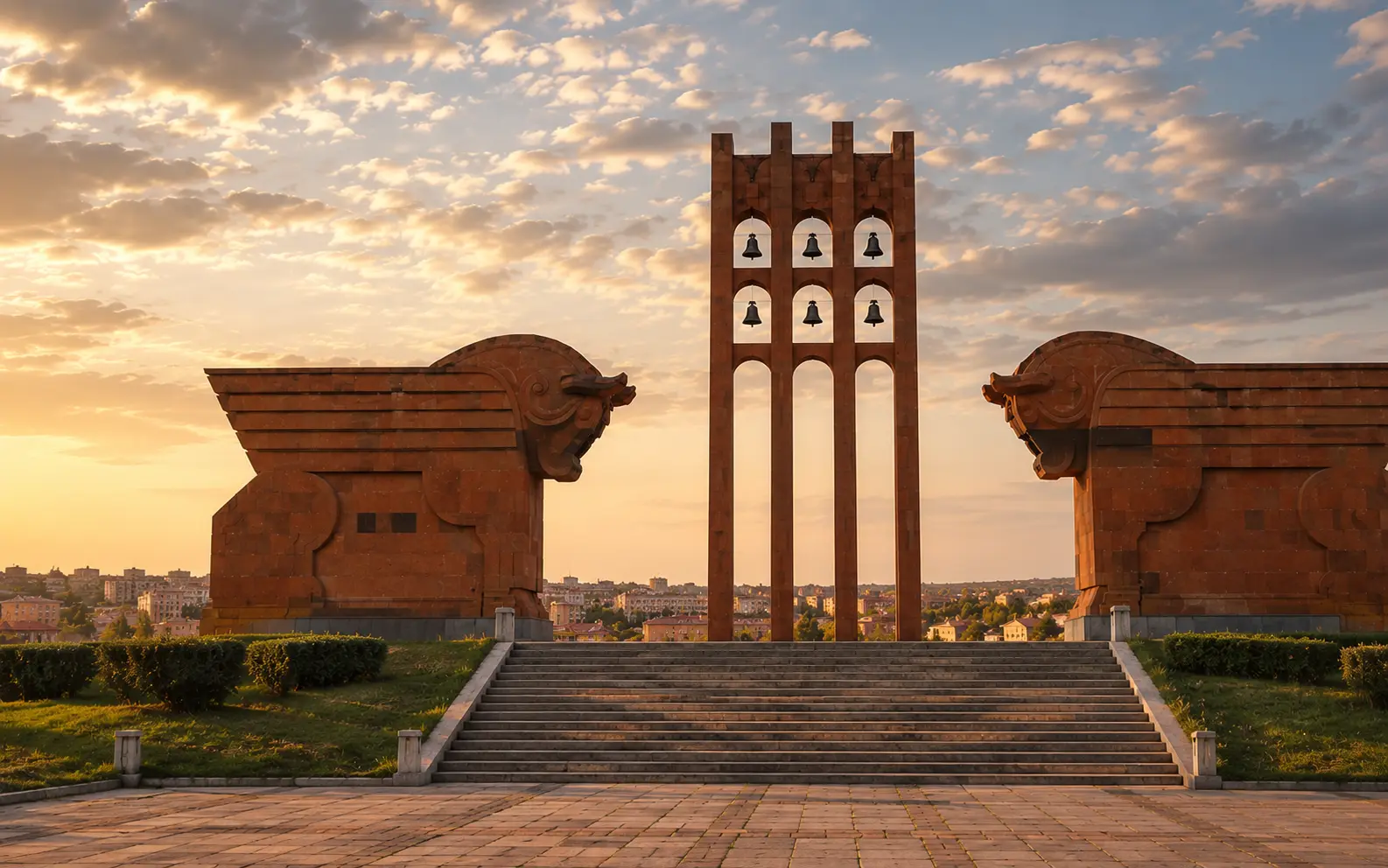
In brief
The First Republic of Armenia existed from 28 May 1918 to 2 December 1920. It emerged after the Armenian Genocide, the collapse of the Russian Empire and the disintegration of the Caucasus front. The May Battles at Sardarapat, Bash Aparan and Karakilisa halted the Ottoman advance and made a declaration of independence possible. Amid famine, epidemics and hundreds of thousands of refugees, the republic formed a government, parliament, army, currency and state university. Its fall resulted from a Turkish invasion, the advance of the Soviet Red Army, border wars, and extreme economic and demographic weakness. Although it lasted only two and a half years, its tricolour, institutions and idea of independent statehood became an important precedent for the Republic of Armenia in 1991.
Key facts
- Declared
- 28 May 1918 in Yerevan
- Ended
- 2 December 1920, when power passed to Soviet authorities
- Capital
- Yerevan
- First prime minister
- Hovhannes Kajaznuni
- Flag
- Red, blue and orange horizontal tricolour, readopted in 1990
- Founding institution
- State university established in 1919, now Yerevan State University
Collapse, genocide and war
The First World War devastated the Armenian population of the Ottoman Empire. Beginning in 1915, deportations and massacres destroyed communities across Anatolia, and hundreds of thousands of survivors fled east into the Russian Caucasus. There they joined a region already strained by war, disease and food shortages, and relief organisations struggled to feed the camps that formed around Yerevan and Etchmiadzin.
The Russian Revolution of 1917 removed the imperial administration and, with it, the Caucasus front. Russian troops left their positions through the winter, and by early 1918 the defence of the region rested on locally raised Armenian units. In April the Transcaucasian Democratic Federative Republic briefly united Armenians, Georgians and Azerbaijanis, but the three national councils wanted different things and the federation dissolved within weeks.
The May Battles and Sardarapat
In May 1918 Ottoman forces were advancing towards Yerevan and the Ararat plain. Armenian regular units, militia, volunteers and villagers resisted them at Sardarapat, Bash Aparan and Karakilisa. The fighting near Sardarapat from 21 to 29 May halted the advance on Yerevan, while resistance on the other two fronts prevented Ottoman forces from quickly outflanking the Armenian defence.
These battles did not remove the military danger or bring an unconditional victory: the new state had to sign the harsh Treaty of Batum in June. But they preserved Yerevan and part of the Armenian population, creating the minimum political space in which an independent republic could be declared on 28 May.
Founding the republic
The Armenian National Council declared independence on 28 May 1918, and the new state was governed largely by the Armenian Revolutionary Federation, with Hovhannes Kajaznuni as its first prime minister and Aram Manukian, the organiser of the defence of Yerevan, as a central figure until his death from typhus in 1919. The Treaty of Batum, signed in June under Ottoman pressure, left the republic with only a small territory around Yerevan and Lake Sevan.
Conditions were desperate. Roughly a third of the population were refugees, harvests had failed, and epidemics of typhus and cholera spread through overcrowded settlements. Famine and epidemic in the winter of 1918 to 1919 killed on the order of a hundred and fifty thousand people, close to a fifth of the population. American and other international relief efforts, including the organisation later known as Near East Relief, kept large numbers of people, especially orphans, alive.
Despite this the government built institutions quickly. Ministries were organised, a parliament was elected in June 1919 with women both voting and standing as candidates, a national currency and postal service were introduced, and a state university was established by decree in May 1919, opening in Alexandropol at the start of 1920 before moving to Yerevan. The tricolour of red, blue and orange was adopted as the national flag.
- Independence declared on 28 May 1918
- First prime minister: Hovhannes Kajaznuni
- Parliamentary elections held in June 1919 with women voting and serving as deputies
- State university founded in 1919, the ancestor of Yerevan State University
Borders and diplomacy
The republic sent delegations to the Paris Peace Conference and pressed for recognition and for a viable territory. In 1920 the Treaty of Sevres awarded Armenia extensive lands in eastern Anatolia, with the boundary to be drawn by United States President Woodrow Wilson. Wilson delivered his arbitration award in November 1920, but by then the treaty had no force on the ground, because the Turkish national movement rejected it and the United States Senate declined to accept a mandate over Armenia.
Relations with neighbours were tense. Disputes with Georgia over the Lori district led to brief fighting in December 1918, and conflict with Azerbaijan over Karabakh, Zangezur and Nakhichevan continued through 1919 and 1920. These wars consumed resources the republic could not spare and left it isolated when a serious threat arrived.
In September 1920 Turkish nationalist forces under Kazim Karabekir attacked from the west and captured Kars and Alexandropol. As the Red Army entered from the east, the government transferred power to a Soviet administration on 2 December 1920. The Treaty of Alexandropol, imposing severe terms, was signed at almost the same moment by a government that had already given up its authority, which is why its legal standing has been disputed ever since.
Why the First Republic fell
The republic's fall had no single cause. The mass arrival of genocide survivors, famine, epidemics and economic blockade had exhausted the state's limited resources. Border conflicts with Georgia and Azerbaijan divided the army's attention, while promises from the great powers brought no practical military protection.
In autumn 1920 the Turkish nationalist army attacked from the west and captured Kars and Alexandropol, while the Red Army and Soviet authorities applied pressure from the east. Unable to fight on two fronts, the government transferred power to Soviet bodies on 2 December. As with the fall of the Bagratid kingdom, external invasion combined with the internal weakness of a state worn down by war. The collapse should therefore not be reduced to one treaty or one political decision.
Sovietisation and the February uprising
Armenia became a Soviet republic, and the new authorities moved rapidly against former officials and officers. Arrests and requisitions provoked a revolt in February 1921, during which insurgents held Yerevan for several weeks before Red Army units retook the city in April. Many of the leaders retreated to Zangezur, where Garegin Nzhdeh had organised a mountain resistance that held out until July 1921.
That resistance had one lasting result. When Nzhdeh finally withdrew, it was on the condition that Zangezur remain part of Soviet Armenia, and the region, today the province of Syunik, has been Armenian territory ever since. Kars and Ardahan were confirmed as Turkish under the treaties of Moscow and Kars in 1921, and Nakhichevan was placed under Azerbaijani jurisdiction.
Soviet Armenia brought stability, industrialisation and mass literacy, alongside political repression that fell heavily on writers and intellectuals in the 1930s, including Yeghishe Charents. Independence returned only in 1991, when the Armenian population voted overwhelmingly for it and the Republic of Armenia declared itself the successor to the state founded in 1918.
The republic in Armenian memory
The First Republic lasted two and a half years, but its achievements were real. It kept a population alive through famine, established a functioning administration in the worst possible conditions, held a democratic election, and founded a university that still operates. It also demonstrated that Armenians could organise a modern state, which mattered enormously to a generation that had just survived the genocide.
Its symbols carried forward. The tricolour flag was readopted in August 1990, a year before independence; the republic that followed recognised 28 May as Republic Day, and treated the First Republic as its legal and moral predecessor. The Sardarapat memorial, built in 1968, is one of the country's principal national monuments, and its bell is rung at commemorations each May.
For students, the period offers a demanding but rewarding subject. It requires weighing decisions made under extreme pressure, understanding how great-power diplomacy affected small states after the First World War, and recognising that a short-lived government can still shape a national future.
Important dates
1915
The Armenian Genocide begins in the Ottoman Empire, driving survivors into the Russian Caucasus.
May 1918
Armenian forces halt the Ottoman advance at Sardarapat, Bash Aparan and Karakilisa.
28 May 1918
The Republic of Armenia declares independence.
June 1919
Parliamentary elections are held, with women voting and elected as deputies.
August 1920
The Treaty of Sevres grants Armenia extensive territory that is never realised.
2 December 1920
The government cedes power and Armenia becomes a Soviet republic.
Why the First Republic of Armenia matters
The republic proved that a modern Armenian state was possible. Formed in the aftermath of genocide and in the middle of famine, war and mass displacement, it nonetheless created ministries, courts, a currency, a parliament elected by men and women alike, and a national university. Few governments have been asked to do so much with so little.
It also supplied the framework for independence in 1991. The flag, the national holiday of 28 May, and the constitutional claim to succession all come directly from 1918. Understanding the First Republic therefore explains not only a brief chapter of the past but the legal and symbolic foundations of Armenia today.
Interesting facts
- 01Women in the First Republic could vote and be elected in 1919, earlier than in many western European countries.
- 02The battle of Sardarapat is commemorated by a memorial complex opened in 1968 whose bell is rung each May.
- 03Yerevan State University traces its founding to a decree of the First Republic in 1919.
- 04President Woodrow Wilson personally drew a proposed Armenian boundary in 1920 that was never put into effect.
- 05Garegin Nzhdeh's resistance in Zangezur helped ensure that the region, now Syunik, remained part of Armenia.
Sources
- Richard G. Hovannisian. The Republic of Armenia, Volume I: The First Year, 1918–1919 — University of California Press, 1971 ISBN 9780520019843The first of four volumes; the series runs to 1921 and remains the standard account.
- James L. Barton. Story of Near East Relief (1915–1930): An Interpretation — Macmillan, New York, 1930 Visit source
- Peace Conference: British Delegation, Correspondence and Papers — The National Archives, Kew, 1919–1920 · TNA FO 608An archival record group, not a publication; consult by series and piece reference.
Related articles
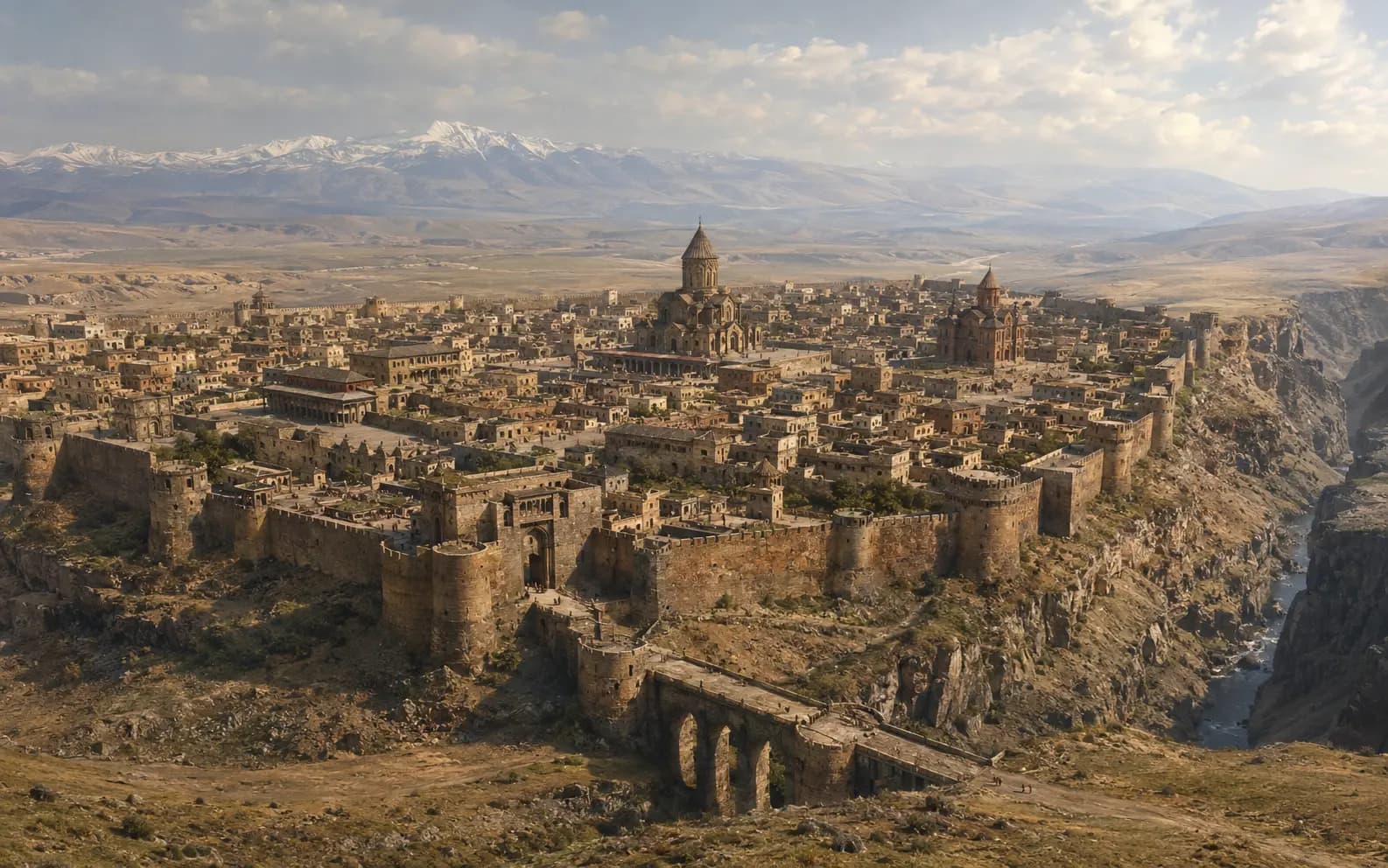
Bagratid Armenia and the City of Ani
The Bagratid kings restored Armenian statehood after two centuries of foreign rule and built Ani into one of the great cities of the medieval world.
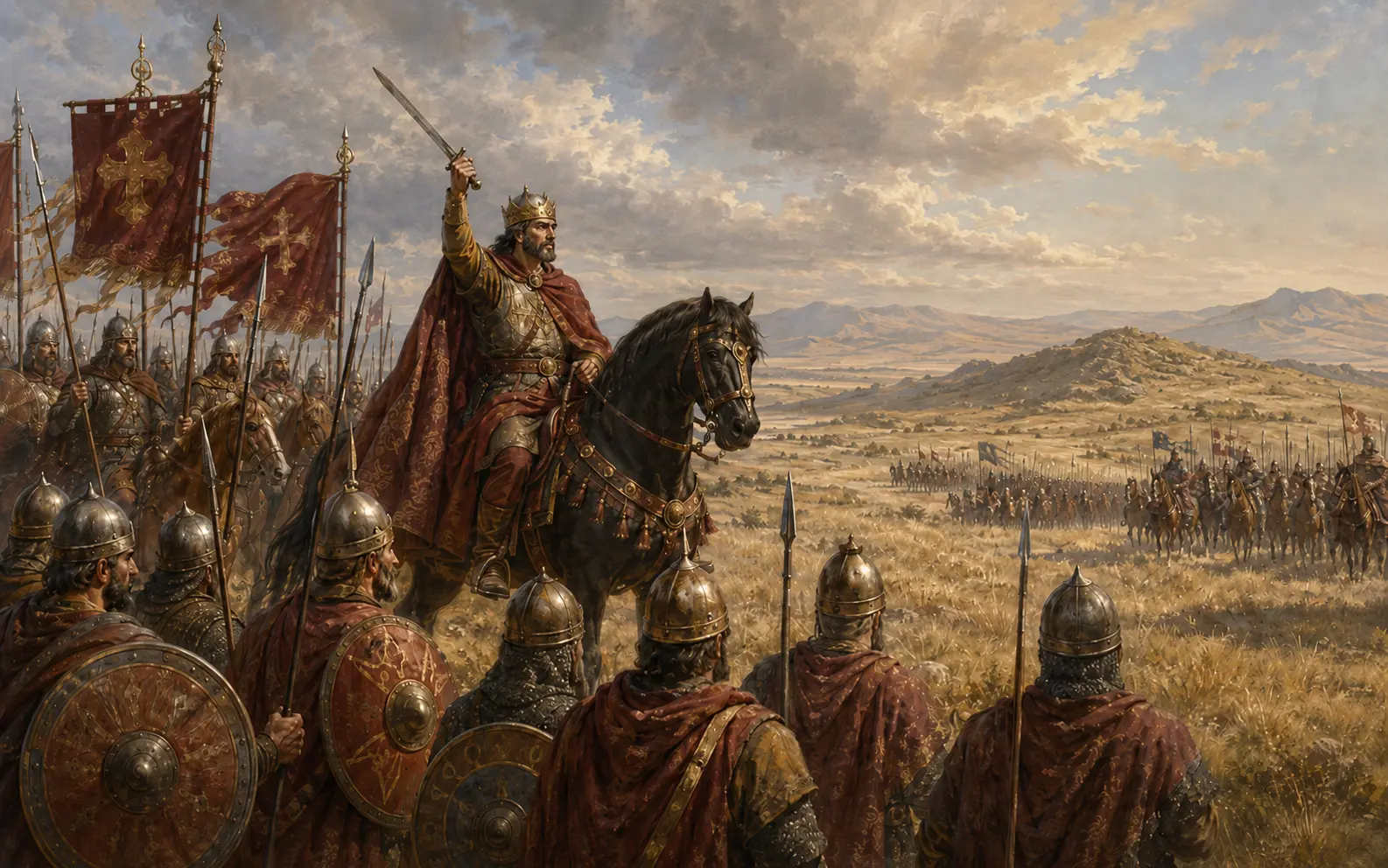
The Battle of Avarayr (451)
In 451 Armenian forces under Vardan Mamikonian faced a far larger Persian army to defend their faith, losing the battle but winning religious freedom.
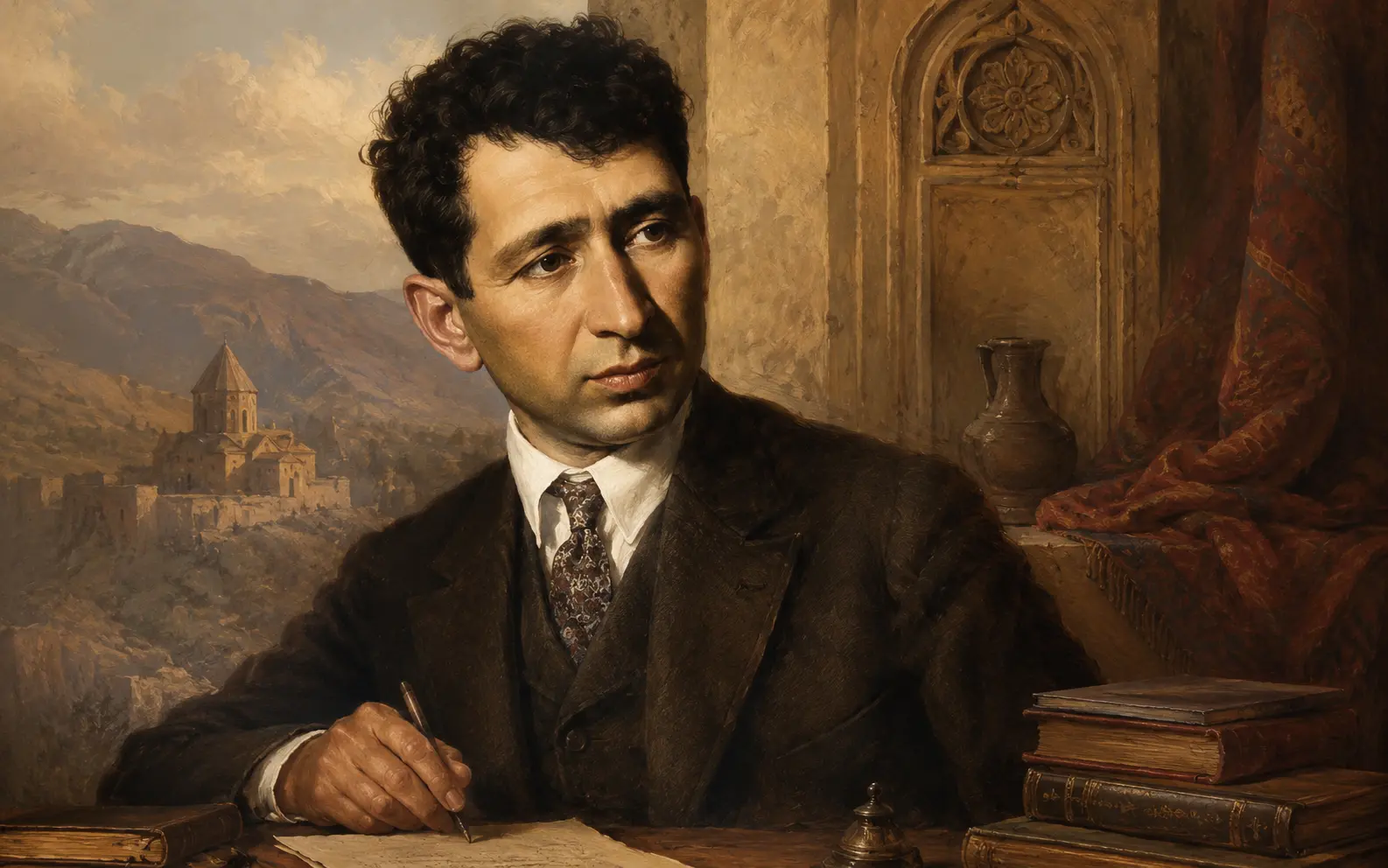
Yeghishe Charents
A restless modernist poet whose bold experiments and fierce love of Armenia made him the defining literary voice of his generation.