
Yeghishe Charents
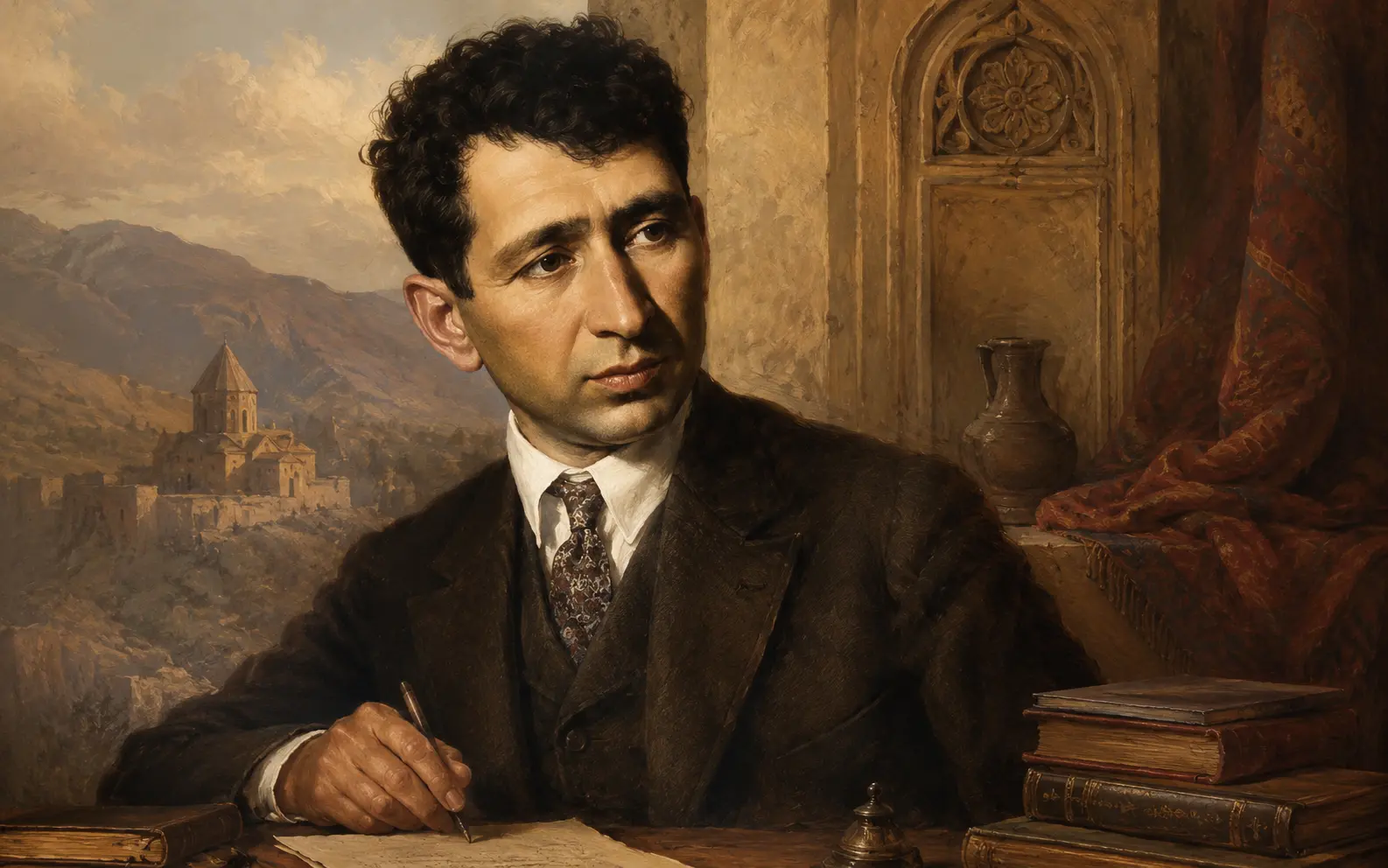
Yeghishe Charents brought modern European poetic techniques into Armenian literature while writing some of the most quoted patriotic lines in the language. His career spanned revolution, genocide, civil war and the building of Soviet Armenia. He died in 1937, during the Stalinist purges, and his work was restored to readers only two decades later.
- Author
- Armat Editorial Team
- Updated
- Reading time
- 7 min read
Key facts
- Born
- 13 March 1897, Kars
- Died
- 27 November 1937, Yerevan, aged 40
- Birthplace
- Kars, then in the Russian Empire
- Known for
- Modernist poetry and the most quoted patriotic verse in Armenian
- Notable works
- Dantesque Legend, Land of Nairi, Book of the Road
- Literary period
- Armenian modernism and the early Soviet era
Early life in Kars
Yeghishe Charents was born Yeghishe Soghomonyan on 13 March 1897 in Kars, a fortress city then held by the Russian Empire and home to a large Armenian population. His family had moved there from Persian Armenia and ran a modest trade in carpets and textiles. He attended the local Armenian school and read voraciously, discovering Russian symbolist poetry alongside classical Armenian texts.
He began publishing while still a teenager, adopting the pen name Charents, which is usually connected to a word meaning evil or hardship. His first substantial work, the cycle Three Songs to a Sad and Pale Girl, appeared in 1914 and already showed a musical, image-driven style unlike anything then common in Armenian verse.
In 1915, at the age of eighteen, he volunteered for an Armenian unit on the Van front and witnessed the deportations and massacres of Ottoman Armenians at first hand. The experience produced Dantesque Legend, a long poem published in 1916 that describes war without heroic decoration and stands among the earliest literary responses to the Armenian Genocide.
Revolution and literary career
After the Russian Revolution Charents supported the Bolsheviks, served briefly in the Red Army and moved to Moscow, where he studied and absorbed the avant-garde currents of the early 1920s. He experimented with free verse, fractured syntax, collage and typographic play, and for a time led a group that called for a complete break with older Armenian literary habits.
He returned to Soviet Armenia and took a leading role in its new cultural institutions, working at the Armenian State Publishing House from 1928 to 1935. He edited texts, promoted young writers and pushed for high production standards, believing that a small nation needed excellent books more than it needed slogans.
His enthusiasm for the new order was genuine but never simple. Alongside revolutionary poems he kept writing intensely personal lyrics about love, memory, exhaustion and doubt, and he defended the value of national tradition at a time when such defence was becoming dangerous.
Major works
The novel Land of Nairi, written between 1921 and 1925 and published in 1926, is his most ambitious prose work. Set in a provincial Armenian city on the eve of catastrophe, it mixes satire, tragedy and modernist narrative games as it examines the illusions its characters hold about themselves and their nation. It is widely regarded as the first modernist Armenian novel.
Book of the Road, published in 1933, gathers his mature poetry and includes historical meditations, lyric cycles and a section of quatrains inspired by Persian forms. The book was attacked by official critics soon after publication, and it became the central evidence used against him in later years.
Among his shorter poems, the one beginning I love the sun-savoured word of my sweet Armenia is probably the most memorised text in modern Armenian literature. Its images of mountains, ancient script and enduring sorrow are quoted at school ceremonies, concerts and commemorations to this day.
- Dantesque Legend, long poem, 1916
- Land of Nairi, novel, 1926
- Book of the Road, poetry collection, 1933
- Rubaiyat and other quatrain cycles
- I love the sun-savoured word of my sweet Armenia, lyric poem, 1920–21
Themes and style
Charents wrote as a man arguing with himself in public. Faith in a new future sits beside grief for what was destroyed, and celebration of the collective sits beside a sharply individual voice. This tension gives his poetry its energy and makes it far more interesting than the confident political verse produced around him.
Technically he was the great innovator of his language. He stretched Armenian metre, invented compound words, borrowed devices from Russian futurism and French symbolism, and moved freely between medieval Armenian forms and radically modern ones. Later poets learned from him that Armenian could do anything a major European literature could do.
Memory is his constant subject. The lost cities of Western Armenia, the alphabet of Mesrop Mashtots, the ruins of Ani and the survivors of 1915 recur across his work as a way of insisting that a nation is held together by what it refuses to forget.
Final years
From the early 1930s Charents came under increasing official criticism for nationalism and formalism, the standard charges of the period. He lost his publishing post, his books were withdrawn from circulation and he was placed under surveillance. His health suffered and he continued to write largely for the drawer.
He was arrested in the summer of 1937 during the mass repressions carried out across the Soviet Union. He was held in Yerevan and died in prison on 27 November 1937 at the age of forty. His burial place is unknown, and no grave has ever been identified.
After Stalin's death Charents was officially rehabilitated in 1954 and 1955, and his work returned to print. Manuscripts hidden by friends and family during the purge years, including papers reportedly buried for safekeeping, allowed scholars to reconstruct much of what had been suppressed.
Legacy
Charents is now read as the pivotal figure of twentieth-century Armenian literature, the writer who connected the folk-rooted tradition of Tumanyan to the questioning modern poetry of Paruyr Sevak and later generations. His house in Yerevan is a museum, and the Charents Arch on the road east of the capital frames a famous view of Mount Ararat.
His fate also made him a symbol. Because he believed in the Soviet project and was destroyed by it, his life is often studied as a case history of what the purges cost a small nation's culture. Students today usually encounter both the poems and that history together.
Important dates
1897
Born Yeghishe Soghomonyan in the city of Kars.
1915
Volunteers on the Van front and witnesses the deportations of Ottoman Armenians.
1916
Publishes Dantesque Legend, his first major long poem.
1926
Publishes the modernist novel Land of Nairi, written across the previous five years.
1933
Publishes Book of the Road, which is soon officially attacked.
1937
Arrested during the purges and dies in prison in Yerevan.
Why Yeghishe Charents matters
Charents modernised Armenian literature almost single-handedly. He showed that the language could carry free verse, irony, fragmentation and psychological complexity, and he did so without abandoning the medieval and folk traditions he loved. Every serious Armenian poet after him has had to respond to his example in some way.
He also stands as a witness. His poetry records the genocide, the collapse of empires, the hopes of a new republic and the closing grip of political repression, all from the inside. Reading him gives students a first-hand sense of how one talented person experienced a decade that reshaped the Armenian world.
Interesting facts
- 01He took the pen name Charents in his teens and used it for the rest of his life, rarely signing his family name.
- 02His 1933 poem Message contains an acrostic, formed by the first letters of successive lines, urging Armenians to find salvation in unity.
- 03Land of Nairi is often described as the first modernist novel written in Armenian.
- 04Friends preserved manuscripts through the purge years, which allowed much of his suppressed work to be published after 1954.
- 05The Charents Arch above the village of Voghjaberd was built in 1957 to mark his sixtieth anniversary and frames a view of Mount Ararat.
Sources
- A. J. Hacikyan, G. Basmajian, E. S. Franchuk and N. Ouzounian (eds.). The Heritage of Armenian Literature, Volume III: From the Eighteenth Century to Modern Times — Wayne State University Press, 2005 ISBN 9780814332214
- Marc Nichanian. Writers of Disaster: Armenian Literature in the Twentieth Century — Gomidas Institute, Princeton and London, 2002 ISBN 9781903656099
Related articles
Hovhannes Tumanyan
The village-born poet whose ballads, fairy tales and quiet moral authority earned him the title Poet of All Armenians.
Paruyr Sevak
The Soviet-era poet whose epic about Komitas broke a long silence and made memory of the genocide speakable again in Armenian verse.
Mesrop Mashtots and the Armenian Alphabet
Around 405 the scholar and monk Mesrop Mashtots created an alphabet that gave Armenian its own written voice and reshaped the nation's culture.