
Mesrop Mashtots and the Armenian Alphabet
In the early fifth century, Armenia had a church, a literature it could not read in its own language, and a political situation that threatened to divide it in two. Mesrop Mashtots, a court secretary turned monk, answered that crisis by inventing a complete alphabet for the Armenian language. Within a generation, scholars trained by him had translated the Bible, founded schools and begun a national literary tradition that has never been interrupted.
- Author
- Armat Editorial Team
- Updated
- Reading time
- 9 min read
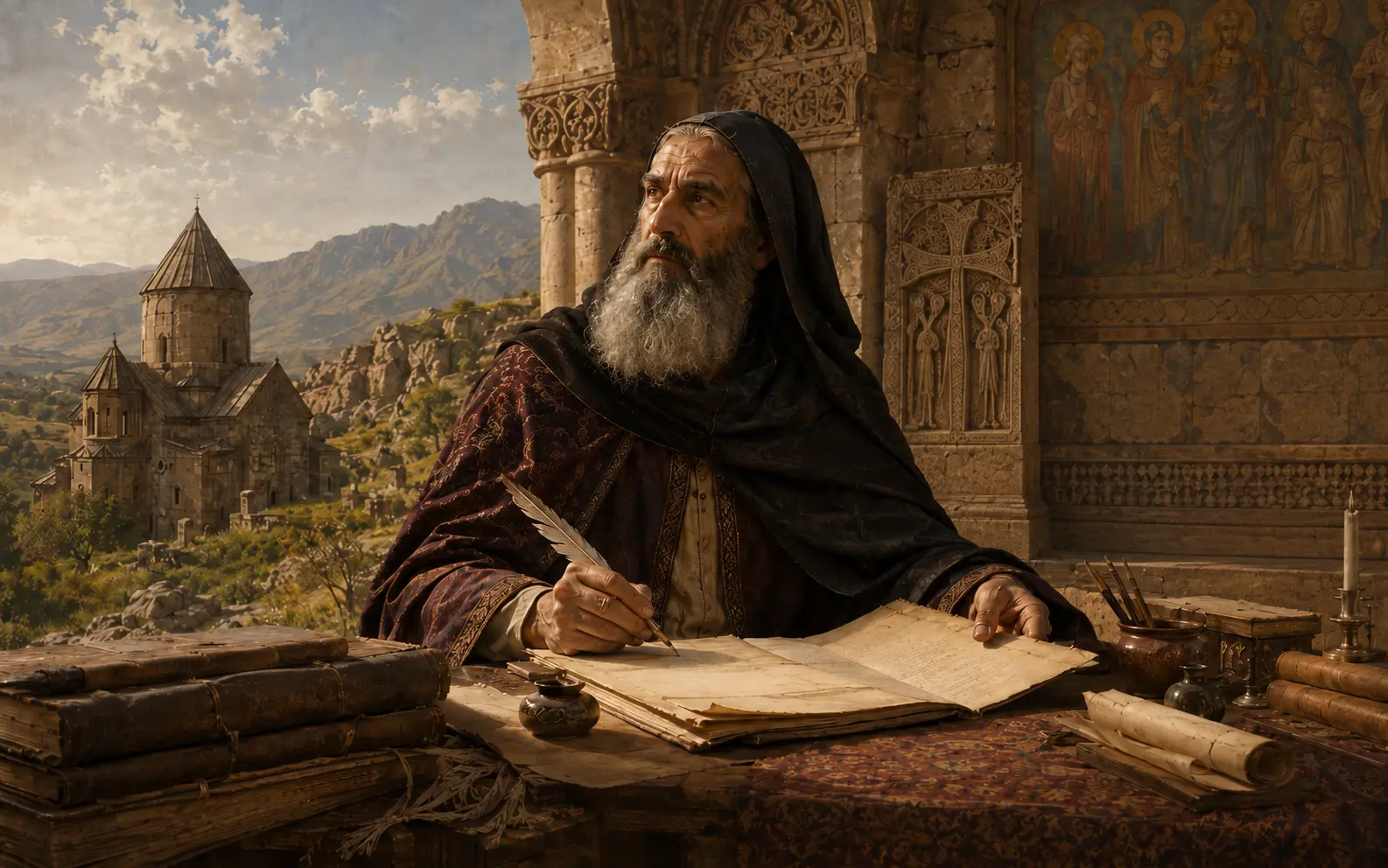
Key facts
- Full name
- Mesrop Mashtots, monk, teacher and linguist
- Lived
- About 361 to 440
- Alphabet created
- Around 405, with thirty-six original letters
- Chief supporters
- Catholicos Sahak Partev and King Vramshapuh
- Best known student
- Koriun, author of the first original Armenian book
- Burial place
- Oshakan, in the Aragatsotn province of Armenia
The world that shaped him
Mesrop Mashtots was born around 361 in the village of Hatsekats in the province of Taron, into a family of modest means. He received a Greek education, learned Persian and Syriac, and entered the service of the Armenian royal chancellery, where documents were written in those foreign languages. That experience placed him at the exact point where the problem became visible: the business of the Armenian state and the worship of the Armenian church were conducted in scripts that ordinary Armenians could not read.
The political background made the problem urgent. In 387 the kingdom was partitioned between the Roman and Sasanian empires, and in 428 the Armenian monarchy was abolished altogether. Greek was the language of learning in the western portion, Persian and Syriac in the eastern. A people divided between two empires with no common written language risked losing the sense that it was one people at all.
Around 392 Mashtots left the court, took monastic vows and went to preach in the province of Goghtn. There he saw the difficulty from the other side. He could speak to villagers in Armenian, but every scripture reading had to be improvised aloud from a Syriac or Greek text, and nothing he taught could be written down for them to keep. Preaching without books, he concluded, left no lasting result.
The creation of the script
With the support of Catholicos Sahak Partev and King Vramshapuh, Mashtots began a systematic search. He travelled to Edessa, Amid and Samosata, centres of Syriac and Greek learning, studying scripts and consulting scholars. An earlier set of letters attributed to a bishop named Daniel was tested and found inadequate, because it could not represent all the sounds of Armenian. Rather than adapting a foreign alphabet by force, Mashtots analysed the spoken language and designed signs to match it.
The result, completed around 405, was an alphabet of thirty-six letters ordered so that each represented a single distinct sound of Armenian. Two more letters, օ and ֆ, were added in the twelfth century. The alphabet is therefore usually counted as thirty-eight letters, or thirty-nine if the ligature և is counted as a letter in its own right, as the reformed orthography treats it. The system is remarkably close to phonetic, which is why Armenian spelling remained stable for centuries and why the script proved easy to teach. Its letter order also follows the Greek sequence where the sounds correspond, which shows careful and deliberate design rather than improvisation.
Tradition records that the first sentence written in the new letters was the opening line of the Book of Proverbs, in which Solomon speaks of knowing wisdom and instruction. The calligrapher Rufinus of Samosata is credited with giving the letters their final graphic form. Mashtots then returned to Armenia and immediately began doing the thing that mattered most: teaching.
- Thirty-six original letters, expanded to thirty-eight in the twelfth century, or thirty-nine counting the ligature և
- Designed to represent each Armenian sound with one distinct sign
- Created around 405 with royal and church support
- First written sentence traditionally taken from the Book of Proverbs
Schools and the Golden Age of translation
Mashtots and Sahak Partev opened schools across the country and sent their most capable students to Edessa, Constantinople and Alexandria to master Greek and Syriac. These students, later known as the Holy Translators, returned with manuscripts and skills. The fifth century that followed is called the Golden Age of Armenian literature, and its central achievement was the translation of the Bible into Armenian, a version so carefully made that later European scholars nicknamed it the queen of translations.
Translation was never limited to scripture. The Holy Translators produced Armenian versions of theological works, histories, philosophy, grammar and science. Several Greek and Syriac texts survive only because an Armenian translation preserved them after the originals were lost, which makes the fifth-century Armenian corpus a resource for scholars far beyond Armenian studies.
Original writing followed at once. Koriun, a direct student of Mashtots, wrote a biography of his teacher that is the earliest original work of Armenian literature. Yeghishe described the wars of the 450s, and Agathangelos recorded the conversion of the kingdom. Within a single lifetime, Armenian had become a literary language with history, theology and biography of its own. Movses Khorenatsi's history of the Armenian people belongs to the same tradition, though his date is one of the long-running disputes of Armenian studies: he presents himself as a fifth-century pupil of Mashtots, while a good deal of scholarship outside Armenia places him in the eighth century on the evidence of the place names and institutions he mentions.
Later work and death
Mashtots did not stop with Armenian. Ancient sources credit him with work on scripts for the Georgian and Caucasian Albanian languages, undertaken during missionary journeys to neighbouring lands. Scholars debate how large his role was in each case, but the accounts show that his method of matching signs to sounds was understood by contemporaries as something that could be applied to more than one language.
He continued teaching until his death in 440, only a few months after his friend and collaborator Sahak Partev. He was buried at Oshakan, and the church built over his tomb remains a place of pilgrimage. Armenian children traditionally visit it at the start of their schooling, a custom that ties the alphabet directly to the act of learning to read.
The Armenian Church commemorates Mashtots, Sahak and their students on the Feast of the Holy Translators, one of the few religious holidays anywhere dedicated to scholars and writers. In Armenia the day is also a cultural festival, marked with readings, book fairs and school events.
The alphabet today
The Matenadaran in Yerevan, the national repository of ancient manuscripts, holds more than seventeen thousand manuscripts, most of them Armenian and the rest in Arabic, Persian, Greek, Syriac and other languages, along with thousands of fragments and archival documents. It stands as the direct institutional descendant of the workshops Mashtots founded, and its collection allows scholars to trace the development of Armenian handwriting from the earliest surviving parchments to the printed age.
Above the village of Artashavan a monument called the Armenian Alphabet Park displays all thirty-nine carved letter forms in stone across an open hillside, erected in 2005 for the sixteen-hundredth anniversary of the script. Visitors walk among the letters as though among standing stones, which captures something true about how Armenians regard the alphabet: not simply as a tool but as a monument in its own right.
For students today the practical lesson is straightforward. A written language of one's own makes it possible to record law, faith, poetry and memory without depending on anyone else's script. That is why the invention of 405 is remembered less as a technical achievement than as the moment Armenian culture gained the means to preserve itself.
Important dates
c. 361
Mesrop Mashtots is born in the village of Hatsekats in Taron.
c. 392
He leaves the royal chancellery, becomes a monk and begins preaching in Goghtn.
c. 405
The Armenian alphabet is completed after study in Edessa and Samosata.
c. 410 to 435
The Bible is translated into Armenian and schools are founded across the country.
440
Mashtots dies and is buried at Oshakan, where a church later rises over his tomb.
2005
Armenia marks the sixteen-hundredth anniversary of the alphabet with monuments and exhibitions.
Why Mesrop Mashtots and the Armenian alphabet matter
The alphabet arrived at the moment when Armenia lost its political independence, and it did the work that the state could no longer do. A people split between two empires kept a single written language, a single liturgy and a single body of literature. Historians often point to this as the clearest example of culture holding a nation together when politics could not.
The script also opened a scholarly tradition of lasting value. Fifth-century translators preserved Greek and Syriac works that vanished in their original languages, and generations of scribes copied manuscripts that now fill the Matenadaran. Every Armenian book, newspaper and website since then descends from a design worked out by one teacher who wanted village congregations to be able to read.
Interesting facts
- 01The Armenian alphabet has been in continuous use for more than sixteen centuries with only two letters added to the original set.
- 02Armenian letters double as numerals, so the first nine letters stand for one through nine and later letters for tens, hundreds and thousands.
- 03The Armenian Bible translation was so admired for its accuracy that European scholars called it the queen of translations.
- 04The Feast of the Holy Translators is one of the rare national holidays anywhere devoted to translators and teachers.
- 05The letters carved at the Armenian Alphabet Park near Artashavan stand up to two metres tall in local tufa stone.
Sources
- Abraham Terian (trans.). The Life of Mashtots' by His Disciple Koriwn: Translated from the Classical Armenian with Introduction and Commentary — Oxford University Press, 2022 ISBN 9780192847416Koriun was Mashtots's own pupil; this is the earliest account of the invention of the alphabet.
- A. J. Hacikyan, G. Basmajian, E. S. Franchuk and N. Ouzounian (eds.). The Heritage of Armenian Literature, Volume I: From the Oral Tradition to the Golden Age — Wayne State University Press, 2000 ISBN 9780814328156
- Maria Polinsky (ed.). The Oxford Handbook of Languages of the Caucasus — Oxford University Press, 2020 ISBN 9780190690694
Related articles
The Adoption of Christianity in Armenia (301)
Armenia is traditionally recognised as the first state to adopt Christianity as its official religion, a decision that reshaped its law, art and identity.
The Battle of Avarayr (451)
In 451 Armenian forces under Vardan Mamikonian faced a far larger Persian army to defend their faith, losing the battle but winning religious freedom.
Bagratid Armenia and the City of Ani
The Bagratid kings restored Armenian statehood after two centuries of foreign rule and built Ani into one of the great cities of the medieval world.