
The Battle of Avarayr (451)
On the plain of Avarayr in the spring of 451, an Armenian army led by Vardan Mamikonian met a Sasanian force several times its size. The Armenians were defending the right to remain Christian against an imperial policy of religious conversion. They lost the field and their commander, yet the resistance they began ended with Persia abandoning the policy, which is why Armenians remember Avarayr as a defeat that achieved its purpose.
- Author
- Armat Editorial Team
- Updated
- Reading time
- 8 min read
In brief
On 26 May 451, forces led by Vardan Mamikonian fought the army of Sasanian Persia on the plain of Avarayr. The conflict grew from Yazdegerd II's policy of imposing Zoroastrianism on Armenians and pressure on the autonomy of the noble houses. The Armenian army lost and Vardan was killed, but resistance continued. The troop figures reported by Yeghishe are inflated and uncertain, so they are not reliable modern estimates. After a new revolt led by Vahan Mamikonian, the Treaty of Nvarsak in 484 recognised freedom of Christian worship and restored some noble rights. Avarayr is therefore remembered as a military defeat whose political and religious aims were later partly achieved.
Key facts
- Date
- 26 May 451
- Location
- Avarayr plain, Vaspurakan, near the river Tghmut
- Armenian leader
- Vardan Mamikonian, commander in chief
- Persian ruler
- Yazdegerd II of the Sasanian Empire
- Immediate outcome
- Persian victory; Vardan and eight commanders killed
- Long-term outcome
- Treaty of Nvarsak in 484 guarantees Armenian religious freedom
Causes of the Battle of Avarayr
After the partition of 387, eastern Armenia lay within the Sasanian sphere, and in 428 the Persian court abolished the Armenian monarchy altogether. The country was governed by a Persian official called a marzpan, while local power remained with the great noble houses, the nakharars, who kept their lands, their cavalry and a strong sense of their own rights. Armenia was thus a province in law but a partly self-governing society in practice.
The Sasanian state was closely bound to Zoroastrianism, and its ruling class saw religious unity as a guarantee of political loyalty. Christian Armenia, sharing a faith with the rival Roman Empire, looked to Persian officials like a strategic weakness on a sensitive frontier. Pressure to conform grew steadily through the first half of the fifth century.
In 449 King Yazdegerd II sent an edict ordering the Armenian nobility to abandon Christianity and accept Zoroastrian worship. A council of clergy and nobles gathered at Artashat and replied that they would obey the king in all worldly matters but would not surrender their faith. Their answer, recorded by the historian Yeghishe, states that no one can move them from their belief, neither angels nor men, neither fire nor sword.
The uprising of 450
When some Armenian nobles were summoned to the Persian court and pressured into outward compliance, resistance broke into open revolt in 450. Vardan Mamikonian, head of the family that traditionally held the office of sparapet or commander in chief, took charge of the Armenian forces. Churches were defended, Zoroastrian fire temples established by the authorities were dismantled, and the rebels appealed to the Roman Empire and to neighbouring Caucasian rulers for help.
That help did not arrive. The Eastern Roman Empire, occupied with its own frontiers and unwilling to open a war with Persia, gave no military support. Some Armenian nobles, led by Vasak of Syunik, chose accommodation with the Persian court, believing that open war would destroy the country. Their decision split the nobility and reduced the forces available to Vardan.
Yeghishe presents Vasak as a traitor, and later tradition followed him, but modern historians read the split more carefully. The pro-Persian party argued that Armenia could preserve its faith through negotiation without risking annihilation, and the eventual settlement suggests their reasoning was not absurd. Understanding both positions helps students see the conflict as a genuine political dilemma rather than a simple story of loyalty and betrayal.
The battle on the plain
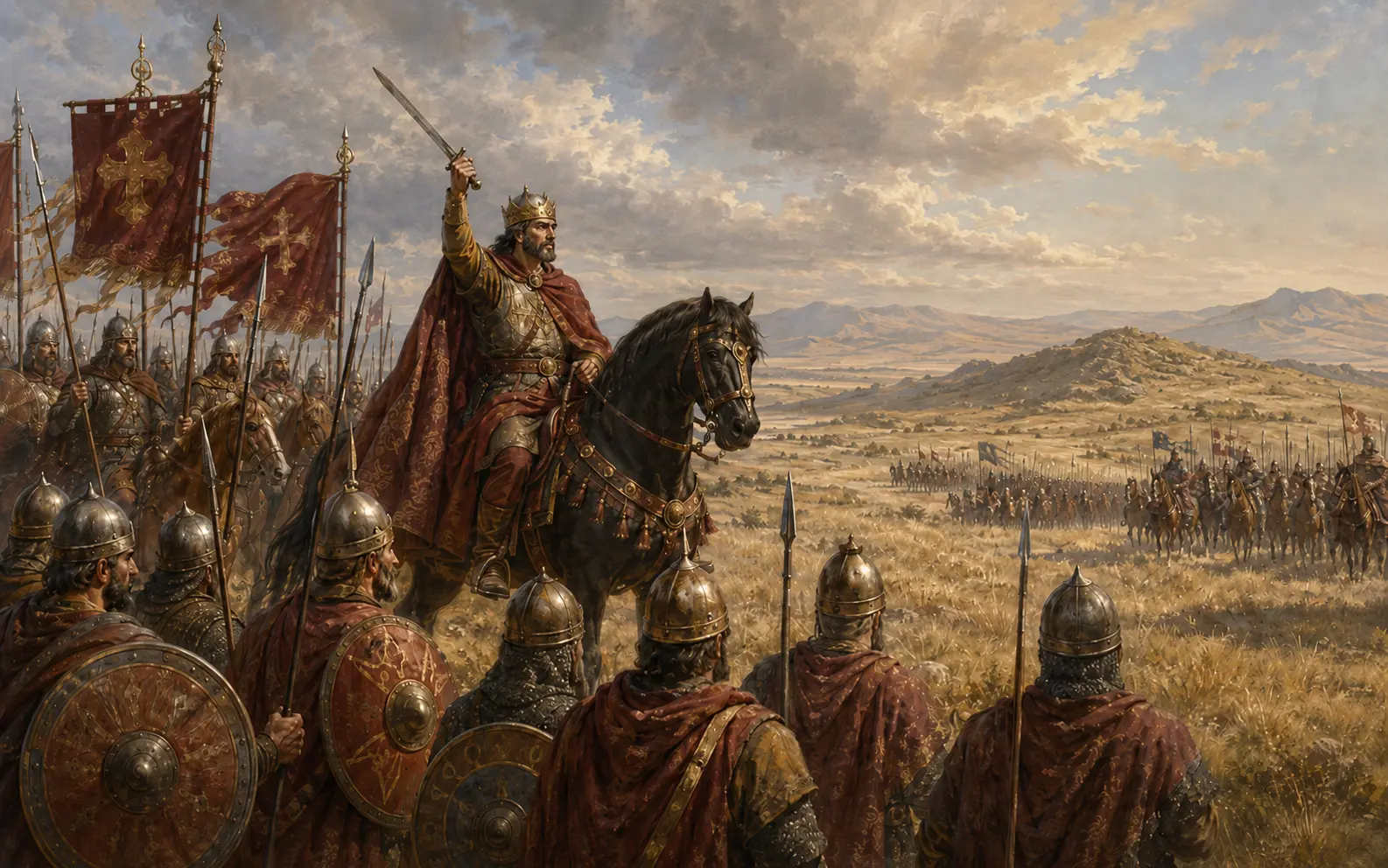
The armies met on 26 May 451 on the plain of Avarayr in the province of Vaspurakan, near the river Tghmut. Yeghishe reports about sixty-six thousand for the Armenian force and more than two hundred thousand for the Persian army, together with war elephants and the elite Immortals. Those figures come from Yeghishe's narrative rather than an independent count. Robert Thomson's scholarly translation likewise supports reading them as literary-historical claims: ancient and medieval troop numbers are often inflated, so the precise numerical balance between the armies is not established.
Before the fighting the priest Ghevond addressed the troops, and Vardan is recorded as telling them that conscious death is immortality. The Armenians attacked in the morning and pressed the Persian centre hard, and for a time the outcome was uncertain. The reserve strength of the Sasanian army, and above all its elephants, eventually turned the battle. Vardan was killed together with eight other named commanders and a large part of his force.
The Persians held the field, but their losses were heavy and they were unable to follow up quickly. Surviving Armenian nobles and clergy withdrew into the mountains, where they continued a guerrilla resistance that persisted for decades. What began as one battle became a long war of attrition that the Sasanian administration could not end.
- Date: 26 May 451, on the plain of Avarayr in Vaspurakan
- Armenian commander: Vardan Mamikonian, sparapet of Armenia
- Persian commander: Mushkan Niusalavurt, under King Yazdegerd II
- Outcome: Persian victory on the field, followed by decades of resistance
Consequences and the Treaty of Nvarsak
Resistance revived in 481 under Vahan Mamikonian, a nephew of Vardan, and this time the Sasanian state was distracted by war on its eastern frontier and by internal instability. After several years of fighting the Persian king Balash opened negotiations. The resulting agreement, the Treaty of Nvarsak of 484, guaranteed Armenians the free practice of Christianity, ended attempts at forced conversion, and restored the privileges of the noble houses.
Vahan Mamikonian was appointed marzpan of Armenia, meaning that the country was now governed by an Armenian rather than a Persian official. The treaty did not restore the monarchy, but it secured what the war of 451 had been fought for. In practical terms, Avarayr and the campaigns that followed it succeeded.
Nvarsak matters not as a peace concluded immediately after Avarayr, but as the political settlement of the same prolonged conflict. It gave legal protection to the demand for which the Vardanants movement had fought—freedom of Christian worship—and restored part of the noble houses' autonomy.
The Armenian Church later canonised Vardan and his companions, and their feast day, Vardanants, falls in February. It remains a major commemoration, marked with services, school programmes and public ceremonies, and the name Vardan has been given to Armenian boys ever since.
Avarayr in Armenian memory
The main source for the battle is Yeghishe's History of Vardan and the Armenian War, written in the fifth century and one of the masterpieces of classical Armenian literature. Yeghishe wrote to explain the meaning of the events rather than to compile a neutral report, and his speeches and figures should be read with that purpose in mind. Even so, his account preserves the political arguments of both sides in unusual detail.
Because of Yeghishe, Avarayr became the central image of principled resistance in Armenian culture. Painters, composers and poets have returned to it repeatedly, and the phrase about conscious death being immortality is quoted far beyond the classroom. The equestrian statue of Vardan Mamikonian in Yerevan is one of the most recognisable monuments in the city.
For students, Avarayr offers a clear case study in how to judge success in history. Measured by the field alone, it was a defeat. Measured by the goal for which it was fought, it was the beginning of a victory that took thirty-three years to complete.
Important dates
428
The Sasanian court abolishes the Armenian monarchy and appoints a governor.
449
Yazdegerd II orders Armenians to adopt Zoroastrianism; the council at Artashat refuses.
450
Open revolt begins under Vardan Mamikonian.
451
The Battle of Avarayr is fought on 26 May; Vardan is killed.
481
Vahan Mamikonian renews the rebellion against Sasanian rule.
484
The Treaty of Nvarsak secures freedom of Christian worship in Armenia.
Why the Battle of Avarayr matters
Avarayr is one of the earliest recorded wars fought explicitly over freedom of religion. The Armenian nobility accepted political subordination to Persia but refused to accept the state's authority over conscience, and they organised a national defence around that distinction. The Treaty of Nvarsak in 484 shows that the strategy worked, since the Sasanian government permanently abandoned forced conversion in Armenia.
The battle also fixed a pattern in Armenian self-understanding: a small nation defending its identity against a much larger power, and measuring success by what survives rather than by who holds the battlefield. Yeghishe's history turned that idea into literature, and Vardanants keeps it alive as an annual public commemoration.
Interesting facts
- 01Vardan Mamikonian is honoured as a saint by the Armenian Apostolic Church, and his feast day of Vardanants is a national commemoration.
- 02The Persian army at Avarayr used war elephants, an unusual sight in the mountains of the Armenian Highlands.
- 03Yeghishe's account of the battle is regarded as one of the finest works of classical Armenian prose.
- 04Clergy fought and served alongside soldiers, and the priest Ghevond is commemorated with the fallen commanders.
- 05The year after the Treaty of Nvarsak, Vahan Mamikonian was appointed marzpan of Armenia, so the country was governed by an Armenian again.
Sources
- Eḷishē, trans. and comm. Robert W. Thomson. History of Vardan and the Armenian War — Harvard University Press, Harvard Armenian Texts and Studies 5, 1982 ISBN 9780674403352The principal source for the battle, and a partisan one — Thomson's introduction sets out why.
- Nina G. Garsoïan. Armenia between Byzantium and the Sasanians — Variorum Reprints, London, 1985 ISBN 9780860781660
- Eberhard W. Sauer (ed.). Sasanian Persia: Between Rome and the Steppes of Eurasia — Edinburgh University Press, 2017 ISBN 9781474401012
Related articles
The Adoption of Christianity in Armenia (301)
Armenia is traditionally recognised as the first state to adopt Christianity as its official religion, a decision that reshaped its law, art and identity.

Mesrop Mashtots and the Armenian Alphabet
Around 405 the scholar and monk Mesrop Mashtots created an alphabet that gave Armenian its own written voice and reshaped the nation's culture.
Bagratid Armenia and the City of Ani
The Bagratid kings restored Armenian statehood after two centuries of foreign rule and built Ani into one of the great cities of the medieval world.