
The Adoption of Christianity in Armenia (301)
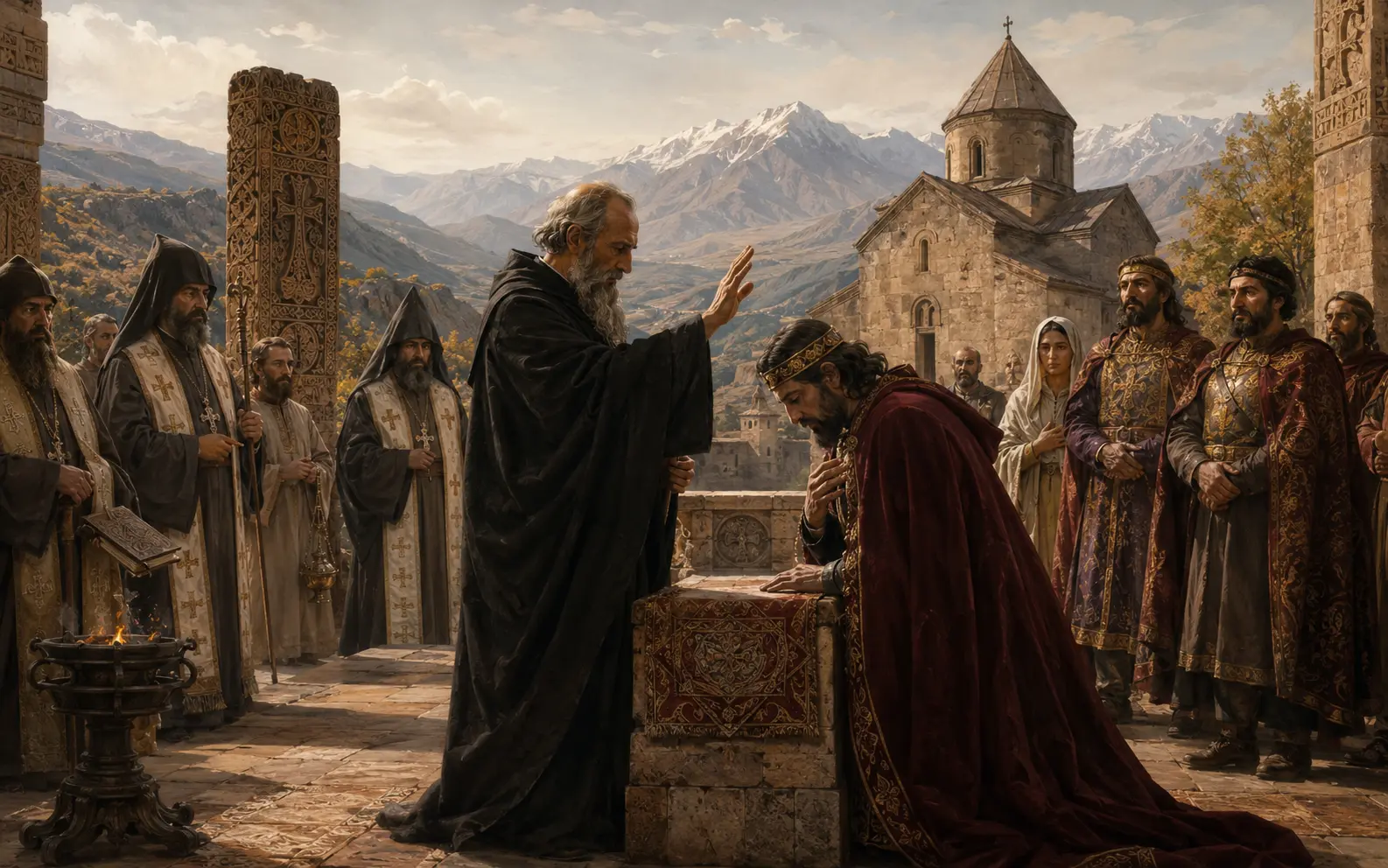
According to Armenian tradition, in the year 301 King Trdat III accepted baptism from Gregory the Illuminator and declared Christianity the religion of his kingdom. The date is traditional rather than certain, and many historians place the conversion closer to 314; on either dating Armenia was the earliest state anywhere to take that step, since Rome would not make Christianity its own state religion for another eighty years. The consequences reached into every part of Armenian life, from architecture and law to the eventual invention of the alphabet.
- Author
- Armat Editorial Team
- Updated
- Reading time
- 10 min read
In brief
According to Armenian tradition, in 301 King Trdat III and his court accepted baptism from Gregory the Illuminator, and Christianity became the official religion of the Armenian kingdom. The change was imposed from the top down: the estates of the pagan temples passed to the new church, the seat of the Catholicos was established at Etchmiadzin, and by 325 Armenian bishops were already present at the Council of Nicaea. The date itself is disputed, with a number of historians arguing for something closer to 314. On either dating Armenia was the earliest state to take the step, more than seven decades ahead of Rome. The most far-reaching consequence came a century later: the need for Armenian scripture led directly to the creation of the Armenian alphabet.
Key facts
- Traditional date
- 301, with some scholars proposing about 314
- King
- Trdat III of the Arsacid dynasty
- First bishop
- Gregory the Illuminator
- Mother see
- Etchmiadzin, founded soon after the conversion
- Church family
- Oriental Orthodox, non-Chalcedonian
- Key source
- The History of the Armenians by Agathangelos
Armenia before the conversion
Third-century Armenia was ruled by the Arsacid dynasty and squeezed between the Roman Empire and Sasanian Persia. Its official religion blended Iranian Zoroastrian worship with older local and Hellenistic elements. Great temple complexes at Ashtishat, Bagavan and Ani-Kamakh held estates, priests and treasuries, and noble families drew status and income from them. Religion was therefore not a private matter but part of the political structure of the kingdom.
Christianity had nevertheless been present for some time. Missionaries reached Armenia along the trade routes from Syria and Cappadocia during the second and third centuries, and Armenian tradition traces the church back to the apostles Thaddeus and Bartholomew, which is why it calls itself apostolic. Communities of believers existed in towns and among some noble households well before any royal decision was made.
The Sasanian dynasty that took power in Persia in 224 pressed a more assertive Zoroastrianism on its neighbours. For an Armenian king, adopting Christianity was thus a religious decision with a political edge, since it drew a clear line between Armenia and the great power on its eastern frontier.
The causes of the conversion
The reason most often cited is foreign policy. The Sasanian dynasty that took power in Persia in 224 made Zoroastrianism a state ideology and pressed it on its neighbours as well. For the Armenian court this meant that sharing the same religion would sooner or later turn into political subordination. Adopting Christianity therefore drew a clear line between Armenia and the great power to its east, without also making Armenia religiously identical to Rome, which had not yet stopped persecuting Christians.
The second reason was internal: Christianity already had a foothold in Armenia. Communities of believers existed in towns and among some noble households during the second and third centuries, along the trade routes from Syria and Cappadocia. The royal decision was therefore not the import of an entirely unfamiliar faith but the granting of official standing to something already spreading. That is what explains how quickly the change took hold: by the middle of the fourth century a full ecclesiastical hierarchy was in operation.
The third reason is economic and administrative, and it is what makes the conversion a redistribution of power rather than only a change of belief. The great pagan temples controlled estates, priests and treasuries, and noble families drew both status and income from them. When those estates were transferred to the church, the wealth moved with them — to an institution whose head remained in Gregory's family for several generations and which was tied closely to the court.
What the sources do not permit is weighing these reasons against one another, or separating them from personal conviction. The principal narrative source for the conversion, Agathangelos's History of the Armenians, was written more than a century after the events it describes and presents the adoption as the consequence of a healing miracle rather than of a calculation of state. The political and economic reading is a later interpretation, made on the basis of what is known about the period. The most cautious formulation is therefore that these factors worked together, and that the order of their importance remains disputed.
- External: separation from Sasanian Persia, which had made Zoroastrianism a state ideology
- Internal: Christian communities already present in towns and noble households
- Economic: the transfer of temple estates and their revenues to the new church
- Unresolved: the sources do not allow these factors to be ranked
Gregory the Illuminator and King Trdat
The traditional account is preserved by the historian Agathangelos. Gregory, raised as a Christian in Cappadocia, entered the service of King Trdat III but refused to take part in pagan sacrifice. Discovering that Gregory was also the son of the man who had killed his father, the king had him thrown into a deep pit at Artashat, the place remembered as Khor Virap. There Gregory survived for years, secretly fed by a pious woman.
The story continues with the martyrdom of Hripsime, Gayane and their companions, a group of Christian women who had fled persecution in the Roman Empire and refused the king's demands. After their deaths Trdat was struck with a severe illness described in the sources as a transformation into a boar. His sister Khosrovidukht dreamed repeatedly that only Gregory could heal him, and the king ordered the prisoner released.
Gregory emerged, healed the king, and preached to the court. Trdat accepted baptism together with his family and nobles, the temple estates were transferred to the church, and Gregory was consecrated as the first bishop of Armenia at Caesarea in Cappadocia. Historians treat the miraculous details as later shaping of the narrative, but they accept the core: a king and his nobility converted, and the change was enforced from the top down.
Building a national church
The conversion was followed by construction. Tradition says Gregory saw a vision of Christ striking the ground with a golden hammer to mark the site of the first cathedral, which gave the church of Etchmiadzin its name, meaning the place where the Only Begotten descended. Etchmiadzin remains the spiritual centre of the Armenian Apostolic Church and the seat of its Catholicos.
Former temple sites were converted into churches and their revenues redirected to the new institution. The office of Catholicos remained for several generations in Gregory's family, which tied the church closely to the aristocratic order of the kingdom. Armenian bishops attended the Council of Nicaea in 325, showing that the new church was recognised within the wider Christian world from the beginning.
The most far-reaching consequence appeared a century later. Because liturgy and scripture were still read in Greek and Syriac, ordinary Armenians could not follow their own worship. That gap led directly to the work of Mesrop Mashtots and the creation of the Armenian alphabet around 405, followed by the translation of the Bible and the golden age of Armenian letters.
- Etchmiadzin founded as the first cathedral and mother see
- Temple estates transferred to church ownership
- Armenian bishops present at the Council of Nicaea in 325
- Need for Armenian scripture leads to the alphabet of 405
A distinct Christian tradition
In 451 the Council of Chalcedon defined the relationship of the divine and human natures in Christ in terms that the Armenian Church did not accept. Armenian bishops were absent, occupied by the war against Persia that culminated at Avarayr in the same year, and the church later formally rejected the Chalcedonian formula. Armenia thus belongs to the family of Oriental Orthodox churches alongside the Coptic, Syriac and Ethiopian traditions.
This independence gave the Armenian Church its own calendar, liturgy, chant and architecture. Armenian churches are typically compact stone buildings with a conical dome over a drum, a form developed in the early medieval centuries and repeated for more than a thousand years. Illuminated manuscripts, carved cross-stones called khachkars, and a distinctive system of musical notation all grew out of the same tradition.
Because the church operated across every political border that divided Armenians, it functioned as a unifying institution during the long centuries without an Armenian state. Monasteries served as schools, libraries and courts, and their scriptoria preserved the manuscripts that fill the Matenadaran today.
How historians read the date
The year 301 comes from the Armenian tradition and has been widely accepted as the official date, celebrated as such in 2001 when Armenia marked seventeen hundred years of Christianity. Some historians argue for a date closer to 314, aligning the conversion with the reign of Trdat after Roman recognition and with the Edict of Milan. The evidence does not allow certainty, since Agathangelos wrote well over a century after the events he describes.
What is not in dispute is that Armenia adopted Christianity as a state religion earlier than any other kingdom, and that the change was complete enough by the middle of the fourth century for a full church hierarchy to be operating. For students, the debate is a useful example of how historians weigh a national tradition against outside evidence without simply discarding either.
The sites of the events remain visible in the landscape. Khor Virap stands within sight of Mount Ararat, and the cathedrals of Etchmiadzin, together with the churches of Hripsime and Gayane, are inscribed on the UNESCO World Heritage list as monuments of the earliest Christian state.
Important dates
c. 224
The Sasanian dynasty takes power in Persia and promotes Zoroastrianism among its neighbours.
c. 287 or 298
Trdat III is installed as king of Armenia and Gregory enters his service. The traditional date is 287; much modern scholarship prefers 298, after the Treaty of Nisibis.
301
Trdat III accepts baptism and Christianity becomes the religion of the Armenian state.
325
Armenian bishops take part in the Council of Nicaea.
c. 405
The Armenian alphabet is created so that scripture and liturgy can be read in Armenian.
451
The Council of Chalcedon meets without Armenian participation, setting the church on its own path.
Why the adoption of Christianity matters
The decision made Armenia the first Christian state and reoriented its culture for the next seventeen centuries. Law, art, architecture, music and education were all reshaped around the new religion, and the church became the institution through which Armenians organised themselves whenever they lacked a state of their own.
It also set in motion the events that produced the Armenian alphabet. Christianity required scripture that congregations could understand, and that requirement produced a script, a translation movement and a national literature. In this sense the conversion stands at the root of nearly everything studied in Armenian cultural history.
Interesting facts
- 01Khor Virap monastery is built over the pit where Gregory the Illuminator is said to have been imprisoned, and it faces Mount Ararat across the plain.
- 02The name Etchmiadzin means the descent of the Only Begotten, a reference to Gregory's vision of the cathedral site.
- 03The Armenian Church has never accepted the definitions of the Council of Chalcedon, which is why it belongs to the Oriental Orthodox family.
- 04Armenia celebrated the seventeen-hundredth anniversary of its conversion in 2001 with a nationwide programme of events.
- 05The cathedral and churches of Etchmiadzin were added to the UNESCO World Heritage list in 2000.
Sources
- Agathangelos, trans. and comm. R. W. Thomson. History of the Armenians — State University of New York Press, Albany, 1976 ISBN 9780873953238The fifth-century narrative of the conversion, written well over a century after the events.
- Nina G. Garsoïan. Studies on the Formation of Christian Armenia — Variorum / Ashgate, 2010 ISBN 9781409403661Includes the arguments for dating the conversion to c. 314 rather than 301.
- Cathedral and Churches of Echmiatsin and the Archaeological Site of Zvartnots — UNESCO World Heritage List, no. 1011, inscribed 2000 Visit source
Related articles
Mesrop Mashtots and the Armenian Alphabet
Around 405 the scholar and monk Mesrop Mashtots created an alphabet that gave Armenian its own written voice and reshaped the nation's culture.
The Battle of Avarayr (451)
In 451 Armenian forces under Vardan Mamikonian faced a far larger Persian army to defend their faith, losing the battle but winning religious freedom.
Urartu: the Kingdom of Van
Urartu was a powerful highland kingdom around Lake Van whose fortresses, canals and cuneiform records shaped the later history of the Armenian Highlands.