
Bagratid Armenia and the City of Ani
In 885 Ashot Bagratuni was recognised as king of Armenia by both the Caliph in Baghdad and the Emperor in Constantinople, ending more than four centuries without an Armenian monarchy. Over the next hundred and fifty years his dynasty rebuilt the country's cities, churches and trade. Its capital, Ani, became a centre of architecture and learning whose ruins still stand above the gorge of the Akhurian river.
- Author
- Armat Editorial Team
- Updated
- Reading time
- 8 min read
In brief
The Bagratid kingdom restored the Armenian monarchy with the coronation of Ashot I in 885 and lasted until the Byzantine annexation of Ani in 1045. It was not a single centralised state: separate Armenian kingdoms formed in Vaspurakan, Syunik, Kars and Lori. From 961, Ani was the Bagratid capital and a major centre of trade, architecture and learning, remembered as the city of a thousand and one churches. Succession disputes, political fragmentation and Byzantine expansion weakened the kingdom. Byzantium took Ani in 1045, and the city fell to the Seljuks in 1064. The churches, monasteries, manuscripts and poetry of the Bagratid age remain a central legacy of medieval Armenian culture.
Key facts
- Dynasty
- Bagratuni, ruling from 885 to 1045
- First king
- Ashot I, crowned in 885
- Capital
- Ani, from 961
- Peak population of Ani
- Traditionally given as around one hundred thousand, though historians question the figure
- Leading architect
- Trdat, builder of Ani cathedral and restorer of the Hagia Sophia dome
- End of the kingdom
- Byzantine annexation in 1045, Seljuk capture of Ani in 1064
Restoring a kingdom
Arab rule over Armenia, established in the seventh century, weakened during the ninth as the Abbasid Caliphate lost control of its distant provinces. The Bagratuni family, hereditary holders of high office since Arsacid times, used the opening skilfully. The nakharar system preserved after the Battle of Avarayr was an important foundation of their power. They collected taxes for the caliph, kept peace among rival noble houses, and gradually made themselves indispensable. In 885 the caliph sent Ashot Bagratuni a crown, and the Byzantine emperor Basil I promptly did the same.
The new kingdom was not a centralised state. Armenian society was organised around noble houses with their own castles and cavalry, and the Bagratid king was the leading prince among many rather than an absolute ruler. The Artsruni family established a separate kingdom in Vaspurakan around Lake Van in 908, and smaller kingdoms appeared in Syunik, Kars and Lori. Historians therefore speak of a Bagratid era rather than a single unified state.
Even so, the restoration brought real benefits. Fighting between noble houses declined, trade routes reopened, and taxes stayed in the country instead of flowing to distant capitals. Population grew, new towns were founded, and the monasteries that had preserved learning through the difficult centuries were able to expand their schools and scriptoria.
Ani, the city of a thousand and one churches
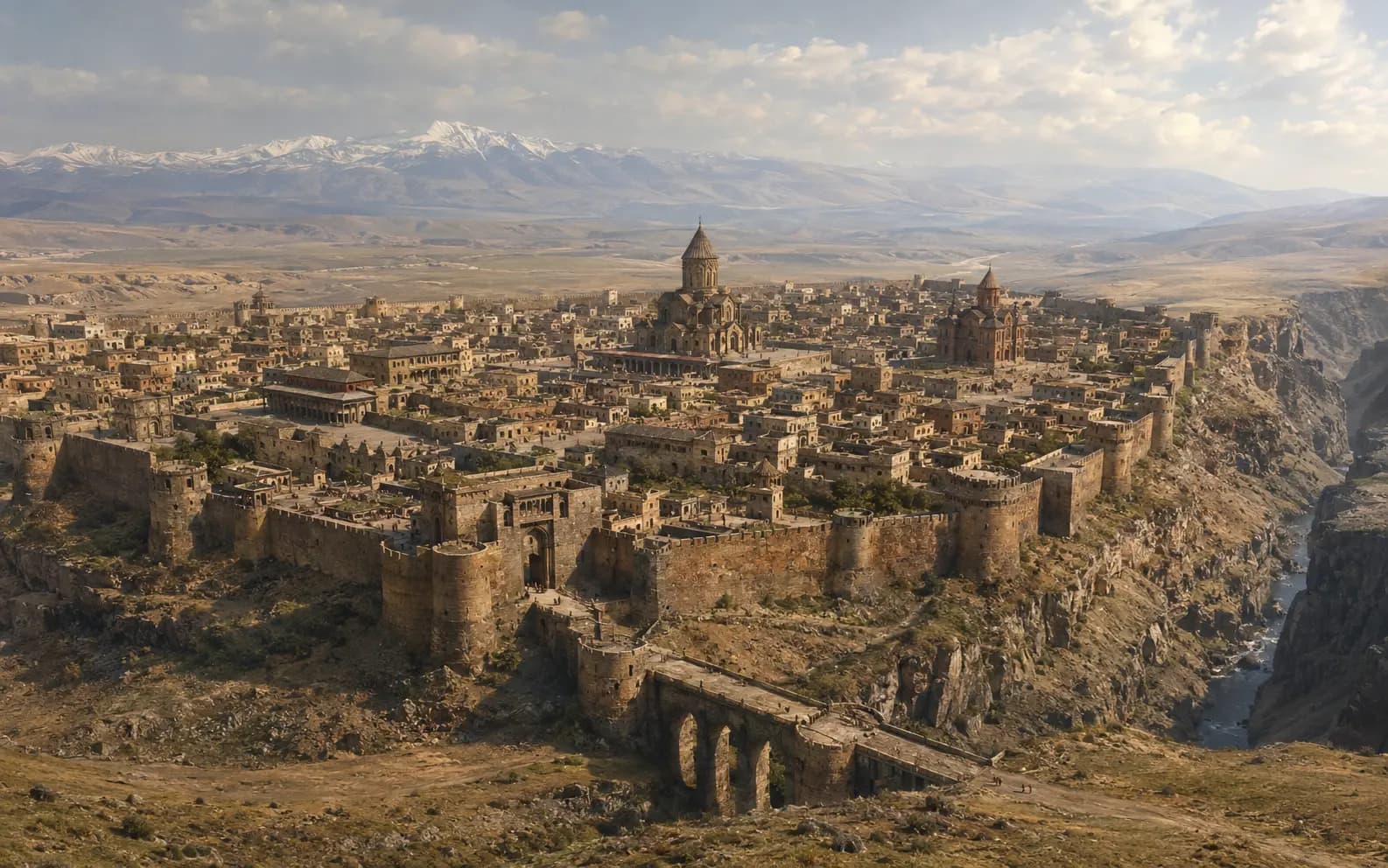
King Ashot III moved the royal seat to Ani in 961, and his successors turned a hilltop fortress into a capital. Smbat II built the outer walls during his reign of 977 to 989, and Gagik I completed a building programme that gave the city cathedrals, palaces, markets, bathhouses and bridges. At its height, in the early eleventh century, Ani may have held around a hundred thousand people, which placed it among the largest cities of its time anywhere in the world.
The site is a natural fortress, a triangular plateau protected on two sides by deep ravines and closed on the third by a double line of walls with towers. Inside, the streets were laid out around a main thoroughfare, and water was brought in through clay pipes. Ani sat on a branch of the Silk Road, and merchants from Persia, Byzantium and the Caucasus traded there, which explains the scale of both its wealth and its construction.
Later writers called Ani the city of forty gates and a thousand and one churches. The numbers are poetic rather than exact, but archaeologists have identified the remains of dozens of religious buildings within and around the walls, belonging to Armenian, Georgian and other communities. The ruins were inscribed on the UNESCO World Heritage list in 2016.
- Became the Bagratid capital in 961 under Ashot III
- Protected by ravines on two sides and a double wall on the third
- Situated on a Silk Road branch linking Persia and Byzantium
- Inscribed as a UNESCO World Heritage site in 2016
Architecture and the arts
The cathedral of Ani, completed around 1001 by the architect Trdat, is the most celebrated building of the period. Its interior uses clustered piers and pointed arches that anticipate features of Gothic architecture in western Europe by more than a century, and the proportions of the nave give an impression of height far greater than the actual dimensions. Trdat's reputation was international: he was invited to Constantinople to repair the dome of Hagia Sophia after an earthquake in 989.
Other buildings show the range of Bagratid design. The church of Saint Gregory built for the merchant Tigran Honents in 1215 preserves extensive frescoes, and the round church of the Redeemer once enclosed a relic of the True Cross. Outside Ani, monasteries such as Haghpat and Sanahin, founded in the tenth century, combine churches, libraries, bell towers and covered halls into complexes that served as universities as much as places of worship.
The same centuries produced remarkable manuscript illumination, carved khachkars and religious poetry. Grigor Narekatsi, a monk at Narekavank on Lake Van, composed the Book of Lamentations around 1002, a long sequence of prayers that remains the most widely read work of classical Armenian literature and is still recited today.
Why the Bagratid kingdom declined
The Bagratid kingdom fell to a combination of internal division and imperial pressure. The Byzantine Empire, expanding eastward, annexed Vaspurakan in 1021 and pressed claims on Ani after the death of King Hovhannes-Smbat. In 1045 Byzantine forces took the city and deposed the young king Gagik II. Byzantine administration replaced the Armenian nobility, dismantled local defensive arrangements and taxed the province heavily.
The consequences appeared quickly. In 1064 the Seljuk sultan Alp Arslan besieged and captured Ani, and seven years later the Byzantine defeat at Manzikert opened Anatolia to Turkic settlement. The removal of the Armenian nobility had left no organised force able to defend the region. Ani continued as a trading town under successive rulers, but earthquakes, shifting trade routes and the Mongol invasions gradually emptied it, and it was completely abandoned by 1735, when the last monks left.
Many Armenians moved south and west during these upheavals, and in Cilicia on the Mediterranean coast they established a new principality that became the Kingdom of Cilician Armenia. That state, with its ports and its links to the crusader world, carried Armenian political life forward for another three hundred years.
- Succession disputes and the political fragmentation of the Armenian kingdoms
- Sustained Byzantine expansion and claims on Ani
- The weakening of local military power after Byzantine annexation
- Seljuk invasions following the Byzantine capture of Ani in 1045
The legacy of the Bagratid age
Bagratid Armenia is often described as a golden age of medieval Armenian culture, and the description is fair. Within a century and a half the country produced architects whose work influenced building far beyond its borders, poets whose verse is still recited, and monastic schools that trained scholars in theology, philosophy and mathematics. Much of what museums display as classical Armenian art dates from this period.
The ruins of Ani, now on the Turkish side of the closed border with Armenia, remain a powerful symbol. Conservation projects supported by international bodies have stabilised several buildings, and the site attracts historians and visitors from around the world. Its skyline of freestanding churches on an empty plateau is one of the most photographed images in Armenian history.
For students, the period repays close study because it shows both what Armenian society could achieve when it governed itself and how quickly those achievements became vulnerable once its political structures were dismantled. The story of Ani is a lesson in the relationship between institutions and culture.
Important dates
885
Ashot I Bagratuni is recognised as king of Armenia by both Baghdad and Constantinople.
961
Ashot III makes Ani the royal capital.
1001
The cathedral of Ani, designed by the architect Trdat, is completed.
1002
Grigor Narekatsi composes the Book of Lamentations at Narekavank.
1045
Byzantine forces take Ani and depose King Gagik II.
1064
The Seljuk sultan Alp Arslan captures Ani after a siege.
Why Bagratid Armenia and Ani matter
The Bagratid period restored Armenian self-government after more than two centuries of foreign administration and showed what the country could build when its resources stayed at home. Cities grew, trade flourished, and the architecture, manuscripts and poetry created in these years still define what people mean by classical Armenian culture.
The fall of the kingdom is equally instructive. Byzantine annexation removed the noble houses that had defended the frontier, and within twenty years the region lay open to Seljuk conquest. The rise and collapse of Ani together form one of the clearest illustrations in Armenian history of how closely cultural achievement depends on stable political institutions.
Interesting facts
- 01The architect Trdat was called to Constantinople to rebuild the dome of Hagia Sophia after it was damaged by an earthquake in 989.
- 02Medieval writers described Ani as the city of a thousand and one churches, a poetic tribute to its many religious buildings.
- 03Ani stood on a branch of the Silk Road, which helps explain both its wealth and the size of its markets.
- 04Grigor Narekatsi's Book of Lamentations was so treasured that copies were kept in homes as a source of comfort in illness.
- 05The monasteries of Haghpat and Sanahin, founded in this period, are inscribed on the UNESCO World Heritage list.
Sources
- Sirarpie Der Nersessian. Armenia and the Byzantine Empire: A Brief Study of Armenian Art and Civilization — Harvard University Press, 1945 Visit source
- Christina Maranci. Medieval Armenian Architecture: Constructions of Race and Nation — Peeters, Louvain, Hebrew University Armenian Studies 2, 2001 ISBN 9789042909397
- Archaeological Site of Ani — UNESCO World Heritage List, no. 1518, inscribed 2016 Visit source
Related articles

The Adoption of Christianity in Armenia (301)
Armenia is traditionally recognised as the first state to adopt Christianity as its official religion, a decision that reshaped its law, art and identity.

The Battle of Avarayr (451)
In 451 Armenian forces under Vardan Mamikonian faced a far larger Persian army to defend their faith, losing the battle but winning religious freedom.
The First Republic of Armenia (1918–1920)
Declared in 1918 amid war and famine, the First Republic gave Armenians a modern independent state for two and a half difficult years.