
Avetik Isahakyan
Avetik Isahakyan wrote poems so close to folk song that many Armenians assume they are anonymous traditional lyrics. He spent decades abroad as an emigre before returning to Soviet Armenia, and his long poem Abu Lala Mahari made him known well beyond Armenian readers. His career links the world of Tumanyan to the middle of the twentieth century.
- Author
- Armat Editorial Team
- Updated
- Reading time
- 6 min read
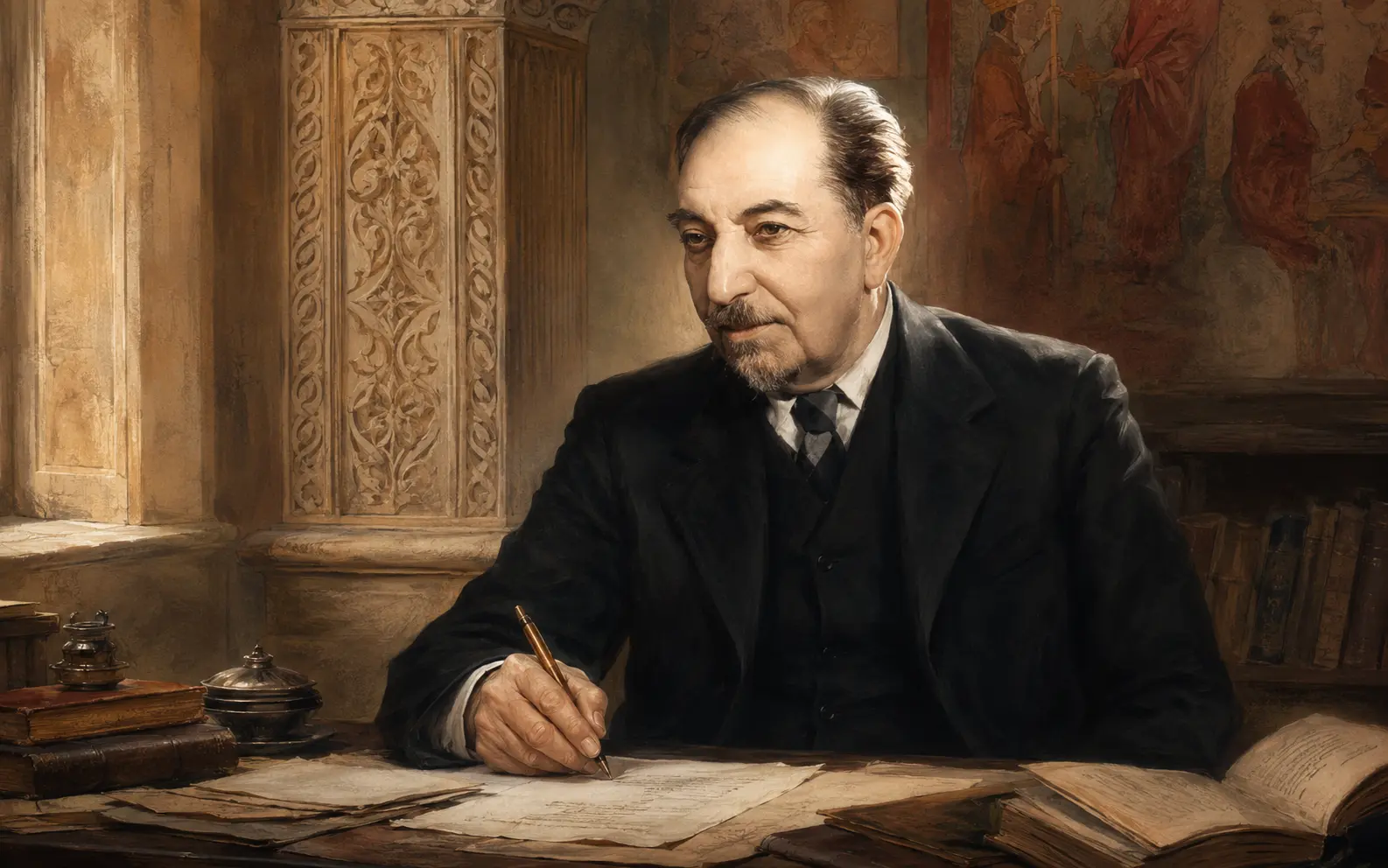
Key facts
- Born
- 30 October 1875, Alexandropol, now Gyumri
- Died
- 17 October 1957, Yerevan, aged 81
- Birthplace
- Alexandropol in the Russian Empire
- Known for
- Folk-toned lyric poetry and the philosophical poem Abu Lala Mahari
- Notable works
- Songs and Wounds, Abu Lala Mahari, Lilith
- Literary period
- Armenian romanticism into the Soviet era
Early life and education
Avetik Isahakyan was born on 30 October 1875 in Alexandropol, today the city of Gyumri, into a family of modest means. The town was a lively centre of Armenian craft, music and humour, and its street songs and ashugh traditions left a permanent mark on his ear for rhythm and phrase.
He studied at the Gevorgian Seminary in Etchmiadzin, the leading Armenian religious and educational institution, where he received a thorough grounding in classical Armenian, history and theology. He then travelled to Germany and attended lectures in literature and philosophy at the University of Leipzig, absorbing European romanticism and the pessimistic philosophy then in fashion.
His first collection, Songs and Wounds, appeared in 1897 and was an immediate success. Its short lyrics of love, separation and homesickness were quickly set to music, and several became so widely sung that their authorship faded from public memory.
Literary career and exile
Back in the Caucasus, Isahakyan joined the Vernatun circle around Hovhannes Tumanyan in Tiflis and formed lasting friendships there. Political activity brought him under suspicion, and he was arrested in 1908 in connection with the mass trial of Armenian political figures, held for about six months in Metekhi prison and released on bail in 1909.
In 1911 he left the Russian Empire and began a long period abroad, living at different times in Berlin, Venice, Vienna and Paris. He continued to write and became an important figure in Armenian emigre culture, particularly after 1915, when he worked to support survivors and to keep the community's literary life alive. He came back to Soviet Armenia in 1926 and stayed four years, but returned to Paris in 1930.
In 1936 he came home for good. He was received with honours, elected to the Academy of Sciences and served as chairman of the Writers Union of Armenia from 1946. He continued writing prose sketches, fables and lyrics until the end of his life.
Major works
Abu Lala Mahari, written between 1909 and 1911, is his best known long poem. A wealthy poet of medieval Baghdad, disgusted by human cruelty and hypocrisy, abandons the city and rides into the desert with his camel caravan, delivering a series of meditations on freedom, society and death. The poem was translated into many languages and drew admiration from writers including Alexander Blok.
Songs and Wounds, his first collection, remains the core of his lyric reputation. Poems such as those beginning with the image of a wandering exile or a mother waiting at the door use very simple diction to produce strong emotional effect, which is why so many entered the repertoire of Armenian singers.
He also wrote narrative works drawing on legend and history, including the unfinished novel Usta Karo and a body of fables and prose sketches. In these he explored Armenian folk belief, medieval story material and the moral questions that occupied him throughout his life.
- Songs and Wounds, poetry collection, 1897
- Abu Lala Mahari, philosophical long poem, 1909 to 1911
- Lilith and other legend-based poems
- Usta Karo, an unfinished novel
- Numerous fables and prose sketches
Themes and style
Longing is Isahakyan's great subject: longing for a lost home, a lost love, or a purer way of living. Because he spent so much of his life away from Armenia, exile is not an abstract theme in his work but a daily condition, and this gave his poems a particular resonance for a dispersed people.
His technique is deceptively plain. He used short lines, repetition, direct address and the vocabulary of folk song, avoiding elaborate metaphor. Composers found the poems easy to set precisely because the rhythms were already musical, and dozens of Armenian art songs use his texts.
Against this simplicity stands the philosophical ambition of Abu Lala Mahari, where he confronts questions of justice, mortality and human worth. The pairing of the small lyric and the large meditation is what gives his body of work its range.
Later years and legacy
Isahakyan died in Yerevan on 17 October 1957, shortly before his eighty-second birthday, and was buried in the Komitas Pantheon. He had by then become a living link between the pre-revolutionary literary world and postwar Soviet Armenia, respected by writers of every generation.
His house museum in Yerevan preserves his library and manuscripts, and streets, schools and a major literary prize carry his name. Gyumri, his birthplace, treats him as one of its defining figures.
Above all he survives in performance. Armenian singers, choirs and schoolchildren continue to sing his lyrics, often without knowing who wrote them, which is arguably the outcome a poet working in folk idiom would have wanted most.
Important dates
1875
Born in Alexandropol, the modern city of Gyumri.
1897
Publishes his first collection, Songs and Wounds.
1911
Completes Abu Lala Mahari and leaves for Europe.
1936
Returns permanently to Soviet Armenia.
1946
Becomes chairman of the Writers Union of Armenia.
1957
Dies in Yerevan and is buried in the Komitas Pantheon.
Why Avetik Isahakyan matters
Isahakyan demonstrated that the simplest lyric forms could hold serious feeling. By writing in the idiom of folk song he made poetry available to readers with little formal education, and he preserved a rhythm and vocabulary that might otherwise have been pushed aside by more literary styles.
He also gave the experience of exile a lasting artistic form. For the many Armenians dispersed after 1915, his poems of separation and remembered homeland offered exact words for a shared condition, which is why his work travelled so widely through diaspora communities as well as within Armenia.
Interesting facts
- 01Several of his lyrics are sung as folk songs today, with many singers unaware that they have a named author.
- 02The Russian poet Alexander Blok, who translated some of his verse, described him as a poet of the first rank.
- 03He studied at the University of Leipzig, an unusual path for an Armenian writer of his generation.
- 04He spent most of the years between 1911 and 1936 abroad, in Germany, Italy, Austria and France, apart from a four year stay in Armenia from 1926.
- 05He was a founding member of the Vernatun circle that met in Hovhannes Tumanyan's Tiflis apartment.
Sources
- A. J. Hacikyan, G. Basmajian, E. S. Franchuk and N. Ouzounian (eds.). The Heritage of Armenian Literature, Volume III: From the Eighteenth Century to Modern Times — Wayne State University Press, 2005 ISBN 9780814332214
- Diana Der Hovanessian and Marzbed Margossian (eds.). Anthology of Armenian Poetry — Columbia University Press, 1978 ISBN 9780231045643
Related articles
Hovhannes Tumanyan
The village-born poet whose ballads, fairy tales and quiet moral authority earned him the title Poet of All Armenians.
Yeghishe Charents
A restless modernist poet whose bold experiments and fierce love of Armenia made him the defining literary voice of his generation.
Anush
Hovhannes Tumanyan's mountain love poem follows two young villagers destroyed by pride, custom and the harsh code of honour.