
Tigran the Great
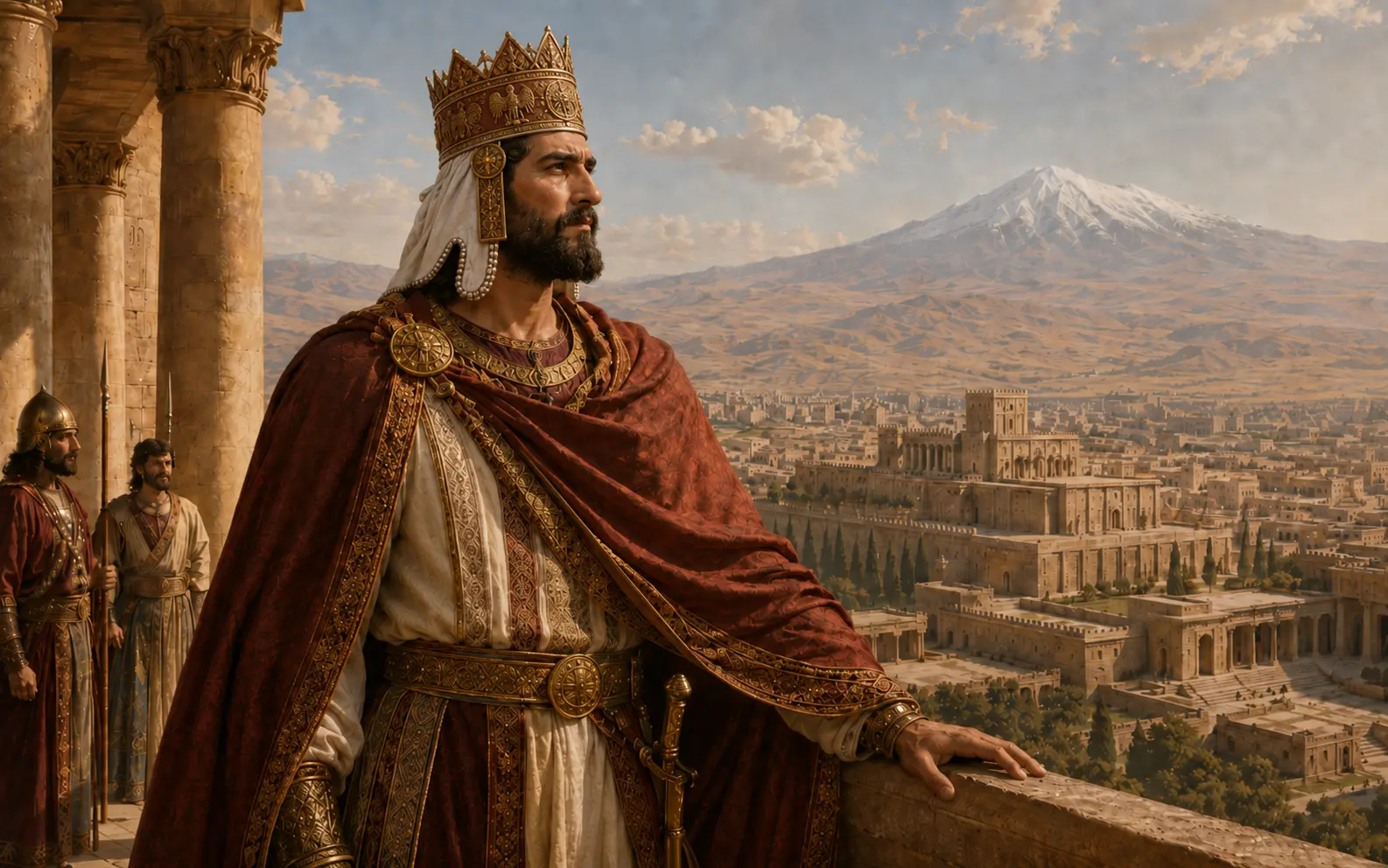
Tigran II, remembered in Armenian tradition as Tigran the Great, ruled the Kingdom of Armenia from 95 to 55 BC. Under his reign Armenia grew from a mountain kingdom into the most powerful state between the Roman Republic and the Parthian Empire, stretching for a short time from the Caspian Sea to the Mediterranean coast. His reign is remembered both for that remarkable expansion and for the collision with Rome that ended it.
- Author
- Armat Editorial Team
- Updated
- Reading time
- 10 min read
Key facts
- Full name
- Tigran II, of the Artaxiad dynasty
- Lived
- c. 140 BC – 55 BC
- Reigned
- 95 BC – 55 BC
- Title
- King of Kings
- Capital
- Tigranocerta (founded c. 83–77 BC)
- Dynasty
- Artaxiad (Artashesian)
Early life
Tigran was born around 140 BC into the Artaxiad dynasty, the royal house founded by Artashes I about a century earlier. His youth was shaped by a difficult political reality: the Parthian Empire to the east had grown strong enough to press on Armenia's borders, and after a military defeat the Armenian court was required to send a royal hostage to the Parthian king. That hostage was Tigran, who spent a significant part of his early life at the Parthian court.
Ancient historians present those years as formative rather than wasted. At the Parthian court the young prince observed how a large multi-ethnic empire was administered, how vassal kings were bound to a central ruler, and how court ceremony was used to project authority. Many of the ideas he later applied in Armenia — the title King of Kings, a network of dependent rulers, a new royal capital — echo what he had seen in exile.
When the Armenian throne fell vacant in 95 BC, Tigran secured his release by ceding to Parthia a group of border valleys often referred to in the sources as the seventy valleys. He returned to Armenia, was crowned king, and immediately began working to recover what he had given away. Whose son he was is not settled: the ancient evidence is thin enough that historians place him variously as the son or the nephew of his predecessor.
Rise to power
Tigran's first task was to unify the Armenian lands. Since the separation of the Kingdom of Sophene from the main Armenian body, the country had been split between two royal branches. Around 94 BC Tigran annexed Sophene, bringing western and eastern Armenia under a single crown for the first time in generations and giving him control of the fertile Upper Euphrates region.
He then secured his western flank through diplomacy. Tigran married Cleopatra, daughter of Mithridates VI of Pontus, creating an alliance between the two strongest powers of Asia Minor. The alliance allowed each king to expand in his own direction while relying on the other to occupy Rome's attention — an arrangement that served Tigran well for almost thirty years and eventually helped bring about his defeat.
With his borders stabilised, Tigran turned east. Taking advantage of a succession crisis that weakened Parthia in the 80s BC, he recovered the seventy valleys, pushed into Media Atropatene and Mesopotamia, and forced several Parthian vassals to acknowledge him instead. It was after these campaigns that he assumed the ancient Near Eastern title King of Kings.
Expansion of the Armenian Empire
At its greatest extent, in the late 80s and 70s BC, the empire Tigran governed reached from the Caspian Sea in the east to the Mediterranean in the west, and from the Kura river in the north to the edge of Judaea in the south. It was not a unified state in the modern sense. Armenia proper formed the core, while the outer regions were kingdoms and cities that paid tribute and accepted Tigran's overlordship while keeping their own institutions.
The most significant acquisition was Syria. In 83 BC, exhausted by dynastic wars, the nobles of the Seleucid kingdom invited Tigran to take the throne in Antioch. He accepted, and for roughly fourteen years an Armenian king governed one of the wealthiest regions of the Hellenistic world, minting coins in Antioch that carried Tigran's portrait in the Armenian tiara.
This expansion brought real wealth. Control of Syria and northern Mesopotamia meant control of the trade routes linking the Mediterranean to Iran and, beyond it, to Central Asia. Tribute and customs revenue funded a large standing army, ambitious building projects, and a court that Greek and Roman writers described as one of the richest of its age.
- Sophene, annexed around 94 BC, unifying the Armenian lands
- Media Atropatene and parts of northern Mesopotamia, taken from Parthia
- Syria and Cilicia, governed from Antioch after 83 BC
- Vassal kingdoms across the Caucasus and the Iranian plateau
Tigranocerta
At some point in the 80s or 70s BC — most often placed around 83, though the sources do not fix it — Tigran founded a new capital, Tigranocerta, in the south-west of his empire. The older capital, Artashat, sat in the Ararat plain — safe, but far from the new southern and western provinces. Tigranocerta was placed to govern the empire he had actually built rather than the kingdom he had inherited.
Ancient sources describe a planned Hellenistic city with strong walls, a royal palace, parks and a Greek theatre. To populate it quickly, Tigran resettled inhabitants from captured Greek and Syrian cities — a common practice at the time, though the sources note that the resettled communities resented it. The city became a centre of Hellenistic culture, and Greek plays are recorded as having been performed there.
The location of Tigranocerta is still debated by archaeologists, with several candidate sites in south-eastern Turkey and northern Iraq. What is clear is what happened to it: after the Roman victory of 69 BC the city was sacked, its treasury carried away, and many of the resettled inhabitants returned home. Tigranocerta never regained its brief importance.
Relations with Rome
Conflict with Rome came through Tigran's father-in-law. When Mithridates VI of Pontus was driven from his kingdom by Roman armies, he took refuge at the Armenian court. Tigran refused to hand him over. For Rome, sheltering its most persistent eastern enemy was justification enough for war, and in 69 BC the general Lucullus crossed into Armenian territory.
The war went badly for Armenia. At the battle of Tigranocerta in 69 BC the Roman force, far smaller but disciplined and experienced, defeated Tigran's much larger but hastily assembled army; the new capital fell soon after. Lucullus pressed on toward Artashat, but a hard mountain campaign, a harsh autumn and mutiny among his own troops forced him to withdraw, and Tigran recovered much of Armenia proper.
The reprieve was temporary. Pompey took over the eastern command in 66 BC and advanced with Parthian cooperation, while Tigran's own son rebelled against him. Facing enemies on every side, Tigran chose negotiation over a war he could not win. He rode into the Roman camp, laid his diadem at Pompey's feet, and accepted terms: he gave up Syria, Cilicia and his other conquests, paid a large indemnity, and kept Armenia itself as a kingdom allied to Rome.
Final years
Tigran ruled for another eleven years after the settlement with Pompey, from 66 to 55 BC. The empire was gone, but the kingdom survived intact and, unusually for a defeated eastern monarch, so did its king. Contemporary Roman writers treat him afterwards as a friend and ally of the Roman people, a status that preserved Armenian independence in domestic affairs.
These last years were spent rebuilding rather than campaigning. Artashat again served as the capital, the administration was reorganised for a smaller state, and Tigran worked to keep Armenia balanced between Rome and Parthia rather than subordinate to either. That balancing act became the defining problem of Armenian foreign policy for the next several centuries.
Tigran died in 55 BC, aged about eighty-five, and was succeeded by his son Artavasdes II, a capable ruler and a playwright in Greek. The Artaxiad dynasty, through interruptions and struggles over the succession, continued to rule until AD 12, as Armenia was drawn ever more tightly into the long struggle between Rome and Parthia.
Historical legacy
Tigran the Great occupies a particular place in Armenian historical memory as the ruler under whom Armenia was, briefly, a great power rather than a contested frontier. Medieval Armenian historians, most notably Movses Khorenatsi, gave his reign a central position in the national narrative, and that framing has carried into modern textbooks, literature and public monuments.
Historians today assess the reign more carefully. The empire was assembled quickly, held together largely by tribute and personal authority, and dissolved almost as quickly when Roman armies arrived. But the achievements that outlasted it were real: the political unification of the Armenian lands, a period of significant urban and economic development, and the integration of Armenia into the wider Hellenistic world.
For students, the reign is also a clear case study in the limits of rapid expansion. Tigran built a state that reached the Mediterranean in under twenty years and lost it in three, largely because it lacked the administrative depth to survive a serious defeat. That question — how much a small country can gain and hold between larger neighbours — runs through the whole of Armenian history.
Important dates
c. 140 BC
Tigran is born into the Artaxiad royal house.
95 BC
He returns from the Parthian court and is crowned king of Armenia.
c. 94 BC
Annexation of Sophene unites the Armenian lands under one crown.
83 BC
Tigran takes the Seleucid throne in Antioch; Tigranocerta is founded around this time.
69 BC
Lucullus defeats the Armenian army at Tigranocerta and sacks the city.
66 BC
Peace with Pompey: Armenia keeps its independence but loses the empire.
55 BC
Tigran dies; his son Artavasdes II succeeds him.
Why Tigran the Great is important
Tigran's reign is the moment when Armenia was not a buffer between empires but an empire in its own right. For fourteen years an Armenian king ruled Antioch, issued coinage across the Near East, and was addressed as King of Kings by rulers from the Caucasus to Mesopotamia. That period gave later generations a concrete answer to the question of what Armenian statehood could look like at its most ambitious.
His more durable achievement, however, is the one that receives less attention: the unification of the Armenian lands and the urban and economic growth that followed. Cities, trade routes and administrative structures established in this period shaped Armenian life long after the conquests were reversed, and the diplomatic problem he faced at the end of his reign — how to remain independent between two stronger powers — defined Armenian political history for centuries.
Interesting facts
- 01Tigran's coins show him wearing the distinctive five-pointed Armenian tiara decorated with stars and eagles, a symbol later revived on modern Armenian currency.
- 02He spent much of his youth as a royal hostage at the Parthian court and bought his freedom by ceding seventy border valleys — territory he reconquered within a decade.
- 03Greek tragedies were staged in the theatre of Tigranocerta; his son Artavasdes II wrote plays in Greek himself.
- 04Plutarch records that when Tigran first saw how small the approaching Roman force was, he dismissed it with a line that has followed him ever since: if they have come as ambassadors there are too many of them, and if as soldiers, far too few. The Romans won the battle that followed.
- 05Rather than fight a war he could not win, Tigran surrendered his crown to Pompey in person — and received it back, keeping his kingdom for another eleven years.
Sources
- Richard G. Hovannisian (ed.). The Armenian People from Ancient to Modern Times, Volume I: The Dynastic Periods, from Antiquity to the Fourteenth Century — Palgrave Macmillan, 2004 ISBN 9781403966360First published by St. Martin's Press, New York, 1997. The two volumes are cited here in the Palgrave reissue, whose ISBNs are unambiguously per-volume.
- Robert H. Hewsen. Armenia: A Historical Atlas — University of Chicago Press, 2001 ISBN 9780226332284
- Plutarch, trans. Bernadotte Perrin. Lives, Volume II: Themistocles and Camillus, Aristides and Cato Major, Cimon and Lucullus — Harvard University Press, Loeb Classical Library 47, 1914 ISBN 9780674990531The Life of Lucullus is the ancient source for the Roman campaigns against Tigran.
Related articles
Urartu: the Kingdom of Van
Urartu was a powerful highland kingdom around Lake Van whose fortresses, canals and cuneiform records shaped the later history of the Armenian Highlands.
The Adoption of Christianity in Armenia (301)
Armenia is traditionally recognised as the first state to adopt Christianity as its official religion, a decision that reshaped its law, art and identity.
The Battle of Avarayr (451)
In 451 Armenian forces under Vardan Mamikonian faced a far larger Persian army to defend their faith, losing the battle but winning religious freedom.