
Manti
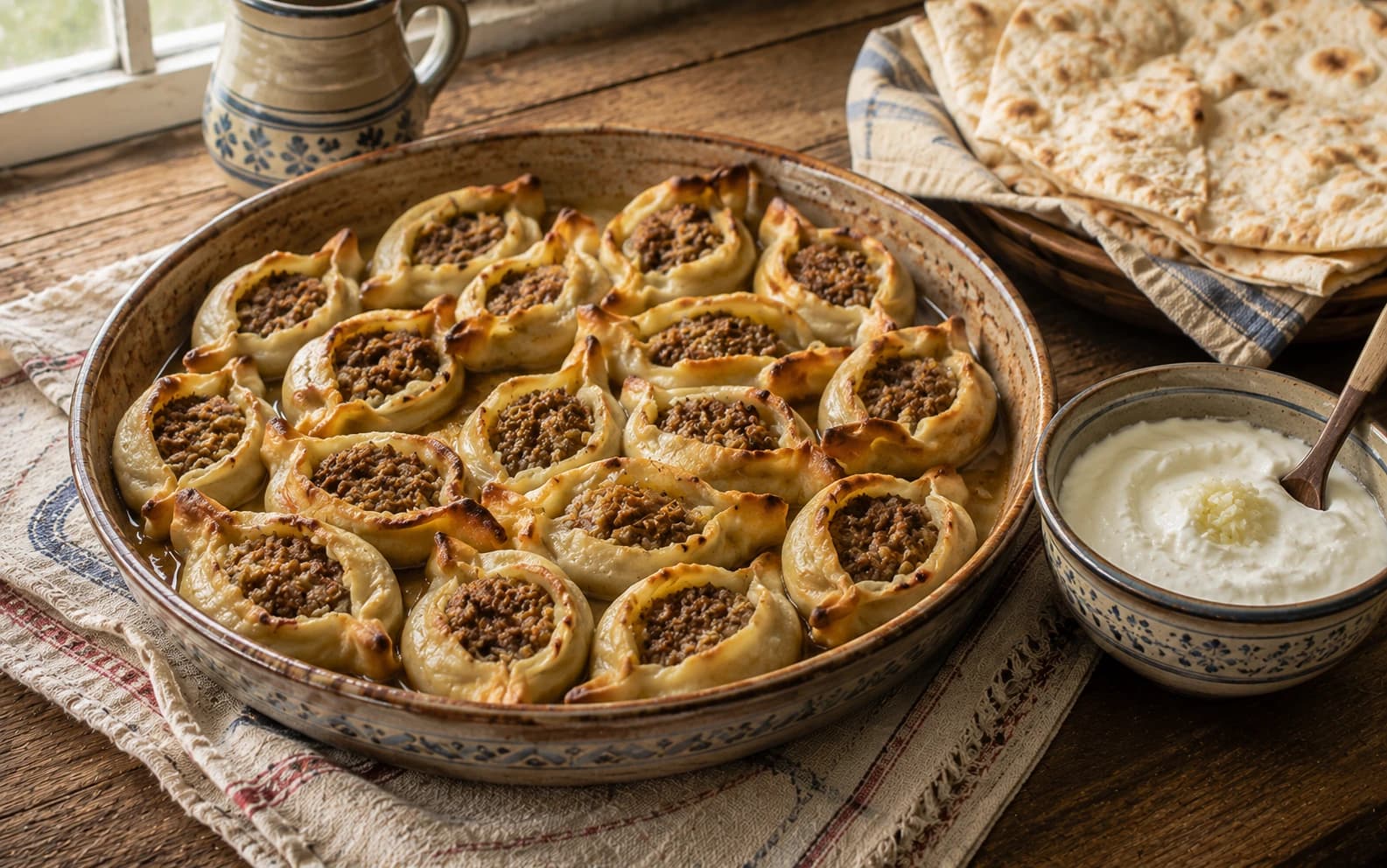
Almost every dumpling in the world is closed. The dough is folded over the filling and sealed, and whatever happens next, boiling, steaming or frying, happens to a parcel. Armenian manti are the ones left open. Two sides of a small square of dough are pinched up around a little meat, the ends are left standing apart, and what goes into the oven is a tray of tiny open boats, not a pot of sealed ones. Dry heat does what water never could: the raised edges brown and turn brittle while the filling cooks inside. Then hot broth is poured straight over the tray and garlicky matsun goes on top, so the dish arrives hard, soft and cold all at once. This article is about that form: what it is, where it belongs, and how much of the history usually attached to it really holds up.
- Author
- Armat Editorial Team
- Updated
- Reading time
- 18 min read
In brief
Manti are small meat-filled dumplings, and you can spot the Armenian kind at a glance. They are pinched into open boats instead of being sealed, set upright on a tray, and baked until the exposed dough turns brown and hard; then broth and garlic matsun are poured over them. This form belongs above all to Western Armenian cooking, from Aintab, Marash and Cilicia, and to the diaspora communities descended from them. Manti also exist far beyond Armenians, in a family that runs from Chinese mantou through Central Asia to Turkish mantı. The popular story that Armenians got them from the Mongols in thirteenth-century Cilicia goes back to a single modern book. What history does support is a particular Armenian way with a shared food, and a well-documented account of how it left Anatolia and survived.
Key facts
- Kind of food
- Small meat-filled dumplings, served as a main dish
- Characteristic Armenian form
- Open boat shapes, baked on a tray until the edges crisp — sini manti
- Filled with
- Ground lamb or beef with onion and spices
- Served with
- Hot broth poured over the baked tray, and matsun beaten with garlic
- Belongs to
- Western Armenian cooking above all: Aintab, Marash, Cilicia and their diaspora
- Also spelled
- Mante, monta; մանթի in Armenian
The dish at a glance
- Common ingredients
- Thin unleavened wheat dough, usually made with egg, Ground lamb or beef with onion, salt, pepper and parsley, Meat broth, often given colour and body with tomato, Matsun beaten with crushed garlic, and sumac to finish
- Traditional preparation
- Thin dough is cut into small squares, and each gets a little filling and is pinched along two sides so the ends stay open. The boats are packed upright on an oiled tray and baked in dry heat until the standing edges brown and harden and the meat browns inside. Hot broth is poured over the tray shortly before serving. This page gives no quantities, oven temperatures or baking times: it describes what manti is and why the form works, and it is not a recipe.
- Occasions
- Family gatherings, where the shaping is shared out among several people, Christmas and Easter tables, and church and community events, Everyday meals in households that keep trays of shaped manti in the freezer
- Known regions
- Western Armenian Anatolia and Cilicia: Aintab, Marash and the towns around them, The Levantine diaspora, above all Aleppo and Beirut, Armenian communities in the United States, France and Canada, Yerevan, mainly in restaurants founded by Western Armenian families
- Serving traditions
- Baked until the open edges are hard, then flooded with hot broth and topped with garlicky matsun and sumac, so that hot, soft and cold arrive together.
What Armenian manti is
Manti are small dumplings of wheat dough filled with ground meat, made under that name across a huge stretch of Asia. What makes the Armenian ones distinct, and not just a local spelling, is how they are handled: shaped open, cooked in dry heat on a tray, and finished at the table with two liquids poured over them. English usually calls them Armenian dumplings. That is accurate but tells you almost nothing, because everything interesting lies in what is done to them.
They are small. These are not the fist-sized steamed manti of Central Asia, and they do not come six to a plate. A tray holds many dozens, and making them takes hours rather than minutes. The size is not just for show. It creates the balance the dish depends on, a lot of edge for very little filling, and it is why the dish is almost never made for one household on an ordinary evening.
One more name is worth knowing from the start. Sini manti, or tray manti, is the term for the baked form in particular, named after the tray it is arranged on. Sini is a Persian word for a large round tray, and it reached Armenian through the same Ottoman-era contact that supplied much of the Western Armenian kitchen vocabulary. When a recipe says sini manti, it means the baked open version and none of the others, a distinction more useful than it looks.
The open baked form, and the trouble with always
The baked open boat is the typical Armenian form, and the one worth explaining. Squares of thin dough each get a little filling, the two opposite sides are pinched together over it and the two ends are left open, so the finished shape is a canoe with the meat visible along the top. They are packed upright and close together on an oiled tray, often in a pattern, and go into a hot oven until the standing dough has coloured and hardened and the meat has browned in its trough. Nothing about this resembles what most dumpling traditions do.
This is also where English-language sources overreach, and the overreach is worth naming because it is repeated everywhere. The claim in circulation is that Armenian manti is always baked and never boiled or steamed, unlike every other regional variety. That goes further than the evidence allows, and Armenian practice itself contradicts it. Sulu manti (soup manti, from the word for water) is Armenian, and its dumplings are closed, not open, and simmered in broth, not baked. Armenian-language recipe sites in the Republic routinely give manti steamed in a stacked steamer, in the larger Central Asian style.
The accurate version is narrower, and it holds up against the evidence. The baked open form is a characteristic and widely documented Armenian style, strongly linked to Western Armenian cooking, and it is what most people mean when they simply say Armenian manti. It is not a rule every Armenian kitchen follows, and the versions that differ are not mistakes. This article describes a form, not a border.
Dough, filling, and why the edge matters
The dough is plain: wheat flour worked with water, usually with egg, rolled very thin and cut into small squares. It is unleavened, and that matters more here than elsewhere, because a risen dough would puff up and soften instead of hardening. The dish needs dough that can dry out and hold a shape, not tender dough, and thinness is what lets it do that in the time the filling takes to cook.
The filling is ground meat with onion and seasoning, and the meat depends more on the household than on any rule. Lamb is usual in the older Western Armenian accounts and remains standard in the Levantine diaspora. Beef is at least as common in American and Armenian kitchens today, and mixtures of the two are normal. Onion is almost always there, and the seasoning runs to salt, pepper, parsley and often a warm spice such as allspice or cumin. Vegetarian versions filled with lentils or chickpeas exist too, made by people who also make the meat kind.
Baking is what gives the dish its identity, and the reason is everyday food science. Dry heat drives water out of the exposed dough and lets its surface get far hotter than boiling point, so the sugars and proteins in it brown and the structure sets hard. A dumpling cooked in water or steam can do neither, because its surface stays wet and stays at the temperature of the water. That is why the open shape and the oven belong together. Leaving the top open exposes as much dough as possible to the dry air, so the dish is truly crisp before anything is poured on it.
Broth and matsun at the table
Having made the dough hard, the cook then wets it again, and the timing of that reversal is the whole trick. Hot broth (meat stock, often given body and colour with tomato) is poured straight over the baked tray shortly before eating, and the crisp edges soak up just enough to soften without collapsing. Some households serve the broth on the side in bowls instead, and some skip it and finish with the dairy alone. Families decide for themselves which way is correct, and they decide with confidence.
The dairy is less optional. Matsun beaten smooth with crushed garlic goes on top, and the mix of hot baked dough, hot broth and cold sour dairy is the whole point of the dish. Matsun is the Armenian fermented milk described in its own article here, and it is worth naming exactly. Recipes written for English-speaking kitchens often call for Greek yogurt or labneh, which are reasonable substitutes but not the same product. The dish belongs to a cuisine that had matsun long before it had manti.
Most Western Armenian versions finish with sumac, sometimes with dried mint or Aleppo pepper, and the choice is not decorative. Sumac is sour and dry, and it does the same job as the matsun from another direction, on a dish that is otherwise rich, salty and soft. This layered, sour-topped style belongs to the eastern Mediterranean, not the Armenian highlands, and its place on the plate is one more clue to where this form of manti comes from.
A dish made by many hands
Filling and pinching several hundred dumplings the size of a thumb joint is too much for one person in an evening, and the custom that grew up around that fact is well documented. Diaspora accounts describe manti-making as a gathering: the women of a family meet at one house, often at a weekend, work through trays together, and freeze what is not needed right away. The food writer Andrew Janjigian describes exactly this at his Aunt Esther's house, where the frozen trays were kept for Christmas Eve.
As a result, manti sits near the special end of the everyday-to-festive scale without being a ceremonial food. It is served at Christmas and Easter, at family gatherings, and at church and community events, because those occasions justify the work and bring the workers together. It is not liturgical, it carries no ritual role, and it belongs in this section among main dishes, not beside harissa and ghapama.
It is worth being clear about what this does not mean. Communal manti-making is a documented practice in particular families and communities, recorded by the people it belongs to. It is not a description of how all Armenians live, and freezers, food processors and bought dough have changed it a great deal within living memory. It is a real tradition, and like any tradition it has a history, including a recent one.
A Western Armenian food
Armenian food is not one cuisine, and manti shows this as clearly as any dish. It belongs above all to Western Armenian cooking: the food of the Armenian communities of Ottoman Anatolia and Cilicia and the diaspora descended from them, not the cooking of the eastern highlands that became the Republic of Armenia. Writing for the Smithsonian Folklife Festival, Liana Aghajanian put the general case bluntly: what is eaten in Armenia is very different from what counts as Armenian cuisine outside it, down to the names and pronunciations of the foods. She names manti among the Western Armenian dishes that diaspora restaurants keep.
The term needs to be used precisely, because Western Armenian is a geographical and historical description and not a synonym for abroad. It refers to the Armenians of the western, Ottoman half of the historic Armenian lands; to the cities and provinces of Anatolia and Cilicia where they lived, such as Aintab, Marash, Kilis, Adana, Kharberd and Sebastia; and to their language, which is a separate standard form of Armenian, not an accent. An Armenian family in Moscow or Rostov is not Western Armenian, and its cooking is generally not manti cooking.
You can follow the regional trail in the sources. The Armenian-American cookbooks of the mid-twentieth century came overwhelmingly from Aintab, compiled in Massachusetts by women born in Anatolia. The Hetq archive's account of Aintab cooking lists tray-baked filled foods served with yogurt among the town's signature dishes, including one served after the New Year liturgy. Manti belongs to that world, and it is no accident that so many modern recipe pages for it begin with a grandmother from Aintab or Marash who left for Aleppo.
The Cilician claim and where it comes from
Almost every English page about Armenian manti carries the same historical sentence: that manti reached Cilician Armenia through contact between Armenians and Mongols during their thirteenth-century alliance, and that Turkic peoples then learned it from the Armenians and carried it into Anatolia. It turns up in food-media explainers, diaspora community pages and recipe blogs, usually with no source at all and sometimes credited to an unnamed Armenian researcher.
The claim can be traced. It goes back to Irina Petrosian and David Underwood's Armenian Food: Fact, Fiction and Folklore (2006), a popular history of Armenian cuisine, and spread from there through an encyclopedia entry into general use. Knowing this changes how much weight it can bear. The Armenian-Mongol alliance is real, well documented and interesting in its own right, and it is quite plausible that food travelled along it. But a reasonable inference in a modern popular book is a hypothesis about the thirteenth century, not a record of it. The second half of the claim, that Turkic peoples got manti from Armenians, is bigger still and rests on the same single source.
So this article does not say that manti originated in Cilician Armenia, and it does not say the opposite either. No medieval Armenian text, inscription or cookbook shows when dumplings by this name entered Armenian cooking, and the earliest hard evidence for the word anywhere in Anatolia is Ottoman, not Cilician. Modern Armenian memory strongly links manti with Cilicia, and that link is real and worth recording for what it is: a fact about where the dish flourished and who carried it, not a dated account of how it arrived.
Manti across a wider region
Armenian manti belongs to a family much bigger than Armenia. Dumplings called manti, mantı, mantu or manta are made from Xinjiang and Uzbekistan through Afghanistan and the Caucasus to Anatolia and the Balkans, and Korean mandu and Chinese mantou belong to the same tangle of names. The Turkish mantı best known abroad is Kayseri mantısı: very small, closed, boiled, and served under garlic yogurt with melted butter and pepper poured over. The dumplings of Central Asia are usually much larger and steamed. The Armenian form is the baked open one.
The timeline is thin, and it comes from outside Armenian sources. The earliest well-known written record of a manti-like dish is in Yinshan Zhengyao, the dietary manual compiled in 1330 by Hu Sihui at the Mongol Yuan court, with recipes clearly related to the later Anatolian ones. The earliest Ottoman manti recipe appears in the fifteenth-century cookbook of Muhammed bin Mahmud Şirvani. Between those two points comes the Mongol expansion, which is why so many accounts reach for it. How these dumplings spread west across Eurasia is a real scholarly subject, explored by Aylin Öney Tan in the Oxford Symposium's volume on wrapped and stuffed foods.
The fair summary is that the wider manti family has a long history across many regions that no single people invented, and that the Armenian baked form is one distinct development within it. Both halves of that sentence matter. Drop the first and you get the invention claims that circulate in several languages at once. Drop the second and a specific, well-recorded cooking practice shrinks into a mere borrowing, which it is not.
The word, and what a word proves
Armenian writes the dish մանթի, and English spells it manti, mante and, in some diaspora communities, especially around Los Angeles and Detroit, monta. These are one pronunciation caught in different spellings, not different foods: a Glendale shop selling monta and a Boston kitchen making manti are making the same thing. Related terms travel with it: mantapour for the broth version, sini manti for the baked one, sulu manti for the soup one.
The etymology of the root is genuinely unsettled. Most etymological references derive manti from Chinese mantou, and Turkish etymological dictionaries also point to a Mongol link. The reverse, that mantou was borrowed into Chinese from a Turkic source, has been argued and questioned. What is not in doubt is that the word is not Armenian in origin and came from the east along with the food.
That fact settles nothing about ownership, and it needs saying because people online argue it both ways. Loanwords are normal in cooking vocabulary across this whole region. Armenian took basturma from Turkish and sini from Persian, and lent its own words to others in turn. So a borrowed name is evidence of contact rather than of who is entitled to the dish. What matters is what a people does with a food after it arrives, and what Armenians did with this one was distinctive enough to earn its own name.
Carried out of Anatolia and kept
The most recent part of this history is also the best documented. The Armenian communities of Aintab, Marash and the Cilician towns were destroyed or driven out during the genocide of 1915 and the years around it. Survivors reached Aleppo and Beirut first and later, in further migrations, France, the United States and Canada. Manti went with them. The same trays are set in Aleppo, Beirut, Boston, Los Angeles and Toronto, made from recipes that trace back through one or two named women to a town where no Armenians live today.
This path differs from that of the section's other Anatolian survival. Basturma was carried by families who had made it commercially, and it re-established itself as a trade, with shops and producers. Manti was carried in households, by people who made it for their own families and taught daughters and daughters-in-law to pinch it. It came back as home cooking and only later reached restaurants. Both routes worked. The household route leaves fewer records, which is why the family accounts collected in community publications are the real evidence here, not decoration.
It also means the dish has kept changing while staying recognisable. Diaspora versions differ by country: more tomato in the Levantine broth, more sumac in some kitchens than others, beef where the grandmother used lamb. Some cooks now use bought wrappers. The people making those changes are the tradition, not a break from it, and what stays constant across all of them is the shape and the oven.
Manti in Armenia today
In the Republic of Armenia the picture is different. Manti is known and available, but it is not a standard dish of the highland kitchen the way dolma or khash are. Where it is served in Yerevan, it is overwhelmingly in restaurants that are openly Western Armenian or Middle Eastern Armenian: places founded by families from Beirut and Aleppo, or named after Aintab. Manti has reached Armenia largely by coming back with the diaspora, not by being handed down within the country.
That gives manti an unusual, and useful, place among the dishes in this section. Most of them are foods of the country that also travelled; this is a food of exile that has been travelling back. Armenian-language recipe collections also show how one name covers two different foods in the two halves of Armenian life: the baked open tray in the diaspora, and the larger steamed dumpling of the post-Soviet repertoire in kitchens inside Armenia.
None of this makes it less Armenian, and this article does not think it worth asking whether it counts. A food that a people has made under its own name for centuries, shaped in a way nobody else shapes it, served with its own dairy, and carried through a catastrophe by the households that survived, is that people's food. The evidence supports something more particular than an invention story: a shared regional dumpling that Armenians handled differently from everyone around them, and kept.
Important dates
1330
Yinshan Zhengyao, compiled by Hu Sihui at the Mongol Yuan court, records dumpling recipes clearly related to the later Anatolian manti.
15th century
The earliest known Ottoman manti recipe appears in the cookbook of Muhammed bin Mahmud Şirvani.
1915
The Armenian communities of Aintab, Marash and Cilicia are destroyed or expelled; survivors carry manti to Aleppo, Beirut and, later, the Americas and Europe.
2006
Irina Petrosian and David Underwood publish the Cilician-Mongol account of manti's arrival, which later spreads across the English-language web without credit.
Why manti matters
Manti is where this section stops being the cuisine of one country. Almost every other dish here can be described from inside Armenia; this one cannot. Its home is the western half of the historic Armenian world, and its living centre is a diaspora created by force. To write about manti at all is to write about Aintab, Aleppo, Beirut and Glendale, and about a kind of Armenian cooking that outlived its own geography.
It is also the section's clearest case of a shared food made distinctive by how it is treated, not by what goes into it. Nothing in a manti is Armenian in itself: the dough is wheat and water, the filling is minced lamb, and the name came from the east. What is Armenian is the choice to leave the parcel open and put it in the oven, then pour broth and garlic matsun over the result. That small technical difference produces a completely different food. It deserves defending as carefully as any origin claim, and more so, because unlike the origin claims it can actually be shown.
Interesting facts
- 01Sini manti means tray manti. Sini is a Persian word for a large round tray, so the baked form is named after the thing it is baked on.
- 02The widely repeated claim that Armenian manti is never boiled or steamed is contradicted by Armenian practice: sulu manti is closed and simmered, and Armenian-language recipe sites give steamed versions.
- 03The Cilician-Mongol origin story found on nearly every English page about Armenian manti goes back to a single popular book published in 2006.
- 04In parts of the American diaspora the dish is called monta, and a Glendale shop sells it under that name: the same food, a different vowel.
- 05In Yerevan, manti is mostly found in restaurants founded by Western Armenian families from Beirut and Aleppo: a diaspora food that has been travelling home.
Sources
- Aylin Öney Tan. Manti and Mantou: Dumplings across the Silk Road from Central Asia to Turkey — in Mark McWilliams (ed.), Wrapped & Stuffed Foods: Proceedings of the Oxford Symposium on Food and Cookery 2012, Prospect Books, 2013 ISBN 9781903018996The non-Armenian academic anchor for the wider-family section, and the reason that section is a description of a scholarly subject rather than a counter-claim. Carries the Eurasian spread of the manti family, the Yinshan Zhengyao of 1330 compiled by Hu Sihui at the Yuan court as the earliest well-known written record of a related dish, and the etymological position that most references derive manti from Chinese mantou while Turkish etymological dictionaries also point to a Mongol link. Cited for the shape of the question and never for an origin verdict: the article's sentence that the wider family has a transregional history no single people invented is this source's position, not Armat's improvement on it.
- Priscilla Mary Işın. Bountiful Empire: A History of Ottoman Cuisine — Reaktion Books, 2018 ISBN 9781780239040The Ottoman end of the chronology, and the reason the article can say that the earliest hard evidence for the word anywhere in Anatolia is Ottoman rather than Cilician — the fifteenth-century cookbook of Muhammed bin Mahmud Şirvani, which carries the earliest known Ottoman manti recipe. Cited for the attestation and its date, and explicitly not for national ownership in either direction: a food documented in Ottoman culinary sources can also have developed distinct Armenian forms, and this article treats those as compatible rather than competing facts.
- Irina Petrosian and David Underwood. Armenian Food: Fact, Fiction & Folklore — Yerkir Publishing, 2006 ISBN 9781411698659Sixth use of this book in twelve Cuisine articles, and the §41 concentration rule was weighed rather than waived. It is here for a reason none of the other five shares: it is the ORIGIN of a claim the article refuses, not support for one the article makes. The sentence that manti reached Cilician Armenia through Armenian-Mongol contact in the thirteenth century, and that Turkic peoples then learned it from Armenians, appears on nearly every English page about Armenian manti, almost always unsourced and occasionally credited to an unnamed Armenian researcher; it traces to this popular history and travelled from it through an encyclopedia entry into general circulation. Naming the book is what converts an anonymous fact into a datable modern attribution, and no other source performs that function. Cited for authorship of the claim; not cited as evidence for it.
- Holly Chase. The Meyhane or McDonald's? Changes in eating habits and the evolution of fast food in Istanbul — in Sami Zubaida and Richard Tapper (eds.), A Taste of Thyme: Culinary Cultures of the Middle East, Tauris Parke, 2000 ISBN 9781860646034The source of the nomadic transmission story, cited with its original hedge intact. Chase writes that Turkic and Mongol horsemen on the move are SUPPOSED to have carried frozen or dried manti that could be boiled quickly over a camp-fire — a reported tradition, marked as one. What circulates online is the same sentence with the hedge removed and the supposition promoted to fact. Listed so the article can say where the story comes from and what its author actually claimed, which is the §22 treatment: a popular origin narrative identified as such rather than repeated or silently dropped.
- Liana Aghajanian. What Is Armenian Food? Depends Who You Ask — Smithsonian Folklife Festival, 28 June 2018 Visit sourceCarries the article's central structural claim — that Armenian food is not one cuisine, that what is eaten in Armenia differs substantially from what is called Armenian food outside it down to the names and pronunciations, and that manti belongs among the Western Armenian dishes diaspora restaurants keep. A national cultural institution stating the diaspora/Republic distinction is a better warrant for that framing than any number of family recipe pages saying the same thing. Cited for contemporary form, contemporary framing and Western Armenian association only, per §29: it is not used, and does not itself claim, anything about medieval chronology.
- Christine Vartanian Datian. Recipe Corner: Manti Made Easy — The Armenian Mirror-Spectator, 20 July 2023 Visit sourceA diaspora community publication, used for exactly what community publications are good for. It supplies the physical description the form section rests on — small canoe-shaped open-faced dumplings baked until crisp, served in a tomato-inflected meat broth under garlic yogurt with Aleppo pepper and sumac — and the communal-preparation account: the food writer Andrew Janjigian's description of the women of his family gathering at his Aunt Esther's house to shape and freeze trays for Christmas Eve. It also repeats the Cilician claim, which is why the article names the claim's real source instead of this one. Cited for form, serving and documented family practice; not for chronology.
- Սոնիա Թաշճեան. Այնթապ — Խոհանոց — Hetq, 20 May 2017 Visit sourceThe Armenian-language Western Armenian source, and the reason the regional section is not sourced entirely from English recipe pages. Tashchyan's account of Aintab cooking records the town's characteristic filled foods, including tray-baked forms and a yogurt-broth version served after the New Year liturgy — the same three elements the article identifies in manti (tray, oven, yogurt), documented inside the tradition rather than inferred from outside it. Cited for the Aintab context that places manti in a real regional kitchen; not cited as an entry on manti itself, which it does not claim to be.
- Mikayel Boyajian. 5 Delicious Spots to Enjoy Manti in Yerevan — Absolute Armenia, 3 April 2022, updated 9 July 2025 Visit sourceCited under the §27 restriction that menus establish presence and nothing else. It supports one narrow factual claim: that manti in Yerevan is served overwhelmingly by Western Armenian and Middle Eastern Armenian houses, several founded by families from Beirut and Aleppo or named for Aintab, and that it is less prevalent in Armenia proper. That is the evidence behind calling manti a diaspora-returned food, which is one of the article's more distinctive statements and would be unsupportable from historical sources alone. Carries no historical claim here and is not asked to.
Related articles
Matsun
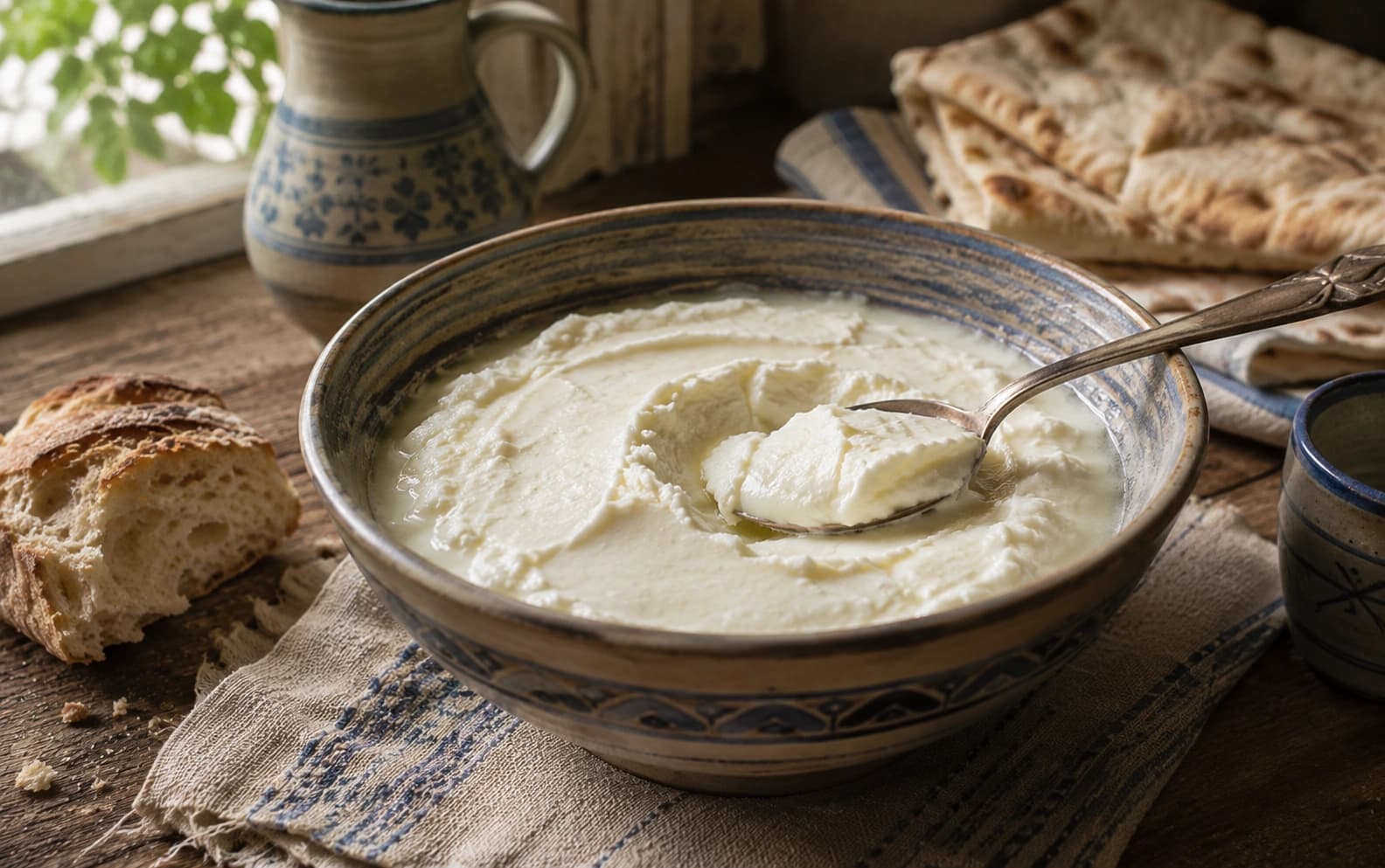
Milk set thick by its own bacteria, eaten every day and turned into half the rest of the cooking. This is Armat Cuisine's first article about an ingredient rather than a dish.
Basturma
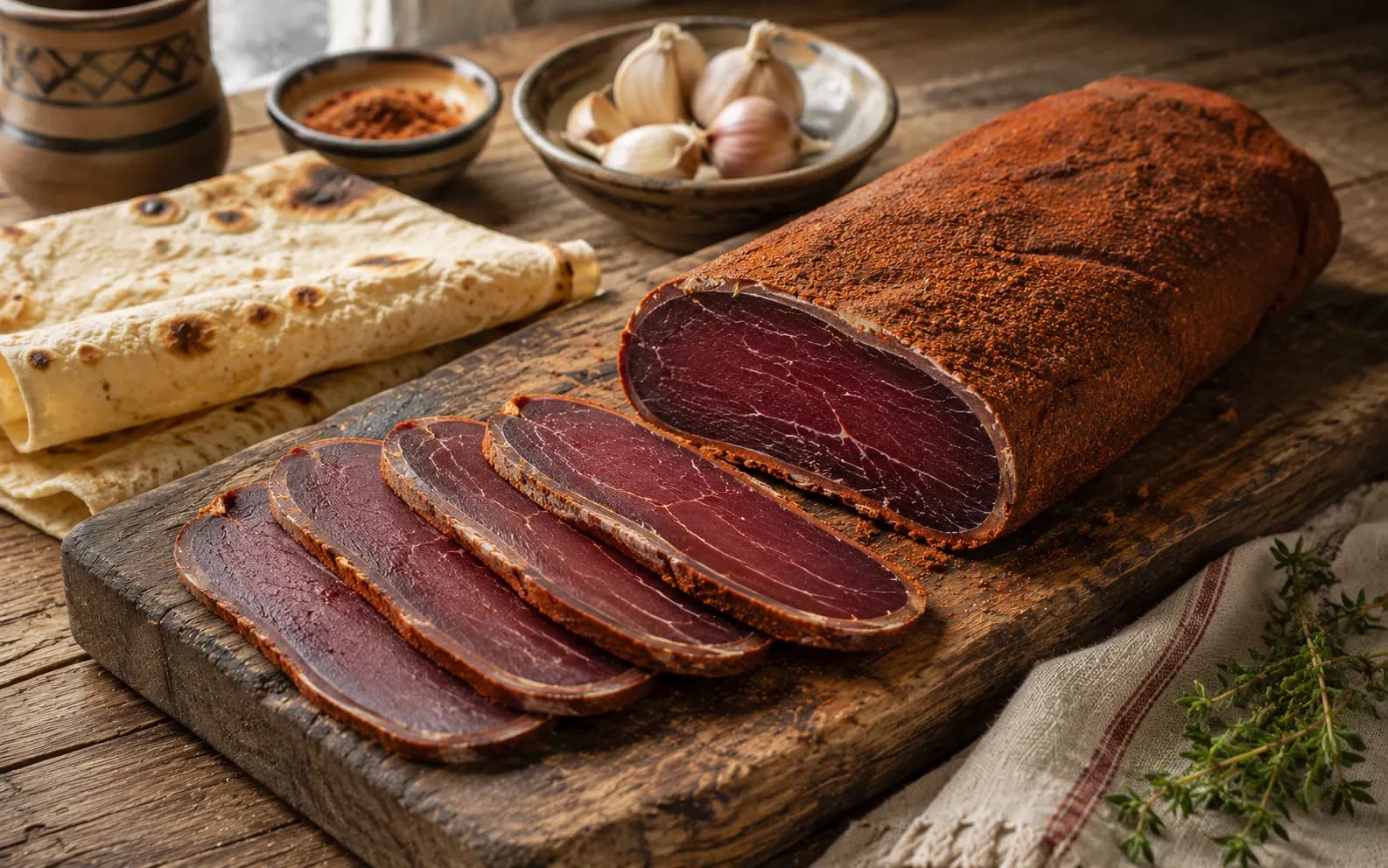
Beef salted, pressed, air-dried and sealed under a paste of fenugreek and garlic. The first article in this section about keeping meat rather than cooking it.
Lavash
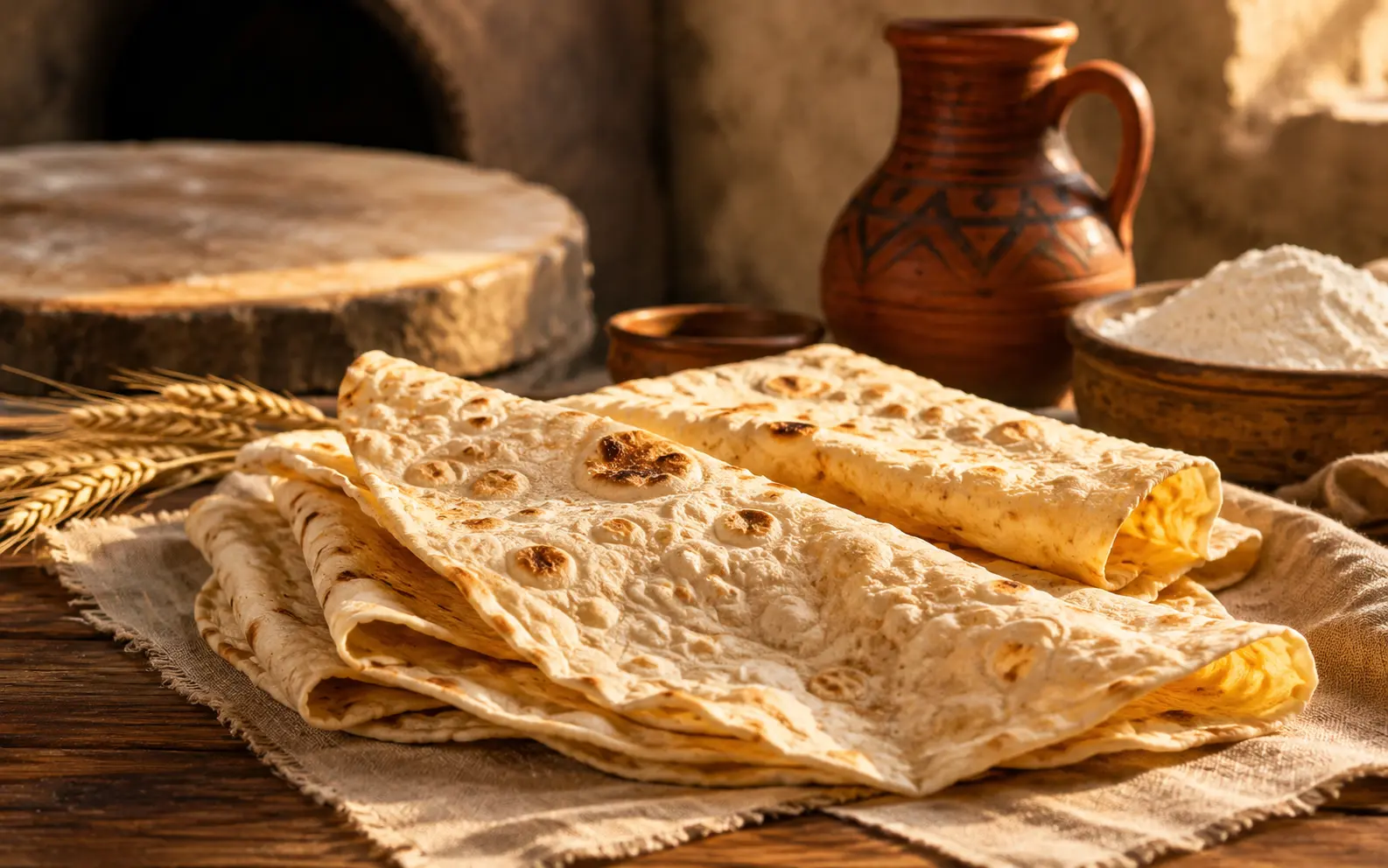
The thin flatbread baked on the wall of a clay tonir. UNESCO listed it in 2014 for how Armenians make, share and use it, and listed it again in 2016 for five other countries.