
Lavash
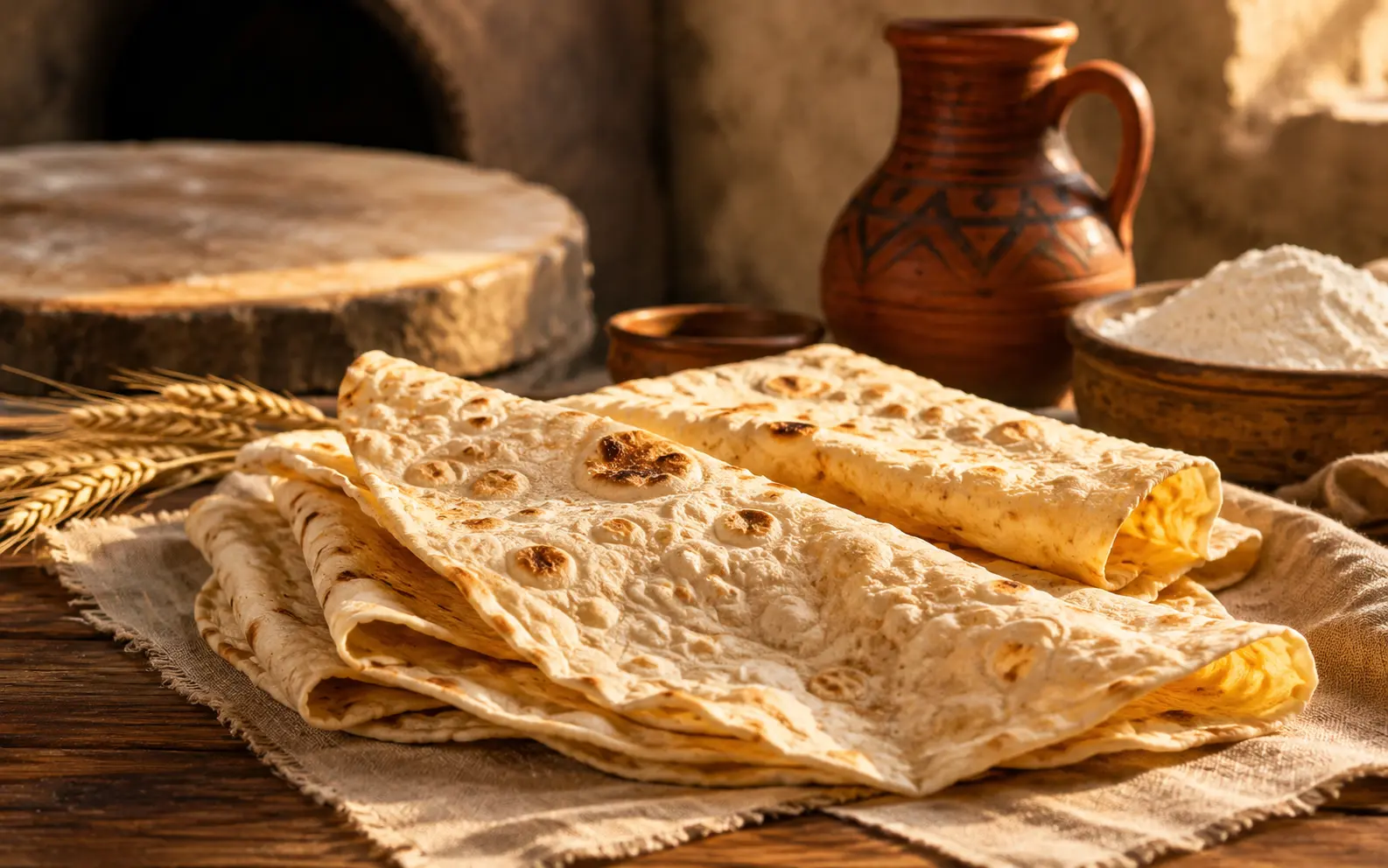
Lavash is a thin, soft flatbread of flour, water and salt, baked in seconds against the hot wall of a tonir, the clay oven sunk into the ground. It is the everyday bread of Armenian households and, at the same time, an object with a ritual life of its own: it is laid on the shoulders of a bride and groom, dried in sheets for the winter, and used as a plate, a wrapper and a utensil. UNESCO inscribed the Armenian practice on its Representative List of the Intangible Cultural Heritage of Humanity in 2014, and inscribed a separate, multinational flatbread element under the same name in 2016.
- Author
- Armat Editorial Team
- Updated
- Reading time
- 7 min read
In brief
Lavash is a thin unleavened flatbread of wheat flour, water and salt, baked in under a minute against the inner wall of a tonir, the clay oven sunk into the floor of a traditional house. Fresh, it is pliable and torn rather than cut, and wraps cheese, herbs and grilled meat; dried and stacked it keeps for up to six months and softens again when sprinkled with water, which is how a household could bake once and eat lavash through a winter. It also carries meanings unrelated to eating: the UNESCO file records lavash being laid on the shoulders of a bride and groom as a wish for prosperity. UNESCO inscribed the Armenian tradition in 2014 and a separate multinational element under the same name in 2016, each recording a living practice rather than ownership.
Key facts
- Kind of dish
- Thin unleavened flatbread
- Ingredients
- Wheat flour, water, salt
- Traditional oven
- Tonir — a clay oven set into the ground
- Baking time
- Under a minute
- Keeps for
- Up to six months when dried
- UNESCO
- Representative List, 2014, no. 00985
The dish at a glance
- Common ingredients
- Wheat flour, Water, Salt
- Traditional preparation
- The dough is kneaded, divided and rolled, then stretched until very thin, spread over an oval cushion and pressed against the hot wall of a tonir, where it bakes in seconds and is lifted off while still soft.
- Occasions
- Everyday meals, Weddings, Autumn baking for the winter store
- Known regions
- Throughout the Republic of Armenia, Armenian communities of the Middle East, Diaspora households, usually bought rather than baked
- Serving traditions
- Torn by hand and used to wrap cheese, herbs and grilled meat, or laid under other dishes to take up their juices; dried sheets are stacked and revived with water.
What lavash is
Lavash is an unleavened flatbread made from three ingredients: wheat flour, water and salt. What distinguishes it is not the dough but the shaping and the oven. The dough is kneaded and divided into balls, each ball is rolled and then stretched until it is thin enough to see light through, and the sheet is spread over an oval cushion and slapped against the inner wall of a tonir. It bakes in well under a minute and is lifted out while still soft.
The result is a bread that behaves differently from a loaf. Fresh, it is pliable and is torn rather than cut. Dried, it stacks flat, keeps for months, and returns to softness when sprinkled with water and left under a cloth — which is why a household could bake once and eat lavash through a winter.
The word covers a family of breads rather than a single fixed product. Sheets differ in length, thickness and colour from one village and one baker to the next, and the same name is used across a wide region for breads that an Armenian baker would not necessarily recognise as her own.
Its place in Armenian life
The UNESCO nomination file describes lavash-making as work that binds a household together. Women do the baking, with younger girls learning by assisting; men build the ovens and make the cushions the dough is stretched on, and pass those skills on in turn. Baking days are collaborative by necessity — the work is fast, hot and continuous once the tonir is lit.
The bread also carries meanings that have nothing to do with eating. The best-documented is the wedding practice recorded in the same file, in which lavash is placed on the shoulders of the newlyweds as a wish for prosperity and children. The Smithsonian Folklife Festival's 2018 Armenia programme described the tonir itself as one of the most sacred places in a traditional house — a sunken hearth at the centre of the home, and in some villages a substitute for a church in the sanctifying of a marriage.
In diaspora communities where no tonir exists, lavash is bought rather than baked, and the ritual uses survive better than the craft. This is a common pattern in the section: the meaning travels more easily than the method.
Documented background
The tonir is the oldest verifiable element of the story. Sunken clay ovens of this kind are a long-established feature of houses across the Armenian highland and the wider region, and the bread is inseparable from the oven that shapes it — a flatbread slapped onto a vertical wall is what that oven can produce.
The written record of lavash as a named tradition is recent and institutional rather than ancient. In 2014 UNESCO inscribed "Lavash, the preparation, meaning and appearance of traditional bread as an expression of culture in Armenia" on the Representative List, on Armenia's nomination. In 2016 the same body inscribed "Flatbread making and sharing culture: Lavash, Katyrma, Jupka, Yufka", submitted jointly by Azerbaijan, Iran, Kazakhstan, Kyrgyzstan and Turkey.
The two inscriptions are worth reading together, because they are often quoted separately to prove opposite things. Neither awards ownership of a bread. What each records is a living practice within particular communities, and the fact that the same name appears twice is a statement about how widely the bread is made, not a contradiction.
Ingredients and preparation
The dough is flour, water and salt, worked until smooth and rested. Portions are rolled out and then stretched — over the backs of the hands, or on a board — until the sheet is very thin and considerably wider than the rolling stage left it. It is transferred to an oval cushion, and the cushion is used to press the sheet firmly against the tonir wall.
The oven does the rest. A tonir holds a strong, dry heat, and the bread blisters and sets in seconds; a baker judges it by sight and lifts it off with a hooked tool. Sheets to be kept are stacked and dried, and revived later with water.
A common Armenian version uses no yeast at all, and many bakers add nothing beyond the three ingredients. Enriched and leavened variants exist, and gas-fired or metal ovens are now widespread; the bread they produce is recognisably lavash, and is not treated as a lesser thing.
Occasions and traditions
Lavash is not a festival bread. It belongs to ordinary days, which is precisely what gives it standing: it is the thing always on the table, and the thing a guest is first offered. Autumn baking, when sheets are prepared in quantity and dried for the winter, is the closest it comes to an event of its own.
Its ceremonial appearances are borrowed from that ordinariness. At a wedding it stands for the household the couple are joining; at a table it stands for hospitality. Many families keep the habit of not putting bread down carelessly or throwing it away, and the same respect is extended to lavash specifically.
Regional variations
Within Armenia the differences are mostly of size and handling: sheets a metre long in some villages, shorter and thicker elsewhere, and doughs slightly softer or firmer according to the flour available.
Across the wider region, breads called lavash range from the very thin Armenian sheet to thicker, chewier breads that are folded rather than rolled. In Armenian communities of the Middle East, commercial bakeries have standardised the product considerably.
In some regions the same tonir is used for other breads on the same day, and lavash is the first thing baked because it needs the fiercest heat.
Important dates
2014
UNESCO inscribes Armenia's lavash tradition on the Representative List of the Intangible Cultural Heritage of Humanity, no. 00985.
2016
A separate flatbread element under the same name is inscribed on the nomination of Azerbaijan, Iran, Kazakhstan, Kyrgyzstan and Turkey.
2018
Lavash baking is demonstrated in Washington as part of the Smithsonian Folklife Festival's Armenia programme.
Why lavash matters
Lavash is the clearest case in this section of a food that is also a technology and a social arrangement. The bread cannot be separated from the tonir, and the tonir cannot be separated from the household that builds, heats and works around it — which is why the heritage listing describes a practice rather than a product.
It is also a useful corrective to the idea that a dish belongs to one people. The same bread name is inscribed twice by the same organisation, for communities in six states. That does not diminish the Armenian tradition; it locates it accurately, as one strongly documented practice within a shared regional foodway.
Interesting facts
- 01The dough is stretched over an oval cushion and slapped onto the wall of the oven; the sheet bakes in less than a minute.
- 02Dried lavash keeps for up to six months and is brought back to softness with a sprinkle of water.
- 03The UNESCO file records the wedding practice of laying lavash on the shoulders of the bride and groom as a wish for prosperity.
- 04The same bread name carries two separate UNESCO inscriptions: Armenia's in 2014, and a five-country one in 2016.
- 05In the nomination file the baking is described as women's work, while men build the ovens and make the cushions — and both pass the skill on to apprentices.
Sources
- Lavash, the preparation, meaning and appearance of traditional bread as an expression of culture in Armenia — UNESCO Representative List of the Intangible Cultural Heritage of Humanity, no. 00985, inscribed 2014 Visit sourceSubmitted by Armenia. The nomination file is the source for the tonir method, the six-month keeping and the wedding practice.
- Flatbread making and sharing culture: Lavash, Katyrma, Jupka, Yufka — UNESCO Representative List of the Intangible Cultural Heritage of Humanity, no. 01181, inscribed 2016 Visit sourceA separate, multinational inscription submitted by Azerbaijan, Iran, Kazakhstan, Kyrgyzstan and Turkey — cited here because the same bread name is inscribed twice, for different communities.
- Levon Abrahamian and Nancy Sweezy (eds.). Armenian Folk Arts, Culture, and Identity — Indiana University Press, Bloomington, 2001 ISBN 9780253337047Hripsime Pikichian's chapter on festival and feast is the ethnographic source used across this section.
- Armenia: Creating Home — The Hearth — Smithsonian Folklife Festival, Center for Folklife and Cultural Heritage, 2018 Visit sourceThe 2018 Festival programme's description of the tonir, its dimensions and its place in the house.
Related articles
Khorovats
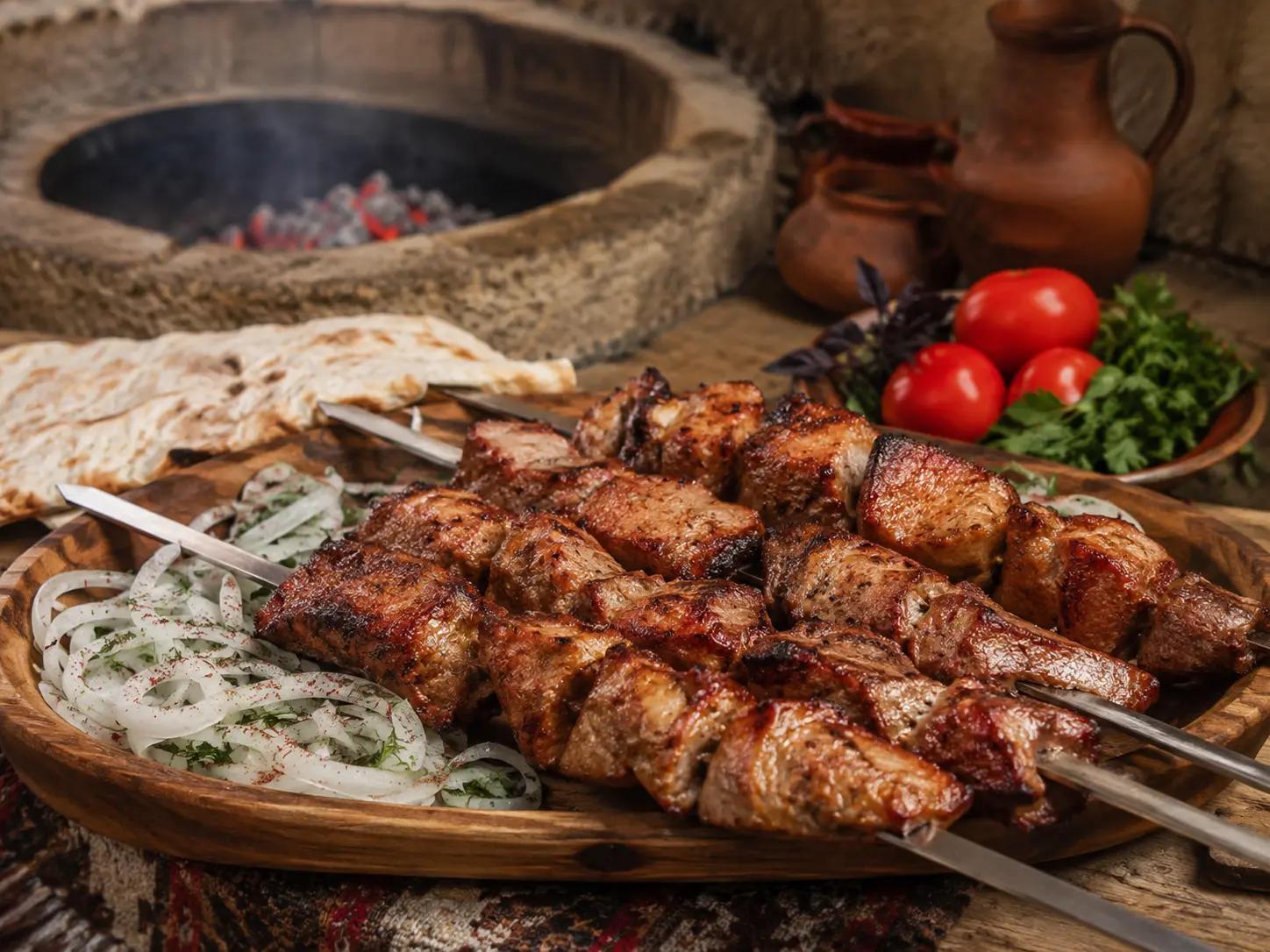
Meat grilled over open embers, and the social occasion built around it: who lights the fire, who tends it, and how it differs from the communal meal of a madagh.
Dolma
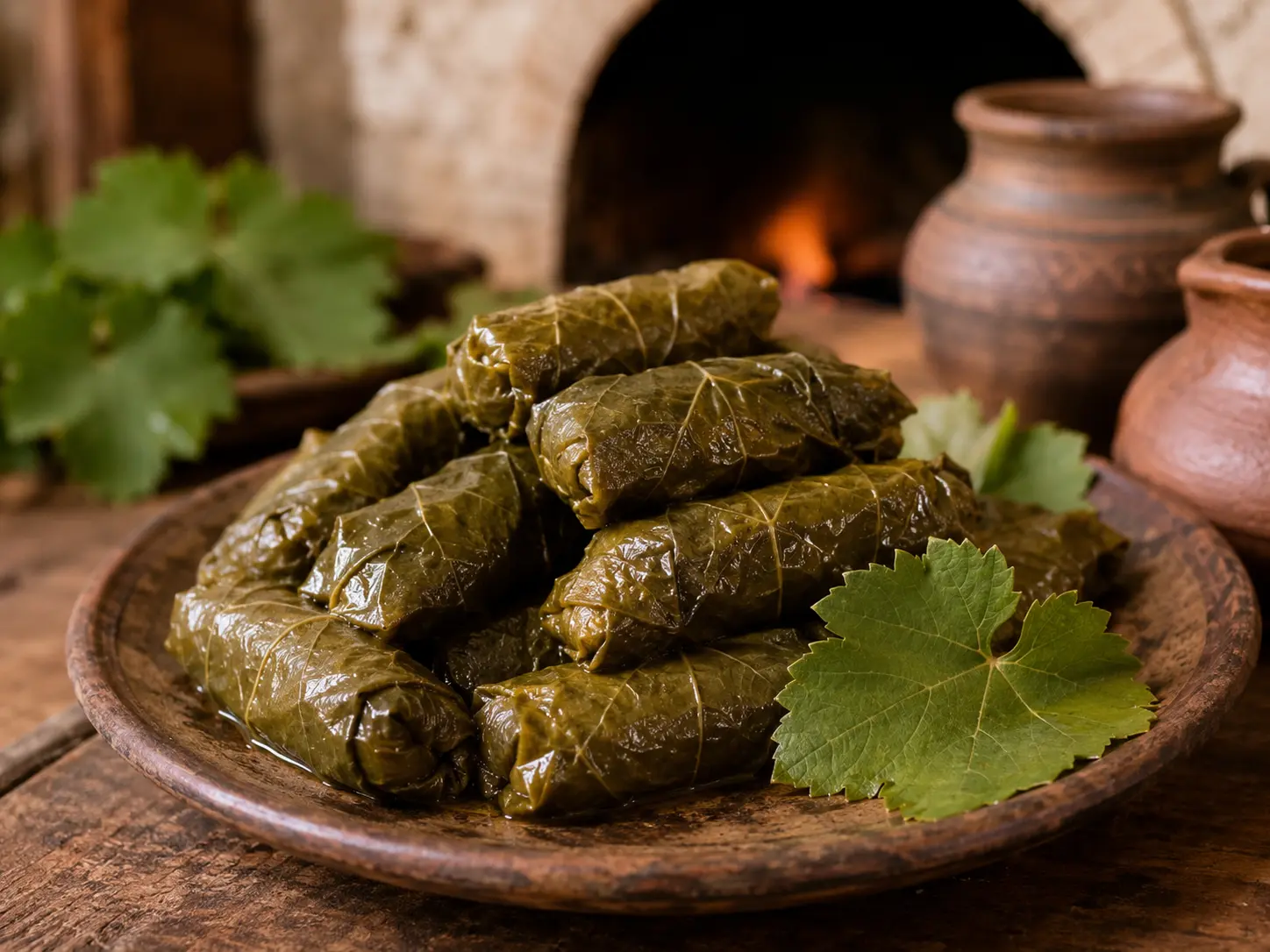
Vine leaves and hollowed vegetables filled with rice, herbs and often meat — a dish made across the whole region, and one of the clearest examples of why this section does not assign dishes to a single owner.
Harissa
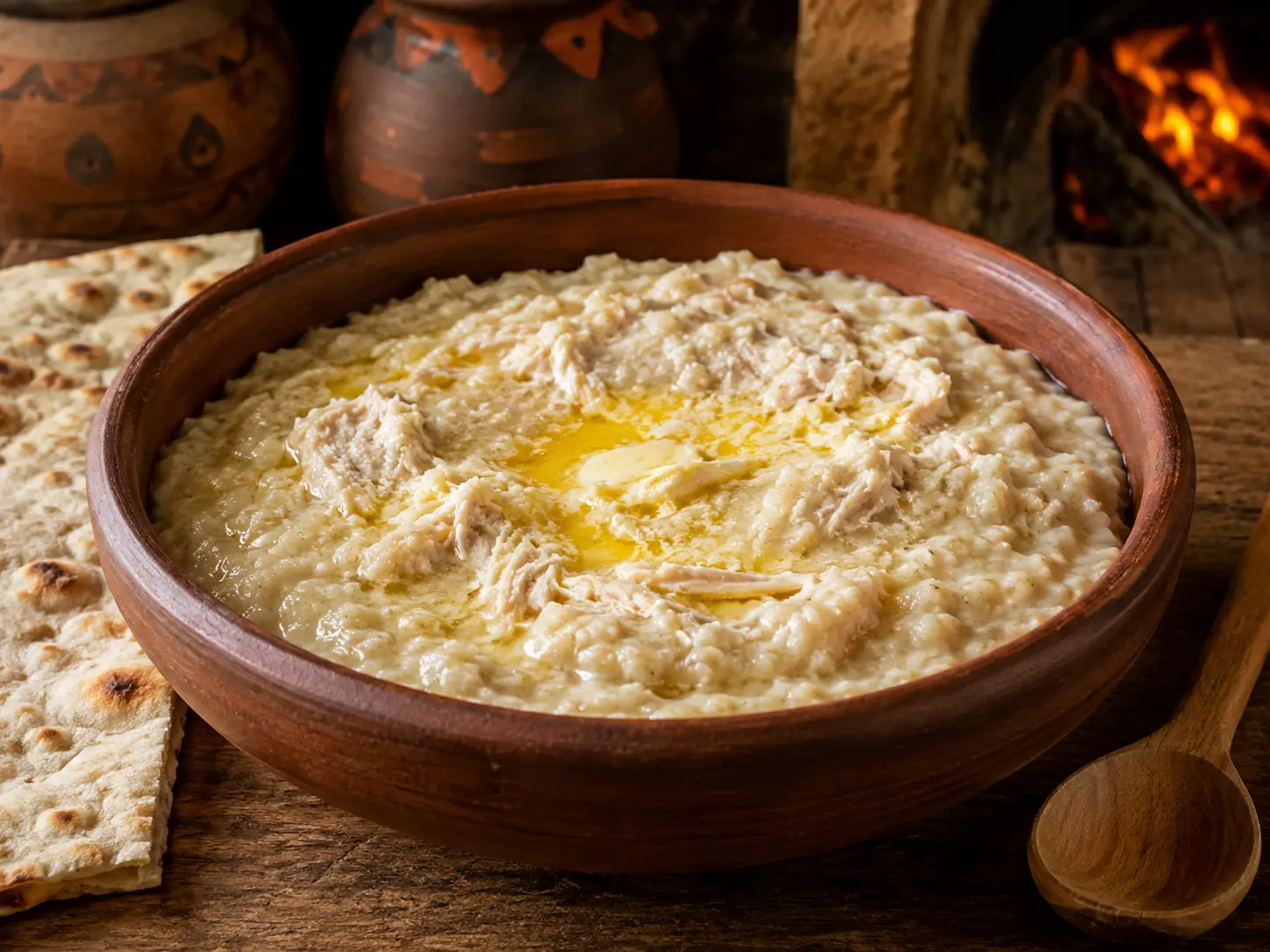
Wheat and meat stirred together for hours until they become one substance — a dish recorded in a tenth-century Baghdadi cookbook, and the food around which the Musa Dagh resistance is commemorated every September.