
Matsun
Matsun is what milk becomes when the right bacteria are left to work on it. They turn the milk's sugar into acid, the acid unsettles the protein, and the whole pot sets into something thick, sour and spoonable that keeps far longer than milk. That is the whole transformation. Armenian households have kept it going for a very long time by the simplest method there is: saving a spoonful of yesterday's batch to start tomorrow's. This is the first article in this section about a basic food rather than a finished dish. Matsun is eaten on its own, and a great deal of other Armenian cooking is made from it.
- Author
- Armat Editorial Team
- Updated
- Reading time
- 14 min read
In brief
Matsun is milk fermented by lactic-acid bacteria until it sets into a thick, sour food eaten with a spoon. People eat it plain and with bread, and much other cooking is built on it: it is thinned into a drink, cooked into soup, drained and salted to keep, or dried into hard sour balls that last for years. A little of each batch starts the next, so traditional matsun carries a local population of microbes rather than a bought culture. Armenian matsun and Georgian matsoni are one food under two names, and microbiologists from both countries have studied them together. The word is native Armenian and old. How far back the food goes in its present form is a separate question the evidence does not settle.
Key facts
- Kind of food
- Fermented milk, set thick: a dairy food, not a prepared dish
- Made from
- Cow's milk usually; also sheep, goat, buffalo, or mixtures
- What sets it
- Lactic-acid bacteria, mainly Lactobacillus and Streptococcus, with yeasts also present
- Started by
- A little of the previous batch, which carries a local population of microbes forward
- Kept as
- Fresh; drained and salted as kamats matsun; or dried into chortan, which lasts for years
- Recognised by
- Armenia's national inventory of intangible cultural heritage, not a UNESCO list
The dish at a glance
- Common ingredients
- Milk: usually cow's, also sheep, goat, buffalo or mixtures, A little of the previous batch, as the starter, Lactic-acid bacteria, mainly Lactobacillus and Streptococcus, with yeasts present, Salt, for the drained and dried forms made for keeping
- Traditional preparation
- Milk is warmed, a little of the previous batch is stirred in, and the pot is left covered and warm until the bacteria have made it acidic enough for the protein to set. It is then cooled. This article gives no quantities or timings, because it explains what matsun is rather than teaching unsupervised fermentation.
- Occasions
- Everyday meals rather than festivals, Eaten plain or with bread, beside salads and soups, As the base of soups, drinks, fillings and mixtures
- Known regions
- Throughout Armenia, as an ordinary household and commercial product, Lori, where the traditional practice is especially well documented, Shared with Georgia, where the same food is called matsoni
- Serving traditions
- Served cold and plain, thinned and salted as a drink, or cooked into soup. The drained and dried forms are softened with water before use.
What matsun is
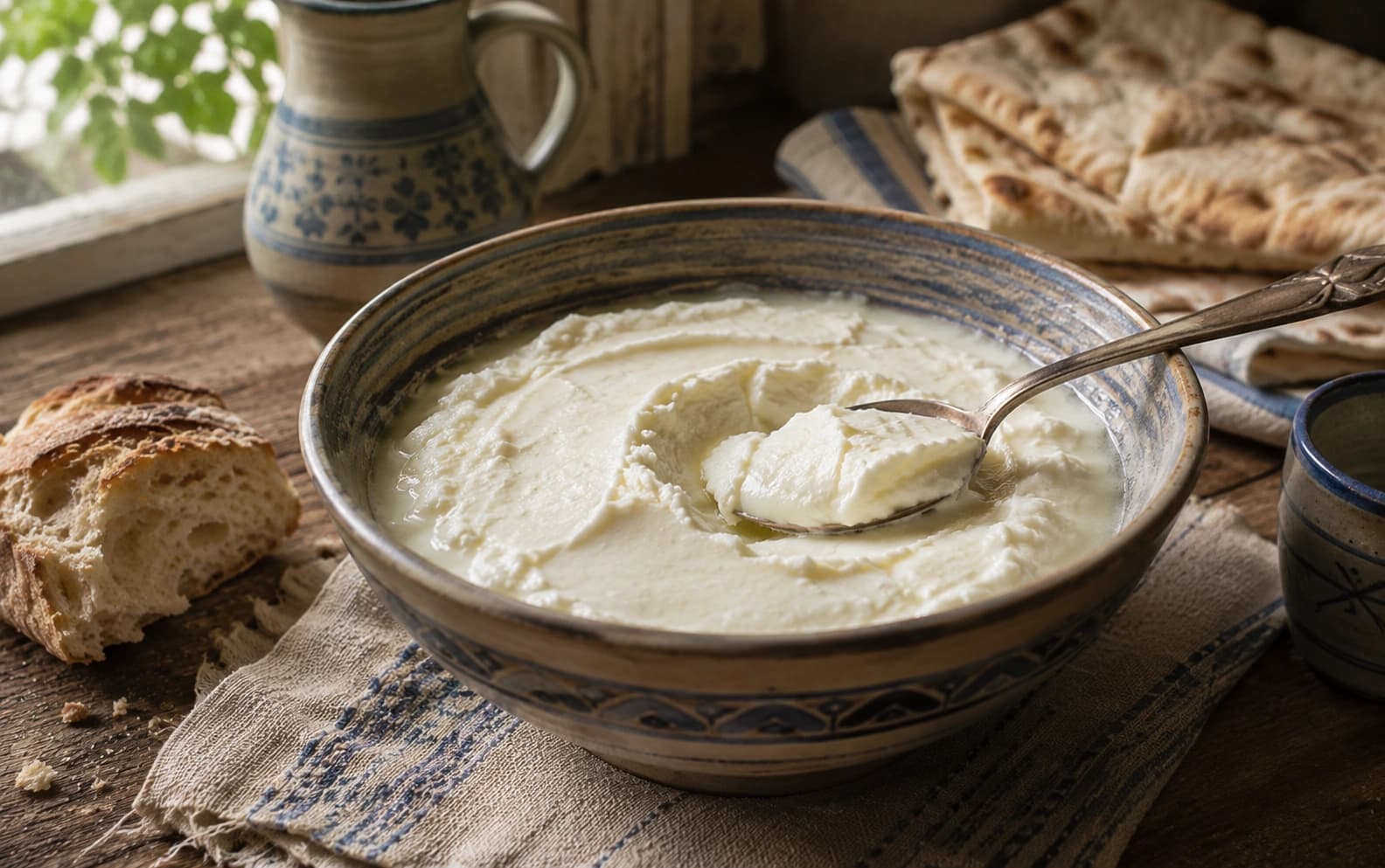
Matsun is milk that has been fermented until it sets. It is white, distinctly sour and thick enough to hold the shape of a spoon. People eat it cold, on its own or with bread, and cook with it in a great many other dishes. Cow's milk is the usual base in Armenia today, but sheep, goat and buffalo milk are all used, as are mixtures of them.
The nearest English word is yogurt, and this article uses it as a comparison, not an equation. Matsun is a fermented milk from the same family, and anyone looking for it under the word yogurt should find it. But the two are not interchangeable names for one standard product. Industrial yogurt is made with a set pair of bacteria at a controlled temperature. Traditional matsun is made with whatever microbes the household's own starter carries, at whatever warmth a cosy corner provides.
That difference is why this is the section's first article about a basic food rather than a prepared dish. Everything else here is something a cook makes and serves. Matsun is something a cook keeps, and then makes other things from.
Milk turned by bacteria
The chemistry is simple and worth explaining properly. Milk contains a sugar called lactose. Lactic-acid bacteria feed on it and give off lactic acid, and as the acid builds up the milk's pH falls. The main milk protein, casein, normally floats in stable clusters. As the acidity rises, the clusters lose that stability and link into a continuous network that traps the water. Nothing has been added to thicken the milk. It has set, where it stands, into a gel.
The acid does a second job at the same time. It makes the food hostile to most of the organisms that would otherwise spoil milk, so fermented milk keeps for days where fresh milk keeps for hours. In a household without a fridge, that is not a happy side effect. It is the whole point.
Scientists have measured what actually lives in it. A survey published in 2015 in the journal Food Microbiology sequenced the bacteria and fungi in matsun and matsoni from across Armenia and Georgia. The bacteria were dominated by Lactobacillus and Streptococcus species. The survey also found yeasts, among them Kluyveromyces marxianus, Candida famata and Saccharomyces cerevisiae, and these varied sharply from place to place. A traditional fermented milk is a small ecosystem, not a two-strain recipe, and this article makes no claim at all about what that ecosystem does to the person who eats it.
The starter and the chain
The usual way to make matsun is to add a little of the last batch to fresh milk. That is all a starter is: a living population moved from a finished pot into a new one, where it does the same work again. Nothing is bought and nothing is measured out, and the chain can run for as long as someone remembers to save a portion.
The same survey shows that this really happens, and is not just a pleasing story about continuity. It found that both the region and the type of milk shaped the microbial community, and concluded that traditional production passes a distinctive regional population from batch to batch. A bought starter would wipe out that pattern. A starter kept going in home kitchens is what creates it.
Other ways of starting a batch are recorded, and one of them should be attributed rather than generalised. The Slow Food Foundation's description of the practice in Lori records a preparation called meran, made from dried cornelian cherries with wheat and rye, along with a rennet step. That is one account of one local practice, and it is reported here as such. The common mistake with foods like this is to treat a single description of a household process as the timeless national method. What is widely recorded is the starter saved from the last batch; the variations around it differ from place to place.
The word and the food
Hrachia Acharian's Armenian etymological dictionary lists մածուն under the root մած-, meaning to stick, to cling, to thicken, and, of milk, to curdle. The same root gives the verbs for curdling milk and setting cheese, and the adjective for anything thick and sticky. Acharian classes it as a native Armenian word, from an Indo-European root meaning to knead or to work into a sticky mass, with relatives in Slavic, Greek and Germanic. The English word make belongs to the same family.
He then makes a point this article borrows, because it cuts through a great deal of noise. Beside matsun he sets Persian māsīdan, to curdle, next to māst; Turkish yoğurmak, to knead, next to yoghurt; and French cailler, to curdle, next to lait caillé. Several unrelated languages each named their fermented milk after the verb for what happens to it. That pattern tells us how people name foods. It says nothing about who made one first.
That is the distinction to hold on to. The word is old, and it is Armenian. Acharian records մածուն in the classical texts he cites, which shows the term was in written Armenian. It does not show that the food those texts meant was identical to what a Yerevan shop sells today, and no source consulted for this article closes that gap.
What the record actually says
One sentence turns up on nearly every English page about matsun: that it is mentioned in many tales by Armenian writers from the eleventh century onward. It is worth tracing that claim back, because what you find at the end is not what the sentence describes.
The eleventh-century figure is Grigor Magistros, and the work is his treatise on grammar. What he offers there is an etymology, a scholar's note on where the word comes from, which reached modern discussion through a language study published early in the twentieth century. A grammarian explaining a word is real evidence that the word existed and was familiar enough to explain. It is not a tale. It does not describe the food, and it cannot support any claim about how matsun was made or eaten.
So the accurate statement is narrower than the popular one, and more useful. Matsun is named in Armenian writing from the medieval period, and its name is native and older still. The evidence available here goes no further, and this article does not pretend otherwise. Claims that matsun is thousands of years old, or the oldest cultured milk anywhere, are not supported by anything consulted for this page. The most confident versions tend to appear on pages that are selling something.
Matsun and matsoni
Armenians call it matsun and Georgians call it matsoni, and the food is the same food. Both names come from the same root, and both traditions set milk with a starter carried forward from the last batch. The products differ the way two households' bread differs, not the way two separate dishes do.
Science has treated it that way. The 2015 survey described above used samples from both countries, its team included Armenian and Georgian researchers, and its title calls matsoni a transnational fermented milk. Its finding, that the microbial community follows region and milk rather than the border, is the most concrete thing anyone can say about the relationship. And it came from people of both traditions working on the question together.
There is also a dispute, and it should be kept apart from the history. In 2012 Georgia registered matsoni as a protected geographical indication, and a disagreement followed over the naming and transit of Armenian matsun. That is a modern argument about trade names and markets. It is not evidence about who fermented milk first, and should not be read as such. This article takes no position on the question of origin, because the sources consulted do not answer it and nothing about the food needs it answered.
An everyday food
Matsun is not festival food. The Slow Food Foundation, describing the tradition as it survives especially in the northern province of Lori, calls it part of the daily diet. That phrase says a lot: this is a food that turns up at ordinary meals, again and again, rather than one brought out for an occasion.
It is eaten plain, with or without bread, and served beside salads and soups. In a whole family of dishes it is also a building block, not just a side. The Armenian repertoire includes preparations built on it, and it turns up in fillings and mixtures where its sourness does the seasoning.
That is why it gets an article of its own. A section that described only finished dishes would keep meeting matsun as a line in other dishes' ingredient lists and never explain it. Most Armenian home cooking assumes there is matsun in the house, the way a great deal of cooking elsewhere assumes there is butter.
What matsun becomes
Thinned with water and salted, it becomes a cold drink, the everyday summer counterpart to the way matsun is eaten in winter. That drink has its own name and deserves its own article one day. It has none here yet, so this article simply notes the connection without pretending to cover it.
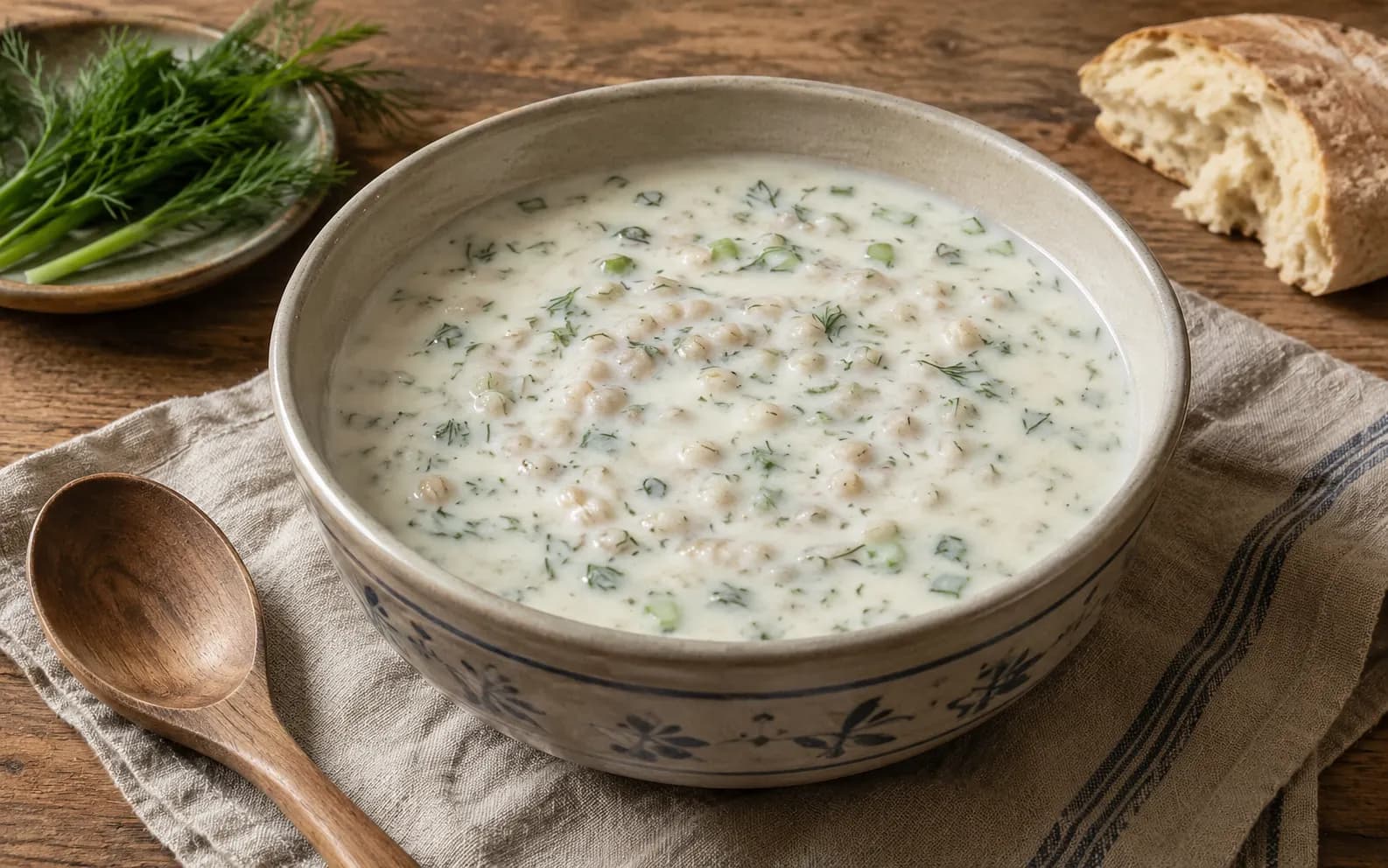
Cooked, it becomes soup. Spas is the clearest case in this section: a soup whose body and sourness both come from fermented milk, stabilised so it can be heated without splitting. That article deliberately left the bigger matsun story to be told elsewhere, and this is where it is told. The two are meant to be read together.
Drained and salted, it keeps. The strained form is called kamats matsun and was stored in clay or leather for months. Dried further into hard balls, it becomes chortan, which lasts for years and is brought back with water when needed. A herding household with no cold store could carry the summer's milk into winter this way. That chain of keeping — fresh, drained, dried — is the practical reason fermented milk sits at the centre of the food system and not at its edge.
Households and factories
Today matsun is made in both places. In Armenia it is an ordinary supermarket product, made industrially with defined cultures and sold in tubs. It is also still made at home from a starter that came from a previous batch, which came from the batch before that.
The difference between the two is exactly what the microbiology found. An industrial culture is chosen, consistent and reproducible, which is what a product sold at scale needs. A household chain is none of those things, and that is why it carries a regional signature at all. Neither is a corrupted version of the other. They are two ways of making the same food reliably, each aiming at a different kind of reliability.
The tradition has also travelled. In 1929 Sarkis and Rose Colombosian, Armenian immigrants in Andover, Massachusetts, began selling their home-made matsun locally, and their wagon carried the Armenian word. The business grew, and along the way the name on the container was changed to yogurt, the word American shoppers recognised. It became one of the first yogurts sold commercially in the United States. The food crossed an ocean intact, but its name did not survive the trip. It is a neat illustration of why this article does not treat the two words as equivalents.
Named on a national list
Armenia keeps a national inventory of intangible cultural heritage, and matsun is on it. The entry is the tradition of the preparation and use of matsun, filed under national cuisine. It is a real, dated, official recognition by the state, of the practice rather than the product.
It is worth being precise about what that listing is not. The national inventory is not the UNESCO Representative List; the two are separate systems with separate procedures. Of Armenia's inscriptions on the UNESCO list, the only food is lavash. Matsun does not appear there, and any page that calls it UNESCO heritage has confused a national listing with an international one.
This matters more than pedantry usually does, because claims like this tend to grow as they are repeated. The national listing deserves to be stated plainly and accurately, and it is a stronger fact without the inflation: a state has formally recognised that making and using matsun is part of its living culture. That is a different and more interesting claim than a badge.
Important dates
1929
Sarkis and Rose Colombosian begin selling matsun in Andover, Massachusetts; the name on the container is later changed to yogurt for the American market.
2012
Georgia registers matsoni as a protected geographical indication, starting a modern dispute over naming, not over history.
2015
A survey in Food Microbiology sequences matsun and matsoni from across Armenia and Georgia, and finds that the microbial community follows region and milk type, not the border.
Why matsun matters
This is the section's first article about something that is not a dish, and it is the reason the section needed a dairy category rather than somewhere to file an awkward entry. Matsun is a food, an ingredient, a way of preserving milk and the base for a drink, all at once. Describing Armenian cooking without it means describing a great many dishes only on the surface.
It is also an unusually clear case of evidence doing better than assertion. The claims that circulate about matsun concern age and ownership. What can actually be established is a native word with a documented root, a measured microbial community that ignores the border, and a state inventory entry that is often mistaken for the international list it is not. Each of those is more interesting than the claim it replaces.
Interesting facts
- 01Nothing is added to thicken matsun. The acid the bacteria produce unsettles the milk protein, and the whole pot sets where it stands into a gel.
- 02Acharian sets matsun beside Persian māst, Turkish yoghurt and French lait caillé. Several unrelated languages each named their fermented milk after the verb for curdling, which says something about naming, not about origin.
- 03Sequencing found that the microbes in matsun and matsoni follow region and milk type, not the Armenian-Georgian border, in a study by researchers from both countries.
- 04Dried into hard balls as chortan, matsun keeps for years and is brought back with water. That is how a herding household carried summer milk into winter.
- 05The Armenian-run creamery that introduced yogurt to the United States started out selling matsun under its Armenian name, and changed the word, not the food.
Sources
- Հրաչյա Աճառյան. Հայերեն արմատական բառարան, հատոր Գ — Երևանի համալսարանի հրատարակչություն, 1926–1935; reprinted 1971–1979 Visit sourceRead directly, in the Internet Archive's scan, after two earlier steps recorded this work as unreachable. The entry for the root մած- gives the sense — to stick, to cling, to thicken, and of milk to curdle — classes մածուն as a native Armenian word from an Indo-European root meaning to knead or work into a sticky mass, lists the Slavic, Greek and Germanic cognates, and records the classical texts in which մածուն is attested. It is also the source of the article's central linguistic observation: Ačaṙyan himself sets Persian māsīdan/māst, Turkish yoğurmak/yoghurt and French cailler/lait caillé beside the Armenian pair, showing the naming pattern to be a widespread independent parallel rather than evidence of priority.
- Nicholas A. Bokulich, Lia Amiranashvili, Karine Chitchyan, Narine Ghazanchyan, Karen Darbinyan, Nino Gagelidze et al.. Microbial biogeography of the transnational fermented milk matsoni — Food Microbiology, 50, 12–19, 2015 Visit sourceThe scientific spine of the article, and the reason its regional section could be written as evidence rather than as diplomacy. Marker-gene sequencing of matsun and matsoni from across Armenia and Georgia: bacteria dominated by Lactobacillus and Streptococcus, yeasts including Kluyveromyces marxianus, Candida famata and Saccharomyces cerevisiae varying sharply by place, and both production region and milk type shaping the community. Its conclusion — that traditional production preserves the transfer of a distinctive regional population from batch to batch — is what turns the back-slopped starter from a nice story into a measured finding. Its title calls the food transnational and its author list contains researchers from both countries, which is the strongest available answer to the ownership question and was not manufactured by this archive.
- Intangible Cultural Heritage — Ministry of Education, Science, Culture and Sport of the Republic of Armenia, consulted 2026 Visit sourceReused from the khash bibliography, where it carried an absence; here it carries a presence. Matsun appears on Armenia's national inventory of intangible cultural heritage as Մածունի պատրաստման ու կիրառման ավանդույթը — the tradition of the preparation and use of matsun — filed under national cuisine. Checked in both languages against the ministry's page and the published enumeration of the inventory, because the article's whole heritage section turns on this being a national listing and not an international one.
- Lavash, the preparation, meaning and appearance of traditional bread as an expression of culture in Armenia — UNESCO Representative List of the Intangible Cultural Heritage of Humanity, no. 00985, inscribed 2014 Visit sourceCited for the negative claim rather than the positive one, which is unusual and deliberate: lavash is the only Armenian food on the UNESCO Representative List, and matsun is not on it. The article's heritage section distinguishes the national inventory from the international list, and the cleanest way to make that concrete is to name the one food that is on both kinds of list and observe that matsun is on only one.
- Matsun — Slow Food Foundation for Biodiversity, Ark of Taste, consulted 2026 Visit sourceScoped, as the comment above sets out. Cited for the association with Lori, for matsun as part of the daily diet, for the meran starter of dried cornelian cherries with wheat and rye, and for the two keeping forms — kamats matsun, drained and stored in clay, and the dried balls that keep for years. Explicitly NOT cited for its opening chronology, which repeats the eleventh-century claim the article takes apart. A heritage organisation describing a living regional practice is doing what it is good at; the same page dating the food is not.
- Colombo Yogurt: A Massachusetts Success Story — Massachusetts Historical Society, Object of the Month, June 2004 Visit sourceThe source for the 1929 date and for the detail the article ends on: that Sarkis and Rose Colombosian sold their household matsun in Andover under the Armenian word, and that the name on the container later became yogurt because that was the word the American market knew. Chosen over the several diaspora and tourism retellings of the same story because it is a historical society writing from an object in its own collection. The food crossing intact while the word did not is the article's argument about terminology, made as an event rather than as an assertion.
Related articles
Spas
A soup with no stock in it. The liquid is matsun thinned with water and cooked with a grain until it thickens, and the whole method is there to stop the fermented milk from curdling.
Lavash
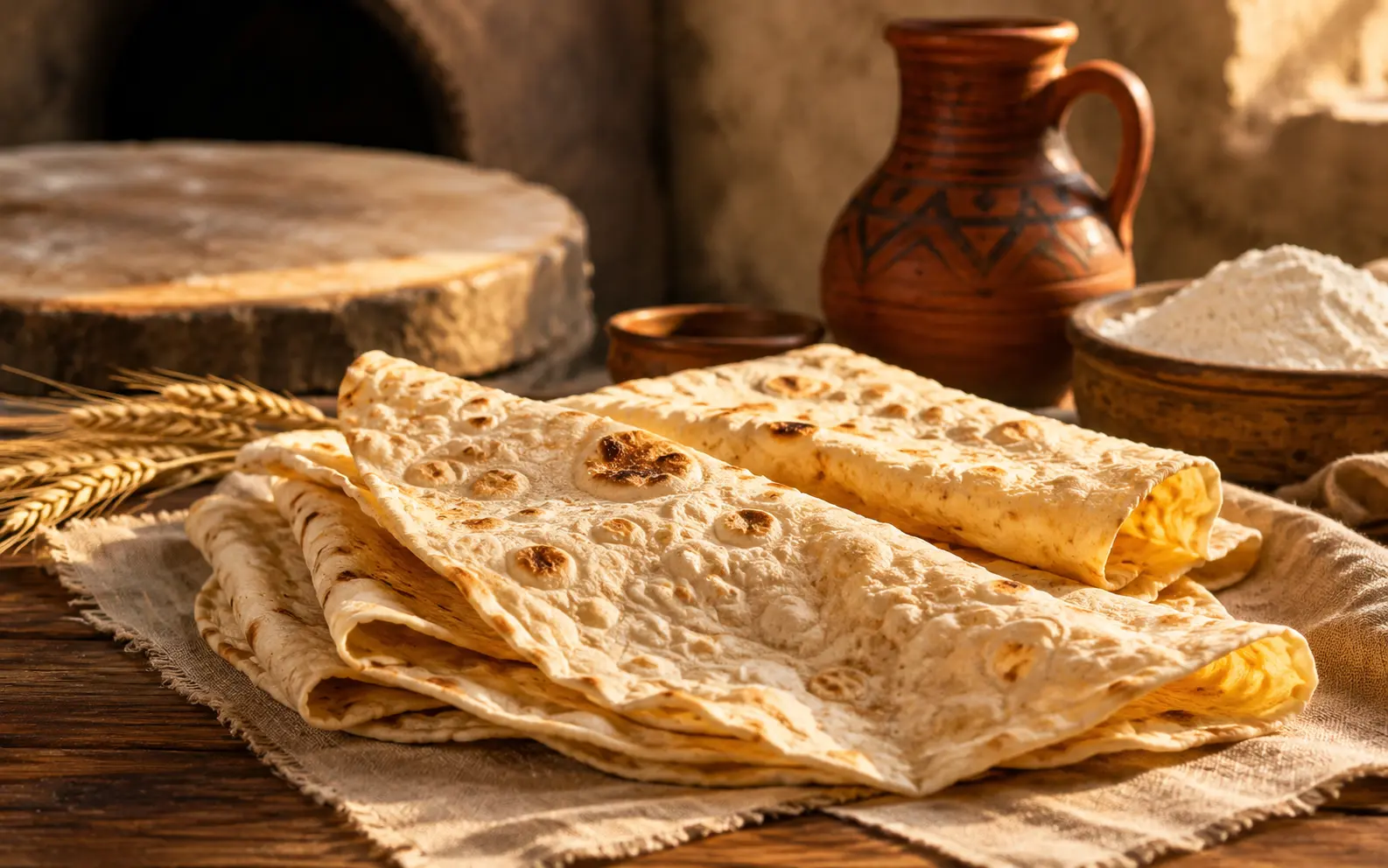
The thin flatbread baked on the wall of a clay tonir. UNESCO listed it in 2014 for how Armenians make, share and use it, and listed it again in 2016 for five other countries.
Dolma
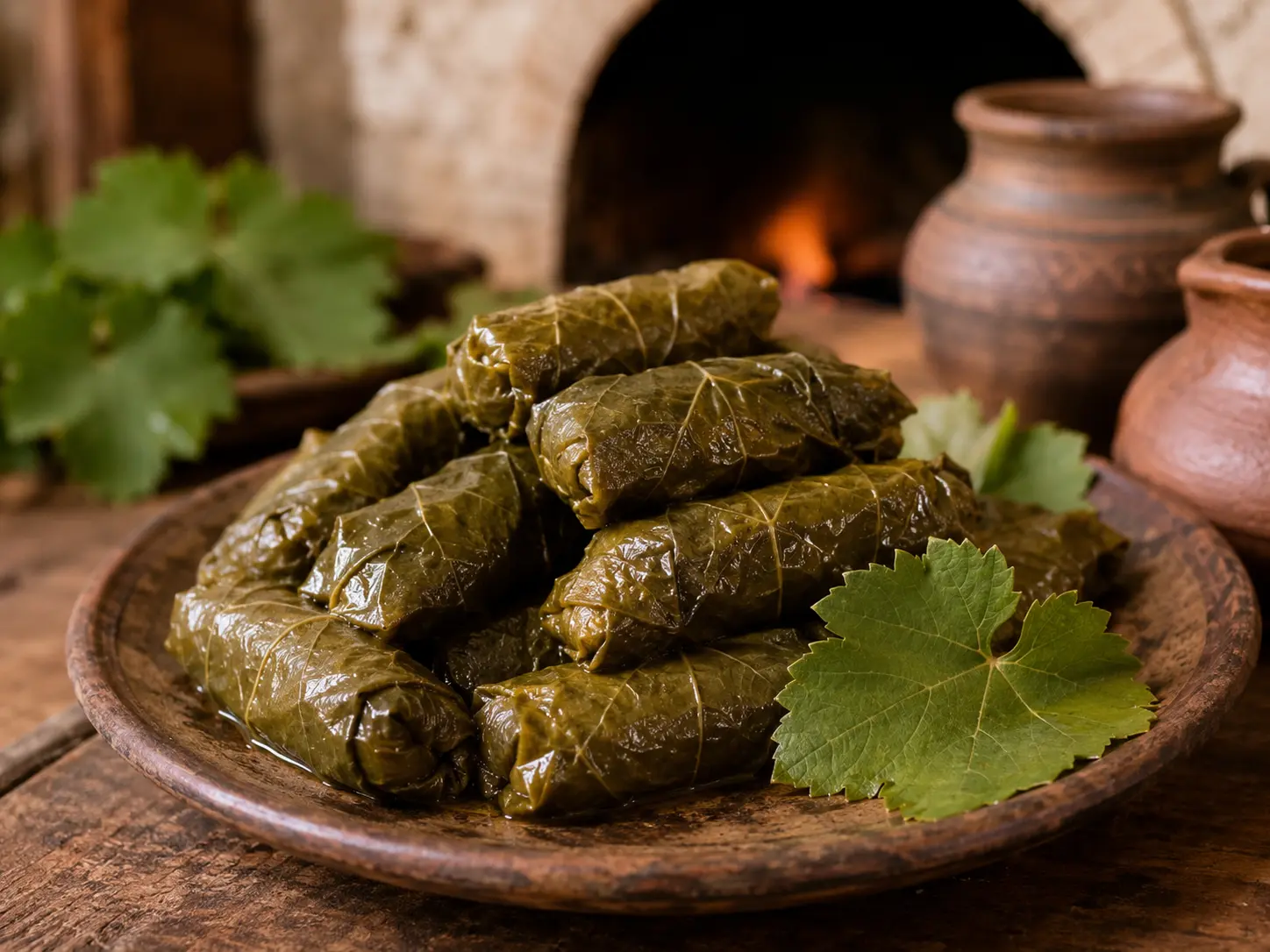
Vine leaves and hollowed vegetables filled with rice, herbs and often meat. The dish is made across the whole region, which is exactly why this section does not name a single owner for it.