
Basturma
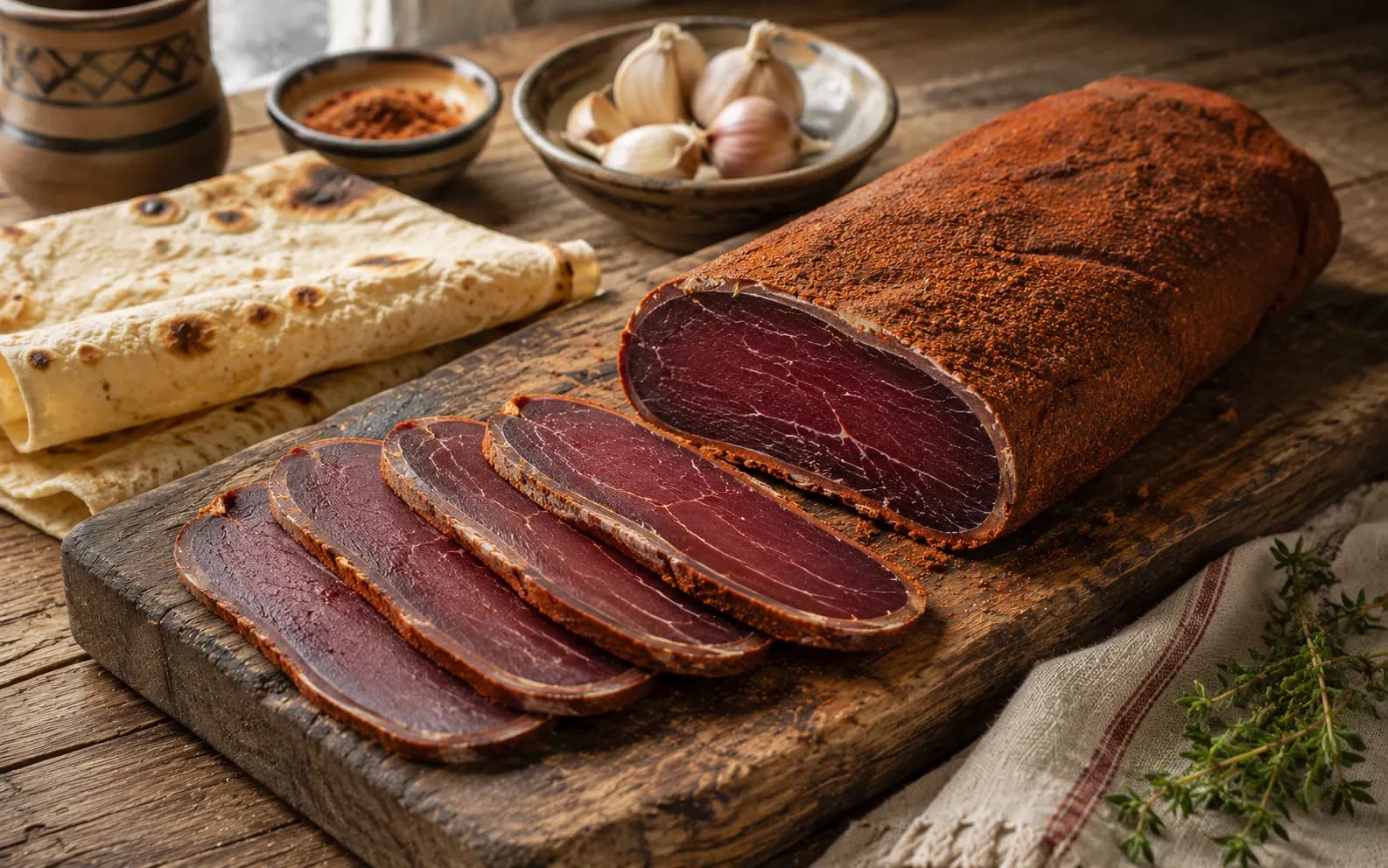
Basturma is what happens to beef when you give it salt, weight, air and time instead of heat. A whole muscle is packed in salt until it gives up much of its water, then pressed under weight until it gives up more. It is hung in moving air until it is firm all the way through, and finally coated in a wet paste of ground fenugreek, garlic and red pepper that dries to a dark crust. Nothing is cooked and nothing is smoked. The result is dense, deep red, intensely savoury, and cut so thin that light shines through it. This is the section's first article about preserving food rather than cooking it: about keeping meat in a country with hot summers, cold winters and no refrigeration, and about the particular Armenian answer.
- Author
- Armat Editorial Team
- Updated
- Reading time
- 19 min read
In brief
Basturma is a whole cut of beef preserved with salt, pressure and moving air, then sealed under a thick paste of fenugreek, garlic and pepper called chaman. It is sliced so thin you can almost see through it. Armenians eat it cold as an appetiser, with bread and with eggs, at everyday breakfasts and festive tables alike. Armenian also has an older native word for salted dried meat, apukht, but it names something broader than the modern coated product and should not be read as basturma's birth certificate. Basturma belongs to a wide regional family of cured meats. What history shows about the Armenian share is a documented craft specialism and an unbroken line of makers into the diaspora, not proof of who invented it.
Key facts
- Kind of food
- A whole cut of beef, cured and air-dried — not a sausage and not cooked
- Made from
- Lean whole muscle: beef today, though older practice also used sheep
- Preserved by
- Salt, pressing and moving air — no heat, no smoke
- Coated with
- Chaman, a wet paste of ground fenugreek with garlic and red pepper
- Served
- Sliced almost see-through thin and eaten cold as meze, or with eggs and bread
- Also called
- Apukht (ապուխտ), the older native Armenian word for salted dried meat
The dish at a glance
- Common ingredients
- A lean whole cut of beef, usually from the loin or leg, Plenty of salt, to draw out water, Ground fenugreek, the base of the coating and its dominant aroma, Garlic and red pepper, with cumin in many but not all versions
- Traditional preparation
- A whole muscle is packed in salt until much of its water has been drawn out, pressed under weight to remove more and flatten it, and hung in moving air until it has dried through. It is then coated in chaman, a wet fenugreek paste, and left until the crust sets. This page gives no quantities, timings, temperatures or humidity levels: it explains what basturma is and how curing works, and it is not a method for curing meat at home.
- Occasions
- Everyday breakfasts, as one of the regular cold parts of the meal, Festive tables, among the cold dishes served at the start, Meze tables, sliced thin and served cold
- Known regions
- Throughout Armenia, both bought for the home and made commercially, Kayseri in Cappadocia, the historic centre of the trade, where Armenians were the documented specialists, The Armenian diaspora: Aleppo, Beirut, Cairo, Greece, France and the United States
- Serving traditions
- Cut almost see-through thin and eaten cold, on a meze table or folded into lavash; or warmed in a pan with eggs broken over it for breakfast.
What basturma is
Basturma is a single piece of lean meat preserved whole. That sets it apart from most of what English speakers call cured meat: it is not ground, not stuffed into a casing and not fermented into a sausage. One muscle goes in and one muscle comes out, smaller, darker and much firmer than it started. Today it is made from beef, usually from the loin or the leg, and sold either as a whole dried piece or ready-sliced.
Four things happen to it, and the order matters more than the amounts. First it is salted until much of its water has been drawn out. Then it is pressed under weight, which squeezes out more and flattens the meat into the shape the finished piece keeps. Next it is hung in moving air until it has dried all the way through, not just on the surface. Finally it is coated in chaman, a wet spice paste that dries into a crust and stays on the meat as part of the food.
It helps to sort out early what is fixed and what varies, because regional versions differ and each maker tends to treat the others' differences as mistakes. Salting, drying and a fenugreek-based coating are constant wherever basturma is made. The cut, the exact paste, the drying time and the amount of pressing all vary by producer, household and country. No single version is the authentic one that the others fall short of.
Meat kept by salt, pressure and air
The principle is the same one behind every dried food, and it is really about water, not salt. Bacteria, moulds and the meat's own enzymes all need liquid water to work. Food scientists measure not how much water a food contains but how much of it is free for that work, a figure called water activity. As it falls, the organisms that spoil meat and the ones that make people ill shut down one after another. Most spoilage bacteria stop well before a food feels dry to the touch, and the more dangerous ones stop at lower levels still.
Salt and drying attack that water from two sides. Salt on the surface of the meat creates a steep difference in concentration across the cell membranes, and water moves outward to even it out, so the meat sheds liquid before the air has done anything. Pressing squeezes out more of that freed liquid. Then hanging does the slow part: air moving across a large flat surface carries moisture away steadily, so the inside dries before the outside spoils. The flat pressed shape is not for looks. It gives the piece enough surface for its thickness to dry evenly.
This article explains that process; it does not teach it. With whole meat cured without refrigeration, the line between a good result and a dangerous one depends on conditions you cannot judge by eye, so no salt proportions, drying times, temperatures or humidity figures appear anywhere on this page. Traditional curing does not sterilise meat, and the line you sometimes hear — that salt kills everything — is not what the science says. Salt and drying make conditions steadily more hostile to growth, which is a more limited claim, and one that depends on circumstances.
Chaman, and what the word covers
The dark red-brown crust is what most people picture when they think of basturma. Its Armenian name is chaman (չաման), written chemen or chaiman in English, and it matches Turkish çemen. The word needs care because it has two meanings. In Armenian it names ground fenugreek itself, and it also names the wet paste made from it. A page headed chaman may be about the spice or about the coating, and it does not always say which.
The paste is led by fenugreek and heavy on garlic, with red pepper (paprika, or something hotter) giving most of the colour. Beyond that, published versions differ. Many include cumin and some do not, and the proportions vary so widely that no single mixture can be called the standard. What stays the same is the dominance of fenugreek. That is why basturma's smell is unmistakable and why it lingers: powerful, faintly bitter, and hard to get off your hands or out of a room.
The coating does more than add flavour. A dense paste seals the surface of the dried muscle and protects it while the piece finishes drying and afterwards. In Armenian kitchen practice, fenugreek in particular is said to keep insects away from food hung in the open air. A thinned version of the same paste, chamanichur, is used as a sauce in its own right, a small sign that Armenian cooks treat chaman as an ingredient and not only as a wrapper.
Basturma, pastirma, and what a name proves
The word came into Armenian from outside. Western Armenian basturma and Eastern Armenian bastoorma are loanwords from Turkish pastırma, a noun formed from the verb bastırmak, to press. The name comes from the weight on the meat, not the spice on it. Turkish spread the word widely: it lies behind Greek pastourmas, Bulgarian and Balkan pastarma, Arabic basterma, and the spellings bastourma, basterma and pasturma that English has never chosen between.
Beneath the Turkish layer lies an older one, and it is truly disputed. The Oxford Encyclopedia of Food and Drink says the Ottomans applied the word to a Byzantine cured beef called paston, and the Oxford Companion to Food describes a Byzantine dried-meat delicacy as a forerunner of modern pastirma. Serious reference works hold that view. But Byzantine scholars do not agree on what the Greek terms meant. Johannes Koder reads paston as salted meat or salted fish and akropaston as salted meat; Andrew Dalby reads paston as salted fish; Gregory Nagy reads akropaston as smoked. Three specialists, three readings of the same words.
Just as important is what none of this proves. A name can travel without the technique, and a technique can travel without its name. Neighbours who trade borrow both, in either order, again and again. Armenians today mostly use a Turkish loanword for this food, but that tells us about language contact in Anatolia, not about who first hung salted beef in the wind. People online argue both ways that the spelling settles ownership, and the argument is just as weak in either direction.
Apukht, the older Armenian word
Armenian has its own word for this kind of food, much older than the loanword. Apukht (ապուխտ) is Classical Armenian. The philologist Vartan Matiossian, following standard etymological scholarship, traces it to Pahlavi apuxt, meaning uncooked (from a-, un-, and puxta, cooked). So it is an Iranian borrowing, not a Turkic one, and it entered Armenian long before Turkish was spoken in Anatolia. It appears in the fifth-century Armenian translation of the Bible, where it means salted and dried meat.
The word spread outward from Armenian, not the other way round. Armenian lent it to Georgian as apukhti and, through the dialect of the Armenians of Poland, to Polish as abucht. Within Armenian it formed compounds, such as khozapukht, literally pig-apukht, for ham. Armenian dictionaries define apukht as flat strips of meat from cattle or sheep, salted, beaten and dried in the open air without cooking, and eaten raw. The apukht of Erzurum is singled out as especially well known. The word is still used in modern Armenian alongside բաստուրմա, often in the same sentence.
This brings us to the most important distinction in the article. In the dictionary, apukht means salted, beaten, air-dried raw meat. It is a category that takes in sheep as readily as cattle, and its definition says nothing at all about a spice crust. Modern basturma is one member of that category, set apart by exactly the thing the definition leaves out. So the fifth-century Bible reference is real and valuable: it shows that Armenians had a word for salted dried meat in late antiquity. It does not establish the fenugreek-coated product, and pages that give the fifth-century date under the heading basturma have quietly swapped a category for one of its members.
What early history can and cannot show
One dating claim spreads further than any other: that basturma is first recorded between 95 and 45 BC, under Tigranes the Great, and that the technique was developed to preserve meat traded from Armenia to China and India. Tourism pages and food sites repeat it, but it falls apart when you trace it back. No source is ever named for it. It even gets the reign wrong: Tigranes II ruled from 95 to 55 BC. The trail leads to recipe blogs, not to any text, inscription or scholarly study. There is no first-century-BC record of this food, and the confident date is best seen as a product of repetition.
The second story is about saddles. Horsemen, it goes, packed salted meat under the saddle, where the horse's weight pressed it and the ride dried it, so the food was ready on arrival. It is a good story, and a revealing one. Armenian pages tell it about Armenian traders and horsemen; Turkish pages tell it about Turkic warriors and nomads, with the same details and the same lack of a source. A legend that changes owner depending on who tells it is folklore about the food rather than evidence about it. This article records it as folklore and does not present it as evidence.
Put the three lines of evidence side by side and the answer is plural. There is an old Armenian word for salted dried meat, borrowed from Iranian. There is a Byzantine vocabulary for salted meat or fish whose meaning specialists dispute. And there is an Ottoman Turkish word for pressing that spread across the whole region and is now what almost everyone says. All three are real. But they do not link up into a chain in which one turns into the next and ends at the modern product, and the sources consulted for this article give no grounds for drawing one.
Kayseri: a craft, not an origin
One place is tied to this food more firmly than any other. Kayseri, the Caesarea of Cappadocia, was the recognised centre of pastirma production, and that reputation is old enough to quote. The seventeenth-century Ottoman traveller Evliya Çelebi, in his Seyahatname, describes the town's cumin-flavoured beef pastirma as found nowhere else and sent to Istanbul as a gift. That is a dated observation by a named outside writer, stronger evidence than most of what surrounds this subject.
We also know who made it there. The trade in Kayseri was overwhelmingly in Armenian hands. By the nineteenth century, accounts describe Armenians as effectively dominating its manufacture and sale, while Greeks and Turks in the town made and ate it at home. The historian Philip Mansel notes Armenians selling pastirma in Istanbul from the seventeenth century on. The best-known survivor of that world is a business, not a legend: Krikor Apikoğlu founded a pastirma house in Kayseri in 1910 and moved production to Istanbul in 1920, and the firm went on to become the first nationwide meat company of the Turkish republic.
What this evidence supports is a specialism, and that is the key difference from an origin claim. Armenians were the acknowledged masters of the craft in the town most famous for it, for long enough that a foreign consulate noted it in passing. That is a strong, documented historical fact. It is not the same as inventing the food, and it does not require that anyone did. The better way to put it is that Kayseri became especially famous for basturma, and Armenians became especially famous for making it there.
A craft carried out of Anatolia
The Armenian population of Kayseri and the surrounding provinces was destroyed or driven out during the genocide of 1915 and the years around it. Among the many things that uprooting moved was this trade. Survivors who reached Aleppo, Beirut, Cairo, Athens and Thessaloniki brought the craft with them, and basturma became a fixture of the Armenian quarters in each city. The people were displaced, but the knowledge was portable, carried by families who had practised it as a business.
That is why basturma is not only a food of the Republic of Armenia. It is a diaspora food in the strict sense: its modern map was drawn by where Armenians ended up. Later migrations carried it further west, to France and the United States, and the shops that opened there clearly descend from the Anatolian trade rather than starting from scratch. The Smithsonian Center for Folklife and Cultural Heritage has documented one of them, a basturma shop in the Little Armenia neighbourhood of Los Angeles. Its owner learned the work from family makers in Armenia and Lebanon, a two-step route that tells the whole history in miniature.
This is the part of the story Armat can tell most precisely and with the least guesswork, because the handing-down is recent, documented and still visible. A cured meat that needs weeks of attention, and a tolerance for the smell of fenugreek in the building, is not something communities keep by accident. Families kept it on purpose, in kitchens and shops, as both a livelihood and a piece of the place they had lost. That continuity says more about what basturma means to Armenians than any claim about the first century BC.
How basturma is eaten
It is cut thin, thin enough to see light through, and eaten cold. That is the default, and it is not just presentation. The meat is dense, salty and strongly spiced, and a thick slice is unpleasant in a way a thin one is not. Sliced like this it goes on a meze table among other cold dishes, gets folded into bread, and fills sandwiches in every diaspora city where it is sold.
The best-known cooked use is with eggs. Slices are warmed in a pan and eggs are broken over them, so the fat and spice from the crust flavour the whole dish. It is a standard Armenian breakfast, and one of the few ways basturma is heated at all. Still, it is one common use, not the definition of the product, a trap English-language pages often fall into.
The bread that goes with it is normally lavash, which this section has already described from the bread's side: a thin, foldable bread does for a strongly flavoured meat exactly what it does for cheese and greens. The contrast with the section's other beef article is worth drawing too, because the two are opposite ways of dealing with the same animal. Khorovats applies fire, quickly, and is eaten the day it is made. Basturma applies salt, weight and air, slowly, and is eaten for months afterwards. One is a way of cooking; the other is a way of keeping.
Everyday food and holiday food at once
Basturma does not sit neatly on either side of the line between ordinary and special food, and it is a mistake to force it onto one. Descriptions of the Armenian breakfast list cured meats among the regular parts of the meal, alongside lavash, cheeses, eggs and fresh vegetables, which is as everyday as food gets. Armenian-language accounts just as readily call it a fixture of the festive table, among the cold dishes served at the start.
Both can be true because what limits it is cost and keeping, not the occasion. It is an expensive product: a large piece of lean beef loses much of its weight and is then held for weeks before it can be sold. So people buy it in small amounts and slice it thin. A food served sparingly can be an ordinary breakfast in small amounts and a generous gesture in larger ones, without changing what it is.
Its official status in Armenia is still an open question. In March 2025 the deputy minister of economy told a parliamentary committee that discussions were under way to protect Armenian basturma, along with Armenian matsun, as national geographical indications under the law that came into force in 2022. That is a stated intention at an early stage, not a completed registration. It shows the state thinks the product is worth protecting, but says nothing yet about whether protection was granted.
A regional food without a single owner
Some form of basturma belongs to Armenian, Turkish, Greek, Arab, Kurdish, Bulgarian, Egyptian and Azerbaijani cooking, and versions of it are made across all of them. The internet's favourite question about it, who invented it, has no answer the evidence can support, and the arguments under that heading are almost always about something other than food. This article does not take a position on it, because doing so would need sources that do not exist.
The questions we can answer are narrower, and better. Armenians have a native word for salted dried meat, recorded in the fifth century and lent on to two other languages. Armenians were the documented specialists in the trade in the town most famous for it. Armenians carried the craft out of Anatolia after 1915 and kept it alive in half a dozen countries, which is why a Los Angeles shop can trace its practice through Lebanon to Armenia. That is a distinctive, well-evidenced Armenian tradition within a shared regional history, and it is substantial without any invention claim.
Two neighbouring foods help mark the edges of this one. Sujuk, the dry spiced sausage that sits beside basturma in every account of an Armenian breakfast, uses a different technique: the meat is ground and cased, not kept whole. It has no article here yet. Pastrami is a linguistic relative, not a descendant. The Turkish word passed into Romanian as pastramă and travelled to New York with Romanian Jewish immigrants in the late nineteenth century, where the food itself was rebuilt around brisket, brine and smoke. Basturma did not become pastrami. The two share an ancestor in a word for pressing, then went their separate ways.
Important dates
5th century
Apukht (ապուխտ), from Pahlavi apuxt, uncooked, appears in the Armenian translation of the Bible, meaning salted and dried meat.
17th century
Evliya Çelebi's Seyahatname describes Kayseri's cumin-flavoured beef pastirma as found nowhere else and sent to Istanbul as a gift.
1910
Krikor Apikoğlu founds a pastirma house in Kayseri; production moves to Istanbul in 1920 and the firm becomes a national meat company.
2025
Armenia's deputy minister of economy tells a parliamentary committee that geographical-indication protection for Armenian basturma and Armenian matsun is under discussion.
Why basturma matters
This is the section's first article about keeping food rather than making it. Most of the others describe what Armenian cooks do with ingredients on the day. This one describes the problem that comes before all of them: how a household in a land of hot summers and hard winters keeps meat through the months when there is none. Bread, dairy and meat each needed an answer, and this is the answer for meat.
It is also the section's clearest case of popular claims and provable ones pointing in different directions. What circulates is a first-century-BC date and a story about saddles. What can actually be shown is an Iranian-derived word in a fifth-century translation, an Ottoman traveller praising one Cappadocian town's pastirma in the seventeenth century, a family firm founded in 1910, and a shop in Los Angeles whose owner learned the work in Lebanon from people who learned it in Armenia. The documented story is less ancient, and far more interesting.
Interesting facts
- 01The Armenian word chaman has two meanings: ground fenugreek, and the wet paste made from it. A mention of chaman may mean either the spice or the coating.
- 02Apukht is an Iranian loanword, from Pahlavi apuxt, uncooked. Armenian lent it on to Georgian as apukhti and, through the Armenians of Poland, to Polish as abucht.
- 03The saddle legend is told about Armenian horsemen on Armenian pages and about Turkic warriors on Turkish ones, with the same details and no source on either side.
- 04Three Byzantine scholars give three readings of the Greek terms behind pastirma: salted meat, salted fish, and smoked. That is why no clean origin chain can be drawn from them.
- 05Basturma did not become pastrami. The Turkish word passed into Romanian and reached New York with Romanian Jewish immigrants, where the food was rebuilt around brisket, brine and smoke.
Sources
- Vartan Matiossian. How Do You Say Basturma in Armenian? — Armenian Language Corner, 2016 Visit sourceThe linguistic spine of the article, and the reason its central distinction could be drawn at all. Matiossian, a philologist rather than a food writer, separates the two Armenian words: apukht (ապուխտ) is Classical Armenian from Pahlavi apuxt, uncooked — a- plus puxta, cooked — attested in the fifth-century Bible translation meaning salted and dried meat, and lent onward to Georgian and, through the Armenians of Poland, to Polish abucht; while basturma and bastoorma are modern loanwords from Turkish pastırma. He also supplies the compound khozapukht for ham and notes cured meat documented in Byzantine Asia Minor as apokti. Cited for the terminology and for the chronology of the words, and explicitly NOT for any claim that the fifth-century word denotes the modern coated product — a distinction the article makes against the grain of nearly every page on the subject.
- Հրաչյա Աճառյան. Հայերեն արմատական բառարան, հատոր Ա — Երևանի համալսարանի հրատարակչություն, 1926–1935; reprinted 1971–1979 Visit sourceThe underlying authority for ապուխտ, which falls in the first volume. Listed with a qualification the reader is entitled to: unlike the մածուն entry in §75, this one was NOT read directly in the scan, because nayiri.com refused connection throughout this step and a page-level reading of the Internet Archive volume was not completed. The etymology the article states is taken from Matiossian above, who reports the standard derivation, and is corroborated by the Armenian Wiktionary entry's Iranian derivation and by the explanatory-dictionary sense — flat strips of cattle or sheep meat, salted, beaten and air-dried without cooking. Recorded this way so that a later step can close the gap rather than inherit an unearned claim.
- Alan Davidson, ed. Tom Jaine. The Oxford Companion to Food — Oxford University Press, 3rd edition, 2014 ISBN 9780199677337Reused from the dolma and ghapama bibliographies. Carries the Byzantine end of the terminology section: a Byzantine dried-meat delicacy described as a forerunner of modern pastirma, alongside the Oxford Encyclopedia of Food and Drink's report that the Ottomans applied the word to a Byzantine cured beef called paston. Cited for that position as a position, not as a settled fact — the article sets it beside the disagreement among Koder, Dalby and Nagy over what the Greek terms meant, which is the point of the section.
- Fidel Toldrá, Iciar Astiasarán, Joseph Sebranek and Régine Talon, eds.. Handbook of Fermented Meat and Poultry — Wiley-Blackwell, 2nd edition, 2015 ISBN 9781118522691The food science behind the preservation section: water activity as the variable that matters rather than water content, the osmotic action of salt at the surface, the mechanical role of pressing, and the progressive rather than absolute suppression of microbial and enzymatic activity as a meat dries. Cited deliberately for concepts and never for parameters — no salt proportion, drying time, temperature or humidity from this or any other source appears on the page, because the article explains curing and does not teach it.
- Joshua Bruce Allen. In Search of Pastırma — Roads & Kingdoms, 12 June 2017 Visit sourceThe Kayseri section rests on this rather than on encyclopedia paraphrase, which is why that section was rewritten once its contents were read. It reports Evliya Çelebi's seventeenth-century Seyahatname on Kayseri pastirma being found nowhere else and sent to Istanbul as a gift; the historian Philip Mansel on Armenians selling pastirma in Istanbul from the seventeenth century onward; Armenian dominance of the Kayseri trade by the nineteenth century; and the Apikoğlu house founded in Kayseri in 1910, moved to Istanbul in 1920, becoming the first nationwide meat company of the Turkish republic. Çelebi is quoted here at one remove and the article attributes it as such.
- Arianna Sikorski and Hannah Luc. The Lure of Basturma in Little Armenia — Smithsonian Center for Folklife and Cultural Heritage, 19 July 2018 Visit sourceCarries the diaspora section, which is where this subject is best evidenced and least speculative. A basturma shop in the Little Armenia neighbourhood of Los Angeles, thirty years in operation, whose proprietor's practice descends from family makers in Armenia and Lebanon — a two-step route that is the post-1915 dispersal in miniature. Chosen over the several diaspora-restaurant write-ups of the same shop because it is a national cultural institution documenting a foodway, not a review.
- Armenia to protect 'basturma' and 'matsun' as national brands — ARKA News Agency, 24 March 2025 Visit sourceCited for a status and for its limits. Armenia's deputy minister of economy, Narek Hovakimyan, told a parliamentary committee on 24 March 2025 that discussions were under way to protect Armenian basturma and Armenian matsun as geographical indications under the law in force since November 2022. That is a stated intention at an early stage. Several pages report it as a completed registration or as an application filed; this article says discussions, because that is what the source says, and the difference is exactly the kind of upgrade-by-repetition the rest of the page is about.
Related articles
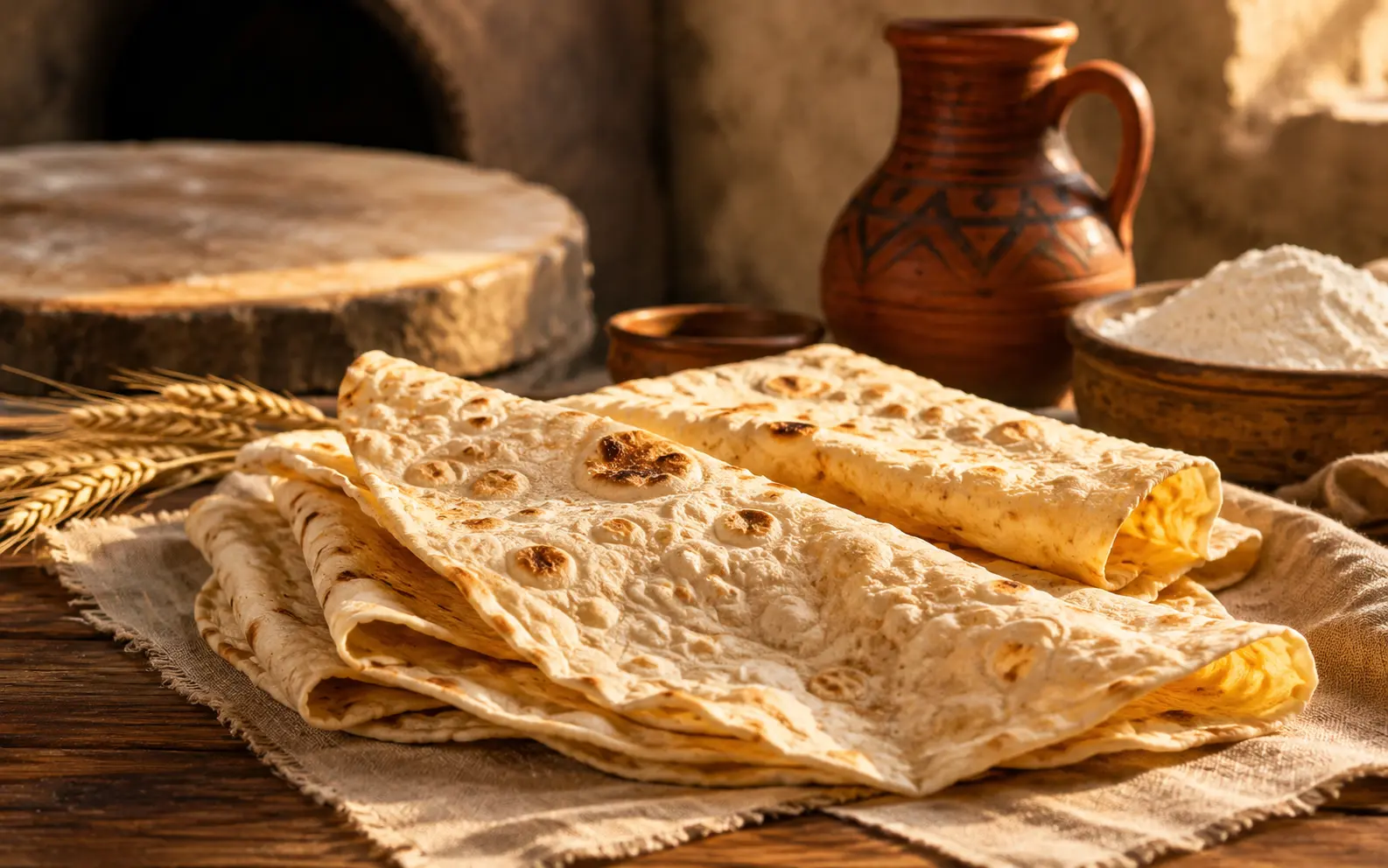
Lavash
The thin flatbread baked on the wall of a clay tonir. UNESCO listed it in 2014 for how Armenians make, share and use it, and listed it again in 2016 for five other countries.
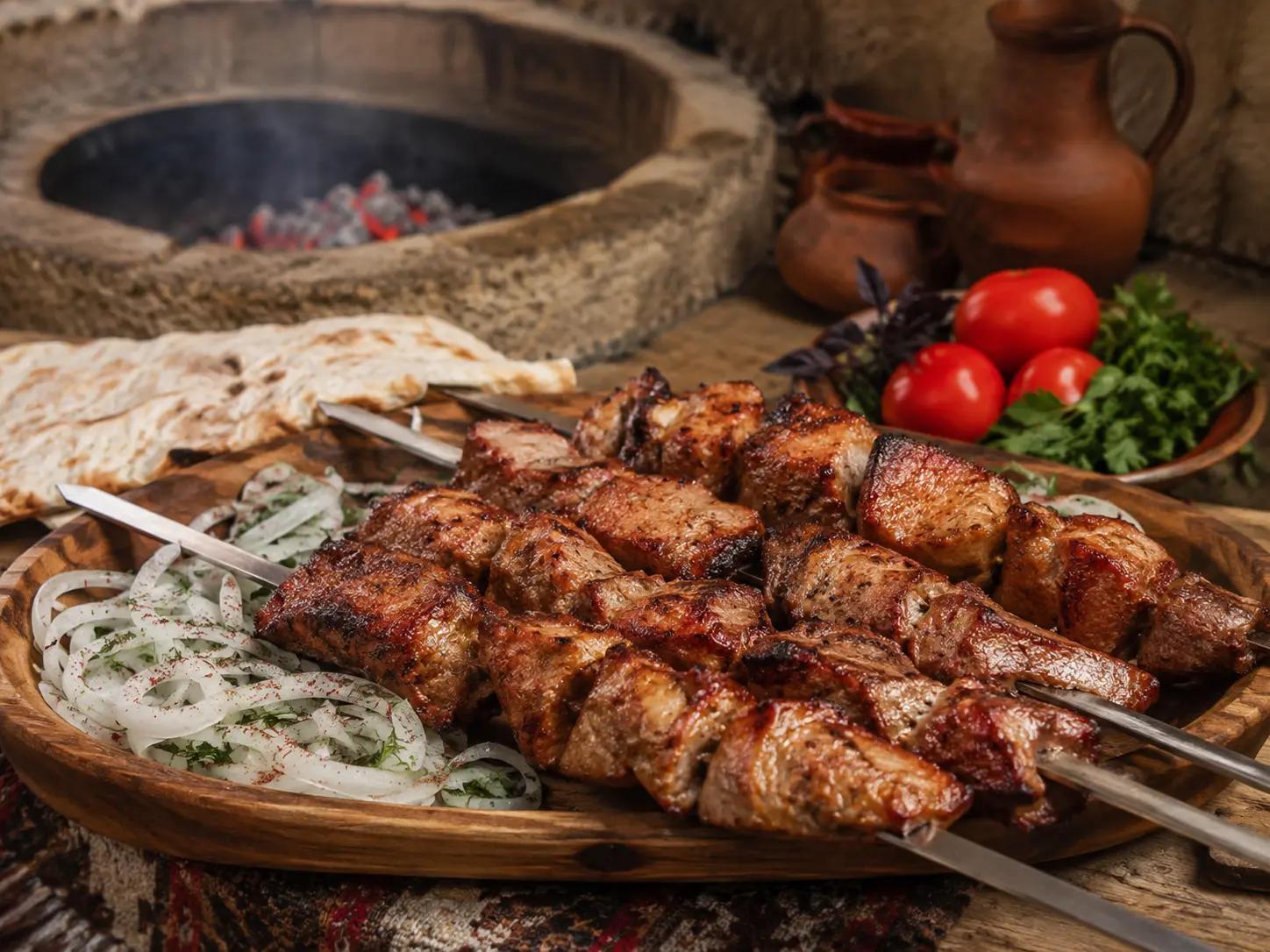
Khorovats
Meat grilled over open embers, and the gathering built around it: who lights the fire, who tends it, and how it differs from the communal meal of a madagh.
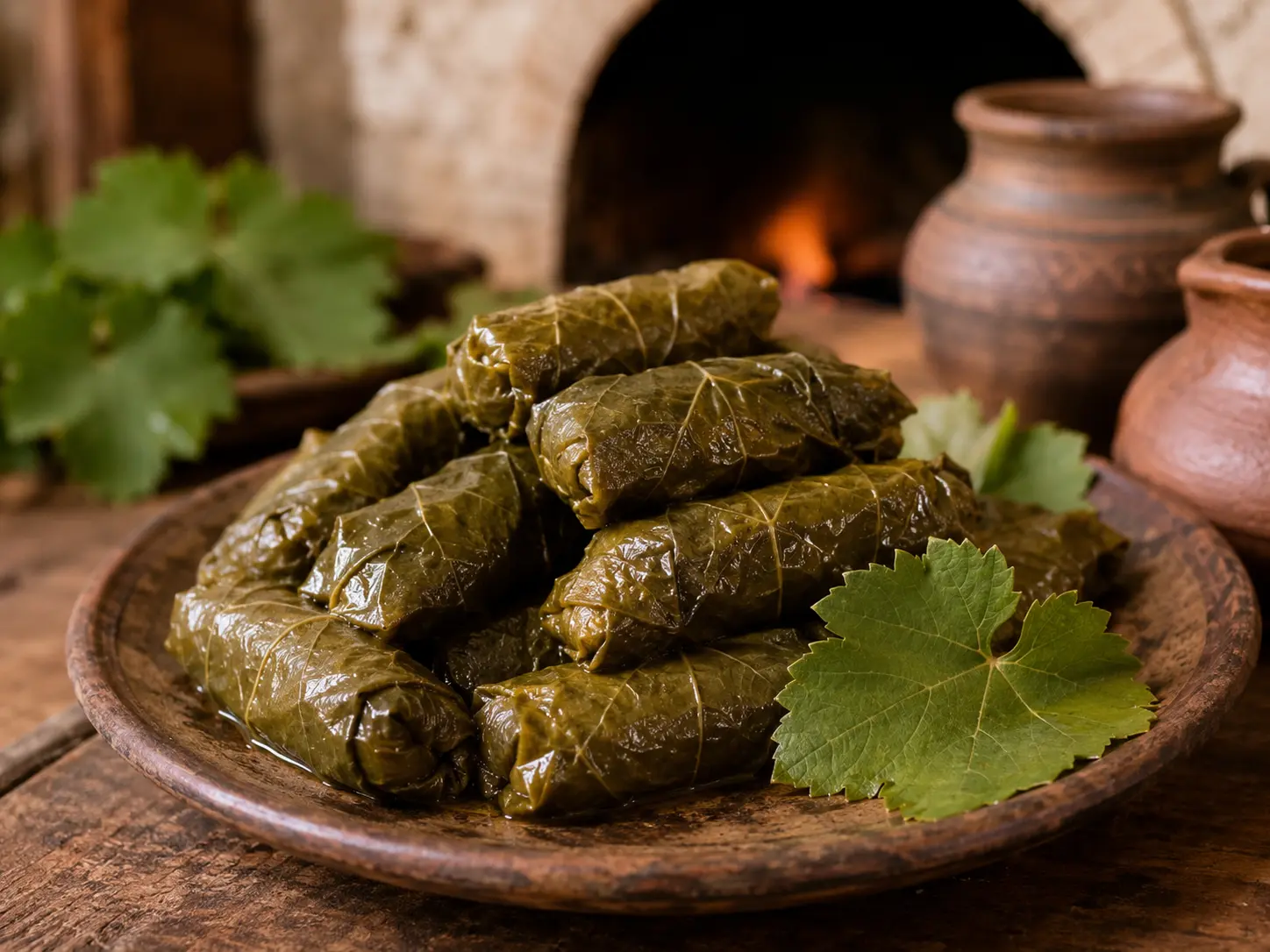
Dolma
Vine leaves and hollowed vegetables filled with rice, herbs and often meat. The dish is made across the whole region, which is exactly why this section does not name a single owner for it.