
Book of Lamentations
The Book of Lamentations is the best-known work of Armenian literature before the modern period, and the one most often mistaken for something else. A monk at the monastery of Narek, above the southern shore of Lake Van, wrote it in Classical Armenian and finished it around the year 1002. It has no plot and no characters. It is ninety-five long speeches addressed directly to God, in which one voice examines itself and never finds relief. It is not the Lamentations of the Bible; the likeness is purely an accident of English translation. This article is about the book itself: what is in it, how it is built, how it survived, and how a private monastic text became the volume that sat in Armenian homes for a thousand years.
- Author
- Armat Editorial Team
- Updated
- Reading time
- 24 min read
In brief
The Book of Lamentations is a single long work of ninety-five discourses addressed to God. Grigor Narekatsi, a monk of the monastery of Narek in Vaspurakan, wrote it in Classical Armenian and completed it around 1002. It is not the biblical Book of Lamentations, which mourns a destroyed city; this book laments the condition of the person speaking it. For centuries Armenians have called it simply the Narek. It was copied more often than any Armenian book except the Gospel, and of all medieval Armenian works it is the one a reader today is most likely to have met in translation.
Key facts
- Author
- Grigor Narekatsi, known in English as Gregory of Narek
- Completed
- About 1002; a colophon copied with the work gives the Armenian year 451
- Written at
- Narekavank, a monastery in Vaspurakan on the southern shore of Lake Van
- Language
- Classical Armenian (grabar)
- Structure
- Ninety-five discourses, called ban in Armenian; often rendered prayers or chapters
- Armenian title
- Մատեան ողբերգութեան, in reformed spelling Մատյան ողբերգության
- Earliest dated manuscript
- Matenadaran MS 1568, copied at Skevra in Cilicia in 1173
- First printed in full
- Marseille, 1673
What the Book of Lamentations is
The Book of Lamentations is one continuous work in ninety-five parts, written by a monk for God to hear. Each part is a long address in the first person. There is no story at all: nothing is recounted, nobody else speaks, and the situation at the end is the same as at the beginning. What builds across the book is pressure, not plot. A speaker who believes he cannot be reconciled with a perfect God keeps saying so, at a length and with an inventiveness that no summary can capture.
It is not the biblical Book of Lamentations, and it helps to say so early, because in English the two books have become impossible to tell apart by name. The biblical book mourns the destruction of Jerusalem: a city, a temple, a defeat. Narekatsi's book mourns the condition of the person speaking it. The two share a translated word and nothing else. There is no shared text or tradition, no borrowing in either direction, and the Armenian title does not refer to Jeremiah.
Its standing among Armenians is hard to overstate, and the simplest measure is the number of manuscripts. The Matenadaran in Yerevan alone holds eighty-four complete copies and a comparable number of partial ones, made between the twelfth and the eighteenth centuries, and it describes the work as the most frequently copied Armenian book after the Gospel. Armenians also stopped using its title long ago. For centuries it has simply been the Narek.
The title, and why English has four of them
The Armenian title is Մատեան ողբերգութեան, Matean voghbergutean, in the classical spelling the work has carried since it was written. Since the spelling reform, publishers in the Republic of Armenia write it Մատյան ողբերգության. Մատեան, matean, is a book in the physical sense: a codex, a volume, a register. The same word gives the Matenadaran its name. Ողբերգութիւն is built from ողբ, a lament or wailing, and երգ, a song, with an abstract ending: lament-song-ness.
That second word is where the trouble in English starts, because in modern Armenian it is also the everyday word for tragedy, in the theatrical sense. This is not simply a later shift in meaning that needs correcting. Annie and Jean-Pierre Mahe deliberately titled their scholarly French translation Tragedie, and Thomas Samuelian, who translated the book into English, notes that the word can be rendered either way. Reading it as tragedy is a considered interpretation of the Armenian, not a mistake.
So English has several titles, each belonging to a different translator and not to a different book. Mischa Kudian published Lamentations of Narek in 1977. Samuelian called it Speaking with God from the Depths of the Heart in 2001, after the phrase that heads almost every section. Khachatoor Khachatoorian called it The Book of Sadness the same year, and Abraham Terian's 2021 annotated translation is From the Depths of the Heart. Scholars generally prefer the singular Book of Lamentation, the more literal rendering of an abstract noun in the genitive singular. General English usage and the book trade have settled on the plural, and this article uses it. Beneath all of them lies an older Armenian alternative, Գիրք աղօթից, book of prayers, which is how the early printed title pages describe it.
Why it is called the Narek
Narek is first of all a place: a village on the southern shore of Lake Van, and the monastery beside it. Narekatsi means of Narek. It is an epithet, not a surname, formed exactly like Lambronatsi, of Lambron. The book then took the same name from the man, and for most of its life that is what people have called it.
The nickname is older and more formal than it sounds, and it was never just household speech. The early printed editions used it on their own title pages, which open Narek girk, the Narek book, and the Mekhitarist scholar Gabriel Awetikian titled his Venice commentary Narek, Book of Prayers. By the eighteenth and nineteenth centuries, then, learned publishers were using the nickname as a bibliographic title, while critical scholarship kept the formal title Matean voghbergutean.
The name has also reached into the present. Narek is now among the most common male given names in Armenia, taken directly from the book and the place. A word that began as the name of a village on Lake Van became the name of a book, and then the name of a person again.
Narek, Vaspurakan and the political map
The monastery of Narek stood in Vaspurakan, the Armenian province wrapped around the eastern and southern shores of Lake Van. In the year the book was finished, Vaspurakan was not a district of some larger Armenian state. It was a kingdom in its own right, ruled by the Artsruni dynasty, which had taken a crown in 908 and held it until 1021. The period is often described as if there were a single Armenian kingdom, but there was not. The Bagratid kingdom centred on Ani was a separate realm to the north. The Artsrunis had come to accept Bagratid seniority, but Narek was not in Bagratid territory.
Vaspurakan was also divided when the book was written. After the death of Abusahl-Hamazasp the kingdom had been split among his sons, and the years around 1002 fall in the reign of Gurgen-Khachik, who died at about the same time as Narekatsi. Two decades later, in 1021, the last Artsruni king handed the kingdom over to the Byzantine Empire in exchange for land around Sebasteia. The Armenian state in which the book was written ceased to exist.
The monastery itself was founded in the 930s or 940s under the Artsruni king Gagik I. Its school, first led by Anania of Narek, made it one of the important centres of learning in medieval Armenia. It remained in use until 1915 and was demolished around 1951. Today a mosque stands on the site, in the Gevas district of Van province in Turkey. The place the book is named after can no longer be visited, which is part of why the name became so firmly attached to the book.
When it was written
Unusually for a medieval Armenian work, the book carries its own date. A colophon copied along with it gives the Armenian year 451, which is 1002 in the common era. It says the author began the work three years after a period of conflict in the church, during what he calls a provisional peace. This is the firmest single piece of evidence, and it is why the date normally printed is about 1002.
Other dates cluster close by without really disagreeing. Abraham Terian writes around 1003, Samuelian around 1001, and the standard English reference about 1002 to 1003. All of them place the work at the very end of a life that ended about 1003. Jean-Pierre Mahe adds a useful qualification. In his reading, the ninety-five pieces built up over more than a decade and were then given their overall design. So the book was finished at the end of Narekatsi's life, but it was not written in a single late burst. Nothing supports the deathbed version of the story.
One date in circulation is simply wrong. The year 977 is sometimes attached to the Book of Lamentations, but 977 is the year Narekatsi was ordained a priest and wrote his Commentary on the Song of Songs. It has nothing to do with this book.
The ninety-five discourses
The work has ninety-five parts, and the number never varies: no manuscript tradition or edition divides it differently. In the manuscripts and in the critical edition, each part is headed ԲԱՆ with a number. Ban, plural bank, is an ordinary Armenian word meaning word, speech or discourse. It is also the word used to translate the Greek logos at the opening of John's Gospel. So the parts are not chapters in the usual sense. They are speeches, each one an address that is begun and completed.
Translators have rendered ban in almost every possible way, which is why English descriptions of the book disagree. Terian, Samuelian and the Matenadaran call them prayers. Jesse Arlen calls them discourses. The French tradition and most encyclopedias call them chapters, and Kudian's title calls them soliloquies. Calling them ninety-five poems is not wrong but loses something, because it suggests free-standing lyrics instead of parts of one long address. There is no single way of citing them either: Terian numbers by prayer and section, Arlen by discourse and lettered subsection, Samuelian by number and letter.
The order is deliberate. Mahe proposed reading the ninety-five as a journey through an Armenian church, from the narthex where penitents stood, to the nave, to the sanctuary. Narekatsi himself describes the book as built like an edifice. A few individual pieces have been questioned. Mkrtich Mkryan argued on grounds of style that discourse 93 and parts of 26, 33 and 34 read like theological prose, unlike the rest, and might not be the author's. The 1985 critical edition examined the manuscripts and kept them, and the doubt now survives only as a footnote in the scholarship.
Is it poetry?
This is a real question, not a pedantic one, and most popular descriptions get it wrong in a specific way. The manuscripts do not lay the text out as verse. They copy it as continuous writing. The lines readers see in modern editions and translations are an editorial decision made much later, and in 2016 one Armenian editor removed them again for exactly that reason. No fixed metre has been established for the work.
What is clearly there is rhythm, built from balanced clauses, controlled pauses, dense sound patterns and frequent rhyme. It reads like measured speech under pressure, not verse in a set form. Scholars therefore reach for compound labels: rhythmic prose or free verse, prayer-poems, penitential prayers, a personal lyric and confessional poem, mystic soliloquies. Arlen's description is the most precise: a text for keeping watch, written for a monk to use during a solitary night vigil. That explains both its length and its unbroken intensity.
This site files the work under Poetry, the closest of the genre filters it uses for literary works, though not a full description. A prayer cycle in rhythmic Classical Armenian prose, meant to be spoken aloud through a night, is not what the word poetry usually brings to mind. The label is a convenience of the catalogue, not a claim about the text.
Who is speaking
The book charges its speaker with an enormous catalogue of sins, in the first person and in language of complete self-condemnation. It is natural to assume this is autobiography, and that is the single most common misreading of the work. Abraham Terian, who translated it, puts the objection bluntly: it is unrealistic to suppose that Narekatsi had personally committed every sin the book lists.
The speaker is a representative instead. In the reading E. A. Nazaryan sets out, the I of the book is not a self-contained individual but a person standing for humanity, whose soul must answer for all human sin. The confession aims at union with God; it is not a record of one monk's failings. Narekatsi says as much himself. He describes the book as speaking in his place, with his voice, as though it were him. In the third discourse he writes that through these prayers supplication may be made on behalf of some and counsel given to others. And the work opens by saying it was undertaken at the request of monks and hermits. It was commissioned, and it was built to be borrowed.
That is also why the list of sins has to cover everything, not just one man's life. If the text is a script that readers take into their own mouths during a vigil, as Arlen argues, it needs more ground than any one life contains. The other reading has not disappeared: the New Catholic Encyclopedia describes the work as an analysis of Gregory's own spiritual progress. Both can be true at once. A real penitent is speaking, and the voice has been deliberately made universal so that anyone can speak it. What a reader should not do is treat the catalogue as a confession of things Narekatsi did.
Lament, confession and what the book is doing
The lament here is penitential, not a memorial. Nothing historical is mourned: no massacre, no fallen city, no dead. What is lamented is the distance between the speaker and God, and his conviction that he cannot cross it. Samuelian finds the tragic element in exactly that self-knowledge. For the book, the disaster is failing to recognise one's own condition and trying to hide it.
The translators themselves found the English word misleading. Terian has said that Penitential Prayers would be a more accurate title than Lamentations, and he named his own version after the recurring Armenian phrase that heads the discourses. Mahe went the other way and chose Tragedie. So two of the work's most serious modern translators, in two languages, chose not to call it a lamentation. That shows clearly that the English name is a problem for scholars, and not only for search engines.
Yet the book is not an exercise in despair. Its tension comes from holding hope and helplessness together without resolving them: the speaker asks for mercy he does not believe he has earned, and keeps asking. Whether you read that as theology or as literary technique, it is what makes ninety-five discourses possible on a subject a shorter book would exhaust in ten pages.
The Armenian it is written in
The language is grabar, Classical Armenian, which by the tenth century was a learned written language that nobody spoke. Narekatsi pushes it to its limits: long chains of near-synonyms, compounds coined on the spot, and sentences stretched far beyond the length the language was built to carry. The difficulty is not just a modern reader's problem. Medieval Armenian readers found the book hard too, and a large tradition of commentary exists precisely because the text needed explaining almost from the start.
Everyone mentions his word-building, and the figures attached to it need care. The Matenadaran, citing the linguist Vardan Arakelyan, puts the number of new words in the Book of Lamentations at about seven hundred. The often-repeated figure of more than two and a half thousand coinages comes from Hrachik Mirzoyan and covers all of Narekatsi's writing, not this book alone. The two numbers do not compete, and quoting either one as the count for this work would misrepresent it.
Nor did he invent from nothing. His teacher Anania of Narek had written on compunction and tears, and specialists see the Book of Lamentations as developing that teaching, not breaking away from it. Behind both stands a longer ascetic tradition: Ephrem the Syrian, Evagrius, John Cassian, John Climacus, Isaac of Nineveh, and Narekatsi's own contemporary Symeon the New Theologian. Narekatsi did not invent the penitential prayer. He took an inherited form to a scale and a linguistic intensity that Armenian had never seen before.
The Bible inside the book
The Psalms are the model, and the debt runs deep into the book's structure. The Psalter supplies a grammar of address: a first person that can accuse itself before God without collapsing, and can speak for a whole community while still saying I. That is exactly what the Book of Lamentations does at length, and several discourses meditate directly on individual psalms.
The references to scripture are so dense that the meaning depends on them. When modern Armenian translations left the biblical allusions without notes, whole passages became unclear, which shows that the references carry meaning and are not just decoration. The medieval commentators understood this. When Nerses of Lambron discussed the thirty-third discourse in 1177, his method was to set Narekatsi's prayer beside the biblical books it draws on.
One distinction here is often blurred. Prayers and hymns by Narekatsi did enter Armenian church services, and some of his chants are still sung. The Book of Lamentations itself, though, is a private prayer book, not a liturgical one. It is not a fixed text in the Divine Liturgy or the Book of Hours. Its life has been devotional: read alone, read aloud beside the sick, kept in the house.
The manuscripts
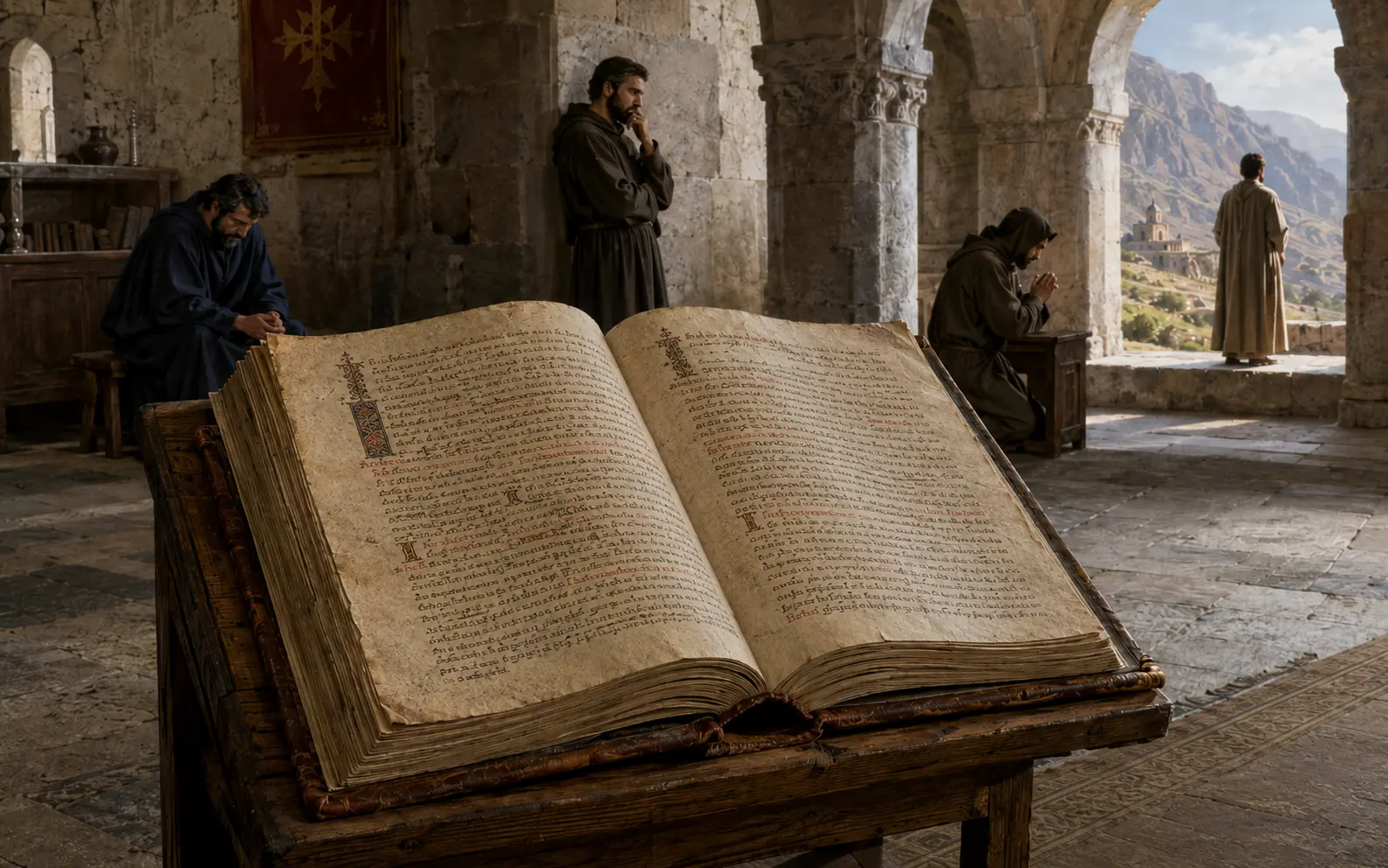
The earliest dated copy is a small parchment codex made in 1173 at the monastery of Skevra in Cilicia, commissioned by the young Nerses of Lambron, later Archbishop of Tarsus. It is held in the Matenadaran in Yerevan as MS 1568. It measures about 15.4 by 11.5 centimetres, has some 343 folios, and is illuminated in tempera and gold, with ornamented headpieces, decorated initials and four portraits of the author. The artist is Grigor Mlichetsi, also called Grigor Skevratsi after the monastery where he ran the scriptorium. Sources differ on whether he also copied the text.
Two claims about this manuscript are often overstated. Official sources call it the earliest dated copy, not the earliest complete one, and none of them makes the stronger claim. It also contains more than the book itself. Nerses of Lambron bound into it a Life of Grigor Narekatsi that he had compiled. That makes MS 1568 the earliest surviving source on the author's life as well as the earliest dated copy of his book.
After that, plenty of copies survive. The Matenadaran holds eighty-four complete copies and a comparable number of partial ones from the twelfth to the eighteenth centuries, including a copy of 1377, MS 4041. Catalogue numbers need care here. MS 5159, sometimes listed with these, is a commentary on the Book of Lamentations copied in 1750, not the work itself. The Matenadaran has digitised the volumes of its main catalogue, but its website has no public shelfmark search, so individual manuscripts are hard to check online.
How it reached print
The book's first appearance in print shows how people were already using it. Long extracts were included in the Urbatagirk, the Book of Friday, printed by Hakob Meghapart in Venice in 1512: the first book ever printed in Armenian. The Urbatagirk is a collection of cures and prayers for the sick, so Narekatsi first reached print inside a book of healing prayers. Some Armenian sources date that printing to 1513. Meghapart's press ran in 1512 and 1513, and both dates refer to the same short episode.
The complete text was first printed in Marseille in 1673 by Voskan Yerevantsi. Seven years earlier he had produced the first printed Armenian Bible in Amsterdam, and he moved his press to Marseille in the early 1670s. Some accounts add that the edition ran into Catholic censorship. That claim rests on a single report, so it is repeated here as a claim, not a fact.
Later editions came from the main centres of Armenian printing: something like thirty-two at Constantinople, fifteen at Venice, six at Jerusalem and three at Smyrna, with single editions elsewhere. The commentaries were printed too: Hakob Nalian's at Constantinople in 1745, Gabriel Awetikian's at Venice from 1801. All serious modern work on the text rests on the critical edition prepared by P. Khachatryan and A. Ghazinyan and published by the Armenian Academy of Sciences in Yerevan in 1985; some catalogues date it 1986.
Translation, beginning with Armenian
The first readers who needed a translation were Armenians. Ordinary readers needed the grabar put into the modern language, and this was done separately for the two branches. Into Western Armenian, it was translated by Misak Gochoonian at Constantinople in 1902, by Bishop Torgom Gushakian at Cairo in 1926, and by Bishop Garegin Khachaturian at Constantinople the same year, revised at Buenos Aires in 1948. Into Eastern Armenian, it was translated by Mkrtich Kheranyan in 1960, Vazgen Gevorgyan in 1979 and Father Mesrop Aramyan in 2019. Kheranyan left out the prefatory title-piece altogether, because no one has ever settled whether the author wrote it.
In Russian the story begins early and oddly. In 1810 Iosif Ioanesov published the closing section of the twelfth discourse in Saint Petersburg as a Prayer Against Nocturnal Terrors, which shows directly that individual parts had taken on specific protective uses. Naum Grebnev's verse selections of 1969 and 1977 made the work known across the Soviet Union, and they are the text Alfred Schnittke set in his Concerto for Choir in 1985. The standard scholarly prose translation is by M. Darbinyan-Melikyan and L. Khanlaryan, Moscow, 1988.
In French, Isaac Kechichian's complete version appeared in 1961, and Annie and Jean-Pierre Mahe's annotated translation was published by Peeters in 2000 in the Corpus Scriptorum Christianorum Orientalium. There are four in English. Mischa Kudian's partial version of 1977 covers the first twenty-five discourses. Thomas Samuelian's complete translation of 2001 is free to read online and is how most English readers have met the book. Khachatoor Khachatoorian's also appeared in 2001, and Abraham Terian's annotated scholarly translation in 2021. This article quotes none of them. The Armenian original is long out of copyright, but the modern translations are not, and explaining how the book works is a better use of the space than reproducing someone else's English.
The Narek in Armenian life
The book left the monastery early and entered ordinary homes, and its life there is as much a part of its history as its manuscripts. Families who could not read grabar owned it, kept it with their valuables, and treated it as an object of standing, not a text to study. By the medieval period it was already called the Narek and described as a medicine of life.
The customs attached to it are recorded across several centuries, and they should be described exactly as what they are: religious belief and devotional custom. In 1912 Malachia Ormanian, Armenian Patriarch of Constantinople, wrote that the Narek was used for private prayer and was regarded as a potent talisman against dangers of every kind. Passages were read aloud beside the sick. Particular discourses took on particular purposes, which is why the end of the twelfth could be published in Russian as a prayer against night terrors. Prayers from the book were also copied into hmayil, the Armenian amulet scrolls. Ethnographic fieldwork in the Aparan district between 2016 and 2023 found families still keeping shrine-books, most often Gospels and works of Narekatsi, with a chosen keeper and a place of honour in the house.
This article records these traditions as part of the book's reception history. It makes no claim that the book cures or treats illness, and nothing here should be read as a medical statement. What the sources show is that Armenians believed the book had protective power, acted on that belief for centuries, and in some places still do.
Afterlife and influence
The clearest influence is also the earliest. In the twelfth century Nerses of Lambron did three things for the book. He commissioned the 1173 manuscript, he wrote the Life of the author that travels with it, and in 1177 he devoted part of a liturgical treatise to the thirty-third discourse. Together these mark the beginning of Narek scholarship, and they are why the Cilician church took up the work so thoroughly.
Among the generations that followed, one Armenian study names Grigor Marashetsi, Nerses Shnorhali and Grigor Tlay as the first inheritors. It argues that Shnorhali took the tiered structure of Narekatsi's prayer and recast it in rhymed verse. That is a claim about structure, not wording. No direct textual borrowing has been shown, and Shnorhali's own prayer cycle follows a quite different plan: twenty-four prayers for the twenty-four hours, where Narekatsi has ninety-five discourses.
For the modern period, the accurate word is invoked, not influenced. Yeghishe Charents wrote a poem in homage to Narekatsi. Armenian criticism reads Siamanto's accumulation of epithets as having affinities with Narekatsi's text, though that comparison comes from the critics; the poet never claimed the debt. The book has also gathered honours that belong to its reception. When Pope Francis named Grigor Narekatsi a Doctor of the Church in April 2015, the apostolic letter referred to the Liber Lamentationum, noted that Armenians call it simply the Narek, and described it as the most venerated and most widely circulated writing in Armenia after the Gospel. That verdict on the book's standing came nine centuries after it was written.
Important dates
about 1002
The book is completed at Narek; its colophon gives the Armenian year 451.
1173
The earliest dated copy is made at Skevra in Cilicia for Nerses of Lambron, now Matenadaran MS 1568.
1177
Nerses of Lambron comments on the thirty-third discourse, the beginning of Narek scholarship.
1512
Long extracts appear in the Urbatagirk, the first printed Armenian book.
1673
The complete text is printed for the first time, at Marseille, by Voskan Yerevantsi.
1745
Hakob Nalian's commentary is printed at Constantinople.
1902
The first modern Western Armenian translation is published at Constantinople.
1985
The critical edition of P. Khachatryan and A. Ghazinyan appears in Yerevan.
2001
Thomas Samuelian's complete English translation is published in Yerevan.
Why the Book of Lamentations matters
It is the earliest Armenian book with a continuous popular life, not only a scholarly one. A great deal was written in Armenian before it, and most of that is now read by specialists. This book was copied more than any Armenian book except the Gospel, kept in homes where nobody could read the language it was written in, and it is still the first title Armenians name when asked what their literature has produced.
As a piece of writing, it showed that a single voice could carry a whole book. Medieval literature is full of narrators. But a work this long, with no story, no second speaker and no resolution, held together only by one person examining himself before God, was an extraordinary thing to attempt, and parallels are still hard to find. That is why it has been translated again and again, into both forms of modern Armenian and into a dozen other languages, and why a reader coming to Armenian literature for the first time is most likely to start here.
Interesting facts
- 01The manuscripts do not lay the text out in verse lines; the line breaks in modern editions and translations were added by editors.
- 02The ninety-five sections are called ban in Armenian, the same word used to translate the Greek logos in the opening of John's Gospel.
- 03Long extracts from the book appeared in the very first Armenian printed book, the Urbatagirk of 1512, a collection of cures and prayers.
- 04The end of the twelfth discourse was published in Russian in 1810 under the title Prayer Against Nocturnal Terrors.
- 05Narek is now one of the commonest male given names in Armenia, taken from the monastery by way of the book.
- 06Alfred Schnittke set Naum Grebnev's Russian version of the text in his Concerto for Choir in 1985.
Sources
- A. J. Hacikyan, G. Basmajian, E. S. Franchuk and N. Ouzounian (eds.). The Heritage of Armenian Literature, Volume II: From the Sixth to the Eighteenth Century — Wayne State University Press, 2000 ISBN 9780814330234The same volume the Narekatsi article cites, used here for the work rather than the man: its literary-historical placement, the reading of the book aloud to the sick, and the transmission of the text through the manuscript centuries.
- Abraham Terian (translator). From the Depths of the Heart: Annotated Translation of the Prayers of St. Gregory of Narek — Liturgical Press, Collegeville MN, 2021 ISBN 9780814684641The scholarly annotated translation, and the source of record for the shape of the text and for the reading of the speaker. Terian's stated preference for Penitential Prayers over Lamentations is cited in the title section. Not to be confused with his The Festal Works of St. Gregory of Narek (2016), which contains the odes, litanies and encomia and not this book.
- Thomas J. Samuelian (translator). Speaking with God from the Depths of the Heart: The Armenian Prayer Book of St. Gregory of Narek — VEM Press, Yerevan, 2001 ISBN 9789993085317The complete English translation that is freely readable online, and the reason most English readers have met the text at all. Cited for the title question and for the psalm comparison; no line of it is quoted here, because it is still in copyright.
- Anush Apresyan. Universal Key Between East and West: St. Gregory of Narek — Banber Matenadarani, Mesrop Mashtots Institute of Ancient Manuscripts, Yerevan, 2025 Visit sourceA Matenadaran study, and the source for the commentary tradition, for Nerses of Lambron's 1177 treatment of the thirty-third discourse, and for the ascetic writers the book stands among. Also the basis for the statement that the work was difficult for medieval readers, which is why commentaries were written.
- Anush Apresyan. Grigor Narekatsi and the Translators — Journal of Armenian Studies, Yerevan, 2021 Visit sourceCarries the finding this article leans on hardest in the form section: the original was not broken into poetic lines in the manuscripts, so the verse layout of modern editions is editorial. Also the source for Kheranyan's omission of the prefatory title-piece and for the reordering in Gevorgyan's translation.
- Jesse S. Arlen. A Window into the Tenth Century: The Life and Literary Works of Anania of Narek — PhD dissertation, University of California, Los Angeles, 2021 Visit sourceThe source for the divisions being called ban, for rendering them as discourses, for the foundation of Narekavank under Gagik I, and for the argument that the book develops Anania of Narek's teaching rather than arriving from nowhere. Arlen's related work characterises it as a text for keeping watch.
- E. A. Nazaryan. Book of Lamentations by Gregory of Narek: Anthropological Aspects — Manuscript, vol. 13 no. 6, 2020 Visit sourceThe peer-reviewed statement of the position the speaking-voice section rests on: the first person is a representative of humanity rather than an autonomous individual, which is why the catalogue of sins cannot be read as a personal inventory.
- Vazgen Safaryan. The First Followers of the Book of Lamentations Poem of Grigor Narekatsi — Journal for Armenian Studies, Armenian State Pedagogical University, no. 4 (63), 2023 Visit sourceNames the first inheritors — Grigor Marashetsi, Nerses Shnorhali and Grigor Tlay — and makes the structural claim about Shnorhali recasting the tiered prayer form in rhymed verse. Cited for that and for nothing stronger: it does not establish verbal borrowing, and the article does not assert any.
Related articles
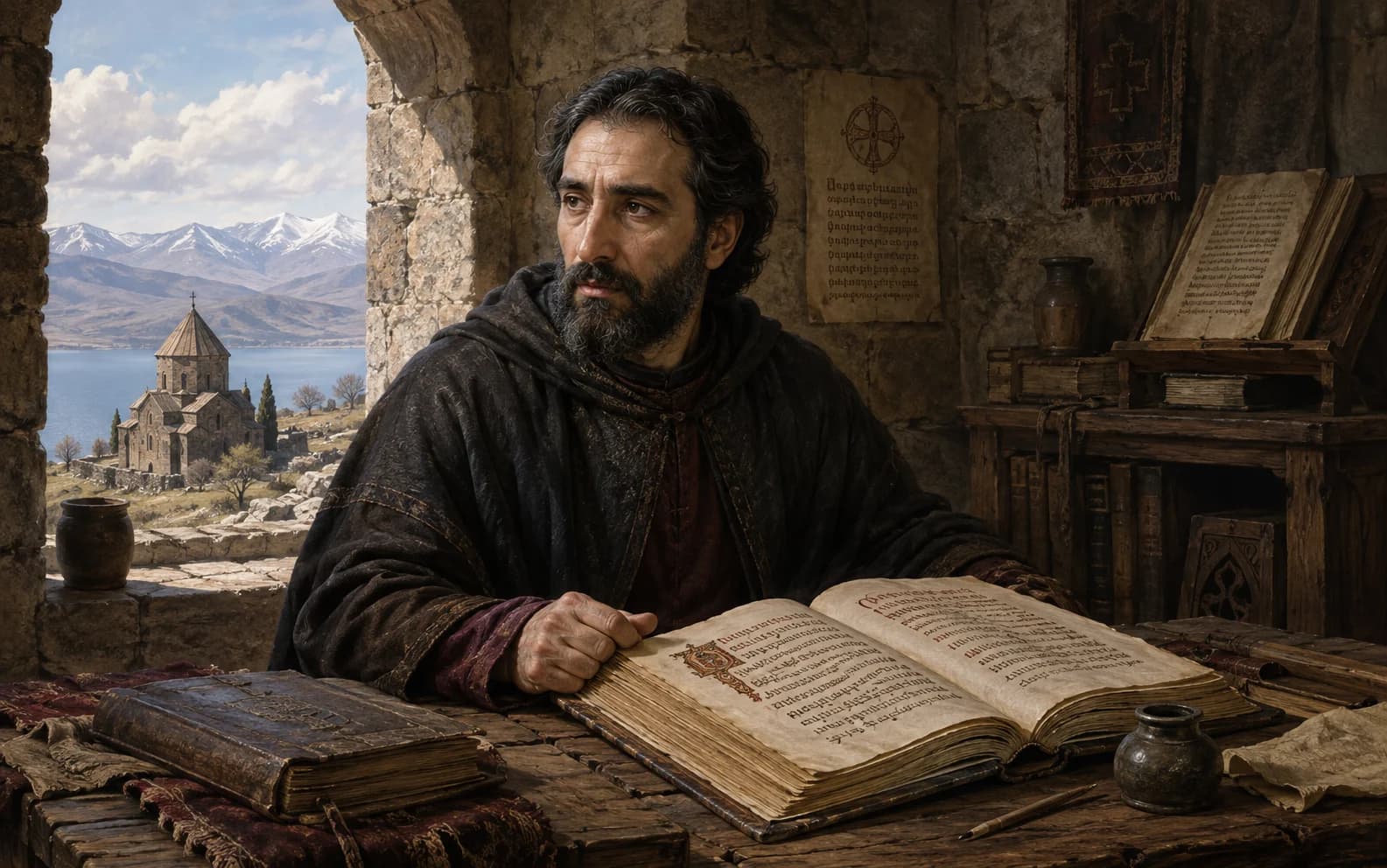
Grigor Narekatsi
A tenth-century monk of Narek whose Book of Lamentations stands at the centre of medieval Armenian literature. He is the first medieval writer in this section.
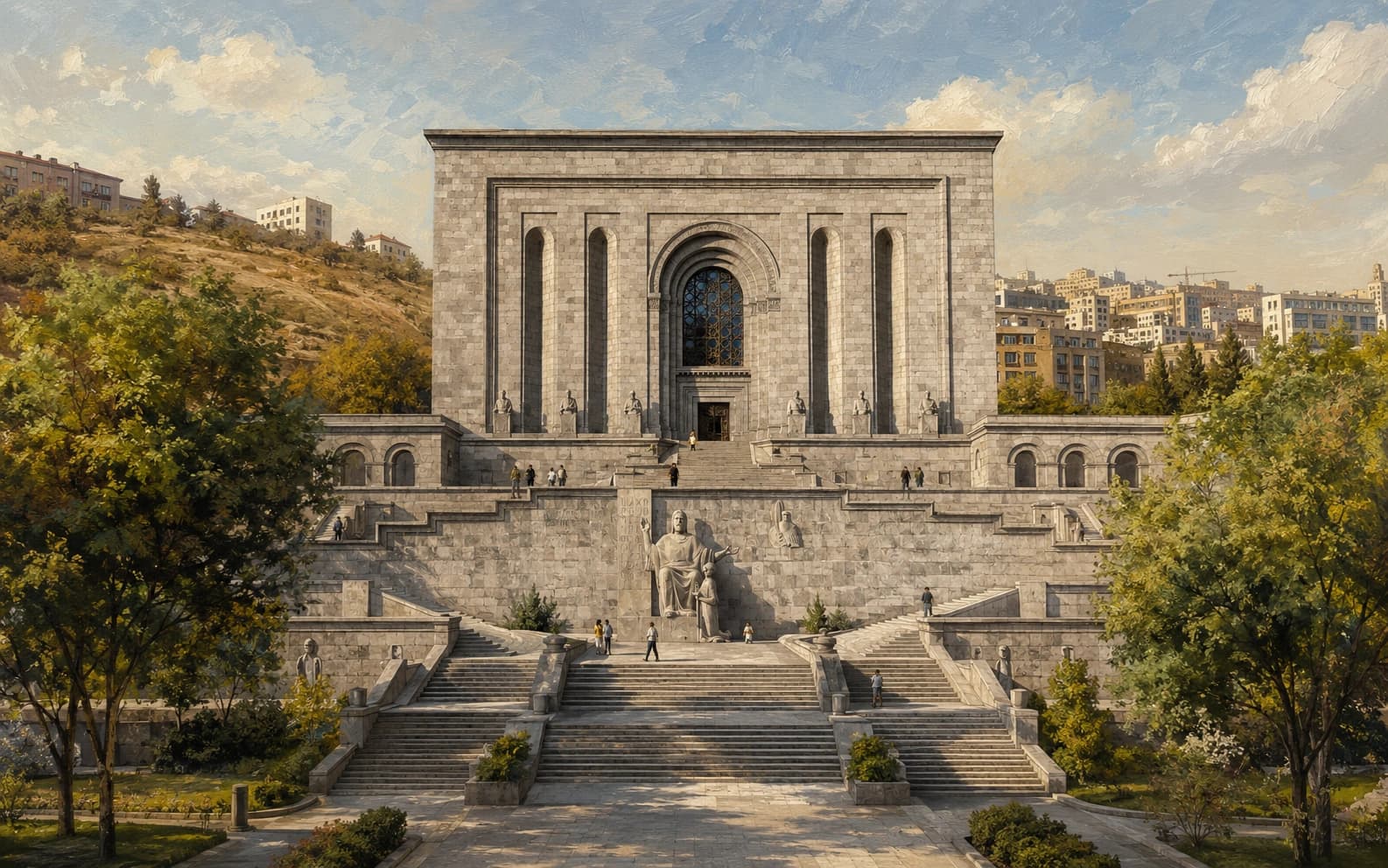
Matenadaran
The national repository of ancient manuscripts in Yerevan: an archive, a research institute and a museum in one. Its collection was built up in monasteries over centuries and brought here in the twentieth.
Nerses Shnorhali
The twelfth-century Armenian poet who wrote a thousand-line verse history in a single rhyme, a lament for a fallen city and hymns still sung today. He spent his last seven years as Catholicos.