
Khor Virap
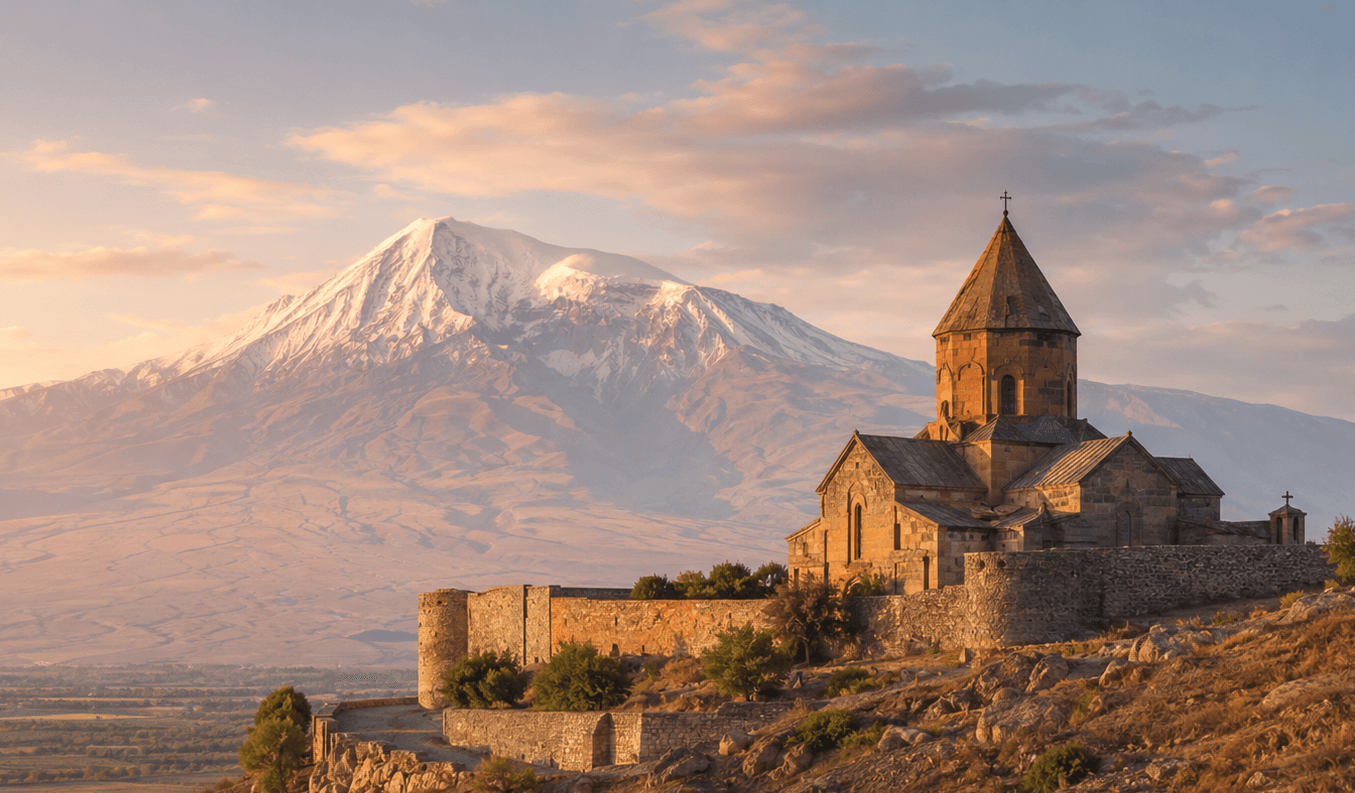
Khor Virap is a monastery on a low hill above the Ararat plain, about thirty kilometres south of Yerevan in Ararat Province. Its name means "deep pit", and it is built over an underground chamber that Armenian tradition identifies as the prison of Gregory the Illuminator. The hill was once part of Artashat, a royal capital founded in the second century BC, and Mount Ararat fills the view to the south. Almost everything that draws people here is older than the buildings themselves, and that is the first thing to understand about the place.
- Author
- Armat Editorial Team
- Updated
- Reading time
- 8 min read
In brief
Khor Virap is a monastery in Ararat Province, on a low hill rising out of the Ararat plain in the south-west of the Republic of Armenia. Its name means "deep pit". It is known for the underground chamber beneath its smaller chapel, which Armenian tradition names as the place where Gregory the Illuminator was held prisoner before the Armenian king accepted Christianity. That tradition comes from Agathangelos, whose narrative was written well over a century after the events it describes. The hill also stands on the site of Artashat, a royal capital founded in the second century BC. The buildings you see today are much later than either story: the main church, Surb Astvatsatsin, dates from the seventeenth century.
Key facts
- Kind of place
- Working monastery of the Armenian Apostolic Church
- Where
- Ararat Province, on the Ararat plain, south of Yerevan
- Name
- Khor Virap — "deep pit" in Armenian
- Stands on
- The site of Artashat, a royal capital of ancient Armenia
- Principal church
- Surb Astvatsatsin (Holy Mother of God), seventeenth century
- Associated with
- Gregory the Illuminator, by tradition
Where Khor Virap is
Khor Virap sits on an isolated hill at the southern edge of the Ararat plain, in Ararat Province of the Republic of Armenia. The plain here is flat, low and heavily farmed. The hill can be seen from a long way off, and the monastery on top is the only thing that rises above the fields.
The hill's real interest is archaeological. It was part of Artashat, the capital that Artashes I founded in the second century BC and that Armenian kings used for several hundred years afterwards. Robert Hewsen's historical atlas places the city here, spread over a group of hills beside the Araks river. The monastery stands on one of them.
The easiest way to picture the site is as a set of layers. First came a royal capital. Then a tradition attached itself to one of its hills, a monastery was built to mark it, and today a working church stands there. Four things share one place, separated by centuries.
Gregory the Illuminator and the pit
The chamber that gives the site its name is a pit cut into the rock. Today a visitor climbs down to it by a ladder through a narrow opening in the floor of the small chapel of Surb Gevorg. Armenian tradition holds that King Trdat III had Gregory the Illuminator imprisoned here for years, and released him when the king turned to him.
The story comes from Agathangelos, the fifth-century History of the Armenians, in R. W. Thomson's translation and commentary. Nearly everything told about Gregory comes from this one source, so it helps to know what kind of text it is. It was composed well over a century after the events, and its aim was to explain how Armenia became Christian. It is not a day-by-day account of what happened.
So the pit is a place where a tradition is kept. It is not a documented cell with a documented prisoner. That makes the site no less interesting: there is a monastery here only because the story was told, retold and finally built over.
The site and Armenia's conversion
Khor Virap is tied to one of the biggest events in Armenian history: the adoption of Christianity as the religion of the Armenian kingdom, traditionally dated to 301. The whole tradition around this hill leads up to that moment. Gregory's release, the king's baptism and the founding of a Christian church in Armenia all belong to the same story.
The date itself is not settled. Nina Garsoïan's studies on the formation of Christian Armenia set out the case for a date closer to 314, and the archive's own article on the conversion follows that discussion instead of treating 301 as fixed. If someone at the site gives you a single confident year, it is the traditional date, not the scholarly consensus.
The outcome is not in dispute. Whatever the year, the Armenian kingdom took this step early, before Rome did, and the church that followed shaped Armenian law, learning and writing for centuries.
The monastery above the pit
Nothing a visitor sees here is ancient. The tradition is old, but the buildings are not. A chapel was raised over the pit in the early medieval period, and the enclosure has been rebuilt more than once since then.
The church that dominates the site today is Surb Astvatsatsin, the Holy Mother of God, built in the seventeenth century. It is a compact domed church, of the kind Christina Maranci's survey of Armenian art describes for the period. It is solid and plainly built, and its carving is concentrated on the drum and the doorway instead of being spread across the walls.
Beside it stands the much smaller chapel of Surb Gevorg, which covers the pit itself. A fortified wall surrounds the whole group. The wall gives Khor Virap its outline against the plain, and it is why photographs make the monastery look more like a small fortress than a church.
Khor Virap is still a working monastery of the Armenian Apostolic Church, in regular use for services, baptisms and pilgrimage. It is not a ruin and is not presented as one.
The mountain in the view
Few sites in Armenia are photographed as often as Khor Virap, and usually for what stands behind it, not on it. Mount Ararat rises directly to the south, and from this hill it fills the horizon with very little in between.
Two simple facts of geography explain the view. The Ararat plain is flat and low, so nothing blocks the line of sight. And Ararat is close, so it looks far bigger here than from most of the country. The mountain itself lies across the border, in present-day Turkey.
Ararat has long held a place in Armenian culture, art and self-image, and visitors meet it everywhere: in paintings, on labels, in the names of half the businesses in Yerevan. It helps to know this in advance, because the view from Khor Virap is where most people first see it.
What to understand before seeing it
Three things help make sense of the site. First, its fame rests on a tradition, not on what survives. There is no ruined prison to see. The pit is a small rock chamber, and all of its meaning lies in the story attached to it.
Second, the site is layered. The hill was a royal capital long before it held a monastery, and the archaeology of Artashat is a separate subject from the church on top. Treating the site as a Christian place from the very beginning gets its history backwards.
Third, this is a working church, not a museum. Services are held, candles are lit, and people come here to be baptised. Visitors are welcome, and the usual courtesies of a place of worship apply.
Important dates
c. 176 BC
Artashes I founds Artashat as a royal capital on a group of hills beside the Araks. One of these hills later carries the monastery.
301
The traditional date for the Armenian kingdom's adoption of Christianity, the event the tradition of the pit leads up to. A number of historians argue for a date closer to 314.
Seventeenth century
The present church of Surb Astvatsatsin is built inside the monastery's walls.
Why Khor Virap matters
Khor Virap is the clearest example in Armenia of a place that matters because of a story, not because of its remains. The pit is small and plain, the buildings are seventeenth-century, and the royal capital beneath the hill is mostly underground. What draws people is the story of the conversion, and the monastery exists because people believed that story and marked the spot.
The site is also a reminder that heritage is more than old buildings. The Armenian kingdom's turn to Christianity left its mark on law, learning and eventually the alphabet itself, and this hill is where that turn is remembered. The stones are recent; the event they commemorate is not.
Interesting facts
- 01The name simply describes the place: khor means deep and virap means pit.
- 02The pit is entered by a ladder through a narrow opening in the floor of the chapel of Surb Gevorg.
- 03The hill was part of Artashat, a royal capital founded in the second century BC. The site was important for roughly five hundred years before any Christian tradition became attached to it.
- 04Almost everything visible today was built more than a thousand years after the events of the tradition; the principal church is a seventeenth-century building.
- 05Mount Ararat, which dominates the view south from the walls, lies across the border in present-day Turkey.
Sources
- Agathangelos, trans. and comm. R. W. Thomson. History of the Armenians — State University of New York Press, Albany, 1976 ISBN 9780873953238The fifth-century narrative in which Gregory is imprisoned in the pit at Artashat. It is the source of the tradition attached to this site, and it was written well over a century after the events it describes.
- Nina G. Garsoïan. Studies on the Formation of Christian Armenia — Variorum / Ashgate, 2010 ISBN 9781409403661Cited for the critical treatment of the conversion narrative and its dating, which is what keeps the tradition at this site described as tradition.
- Robert H. Hewsen. Armenia: A Historical Atlas — University of Chicago Press, 2001 ISBN 9780226332284The standard historical geography of the Armenian lands; cited here for the position of Artashat on the Ararat plain and for the setting of the site.
- Christina Maranci. The Art of Armenia: An Introduction — Oxford University Press, 2018 ISBN 9780190269005A survey of Armenian architecture and its periods; cited for the building history of the monastery rather than for the tradition.
Related articles
The Adoption of Christianity in Armenia (301)
Armenia is traditionally recognised as the first state to adopt Christianity as its official religion, a decision that reshaped its law, art and identity.
Tigran the Great
The Artaxiad king who expanded Armenia into the strongest state of the Near East, founded Tigranocerta, and met the Roman legions of Lucullus and Pompey.
Etchmiadzin Cathedral
The principal church of the Mother See of Holy Etchmiadzin and the seat of the Catholicos of All Armenians. Its tradition reaches back to Armenia's conversion, but most of the building standing today does not.