
Etchmiadzin Cathedral
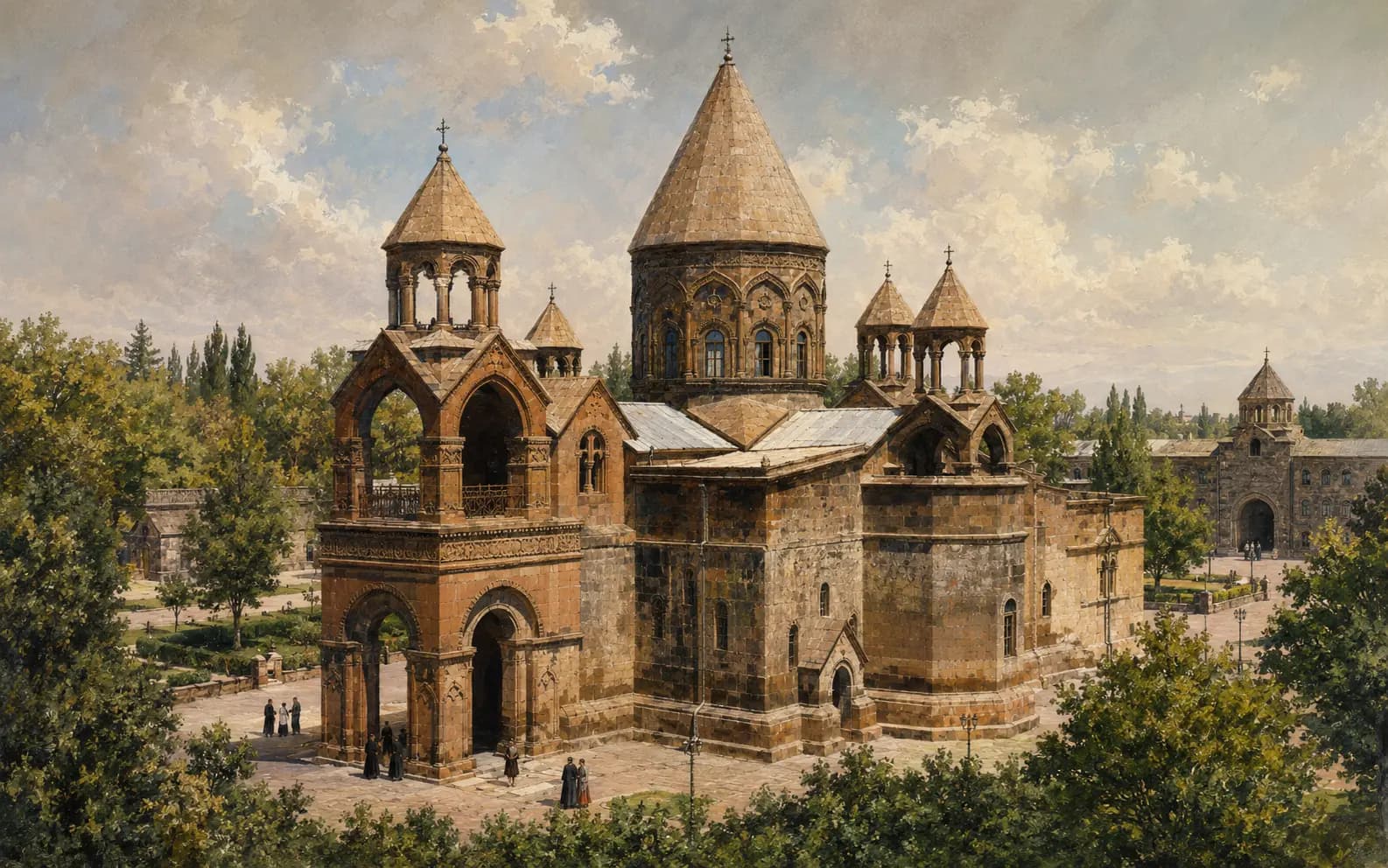
Etchmiadzin Cathedral stands in Vagharshapat, in Armavir Province, about twenty kilometres west of Yerevan. It is the principal church of the Mother See of Holy Etchmiadzin and the seat of the Catholicos of All Armenians. Armenian tradition says Gregory the Illuminator founded it early in the fourth century, around the time the kingdom adopted Christianity in 301. The building you see today is not that church. Its cruciform core dates from a rebuilding of 483, and the dome above it, the belfry in front of it and the rooms at its eastern end are later still. The first step here is to tell those layers apart.
- Author
- Armat Editorial Team
- Updated
- Reading time
- 11 min read
In brief
Etchmiadzin Cathedral is the principal church of the Mother See of Holy Etchmiadzin, in Vagharshapat in Armavir Province, and the seat of the Catholicos of All Armenians. Armenian tradition, following Agathangelos, says Gregory the Illuminator founded it early in the fourth century, around the time of the kingdom's adoption of Christianity, traditionally dated to 301. The name is said to record a vision of the Only Begotten coming down to mark the spot. Very little of that first building stands. The cruciform church on four piers that visitors walk through goes back to a rebuilding of 483, and the stone dome, the belfry and the eastern sacristy are later still. The see itself was based elsewhere for centuries and returned here in 1441.
Key facts
- Kind of place
- Working cathedral and monastic centre of the Armenian Apostolic Church
- Where
- Vagharshapat, Armavir Province, west of Yerevan
- Name
- Etchmiadzin — where the Only Begotten descended
- Institution
- Mother See of Holy Etchmiadzin, seat of the Catholicos of All Armenians
- Present fabric
- Cruciform plan of the rebuilding of 483; dome, belfry and sacristy later
- World Heritage
- Inscribed 2000, UNESCO list no. 1011
Where Etchmiadzin Cathedral is
The cathedral stands in the middle of Vagharshapat, a town on the flat, irrigated plain of Armavir Province, a short way west of Yerevan. Unlike Khor Virap or the mountain monasteries, it is not set apart in open country. It sits inside a walled precinct in an ordinary working town, and you reach it through streets, not across the land.
Vagharshapat is an old town in its own right. Robert Hewsen's historical atlas lists it among the royal centres of the Armenian kingdom, and it was a capital before any church was built there. That is part of the reason the cathedral was founded on this spot. The town has gone by both names for a long time, and today the cathedral's name is commonly used for the town as well.
The precinct is a compound, not a single building. The cathedral is at its centre, but the walls also enclose the residence of the Catholicos, a seminary, museums, a library and open ground. The churches most often visited alongside it stand elsewhere in the same town.
The cathedral and Armenia's conversion
This place matters because it gave the Armenian church a physical centre. The whole site looks back to the adoption of Christianity as the religion of the Armenian kingdom. The founding of a cathedral here belongs to the same chain of events as the king's baptism and the ordination of the first bishop.
The traditional date for the conversion is 301, but it is not settled. Nina Garsoïan's studies on the formation of Christian Armenia set out the case for a date closer to 314, and this archive's own article on the conversion follows that discussion instead of treating the traditional year as fixed. The date of the cathedral's founding is even less certain, because it rests on the same narrative source and nothing independent confirms it.
The order of events, at least, is clear. A kingdom converted, a church was organised, and a cathedral was built at Vagharshapat to lead it. Everything else on the site — the see, the seminary, the treasuries — grew out of that decision and came after it.
The vision, and the name
The name sums up the tradition in a single word. Agathangelos, in R. W. Thomson's translation and commentary, tells how Gregory the Illuminator saw Christ come down and strike the ground with a golden hammer to show where the cathedral should be built. Etchmiadzin means the place where the Only Begotten descended. The church is named after this vision, not after a saint or a founder.
It is worth being clear about what kind of claim this is. Agathangelos is a fifth-century narrative, composed well over a century after the events it describes and written to explain how Armenia became Christian. The vision is the Armenian church's own account of its beginnings. Nobody wrote it down at the time, and no other evidence supports it.
The archive draws the same line at Khor Virap, where the pit is a place where a tradition is kept, not a documented cell. The two sites belong to one story and come from one source. Read either one as eyewitness reporting and you will misread both.
What survives, and from when
Almost nothing a visitor sees dates from the fourth century. Excavation has found remains of an earlier building beneath and within the present one, and the original is generally reconstructed as a basilica, a different shape from the church standing today. But these are remains and reconstructions, not a surviving fourth-century building.
The turning point is a rebuilding usually dated to 483–484, carried out under Vahan Mamikonian and described by the historian Ghazar Parpetsi. This is when the cathedral took a cruciform plan, with a dome carried on four free-standing piers, and that plan is still the core of the building. The timing matters. It came in the years when the long revolt against Sasanian rule was being brought to an end, a settlement sealed by the Treaty of Nvarsak of 484, and it is what a restored church built for itself as soon as it could.
The building kept changing after that, and the parts that show most clearly in photographs are the newest. The present stone dome replaced an earlier one in the seventeenth century. The belfry at the west end was built between 1653 and 1658, and smaller bell turrets were added over the other arms in 1682. A sacristy was added at the eastern end in 1868 or 1869 (sources give both years). Christina Maranci's survey of Armenian art places these additions within the wider building practice of the period, instead of treating them as accidents of one building.
So the cathedral has to be read in layers: a traditional fourth-century foundation, a fifth-century church that provides the plan, a seventeenth-century skyline and a nineteenth-century east end, with restoration work continuing into recent decades. The cathedral is old, but it was not built all at once.
The Mother See and the Catholicos
Etchmiadzin is the Mother See of the Armenian Apostolic Church: the seat of the Catholicos of All Armenians and the administrative centre of the church worldwide. That role is its main importance today, and it comes from the institution, not the architecture.
The see has a long history here, but not an unbroken one, even though it is often described that way. It left Vagharshapat in the early medieval centuries and followed Armenian political power, first to Dvin and later into Cilicia. Only in 1441 did an assembly of clergy restore the Catholicosate at Etchmiadzin. Ever since, the Armenian church has also had a second catholicosate, the Catholicosate of the Great House of Cilicia, with its own jurisdiction. Since 1930 it has been seated at Antelias, in Lebanon.
The office is what makes the compound more than a monument. Ordinations, the consecration of bishops and the preparation of holy oil take place here, and the residence and offices of the Catholicos stand inside the same walls as the cathedral. This is a working headquarters, and its buildings are used as one.
The wider complex
Inside the precinct, the cathedral is surrounded by the institutions the see needs. The Gevorgian Seminary, opened in 1874, is the main theological school of the Armenian church and has trained its clergy ever since. The site also holds museums, a library and the treasuries where the church's relics and liturgical objects are kept.
Beyond the walls, three churches in Vagharshapat are usually counted as part of the same heritage: Saint Hripsime, Saint Gayane and Shoghakat. Each is linked to the martyrdom story that Agathangelos attaches to the conversion. They are separate buildings on separate sites, not parts of the cathedral, and the early medieval churches among them are in some ways better preserved than the cathedral itself.
The cathedral, those churches and the archaeological site of Zvartnots were inscribed together on the UNESCO World Heritage list in 2000. The criteria describe them as showing how the Armenian domed church developed. The listing covers a group of monuments across the town, not a single building.
Manuscripts, learning and what left the site
A see is also an archive. Over the centuries Etchmiadzin built up a collection of manuscripts through copying, donation and the steady gathering that a central institution makes possible. By modern times it held one of the largest collections of Armenian writing anywhere.
That collection is no longer here, which is worth knowing before a visit. The manuscripts were declared state property in 1929, and in 1939 the Soviet Armenian government moved them to Yerevan, where they became the founding collection of the Matenadaran. To see what Etchmiadzin preserved, you have to go to Yerevan.
What remains on site is the institutional side of the same work: the seminary, the library and the museums, and the see's ongoing role in publishing, liturgy and the training of clergy. Etchmiadzin really did preserve a great deal, but much of its best-known work is now kept elsewhere.
What to understand before seeing it
The first thing to keep in mind is the gap between the tradition and the stones. The site's place in Armenian history rests on a fourth-century founding described by a fifth-century author. The church you stand in is essentially a fifth-century plan under a seventeenth-century roofline. Both are true, and keeping both in view is the key to understanding the place.
The second is that this is a headquarters, not just a monument. The precinct is in daily use, services are held, and parts of it may be closed or busy for reasons that have nothing to do with visitors. The usual courtesies of a place of worship apply, and so does a little patience.
The third is that the site is a group of places, not a single spot. The cathedral is the centre, but the churches elsewhere in Vagharshapat and the ruins at Zvartnots belong to the same World Heritage inscription and the same period of Armenian building. Seeing only the cathedral gives a narrower picture than the place deserves.
Important dates
Early fourth century
Armenian tradition says Gregory the Illuminator founded the cathedral here in the years around the kingdom's adoption of Christianity. That is traditionally dated to 301, though a number of historians argue for a date closer to 314.
483–484
Vahan Mamikonian rebuilds the cathedral from the foundations. The cruciform, domed plan of that rebuilding is still the core of the building today.
1441
An assembly of clergy restores the Catholicosate at Etchmiadzin after centuries in which the see was based elsewhere.
1653–1658
The western belfry is built in front of the cathedral, giving the west front the profile it has today.
1682
Smaller bell turrets are added over the remaining arms of the church.
1868 or 1869
A sacristy is added at the eastern end of the cathedral.
1874
The Gevorgian Seminary opens within the precinct and becomes the main theological school of the Armenian church.
2000
The cathedral, the other churches of Vagharshapat and the archaeological site of Zvartnots are inscribed together on the UNESCO World Heritage list.
Why Etchmiadzin Cathedral matters
Etchmiadzin is where the Armenian church became an institution with an address. The conversion gave Armenia a religion. This site gave that religion a head, a hierarchy, a treasury and a school, and these carried it through the centuries when there was no Armenian state to do so. The cathedral matters less as a building than as the place from which the church was run.
It is also the clearest example of how a heritage site builds up over time. Nothing here was built in one go. A traditional foundation, a fifth-century reconstruction, a seventeenth-century dome and belfry, a nineteenth-century east end and modern restoration all sit in one structure, so there is no single date to give it. Reading the layers tells you more than picking a year.
Interesting facts
- 01The name states the tradition outright: Etchmiadzin means the place where the Only Begotten descended.
- 02The cruciform plan that visitors walk through belongs to the rebuilding of 483, not to the original foundation.
- 03The seat of the Catholicos was away from Etchmiadzin for centuries and was restored here in 1441.
- 04The belfry that dominates the west front is a seventeenth-century addition, roughly thirteen hundred years younger than the traditional foundation.
- 05The manuscripts once kept at Etchmiadzin were moved to Yerevan in 1939 and became the founding collection of the Matenadaran.
Sources
- Agathangelos, trans. and comm. R. W. Thomson. History of the Armenians — State University of New York Press, Albany, 1976 ISBN 9780873953238The fifth-century narrative containing the vision of the Only Begotten that gives the cathedral its name. It is the source of the foundation tradition and was written well over a century after the events it describes.
- Nina G. Garsoïan. Studies on the Formation of Christian Armenia — Variorum / Ashgate, 2010 ISBN 9781409403661Cited for the critical treatment of the conversion narrative and its dating, which is what keeps the foundation date described here as tradition.
- Christina Maranci. The Art of Armenia: An Introduction — Oxford University Press, 2018 ISBN 9780190269005Cited for the building history: the cruciform domed plan of the fifth-century rebuilding and the seventeenth-century dome and belfry, set against the wider periods of Armenian architecture.
- Richard G. Hovannisian (ed.). The Armenian People from Ancient to Modern Times, Volume I: The Dynastic Periods, from Antiquity to the Fourteenth Century — Palgrave Macmillan, 2004 ISBN 9781403966360Cited for the institutional history — the organisation of the church after the conversion and the movement of the catholicosal see away from Vagharshapat and back.
- Robert H. Hewsen. Armenia: A Historical Atlas — University of Chicago Press, 2001 ISBN 9780226332284The standard historical geography of the Armenian lands; cited here for Vagharshapat's position and its standing as a royal centre before the cathedral was founded.
- Cathedral and Churches of Echmiatsin and the Archaeological Site of Zvartnots — UNESCO World Heritage List, no. 1011, inscribed 2000 Visit sourceThe inscription covers the cathedral, the churches of Hripsime, Gayane and Shoghakat, and the ruins of Zvartnots as one property. "Echmiatsin" is UNESCO's own spelling in the official property name and is kept here as cited; the archive's prose uses Etchmiadzin throughout.
- Mother See of Holy Etchmiadzin — official site — Mother See of Holy Etchmiadzin, Vagharshapat Visit sourceCited only for the present-day institution: the office of the Catholicos of All Armenians, the Gevorgian Theological Seminary, and the museums and library inside the precinct.
Related articles
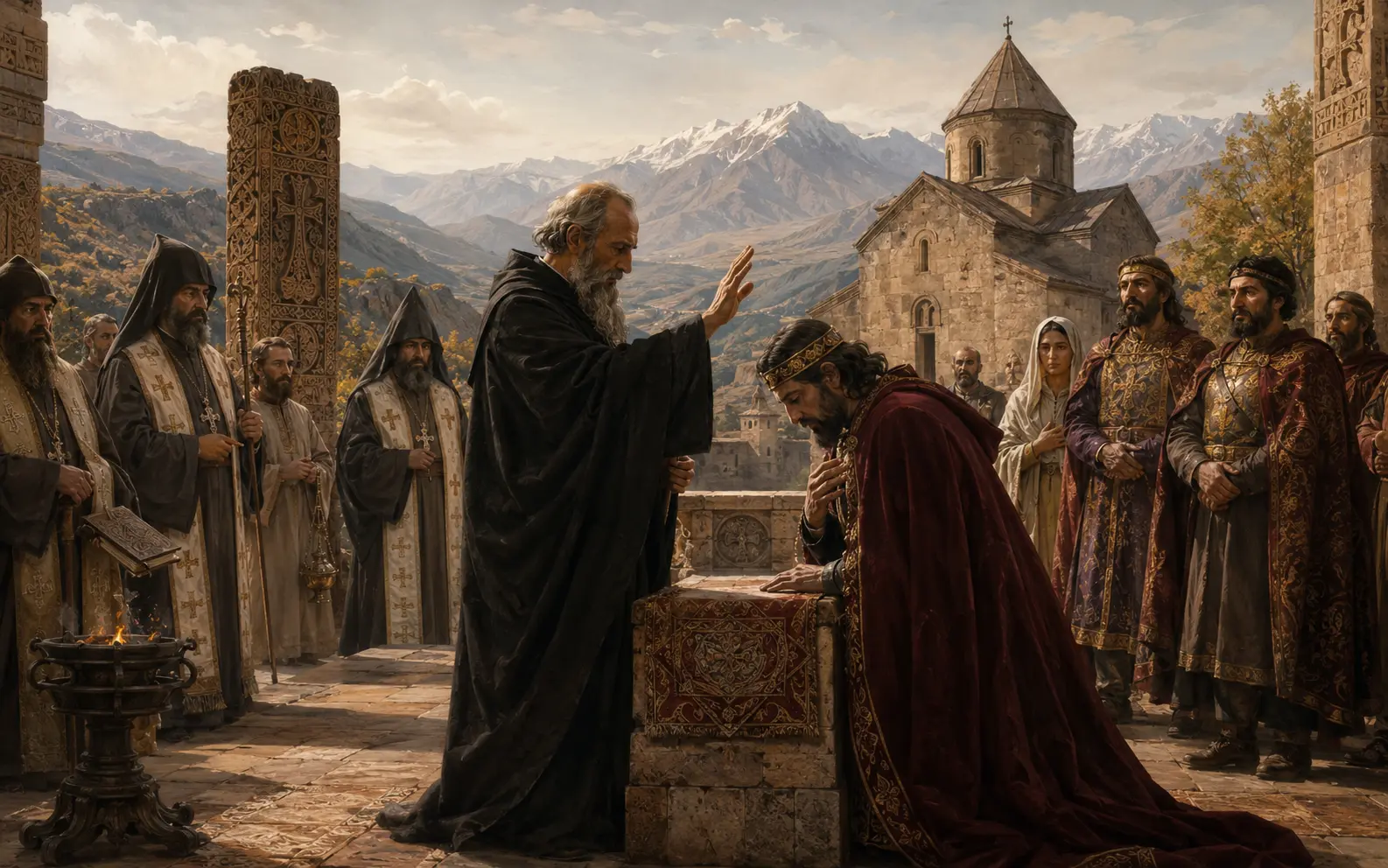
The Adoption of Christianity in Armenia (301)
Armenia is traditionally recognised as the first state to adopt Christianity as its official religion, a decision that reshaped its law, art and identity.
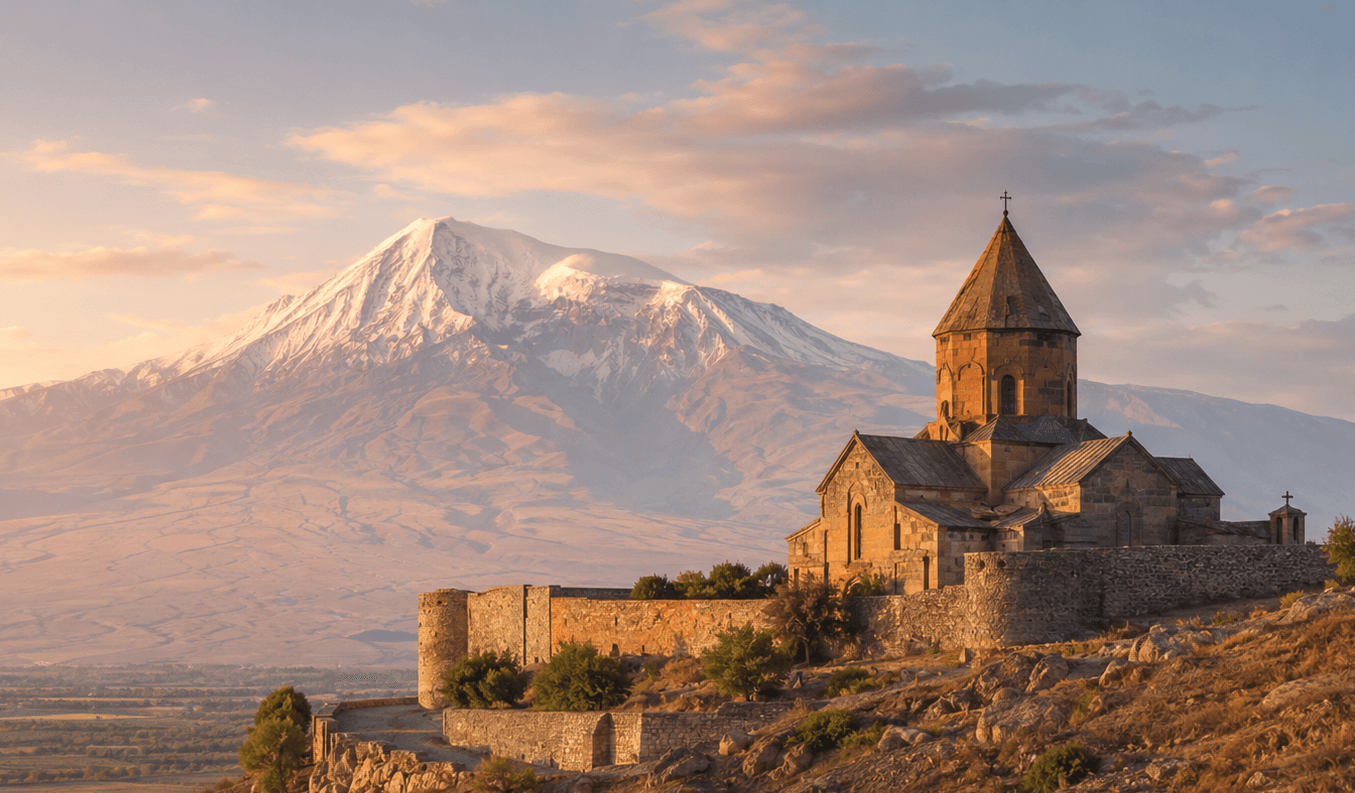
Khor Virap
A working monastery on a low hill above the Ararat plain, built over the pit where tradition says Gregory the Illuminator was imprisoned. It stands on the site of Artashat, an ancient Armenian capital.
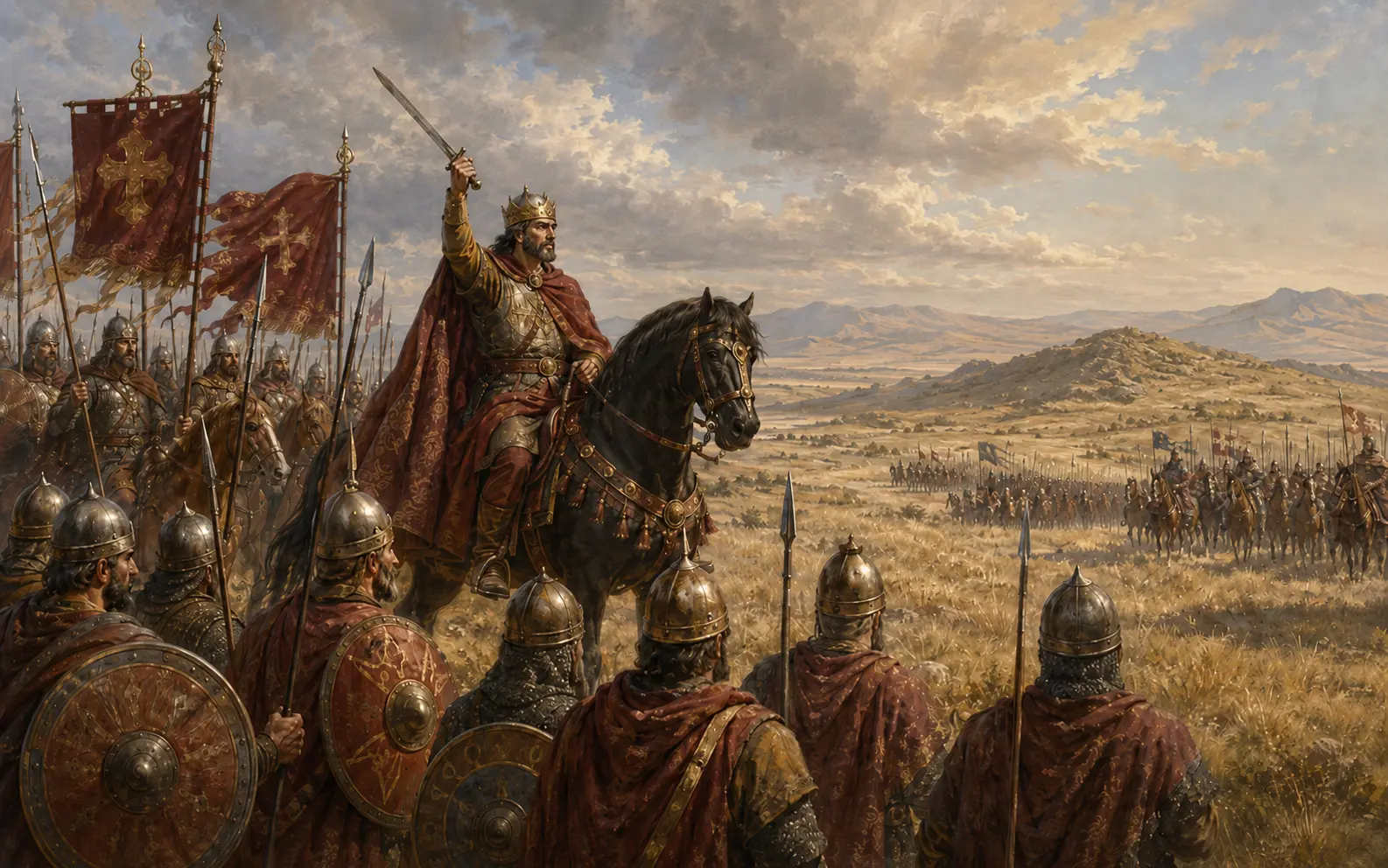
The Battle of Avarayr (451)
In 451 Armenian forces under Vardan Mamikonian faced what the sources describe as a far larger Persian army to defend their faith, losing the battle but winning religious freedom.