
Abu-Lala Mahari
Abu-Lala Mahari is a poem by Avetik Isahakyan, written between 1909 and 1911. Its hero borrows the name of Abū al-ʿAlāʾ al-Maʿarrī, an Arab poet and thinker of the eleventh century, but Isahakyan makes him a literary figure of his own: a celebrated poet who turns his back on Baghdad, gives away everything he owns and leads his caravan into the desert. The journey away from the city carries the poem's argument. With every stage the hero rejects another thing society values, and the poem keeps asking what freedom is worth, what it costs, and what is left of a person who refuses all of it.
- Author
- Armat Editorial Team
- Updated
- Reading time
- 20 min read
In brief
Abu-Lala Mahari (Աբու-Լալա Մահարի) is a poem by Avetik Isahakyan, written between 1909 and 1911 and first published as a book in Constantinople in 1911. Its hero takes his name from the Arab poet Abū al-ʿAlāʾ al-Maʿarrī (973–1057), but he is a literary creation, not a portrait. After decades of fame in Baghdad he gives his wealth to the poor, leaves the city by night with his camel caravan and crosses the desert, rejecting love, homeland, glory, wealth, power and law, until he presses on toward the sun. The poem is built from a prose preamble and a sequence of suras. The literary scholar Edward Jrbashyan called it the peak of Isahakyan's poetry, and its subject is freedom and the cost of leaving society.
Key facts
- Author
- Avetik Isahakyan (1875–1957)
- Form
- Poem: a prose preamble followed by a sequence of suras
- Written
- 1909–1911; some scholars date the writing to 1909–1910
- First book edition
- Constantinople, 1911
- Hero
- A literary figure named after the Arab poet al-Maʿarrī (973–1057), not a portrait of him
- Setting
- Baghdad, then the desert beyond it
- First Russian translation
- Valery Bryusov, in the anthology Poetry of Armenia, Moscow, 1916
- English translations
- Zabelle C. Boyajian (Yerevan edition, 1975); Tatul Sonentz-Papazian (serialized, 2014)
What Abu-Lala Mahari is
Abu-Lala Mahari (Աբու-Լալա Մահարի) is a poem by Avetik Isahakyan, the lyric poet from Alexandropol, now Gyumri, whose songs so many Armenians know without knowing their author. Jrbashyan called it the peak of his poetry. The Armenian Soviet Encyclopedia dates it to 1909–1911 and calls it an artistically weighty testimony to his view of the world.
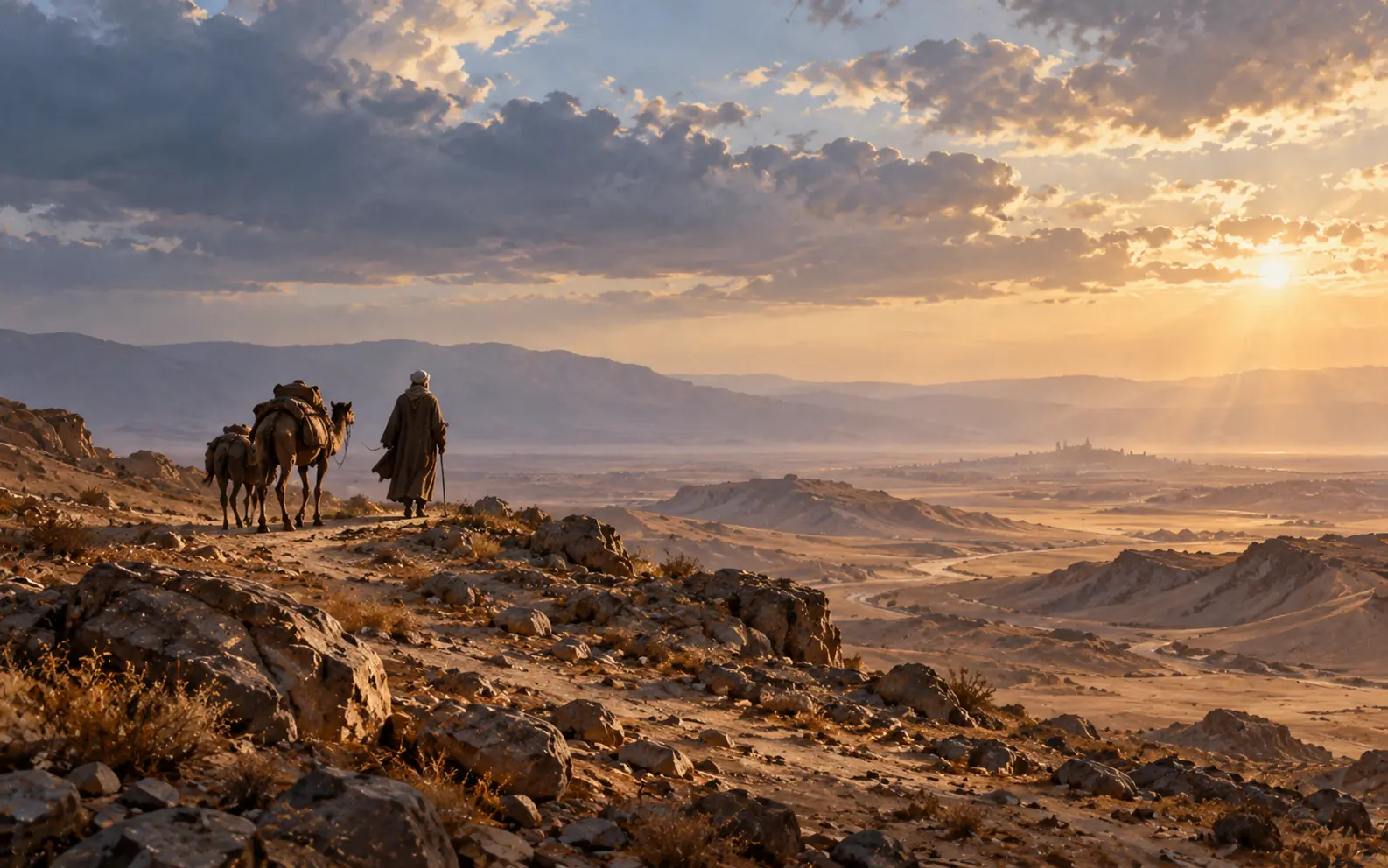
The story is simple. A famous poet who has lived for decades in Baghdad gives his wealth to the poor, gathers his camel caravan and slips out of the sleeping city at night. He crosses the desert, and in a series of long speeches he renounces, one after another, the things that bound him to other people. The poem ends with him moving on toward the sun.
What makes the poem more than a travel story is that the route is the argument. Each stage of the crossing is also a stage in an argument about society, freedom and human worth. This article follows that argument. It also keeps apart three things that are easy to blur: the historical Arab poet, the literary hero who takes his name, and Isahakyan himself.
The title and the name behind it
The title is an Armenian rendering of a real name. "Abu-Lala" renders Abū al-ʿAlāʾ, the name by which the Arab poet was known, and "Mahari" renders al-Maʿarrī, "the man from Maʿarra," his home town in northern Syria. The hyphenated form Աբու-Լալա Մահարի is the one used by the Armenian Soviet Encyclopedia, by the Academy of Sciences' own journals and by the standard Yerevan editions, and this article follows it. The unhyphenated Աբու Լալա Մահարի is common in popular use and names the same poem.
In English, the poem circulates under a transliteration, not a translated title. Zabelle Boyajian's translation is catalogued as Abu Lala Mahari, and Armenian scholarly journals and the 2014 serialized translation use Abu-Lala Mahari. Valery Bryusov's Russian translation used a form closer to the Arabic, Абул Ала Маари (Abul Ala Maari). This article uses Abu-Lala Mahari for the poem and its hero, and the scholarly spelling al-Maʿarrī only for the historical man. The two spellings mark two different figures.
The real Abū al-ʿAlāʾ al-Maʿarrī
Abū al-ʿAlāʾ Aḥmad ibn ʿAbd Allāh al-Maʿarrī was born in 973 at Maʿarrat al-Nuʿmān, south of Aleppo, and died there in 1057. He lost his sight to smallpox in early childhood. Around 1008–1010 he spent a relatively short stay in Baghdad, the Abbasid capital and the great literary center of the age. Then he went home and lived the rest of his life in near seclusion, eating no meat and teaching the students who came to him.
He is remembered as one of the most original poets in Arabic, above all for his Luzūmiyyāt, a large collection of poems in a deliberately difficult rhyme scheme, and for his prose Risālat al-ghufrān (The Epistle of Forgiveness). Modern reference works stress his skepticism toward received dogma, his ascetic life and the dark, critical cast of his view of human society. The line he is said to have asked for as his epitaph, that his father had wronged him by bringing him into the world while he himself had wronged no one, is the best-known summary of that view.
This article gives the historical poet only as much space as the poem needs. He is the source of a name, a reputation and a few borrowed details, not the subject of Isahakyan's poem.
From historical poet to literary hero
Isahakyan kept the name, the Baghdad setting, the renown and the bitter view of human society, and he changed almost everything else. The poem's preamble makes its hero a man who has lived "for decades" (տասնյակ տարիներ) in the caliphs' city, in wealth and honor, at the tables of the powerful. The historical al-Maʿarrī spent a year or two there. The poem's hero gives away a fortune and sets out across the desert with a caravan. The historical poet was blind and poor, went home to Maʿarra and shut himself away. Isahakyan's hero leaves for a desert journey toward the sun, while the historical man withdrew into his house.
So the hero is not a documentary reconstruction, and not every idea he voices can be traced back to the historical poet. The Armenian scholar M. Zakaryan has compared the poem with al-Maʿarrī's own writings, and the Armenian Wikipedia article on the poem singles out the epitaph attributed to him as the seed of the hero's outlook. It is best read as a modern poem that borrows a medieval voice, not as a medieval voice restored.
When the poem was written
The sources agree on the period but not on its exact limits. The Armenian Soviet Encyclopedia, like this site's biography of Isahakyan, gives 1909–1911. The literary scholar Edward Jrbashyan, writing in 1975, dated the poem 1909–1910. The Armenian Wikipedia article gives the same years for the writing and 1911 for the complete text. A 2007 study by the scholar Avik Isahakyan dates it to 1910. These dates do not really contradict one another. The writing seems to fall in 1909–1910, with the complete poem appearing in 1911. This article gives 1909–1911 as the outer frame and names the narrower dates rather than choosing silently between them.
The years themselves matter. In 1908 Isahakyan was arrested in the mass tsarist prosecution of Armenian political activists and held in the Metekhi prison in Tiflis. He was released on bail in 1909, and in 1911 he left the Russian Empire for a long exile in Europe. Avik Isahakyan's study places the poem in exactly this crucial period, just before a departure from the homeland made under the threat of trial.
A well-known account says the idea came to Isahakyan in 1909 when he saw a camel caravan from a train window between Tiflis and Yerevan. The story is repeated widely, but the sources consulted for this article give no documentary basis for it, so it is reported here as tradition. They also do not fix the city where the poem was written, and this article does not name one.
Publication history
Some reference works say parts of the poem were printed as early as 1909, but none of the sources consulted names the periodical, and this article does not guess at one. The complete poem first appeared as a book in 1911 in Constantinople, published by the Artsiv bookshop (Արծիւ). A study of the poem's illustrated editions records this first edition along with later Constantinople printings, including one by the Kilikia bookshop in 1920, and the first Soviet Armenian edition of 1929.
From then on the poem was reprinted steadily, and it became a favorite subject for Armenian book artists. Illustrated Yerevan editions of 1971, 1975 and 1984 each gave it a full visual program, the 1971 edition with a plate at the head of every sura. A Russian edition illustrated by Martiros Saryan was prepared for Tiflis in 1935 but never published. The number of illustrated editions is one concrete measure of how firmly the poem settled into the Armenian canon.
Preamble and suras: the form of the poem
The poem opens with a short prose preamble that tells, in the third person, how the poet left Baghdad. The verse that follows is divided into suras. Sura is the word for a chapter of the Qur'an, and Bryusov's Russian version calls the whole poem a qasida, the classical Arabic ode. Both names are deliberate: the structure itself tells the reader that this is meant to sound like Arabic poetry in Armenian.
The count needs care. The subtitle used for the poem and its translations speaks of seven suras, and Bryusov's Russian heading reads "a qasida in seven suras." Printed Armenian texts number seven suras and then close with a section headed «Վերջին սուրահ», the "Last Sura," which returns to the third-person narration of the preamble. This article therefore describes the poem as a preamble, seven numbered suras and a closing "Last Sura," and does not reduce it to a single number.
The verse is built from long lines grouped in couplets. Reference works describe them as twenty-syllable lines governed by their own prosodic rules. Their length and slow, even pace suit a poem about a long crossing.
The journey
The departure is quiet and deliberate. The preamble has the poet give his wealth to the poor and the needy, since he has no wife or children, and then, while Baghdad sleeps on the banks of the Tigris, lead his caravan silently out of the city "toward the unknown." There is no quarrel, no exile, no scene. He simply goes.
From then on, movement shapes the poem. The caravan travels farther and farther from the city, and at each stage the hero looks back and names something else he refuses. Across the suras he turns against one bond after another: love and women, his father's house and homeland, society, friendship, fame, treasure, power and law. The physical distance and the growing list of renunciations advance together. By the time the caravan is deep in the desert, the hero has left behind not only a city but every bond that city stood for.
The journey is not an adventure. Nothing happens on the road in the usual sense: there are no encounters, dangers or discoveries. The only events are changes in how the hero sees things, and the landscape exists to make those changes visible.
The desert
The desert is the poem's strongest image, and it works first of all as the opposite of Baghdad. The city is crowded, rich, lawful and full of speech. The desert is empty, poor, lawless and silent. Moving from one to the other turns the hero's rejection of society into a place the reader can see: the farther the caravan goes, the fewer people, institutions and obligations remain.
Scholars have looked closely at how the desert is made. Tatevik Harutyunyan of the Academy of Sciences' Institute of Literature has studied the poem's "Eastern layer." She shows how Isahakyan builds the caravan and desert scenes from words and expressions of Arabic origin, so that the setting is carried by the language itself and not only by description. The desert is therefore a literary construction as much as a geographical one.
What the desert means beyond that is a matter of reading. In this article's reading, it is where the hero's freedom becomes absolute and where its emptiness becomes impossible to ignore. The poem does not settle whether that emptiness is purity or loss.
Leaving society
The hero's charges against society are specific. He condemns hypocrisy and false friendship, honor that is only reputation, fame, riches, the power of rulers and the laws that protect them. In one of the later suras he speaks of tearing the masks from people's faces. His complaint is that human society runs on pretense: it rewards the appearance of virtue, and it binds people with duties that serve the strong.
It would be too simple to say that he hates humanity. He knows the city from the inside, because he has sat at its best tables and enjoyed its honors, and his bitterness is that of someone who has seen through something he once loved. The poem also lets his rejection spread until it spares nothing, not even homeland and family, and that totality is part of the point. The reader is shown where the logic of complete refusal leads, not simply invited to agree with it.
The hero's verdict is the hero's. The poem gives it great eloquence, but that does not make it Isahakyan's own program, and the poem is not a social manifesto.
Freedom
Freedom is the poem's central value and its central problem. The hero leaves in order to be free: free of the city's judgments, its laws and its demands, and of every bond that could hold him. Each renunciation widens that freedom, and the open desert is its image.
But the poem also counts the cost. A freedom won by cutting every tie leaves the hero alone, with only his caravan, the landscape and the sky around him. The questions the poem raises are real ones. Can a person leave society at all, or only carry it with him into the desert? Is solitude liberation, or another kind of loss? What remains of a person once love, friendship, fame and home have all been rejected? The poem raises these questions with great force and does not claim to have answered them.
Love and human attachment
Love is among the first things the hero renounces, and some of his harshest words are aimed at women. He voices a sweeping distrust of them and of the attachments they stand for. These lines belong to the hero, spoken at a particular point in his turning away from everything. They are not presented as a truth about women, and this article does not treat them as one.
Read in context, they are part of the same total refusal that also sweeps away homeland, father's house and friendship. The hero rejects love for the same reason he rejects everything else: it binds him to other people and exposes him to disappointment. That is what makes the lines significant. They show how far his refusal reaches, and they also show its blindness, since a freedom that can only be defended by condemning everyone who might be loved is a narrow kind of freedom.
Skepticism and belief
The historical al-Maʿarrī is often described as a skeptic and a critic of religious dogma. Those labels belong to him and to the debates about him. They should not be transferred automatically to Isahakyan's hero, and still less to Isahakyan.
What the poem itself does is plainer. The hero's refusals reach even the things society holds sacred, including homeland and law, and the Armenian Wikipedia article notes that he spares not even these. At the end he turns to the sun and calls it the only mother and the only holy thing left to him. The structure borrows the Qur'anic word "sura," but the poem is not a religious argument. It sets what the hero still honors against everything he has rejected, and the only thing left standing is the sun. This article draws no conclusion from it about Isahakyan's own beliefs.
Pessimism and revolt
Critics have long called the poem pessimistic, and they have usually connected it to philosophy. Zakaryan traces the young Isahakyan's attraction both to the pessimism of Schopenhauer and to Nietzsche's rebellious, critical spirit. Jrbashyan observed in 1975 that Armenian scholarship had concentrated on the poem's supposed Nietzschean elements.
"Pessimistic" does not cover the whole poem, though. The hero's rejection is also a positive act: he chooses the road, the desert and the sun, and he does not simply give up. The ending is not collapse but ascent, as he presses on "toward the sun, the immortal sun." A study of the poem's illustrators notes that Martiros Saryan was perhaps the only interpreter to find optimistic tones in it alongside the disillusionment. That remark shows how differently the poem can be read. The tension between despair about people and exaltation at the end is the poem's shape, not a contradiction to explain away.
The poem and the Romantic tradition
Edward Jrbashyan's 1975 study in the Academy of Sciences' Historical-Philological Journal argued that the Nietzschean reading had hidden something important: the poem's roots in the classical tradition of the Romantic poem, in national as well as world poetry. On that reading, the poem belongs to a long line of Romantic narrative poems and is not simply a vehicle for a fashionable philosophy.
The features that make the comparison persuasive are visible in the text. There is a solitary hero at odds with society. There is a journey that is also a spiritual crisis. The emotion is intense and the rhetoric is grand. The landscape reflects the hero's inner state, and freedom is placed above every social bond. This site's biography already notes that Isahakyan absorbed European Romanticism during his studies at Leipzig. The poem shows what he made of it: an Eastern setting and a medieval name, used to carry a Romantic hero's quarrel with the world.
Voice and imagery
The poem has two voices. A narrator speaks in the prose preamble and again in the "Last Sura," telling of the hero in the third person. In between, the suras are dominated by the hero's own speech, as he looks back on what he is leaving. The frame keeps a certain distance. The hero's words are given at full strength, but they are presented as his, inside a story told by someone else. Isahakyan does not speak in his own name at any point.
The images follow the journey. Baghdad sleeps on the Tigris as the caravan slips away by night. The camels move on through the sand. A high rock gives the hero a last view over the world. The sun keeps growing in importance until it becomes his destination. In the closing lines, the poet, wrapped in a purple mantle foaming with gold, flies on tirelessly toward the immortal sun. None of these images is decoration. Each marks a stage in the move from the human world to a place beyond it.
Translation and reception
The poem reached Russian readers early. Valery Bryusov translated it as Абул Ала Маари for the anthology Poetry of Armenia, which he edited in Moscow in 1916, and critics have called his version a literary monument of Russian translation. Alexander Blok's often-quoted praise of Isahakyan as "a first-class poet" dates from the same years, but it concerned Isahakyan in general, not this poem.
In English, the translation by Zabelle C. Boyajian, Abu Lala Mahari: Poem in Seven Suras, is recorded in a Yerevan edition published by Hayastan in 1975. An earlier date is sometimes given for it, but this article could not confirm one. Tatul Sonentz-Papazian published a new English translation in The Armenian Weekly in 2014, one sura per installment. The poem has also been translated into Arabic several times, and Harutyunyan has compared those versions from different periods. This article could not verify a French edition and does not list one.
In Armenia the poem holds a secure place. Jrbashyan called it the peak of Isahakyan's poetry. It has been reprinted and illustrated again and again, and scholars have continued to write about it from the 1970s to the present.
Important dates
973–1057
Life of the Arab poet Abū al-ʿAlāʾ al-Maʿarrī, whose name and reputation the poem's hero borrows.
1908–1909
Isahakyan is arrested in the tsarist prosecution of Armenian activists and held in Metekhi prison, then released on bail.
1909–1911
The poem is written; some scholars date the writing itself to 1909–1910.
1911
First book edition, Constantinople (Artsiv bookshop); Isahakyan leaves the Russian Empire for Europe.
1916
Valery Bryusov's Russian translation appears in the anthology Poetry of Armenia, Moscow.
1929
First Soviet Armenian edition.
1971–1984
Illustrated Yerevan editions of 1971, 1975 and 1984; Boyajian's English translation is published in Yerevan in 1975.
2014
Tatul Sonentz-Papazian's English translation is serialized in The Armenian Weekly.
Why Abu-Lala Mahari matters
It is the work in which Isahakyan, the master of the short folk-toned lyric, sustained a single argument across a whole poem. The argument is carried by a journey. A man leaves the city, crosses the desert and gives up one human bond after another, until only the road and the sun remain.
The poem never decides whether that road leads to freedom or to loss, and that is why it keeps being read. The desert is at once release and emptiness, and the hero's refusal is at once a clear-sighted judgment and a narrowing of life. The closing flight toward the sun is both a triumph and a departure from everything human. Isahakyan's voice holds these together in long, even lines, and it lets the caravan go on without passing judgment on the man who leads it.
Interesting facts
- 01The hero's name renders that of a real Arab poet, Abū al-ʿAlāʾ al-Maʿarrī, but the historical poet was blind and spent only a year or two in Baghdad. The poem's hero is a wealthy man who has lived there for decades.
- 02The poem is divided into suras, the word for the chapters of the Qur'an, and Bryusov's Russian version calls it a qasida, the classical Arabic ode.
- 03Printed Armenian texts close with a section headed "Last Sura," after seven numbered suras.
- 04A Russian edition illustrated by Martiros Saryan was prepared in 1935 but never published.
- 05The poem has been translated into Arabic more than once, and scholars have compared the translations from different periods.
Sources
- Գ. Հովհաննիսյան. Իսահակյան Ավետիք — Հայկական սովետական հանրագիտարան, հ. 4, Երևան (Վիքիդարանի հրատարակություն), 1978 Visit sourceThe anchor for the 1909–1911 dating, the genre (պոեմ), the hyphenated title form and the characterisation of the poem as a «գեղարվեստական մեծարժեք վկայագիր» of Isahakyan's outlook. Also the source of Blok's praise, which it quotes about Isahakyan in general, not about this poem.
- Ավիկ Իսահակյան. «Աբու-Լալա Մահարի» պոեմի հերոսը և հեղինակը — Պատմա-բանասիրական հանդես, ՀՀ ԳԱԱ, 2007, № 2, էջ 134–161, 2007 Visit sourceThe hero-and-author study. Dates the poem to 1910 and places it in the period just before Isahakyan's departure, under threat of trial; the article cites it for that attributed autobiographical reading, not as proof that the hero is the poet.
- Է. Մ. Ջրբաշյան. Ավետիք Իսահակյանի «Աբու-լալա Մահարին» և ռոմանտիկական պոեմի ավանդույթները — Պատմա-բանասիրական հանդես, Հայկական ՍՍՀ ԳԱ, 1975, № 3, էջ 43–64, 1975 Visit sourceThe basis of the Romantic-tradition section: dates the poem 1909–1910, calls it the peak of Isahakyan's poetry, and argues that scholarship's focus on Nietzschean elements obscured its roots in the classical Romantic poem. The specific Romantic features the article lists are its own reading of the text in the light of this argument.
- Մ. Գ. Զաքարյան. Ավ. Իսահակյանի «Աբու-Լալա Մահարի» պոեմի ստեղծագործական ակունքները — Լրաբեր հասարակական գիտությունների, 2001, № 2, էջ 3–17, 2001 Visit sourceCited for the young Isahakyan's attraction to Schopenhauer's pessimism and Nietzsche's rebellious spirit, and for the comparison of the poem with al-Maʿarrī's own writings.
- Նունե Մինասյան. Ավետիք Իսահակյանի «Աբու-Լալա Մահարի» պոեմի … [a study of the poem's illustrated editions] — Գեղարվեստի պետական ակադեմիայի տարեգիրք, Երևան (via arar.sci.am), consulted 2026 Visit sourceThe publication-history source: the first book edition (Constantinople, Արծիւ bookshop, 1911), the Կիլիկեա printing of 1920, the first Soviet edition of 1929, the unrealised 1935 Tiflis edition with Saryan's illustrations, and the illustrated Yerevan editions of 1971, 1975 and 1984. Also the source of the remark that Saryan was perhaps the only interpreter to see optimistic tones in the poem. The heading is given as far as the repository's index records it; the remainder is described in brackets rather than reconstructed.
- Tatevik Harutyunyan. Eastern Layer of the Poem “Abu-Lala Mahari” by Avetik Isahakyan — Foreign Languages in Higher Education, Yerevan State University, vol. 19, no. 1, pp. 201–207, 2015 Visit sourceThe source of the desert section's claim that the caravan and desert scenes are built from vocabulary and expressions of Arabic origin.
- Տաթևիկ Հարությունյան. «Աբու-Լալա Մահարի» պոեմի արաբերեն թարգմանությունները և թարգմանիչների մեկնաբանությունները — Կանթեղ. գիտական հոդվածների ժողովածու, ՀՀ ԳԱԱ, 2015, № 2, էջ 3–12, 2015 Visit sourceThe evidence that the poem exists in several Arabic translations from different periods. Cited for that fact only; the article names no individual Arabic translator.
- Ավետիք Իսահակյան. Պոեմներ — «Աբու-Լալա Մահարի» — Ավետիք Իսահակյանի տուն-թանգարան, Երևան, consulted 2026 Visit sourceThe primary text as the house-museum publishes it: the prose preamble («Տասնյակ տարիներ ապրեց Խալիֆաների հոյակապ քաղաքում»), the section headings Սուրահ 1–7 followed by «Վերջին Սուրահ», and the closing lines toward «անմահ արևը». The museum's English page renders the same preamble as "for thirty years"; the article quotes the Armenian.
- Աբու-Լալա Մահարի (պոեմ) — Հայերեն Վիքիպեդիա, consulted 2026 Visit sourceUsed with caution and named in the article wherever it is relied on: the 1909–1910 writing / 1911 complete-text dating, the twenty-syllable couplets, the camel-caravan conception story (reported as tradition, since the entry gives no source), the epitaph as the seed of the hero's outlook, and the observation that the hero spares not even homeland and law.
- al-Maʿarrī: Arab poet — Encyclopaedia Britannica, consulted 2026 Visit sourceThe only source for the historical al-Maʿarrī: dates, Maʿarrat al-Nuʿmān, childhood blindness, the short Baghdad stay ending in 1010, seclusion, the Luzūmiyyāt and Risālat al-ghufrān, and the skeptical reputation. Kept separate from every claim about Isahakyan's hero.
- Переводы Аветика Исаакяна на русский язык — Армянский музей Москвы и культуры наций, consulted 2026 Visit sourceBryusov's translation «Абул Ала Маари» for the 1916 anthology Поэзия Армении, and the critical description of it as a literary monument of Russian translation, cited as the critics' judgement the page reports. The museum's text page carries the subtitle «Касыда в 7 сурах».
- Avetik Isahakyan, trans. Zabelle C. Boyajian. Abu Lala Mahari: Poem in Seven Suras — Hayastan, Yerevan, 1975 Visit sourceNational Library of Russia record of the English translation. An earlier date (1948) circulates for Boyajian's version without a verifiable imprint, which is why the article gives only this edition.
- Avetik Isahakyan, trans. Tatul Sonentz-Papazian. Abu-Lala Mahari — The Armenian Weekly, 2014 Visit sourceFirst installment of a serialized English translation published one sura at a time in 2014.
Related articles
Avetik Isahakyan
A lyric poet of exile and longing whose folk-toned songs and philosophical epic made him one of the most beloved Armenian voices.
Anush
Hovhannes Tumanyan's mountain love poem follows two young villagers destroyed by pride, custom and the harsh code of honour.
Wounds of Armenia
Khachatur Abovyan's novel of the Russo-Persian war is the first major work written in the living speech of the Armenian people.