
Anush
Anush is a narrative poem by Hovhannes Tumanyan, written in 1890, first printed in 1892 and reworked into its final form across 1901 and 1902. Set among the shepherds and highland villages of Lori, it tells of a village girl and her beloved whose happiness is broken by a moment of wrestling pride. Turned into an opera by Armen Tigranian in 1912, it became one of the best known works in all of Armenian culture.
- Author
- Armat Editorial Team
- Updated
- Reading time
- 8 min read
Key facts
- Author
- Hovhannes Tumanyan (1869–1923)
- Written
- First version 1890–1892; final version completed 1901–1902
- First published
- 1892, with the revised text published in 1903
- Genre
- Narrative poem, romantic tragedy in verse
- Setting
- Villages and mountain pastures of Lori, northern Armenia
- Main characters
- Anush, Saro, Mosi, Anush's mother
Historical context
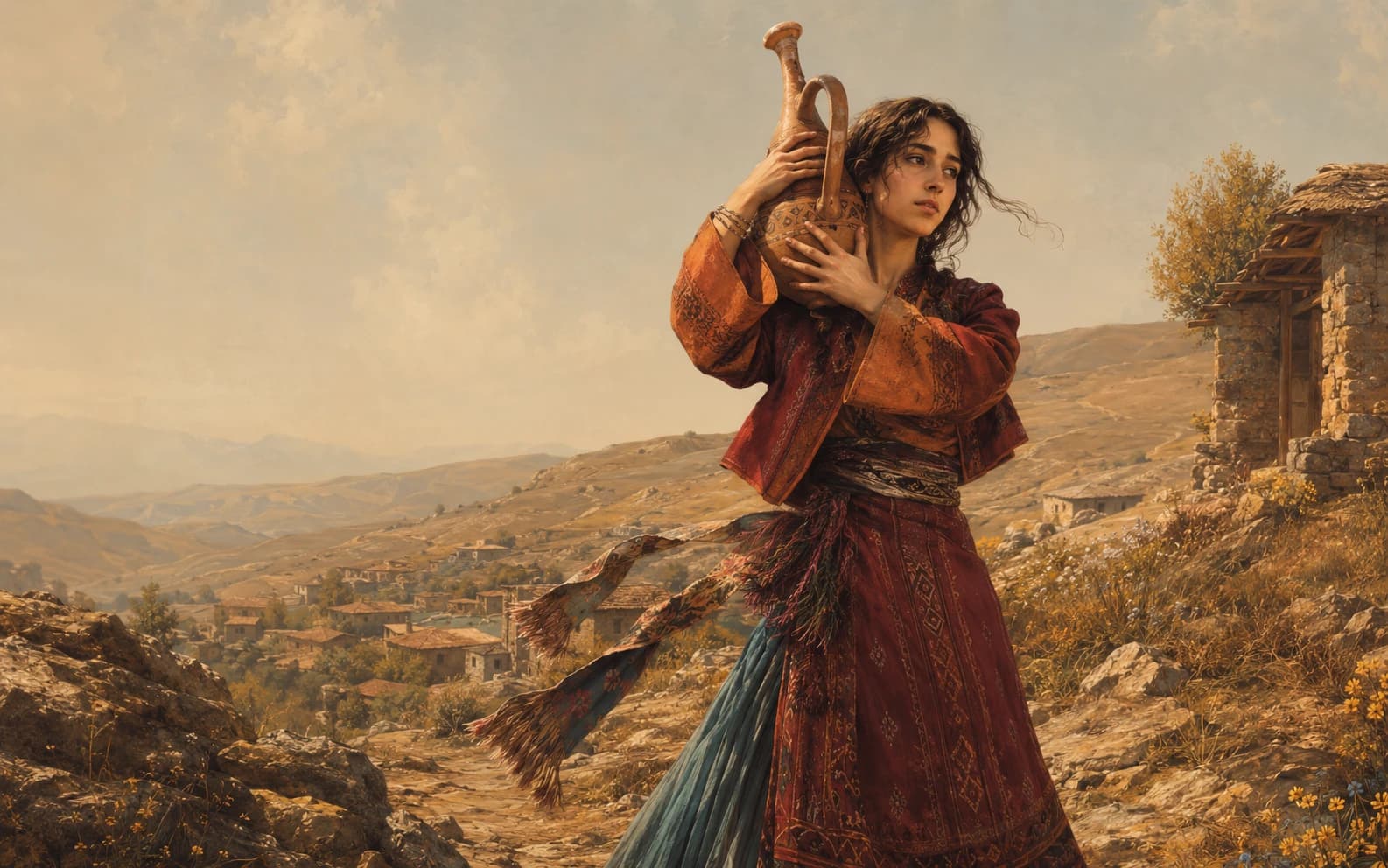
Tumanyan grew up in the Lori highlands of northern Armenia, a region of steep gorges, stone villages and seasonal pastures. In the late nineteenth century, life there was still shaped by clan loyalty, arranged marriage and an unwritten code of family honour that a young man was expected to defend with his body. Tumanyan knew these customs from the inside, and he wrote about them without either mocking them or pretending they were harmless.
The 1890s were also a period when Armenian writers were consciously building a modern national literature in the Eastern Armenian literary language. Rather than imitating European models, Tumanyan turned to village speech, folk song and local legend. Anush was his attempt to give the everyday tragedy of ordinary highlanders the weight and dignity usually reserved for epic subjects.
Tumanyan wrote the first version in 1890 and printed it in 1892 in his second collection of poems, published in Moscow; he had considered sending it to a magazine and was advised to keep it for a book. He was not satisfied with it and kept reworking the poem for another decade. The version completed in 1901 and 1902, and published in the Tiflis collection of 1903, is the one read in schools today and the one that formed the basis of the opera.
Summary of the story
Anush, a young woman from a Lori village, loves Saro, a shepherd who tends flocks in the high pastures. Their love is mutual and openly known among the young people of the village, and the early sections of the poem move through spring festivals, songs and the ordinary joys of highland life. Anush's brother Mosi is a proud young man who takes the family name seriously.
At a village wedding the young men wrestle, and there is a firm local rule: an opponent must never be thrown on his back, because to be pinned that way is a public humiliation. In the excitement of the match Saro forgets himself and throws Mosi flat. The crowd laughs. Mosi rises with the shame burning in him and swears revenge on the man who has disgraced his family before the whole village.
Saro escapes into the mountains and lives there as a fugitive, and Anush, who goes on meeting him in secret, is driven from her father's house. Mosi tracks his sister's beloved down and shoots him. When Anush learns that Saro is dead she loses her reason, wanders the gorges calling his name, and throws herself into the river. The poem closes on the mountains, unchanged and indifferent, and on the village that will keep repeating the same customs.
Main characters
Tumanyan builds the tragedy out of four figures, each of whom acts reasonably by the standards of the world they live in. Nobody in the poem is a villain in the ordinary sense, and that is precisely what makes the ending so painful for readers.
The supporting figures of the village crowd, the old women and the wandering fortune teller form almost a character in themselves, voicing the collective opinion that decides what is shameful and what is honourable.
- Anush: a spirited village girl whose love is total and unguarded; her descent into madness after Saro's death is one of the most famous passages in Armenian poetry.
- Saro: a shepherd, generous and physically confident, whose single careless act in the wrestling ring costs him his life.
- Mosi: Anush's brother, bound by the code of honour; he loves his sister yet kills the man she loves because public shame demands it.
- The mother: Anush's mother, who reads the omens and fears the outcome but has no power to prevent it.
- The fortune teller and the village chorus: voices of custom, superstition and collective judgement that hem the young people in.
Themes and key ideas
The central theme is the collision between individual feeling and inherited custom. Anush and Saro want nothing extraordinary, only to marry, yet the unwritten law of honour turns an accident in a friendly wrestling match into a death sentence. Tumanyan does not preach; he simply shows how a rule that once bound a community together can destroy the people it was meant to protect.
A second theme is the presence of nature as both witness and mirror. The gorges, the spring flowers, the flocks and the river are described with great tenderness, and the same river that carries the songs of the harvest also carries Anush's body away. Nature is not cruel in the poem, but it is entirely indifferent to human grief, which sharpens the tragedy rather than softening it.
Finally, the poem examines the position of women. Anush has no vote in any decision that shapes her life; she cannot stop the wrestling match, cannot protect Saro, cannot choose her own marriage. Her madness is the only form of protest available to her, and Tumanyan presents it with sympathy rather than as a mere plot device.
Language and style
Tumanyan wrote Anush in a clear, musical Eastern Armenian that stays close to the speech of Lori. He uses short lines, strong stresses and a great deal of direct dialogue, so that whole passages can be sung or recited from memory. Generations of Armenian schoolchildren have learned sections by heart, and the opening lines are recognised almost universally.
The poem is built on folk forms. Tumanyan weaves in laments, wedding songs, the calls of shepherds and the seasonal rituals of the village, so the narrative regularly pauses for a piece of communal music. This structure gives the work its operatic shape long before Tigranian set it to music, and it is one reason the adaptation felt so natural.
The imagery is drawn entirely from the highland world: flocks, mist, cliffs, hearth fires and mountain flowers. Tumanyan avoids abstract or bookish vocabulary, and this restraint is deliberate. The plainness of the language makes the moments of extreme emotion, especially Anush's final wandering, land with unusual force.
Legacy and adaptations
Armen Tigranian composed an opera based on the poem, first staged in Alexandropol, today's Gyumri, in 1912. It is generally regarded as the first Armenian opera to draw its melodic material directly from folk song, and it entered the permanent repertoire of Armenian theatres. Arias such as Anush's lament are standards for Armenian singers.
The story has also been filmed several times, staged as ballet, illustrated by leading Armenian artists and set as a school text in both Armenia and the diaspora. Its characters have become shorthand in everyday speech for doomed love and for the destructive side of family pride.
For students today, Anush is often the first serious literary work encountered in the Armenian curriculum. It is short enough to read closely, rich enough to reward discussion, and connected to music, painting and film in ways that make it a natural gateway into the wider tradition.
Important dates
1892
The first version, written in 1890, is printed in Tumanyan's second collection of poems in Moscow.
1901
Tumanyan completes the expanded version of Anush, finished in its final form the following year.
1912
Armen Tigranian's opera Anush premieres in Alexandropol, today's Gyumri.
1935
A revised staging of the opera enters the permanent repertoire of the Yerevan opera house.
1983
A film version of Tigranian's opera is made for television, following a silent feature film of the poem in 1931.
Why Anush matters
Anush is the work in which Armenian literature found a way to be modern and rooted at the same time. Tumanyan took the material of village life, which earlier writers had often treated as picturesque background, and made it the subject of a full tragedy. In doing so he showed that Armenian speech, folk song and highland custom could carry the emotional weight of any European classic.
Its influence reaches far beyond the page. Through Tigranian's opera the poem shaped Armenian musical theatre; through school curricula it shaped how several generations think about love, honour and the cost of tradition. Reading Anush is a way of understanding not only one story but the moment when a national literature came of age.
Interesting facts
- 01Tumanyan reworked the poem for almost ten years before he was satisfied with it.
- 02The wrestling rule that triggers the tragedy was a real custom in the Lori highlands.
- 03Tigranian composed most of the opera while working as a music teacher in Alexandropol.
- 04Anush's lament is one of the most frequently performed arias in Armenian concert repertoire.
- 05The poem is set in the same region where Tumanyan spent his childhood, near the village of Dsegh.
Sources
- A. J. Hacikyan, G. Basmajian, E. S. Franchuk and N. Ouzounian (eds.). The Heritage of Armenian Literature, Volume III: From the Eighteenth Century to Modern Times — Wayne State University Press, 2005 ISBN 9780814332214
- Hovhannes Tumanyan Museum, Yerevan — Museum of Hovhannes Tumanyan Visit sourceHolds the manuscripts, and documents the 1890 first version of Anush, the 1892 printing and the 1901–1902 revision.
Related articles
Hovhannes Tumanyan
The village-born poet whose ballads, fairy tales and quiet moral authority earned him the title Poet of All Armenians.
David of Sassoun
The great Armenian oral epic tells of four generations of Sassoun heroes who defend their mountain homeland against foreign tribute and invasion.
The Fool
Raffi's novel Khente follows a young villager branded a madman for seeing clearly what his neighbours refuse to admit.