
Paruyr Sevak
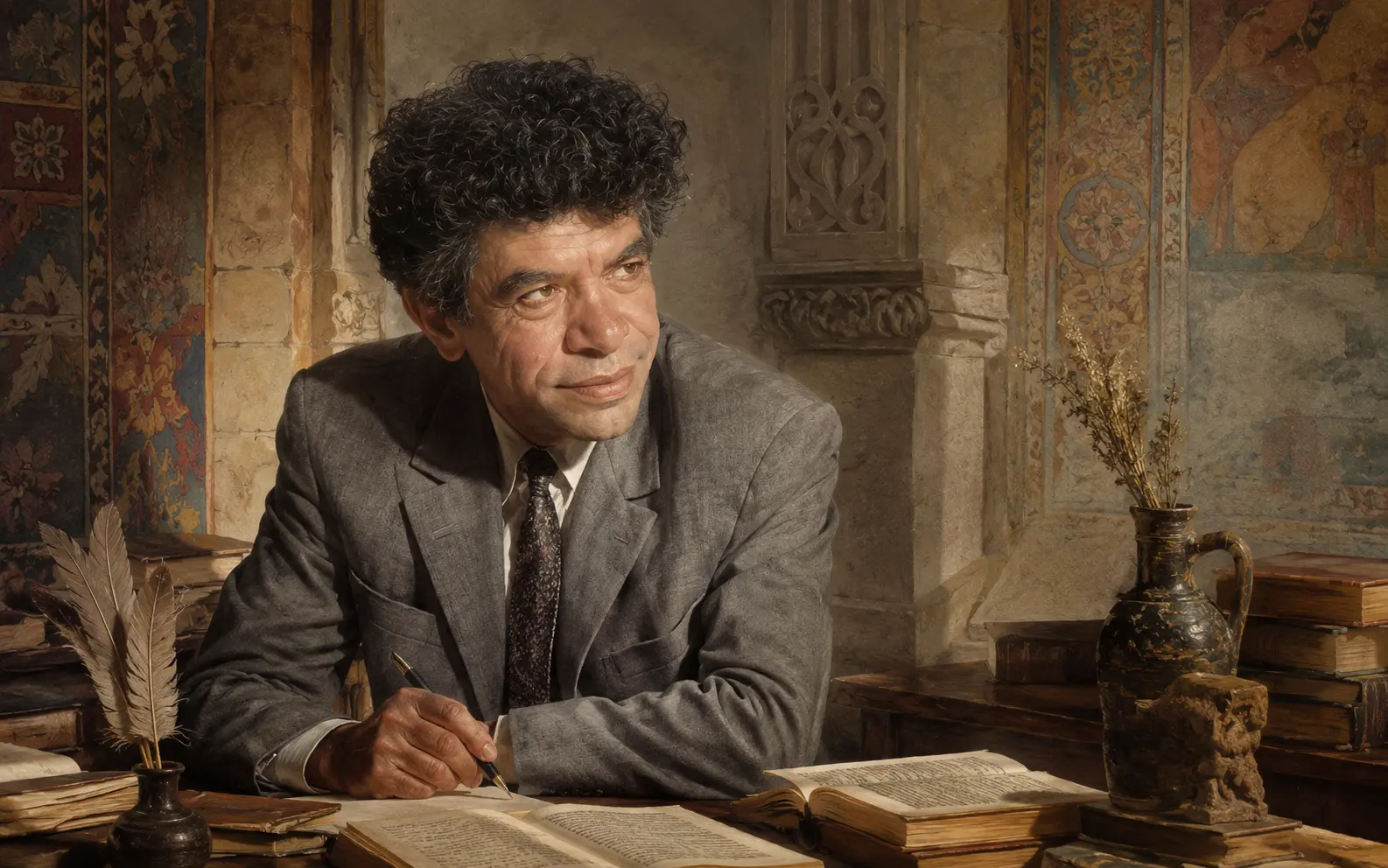
Paruyr Sevak was the leading Armenian poet of the postwar Soviet decades. His long poem about the composer Komitas confronted the Armenian Genocide at a time when the subject was barely permitted in print, and his restless, questioning style renewed Armenian poetry. He died in a road accident in 1971 at the age of forty-seven.
- Author
- Armat Editorial Team
- Updated
- Reading time
- 7 min read
Key facts
- Born
- 24 January 1924, Zangakatun, Ararat province
- Died
- 17 June 1971, in a road accident, aged 47
- Birthplace
- The village of Zangakatun, then called Chanakhchi
- Known for
- The Unsilenceable Belfry and the renewal of Armenian poetry after 1950
- Notable works
- The Unsilenceable Belfry, Man in the Palm of the Hand, Let There Be Light
- Literary period
- Soviet Armenian literature of the postwar decades
Early life and education
Paruyr Ghazaryan was born on 24 January 1924 in Zangakatun, then called Chanakhchi, a village in the Ararat valley south of Yerevan. He grew up in a farming family, and the rural landscape and speech of the region remained present in his poetry throughout his life.
He entered Yerevan State University in 1940 to study Armenian language and literature, graduating in 1945 and continuing with postgraduate research. The editor Ruben Zaryan gave him the pen name Sevak, in memory of the poet Ruben Sevak, who was killed in 1915 — a name that signalled from the start where his literary loyalties lay.
From 1951 to 1959 he studied and then taught at the Gorky Literature Institute in Moscow. The years in Moscow exposed him to Russian and translated world poetry and to the cautious loosening of cultural controls that followed 1953, and he returned to Yerevan with a much wider sense of what a poem could attempt.
Literary career
Sevak published his first collection in 1948 and several more in the following decade, but his mature voice arrived at the end of the 1950s. He worked afterwards as a researcher and then as a senior figure at the Institute of Literature in Yerevan, and he was elected secretary of the Writers Union of Armenia in 1966.
He was also an active translator and critic, writing a substantial scholarly study of the eighteenth-century troubadour Sayat-Nova. His literary criticism argued for honesty and craft against formulaic official verse, and he encouraged younger poets who wanted to write about private experience.
His public standing grew steadily through the 1960s. Readings drew large audiences, his books sold out quickly, and he became one of the few writers whose opinions carried weight with both the intelligentsia and the general reading public.
Major works
The Unsilenceable Belfry, published in 1959, is his central achievement. Built around the life of Komitas, the priest and musicologist whose mind gave way after the genocide, it uses the composer's story to speak about the destruction of Western Armenian life. Published four decades later and years before public commemoration was permitted, it was received as an act of courage as much as a literary work.
Let There Be Light, issued in 1969, collects the poems of his last decade and shows his range: love lyrics, sharp epigrams, meditations on science and history, and poems about ordinary domestic life. Man in the Palm of the Hand, from 1963, gathers his philosophical verse about human responsibility and the individual conscience.
He also wrote the long poem The Three Voiced Liturgy and a body of shorter poems that are widely anthologised. His scholarly monograph on Sayat-Nova, defended as a doctoral dissertation, remains a respected contribution to Armenian literary history.
- The Unsilenceable Belfry, long poem about Komitas, 1959
- Man in the Palm of the Hand, poetry collection, 1963
- Let There Be Light, poetry collection, 1969
- A scholarly monograph on the poet Sayat-Nova
- Numerous translations and critical essays
Themes and style
Sevak wrote about conscience. His poems return to the question of what a person owes to truth, to the dead and to their own convictions, and he treated modern life, science and technology as material for poetry rather than as intrusions upon it. He disliked decoration and preferred a direct, argumentative voice.
Formally he was inventive. He mixed free verse with rhymed stanzas, used long accumulating sentences, broke lines for emphasis and let colloquial speech sit beside high rhetoric. Some contemporaries found the results uneven; readers responded to the sense of a mind thinking aloud on the page.
Memory of the genocide runs through his work, but he approached it through individual figures and specific images rather than through general lament. That method allowed him to write about the subject with a seriousness that abstraction would have blunted.
Death and legacy
On 17 June 1971 Sevak and his wife Nelly were killed in a car crash as they drove back from his native village towards Yerevan. He was forty-seven. The suddenness of the loss, and his prominence as a critical national voice, led to widespread and lasting suspicion that the security services were involved. The only inquiry was a Soviet one, and it recorded a traffic accident; the archives that might settle the question have never been opened. He was buried in the garden of his family house in Zangakatun.
The village home is now the Paruyr Sevak House Museum. Schools, streets and a literary prize carry his name, and his poems are standard reading in Armenian classrooms.
His lasting importance lies in what he made sayable. By writing The Unsilenceable Belfry when he did, he helped move remembrance of 1915 from private grief into public culture, a shift that fed directly into the commemorations of 1965 and the building of the memorial at Tsitsernakaberd.
Important dates
1924
Born Paruyr Ghazaryan in the village of Chanakhchi.
1945
Graduates in Armenian philology from Yerevan State University.
1951
Moves to Moscow to study at the Gorky Literature Institute.
1959
Publishes The Unsilenceable Belfry, his poem about Komitas.
1966
Elected a secretary of the Writers Union of Armenia.
1971
Dies in a car accident near his native village.
Why Paruyr Sevak matters
Sevak restored intellectual seriousness to Armenian poetry after decades in which much published verse had been cautious and formulaic. He argued in both poems and essays that literature must be honest about difficulty, and he demonstrated it by writing openly about grief, doubt and moral responsibility.
His treatment of the genocide was decisive for public memory. The Unsilenceable Belfry gave a subject that had been largely unspoken in Soviet Armenia a language and a central symbol in the figure of Komitas, and it prepared the ground for the commemorations and the memorial that followed in the 1960s.
Interesting facts
- 01He took his pen name from Ruben Sevak, a young Armenian poet killed in 1915.
- 02His doctoral research on the eighteenth-century troubadour Sayat-Nova is still cited by scholars.
- 03The Unsilenceable Belfry appeared six years before the 1965 demonstrations that pushed for public recognition of the genocide.
- 04His native village of Chanakhchi now bears the name Zangakatun, meaning belfry, the same word as the title of his most famous poem.
- 05He is buried in the garden of his family home, which now serves as his house museum.
Sources
- A. J. Hacikyan, G. Basmajian, E. S. Franchuk and N. Ouzounian (eds.). The Heritage of Armenian Literature, Volume III: From the Eighteenth Century to Modern Times — Wayne State University Press, 2005 ISBN 9780814332214
- Marc Nichanian. Writers of Disaster: Armenian Literature in the Twentieth Century — Gomidas Institute, Princeton and London, 2002 ISBN 9781903656099
Related articles
Yeghishe Charents
A restless modernist poet whose bold experiments and fierce love of Armenia made him the defining literary voice of his generation.
Hovhannes Tumanyan
The village-born poet whose ballads, fairy tales and quiet moral authority earned him the title Poet of All Armenians.
David of Sassoun
The great Armenian oral epic tells of four generations of Sassoun heroes who defend their mountain homeland against foreign tribute and invasion.