
Daniel Varoujan
Daniel Varoujan published his first book at twenty-two and the last one he lived to see at twenty-eight. He was arrested in Constantinople in the spring of 1915 and killed that August. The collection he was working on appeared only in 1921, printed from a manuscript whose survival nobody has ever fully explained. He is one of the two or three writers at the heart of modern literary Western Armenian, yet he is more often summed up by his death than read for his work.
- Author
- Armat Editorial Team
- Updated
- Reading time
- 18 min read
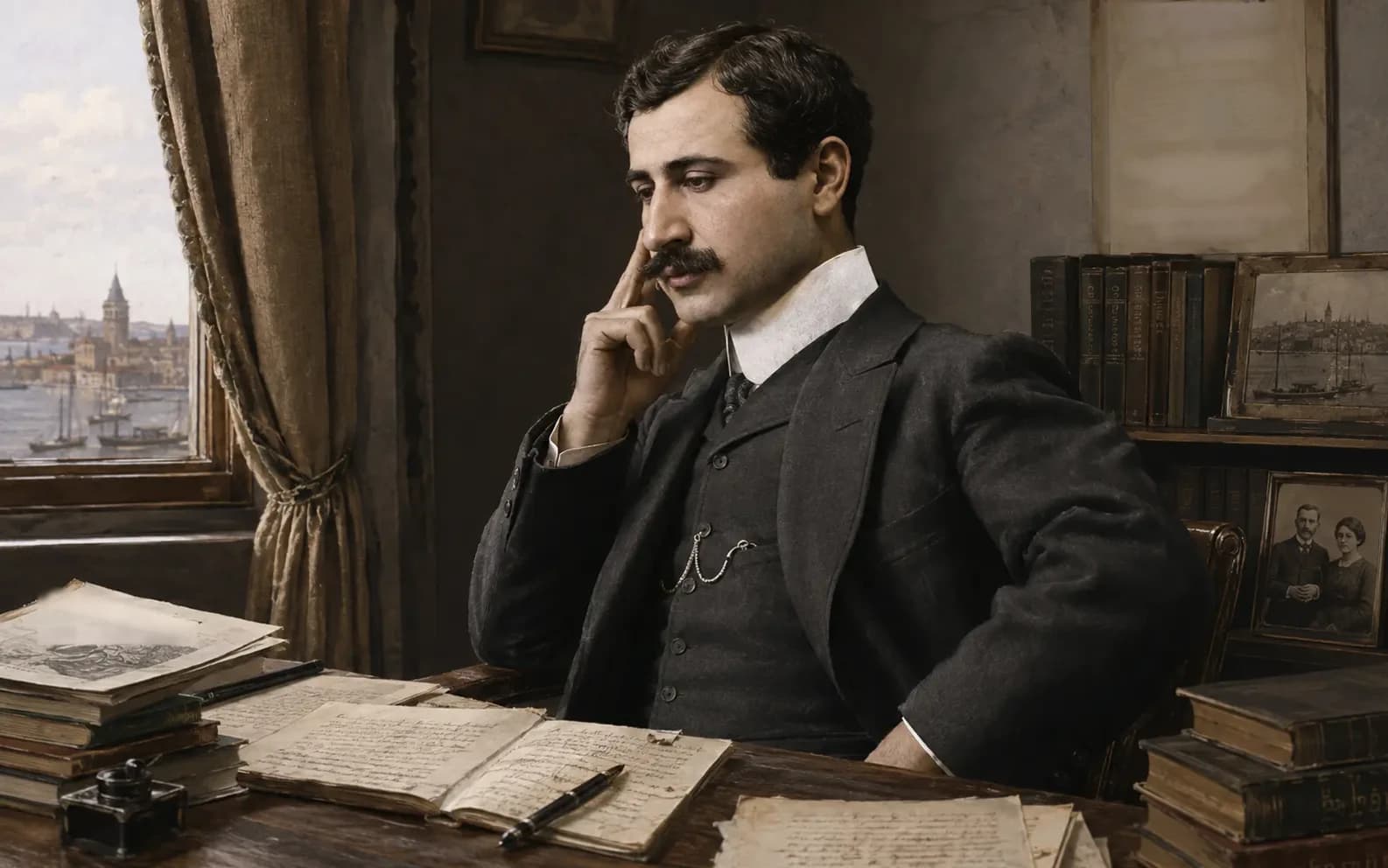
In brief
Daniel Varoujan was a Western Armenian poet, born in the village of Brgnik in the district of Sebastia in the Ottoman Empire. He was educated at Mkhitarist schools in Constantinople and Venice and then at the University of Ghent. Between 1906 and 1912 he published three collections, Sarsurner, Tsegin sirte and Hetanos erger. A fourth, Hatsin ergi, was left unfinished and printed after his death in 1921. He wrote in Western Armenian and worked to widen what it could do as a literary language, taught school, and joined the Mehean group in 1914. He was arrested in Constantinople on 24 April 1915 and killed the following August.
Key facts
- Lived
- 20 April 1884 to 26 August 1915
- Born
- Brgnik, in the district of Sebastia (Sivas), Ottoman Empire
- Wrote in
- Western Armenian
- Educated at
- Mkhitarian school at Chalcedon; Moorat-Raphael College, Venice; University of Ghent
- Best known for
- Հացին երգը, The Song of the Bread, published after his death in 1921
- Also written
- Daniel Varujan, Taniel Varoujan; born Chpugkyarian
Who Daniel Varoujan was
Daniel Varoujan was a poet of the Ottoman Armenian world who wrote in Western Armenian. He published three collections between 1906 and 1912 and left a fourth unfinished when he was arrested in 1915. He was also a schoolteacher and a school principal, and that matters to the poetry. Teaching was how he earned his living for most of his adult life, and the schools he taught in were where the literary language he wrote in was passed on.
He was born Daniel Chpugkyarian and took Varoujan as a pen name early on. The surname is spelled several ways, depending on the Armenian spelling system and the romanisation. It is Չպուգքյարյան in modern Eastern spelling and Չպուգքեարեան in the classical spelling his own branch of the language uses, and it reaches English as Chboukkiarian, Tchboukkiarian and other forms. None of these is the single correct version. They are the same name passing through different systems.
Almost every short account of him is built around 1915. That is understandable, but it distorts the picture. It puts the last four months of his life ahead of the nine years of work that are the reason anyone looks him up. This article starts with the poetry and reaches the arrest when the story does.
Brgnik and the world of Sebastia
Varoujan was born on 20 April 1884 in Brgnik, a village in the district of Sebastia. Sebastia is Sivas in Turkish, and it was the administrative centre of the Ottoman province of the same name. The village name is also written Prgnik and Perknik. That is the usual result of moving Armenian consonants into Latin script, not a dispute about the place.
Sebastia was one of the large Armenian centres of the Ottoman interior, with its own schools, printing, dialect and church organisation. Describing that world takes some care with words. Armenians called this cultural region Western Armenia. The phrase is historical, not a modern invention, but it names a cultural and demographic region, not a state or a province with those borders. Armat uses the Ottoman administrative names for places and the Armenian names for the culture, because that is what the sources do.
His father worked away from home in Constantinople. That was a common pattern for men from the interior provinces, and it is why the family had a link to the capital at all. Several popular biographies attach vivid stories to this period, such as an imprisoned father or a childhood shadowed by a specific atrocity, and the more dramatic of them are hard to trace to any source. Setting those aside, his childhood fell in the decade of violence against Ottoman Armenians in the eighteen-nineties, and Sebastia lay inside the affected region. His family's ability to send him to school in the capital shaped everything that followed.
Constantinople and the Mkhitarian schools
He was sent to Constantinople and educated at the Mkhitarian school at Kadıköy, on the Asian shore of the city, the district Armenians called Chalcedon. The Mkhitarists were an Armenian Catholic order of monks. Their schools in Constantinople and Venice were among the most demanding Armenian schools of the time, and their curriculum is the key to how Varoujan was formed. It taught classical Armenian alongside the modern language, and it taught European literature in the original.
His earliest surviving literary attempts date from these school years. His first verses were published in 1901 in a handwritten student paper, Ardzagank Motayi. The detail is worth giving exactly, because it is a documented date and not a vague impression of early talent.
The reference books are confused on one point here. Different encyclopedias name different Mkhitarian schools for these years, and some give the Sakızağacı school in the European part of the city instead. The Armenian sources that go into detail place his boarding-school years and his first published verse at Chalcedon, and this article follows them.
Venice and the first collection
In 1902 he moved to the Moorat-Raphael College in Venice, the Mkhitarist school attached to the monastery on the island of San Lazzaro. San Lazzaro had been the order's centre of Armenian scholarship and printing since the eighteenth century. Studying there meant living inside a working centre of language scholarship, which was much more than a school abroad.
His first collection, Սարսուռներ, was printed at San Lazzaro in 1906. It was a short book of about forty pages, published where he had studied. The title is usually given in English as Shivers or Tremors. Both try to catch a word that means something closer to a physical shudder passing through the body.
Scholars do not dismiss it as juvenilia. The sensory vocabulary that defines his later work is already there, though not yet organised. The gap between this book and the one that followed three years later shows clearly how fast he developed.
The years in Ghent
In 1905 Varoujan entered the University of Ghent in Belgium on a scholarship, and he stayed there until 1909. Short biographies usually squeeze this period into a single clause, yet it is unusually well documented. The essays gathered by the historian Simon Payaslian include archive lists of his expenses in the city, down to rent and household items, alongside the thirty-nine poems he wrote there.
Sources describe what he studied in slightly different ways. The commonest version is that he took courses in literature, sociology and economics; Western Armenian accounts often say economics and political science. Both can be true of the same course of study, so Armat gives the range instead of picking whichever sounds most precise.
One claim should be left out. The sources show that he studied at Ghent for four years; they do not establish that he completed a degree there, and the biographies that give him one do not say where the claim comes from. He returned to the Ottoman Empire in 1909, and that date is certain.
European reading and its traces
He spent four years at a Belgian university at the height of European symbolism, and scholars can point to the marks it left in the writing itself, not just guess at them from the dates. The influence most often argued for is Nietzsche. His reception in Armenian letters in the early twentieth century is a subject of study in its own right, and his vocabulary of strength, vitality and self-overcoming gave Varoujan words for what he was trying to say about beauty and the body.
Influences are only worth naming if you can see them at work. What Varoujan took from his European reading was less a set of opinions than a licence. It gave him permission to write a poetry of physical sensation and pre-Christian imagery in a literary language used mainly for religious, instructional and patriotic writing. Marc Nichanian's study of the period argues that he had to invent a language to carry a pantheistic experience, and that certain parts of Nietzsche helped him do it.
Lists of movements are easy to make and hard to defend. So this article names only the influences that scholars tie to specific features of the work. It does not credit him with absorbing every current that happened to be fashionable in Europe while he was there.
Teaching, marriage and the capital
He came back in 1909 and taught for about three years in the Sebastia region, in and around the villages he had come from. In 1912 he married Araksi. Around the same time he moved to Constantinople, where he became principal of the school of St Gregory the Illuminator.
The teaching fed straight into the poetry. His years in the villages of the interior come between the urban, literary first books and the farming material of the collection he began afterwards. The link is one of chronology, not sentiment: he wrote about sowing and harvest after living where sowing and harvest happened.
The four collections
Four books carry his reputation. Սարսուռներ appeared at San Lazzaro in Venice in 1906; Ցեղին սիրտը in Constantinople in 1909; Հեթանոս երգեր in Constantinople in 1912; and Հացին երգը in Constantinople in 1921, six years after his death. Everything else sits around these: occasional verse, criticism, letters and the unfinished narrative poems.
The English titles are not settled. Հեթանոս երգեր is reliably Pagan Songs and Հացին երգը is reliably The Song of the Bread. But Սարսուռներ appears as both Shivers and Tremors, and Ցեղին սիրտը has been printed as The Heart of the Race, The Heart of the Nation and The Heart of the Tribe. Where translations differ, this article says so instead of picking one and presenting it as the standard.
The second book changed his standing. Ցեղին սիրտը is a long collection about shared history, oppression and endurance, and Armenian critics see it as the moment Western Armenian poetry found a new register. It is also the book read most ideologically, from both sides, which is why what follows is about a single word in its title.
The word in the title
Ցեղ, the word in Ցեղին սիրտը, is why the title resists translation. In Armenian literary usage of the early twentieth century it means a people, a stock, a lineage. English once carried the same sense in phrases like the English race, before the word narrowed. It is not the vocabulary of biological racial theory, and reading it that way imposes ideas that came after the poem.
The three English versions in circulation show the problem. Race, Nation and Tribe are three attempts to catch a word that sits between them, and each loses something. Race carries associations that Varoujan's usage does not. Nation implies a political state that did not exist. Tribe suggests something smaller and more archaic than he meant.
So Armat prints the Armenian title, gives the existing translations, and explains the difficulty instead of quietly settling it. This is not a defensive footnote. Any serious reader of the book will run into this translation problem, and it deserves a plain explanation.
Pagan Songs and poetic paganism
Հեթանոս երգեր, published in 1912, is his most influential book and the one most often misdescribed. Its poems draw on pre-Christian imagery, on classical and Near Eastern antiquity, and on the physical world: bodies, light, heat, appetite, strength. They treat beauty and vitality as worth a poem for their own sake, not as illustrations of a moral.
The paganism is a literary and aesthetic programme, not a religious conversion. Varoujan did not renounce Christianity or try to revive an ancient cult, and no source suggests he wanted to. He used what he called poetic paganism to reach a register the Armenian literary tradition had mostly held back from. It was sensual, physical and unembarrassed by the body, and it saw force as a source of beauty instead of a moral problem.
The distinction matters because a modern Armenian religious movement, Hetanism, does exist and does revive pre-Christian worship. It was founded in the nineteen-nineties, generations after Varoujan died. The shared vocabulary is a coincidence of translation, not a line of descent.
Mehean and cultural renewal
In 1914 Varoujan and four other writers, Gostan Zarian, Hagop Oshagan, Kegham Parseghian and Aharon Dadourian, founded Mehean, a literary group and monthly review in Constantinople. The name means a pagan temple, and it tells you what the group thought it was doing. Its founders saw their culture as scattered, and they set out to build it a centre, a temple of art.
Its manifesto announced the worship and the expression of the Armenian spirit, and argued that without that spirit there is no Armenian literature and no Armenian artist. We know what part Varoujan played in writing it. By Zarian's own account, Zarian drafted most of the text in French, and Varoujan completed it and translated it into Armenian.
Its size should not be exaggerated. Mehean ran for a matter of months in 1914, produced a small run of issues, and broke up amid disagreements among its founders; Varoujan himself left before the end. It mattered as a programme stated at the right moment, not as a long-lived institution. It is also easy to file it away as a nationalist literary circle, and that label sells it short. Its argument was at least as much about artistic independence and cultural self-definition as about the nation.
The Song of the Bread
Հացին երգը is the book he was writing when he was arrested, and it is the one most readers meet first. It follows the farming year, through ploughing, sowing, harvest, threshing, the mill and the oven, and treats each stage as worthy of formal poetry. The labour, and the bodies of the people doing it, stay in the picture instead of being tidied away.
It is more than a pastoral cycle because the dignity lies in the work itself. The land is not scenery and the villagers are not types. The poems are about effort, about grain turning into bread through human labour, and about a physical world that yields to that effort and rewards it. The same interest in the body and in strength runs through Հեթանոս երգեր; here it moves from myth to the field.
The book was unfinished when he died, and the published version is the manuscript as it stood, not a completed design. Armat has an article on lavash, and it is tempting to link the two, but this article does not. A literary symbol of bread and a flatbread tradition are different subjects, and a reader sent from one to the other would learn nothing about either.
Western Armenian as a literary language
Varoujan wrote in Western Armenian, and this is not a detail of spelling. Western and Eastern Armenian are two standard forms of the same language, each with its own pronunciation, verb system and vocabulary. By Varoujan's lifetime each had its own literature, press, schools and readers. Western Armenian was the language of the Ottoman Armenian world; Eastern Armenian was the language of the Russian Caucasus.
He widened what the language could do. Scholars of the Mehean circle say that refining Western Armenian into a language of art was one of the group's stated aims, and they see Varoujan's poetry as the clearest example. He wrote a dense, sensuous, richly coloured Armenian while the standard was still taking shape. Much of what later writers could do in the language, they could do because he had shown it was possible.
The other branch makes the contrast clear. Hovhannes Tumanyan was writing in Eastern Armenian in exactly the same years, aiming for the opposite ideal: plainness, the rhythm of speech, the folk tale. Together they mark the range of Armenian poetry in a single decade, and Armenian scholars have compared their views of language directly. Within a few years one tradition would lose its territory and most of its readers. That imbalance is why the two names are not equally famous today.
Arrest, deportation and death
On 24 April 1915 Varoujan was arrested at his home in Constantinople and his papers were confiscated. He was one of several hundred Armenian writers, editors, clergy, teachers and community leaders seized in the capital that night and over the following days. The operation removed the intellectual leadership of the Ottoman Armenian community at the start of the Armenian Genocide. That date is now commemorated as the beginning of the genocide, and it is the date of the arrests, not of his death.
He was deported inland and held for about four months at Çankırı, in the province of Kastamonu. On 26 August 1915 he was killed, together with four other detainees, while being moved from Çankırı toward Ankara. The source for the place and the circumstances is the memoir of Grigoris Balakian, who was held in the same group and survived. Varoujan was thirty-one.
Armat states this and does not illustrate it. Detailed eyewitness accounts of how he and the men with him died exist and are widely reproduced, sometimes for no reason except their power to shock. They are not needed to understand either the history or the poetry, and this is a biography of a writer.
What was lost, and what survived
The loss was not only of one man. Ruben Sevak, another Western Armenian poet, was killed with him, and Kegham Parseghian of the Mehean group was killed the same year. Within a few years the Ottoman Armenian literary world lost its writers, its editors and its readers. Western Armenian went from being the everyday language of a large population, with its own presses and schools, to being a diaspora language, which it still is.
Հացին երգը survived. The manuscript was confiscated when he was arrested, and it reached print in Constantinople in 1921. How it got from one to the other is unclear. The version repeated almost everywhere is that it was recovered by bribing Ottoman officials, but the story circulates without a named source or a named go-between. Armat records it as a tradition, not as established fact. What nobody disputes is that the book exists.
His reputation since has been steady but somewhat divided. Soviet Armenian scholarship made him a classic, but read him through the categories of social protest and national liberation, which fit some of the work and flatten the rest. The focus on beauty, labour and the body in the last two books cannot be reduced to politics. Later criticism, including work that reads him alongside Yeghishe Charents, has been recovering the parts the earlier approach had little use for.
Important dates
1884
Born on 20 April in Brgnik, in the district of Sebastia.
1901
First verses published in a handwritten student paper at the Mkhitarian school at Chalcedon.
1902
Enters the Moorat-Raphael College in Venice.
1905
Enters the University of Ghent on a scholarship.
1906
Սարսուռներ printed at San Lazzaro in Venice.
1909
Returns to the Ottoman Empire; Ցեղին սիրտը published in Constantinople.
1912
Հեթանոս երգեր published in Constantinople; marries Araksi.
1914
Founds the Mehean group and review with four other writers.
1915
Arrested in Constantinople on 24 April; killed on 26 August near Çankırı.
1921
Հացին երգը published in Constantinople from the unfinished manuscript.
Why Daniel Varoujan matters
Varoujan is one of the writers who decided what Western Armenian poetry could sound like. In nine years he moved it beyond a mostly devotional and patriotic register into one that could carry physical sensation, classical imagery and the dignity of manual labour. He did it while the standard language itself was still being settled.
He also marks the point where that literature was cut off. Within a decade of his death, the tradition he was extending lost its territory, its institutions and most of its readers. Western Armenian became a language kept up by a scattered population, no longer spoken by a settled one. Reading Varoujan is one of the few direct ways to hear that literature at full strength.
Interesting facts
- 01His first published poems appeared in 1901 in a handwritten school paper, not in a printed journal.
- 02Simon Payaslian's archival work on his years in Belgium includes lists of his rent and household expenses alongside the thirty-nine poems he wrote in Ghent.
- 03Mehean means a pagan temple: the group named itself after the thing it wanted to build.
- 04Ցեղին սիրտը has been published in English as The Heart of the Race, The Heart of the Nation and The Heart of the Tribe.
- 05Հացին երգը was confiscated when he was arrested and printed in 1921; nobody has ever documented how the manuscript survived.
- 06Ghent held a commemoration for him in 1958, more than forty years after his death.
Sources
- A. J. Hacikyan, G. Basmajian, E. S. Franchuk and N. Ouzounian (eds.). The Heritage of Armenian Literature, Volume III: From the Eighteenth Century to Modern Times — Wayne State University Press, 2005 ISBN 9780814332214The section's backbone series, at the volume that covers him — the same volume the six modern writers here cite, and the tenth article to rest on it. Carries the literary-historical placement: Varoujan inside the Western Armenian tradition rather than as an isolated figure, and the four collections as a development rather than a list.
- Marc Nichanian, translated by G. M. Goshgarian and Jeff Fort. Mourning Philology: Art and Religion at the Margins of the Ottoman Empire — Fordham University Press, 2014 ISBN 9780823255245The source of record for the two hardest sections. It is where the argument comes from that Varoujan had to invent a language to carry a pantheistic experience, that the aestheticisation of literary Western Armenian was an explicit aim of the Mehean circle, and that the group's paganism was an aesthetic programme rather than a religious position. Cited for the literary and intellectual reading, not for the chronology.
- Grigoris Balakian, translated by Peter Balakian with Aris Sevag. Armenian Golgotha: A Memoir of the Armenian Genocide, 1915–1918 — Alfred A. Knopf, 2009 ISBN 9781400096770The primary witness for where and how Varoujan died: Balakian was deported in the same group, survived, and wrote the account every later source depends on. Cited for the date, the transfer from Çankırı and the fact that four other detainees were killed with him — and for nothing else. The memoir contains far more detail than this article uses, and the omission is deliberate.
- Հայկական սովետական հանրագիտարան, հատոր 11 (Armenian Soviet Encyclopedia, volume 11). Վարուժան, Դանիել — encyclopedia entry, via Armenian Wikisource — Armenian Soviet Encyclopedia, 1985 Visit sourceThe Armenian-language biographical spine: the Chalcedon boarding school, the 1901 student paper, the publication cities, and the naming of beauty, strength and labour as the substance of the work — a framing this article follows because it is better than the political one. Its interpretive apparatus is Soviet and is treated as interpretation: the article reports the national-liberation reading as a reading rather than adopting it.
- Christopher Atamian, on the archival work of Simon Payaslian. A Critical Exclusive — Daniel Varoujan: An Armenian Poet in Ghent — The Armenian Mirror-Spectator, 2020 Visit sourceThe reason the Ghent section can say anything concrete. Reports Payaslian's archival lists — rent, household expenses, the thirty-nine poems written in the city — from essays published bilingually in French and Flemish. Cited for what it documents and used as the reason the article refuses to award him a degree: it establishes four years of study and no completion, and no source that grants him one names its authority.
- Յուրի Ավետիսյան (Yuri Avetisyan). Արևելահայերենի և արևմտահայերենի զուգադրական քերականություն (Comparative Grammar of Eastern and Western Armenian) — Yerevan State University, via ARAR, 2019 Visit sourceCited so that the article's central linguistic claim rests on grammar rather than on assertion: Western and Eastern Armenian differ in pronunciation, verb system and vocabulary, and are two standard forms of one language rather than two spellings of it. The distinction matters here more than anywhere else in the archive, because the subject wrote in one of them and this edition of the article is written in it.
Related articles
Hovhannes Tumanyan
The village-born poet whose ballads, fairy tales and quiet moral authority earned him the title Poet of All Armenians.
Yeghishe Charents
A restless modernist poet whose bold experiments and fierce love of Armenia made him the defining literary voice of his generation.
Raffi (Hakob Melik-Hakobian)
The novelist who invented the Armenian historical novel and used fiction to argue that a nation must act to save itself.