
Nerses Shnorhali
Nerses Shnorhali is one of the two medieval writers in this section, and the one whose work you are most likely to have heard already without knowing it was his. He wrote in the twelfth century, in the Armenian world that had rebuilt itself along the northern edge of the Mediterranean after the old kingdoms were lost. And he wrote a great deal: narrative verse, laments, a long devotional poem, prayers, letters, and hymns that are still sung in Armenian churches. For the last seven years of his life he also led that church. This article is about the writer first.
- Author
- Armat Editorial Team
- Updated
- Reading time
- 17 min read
In brief
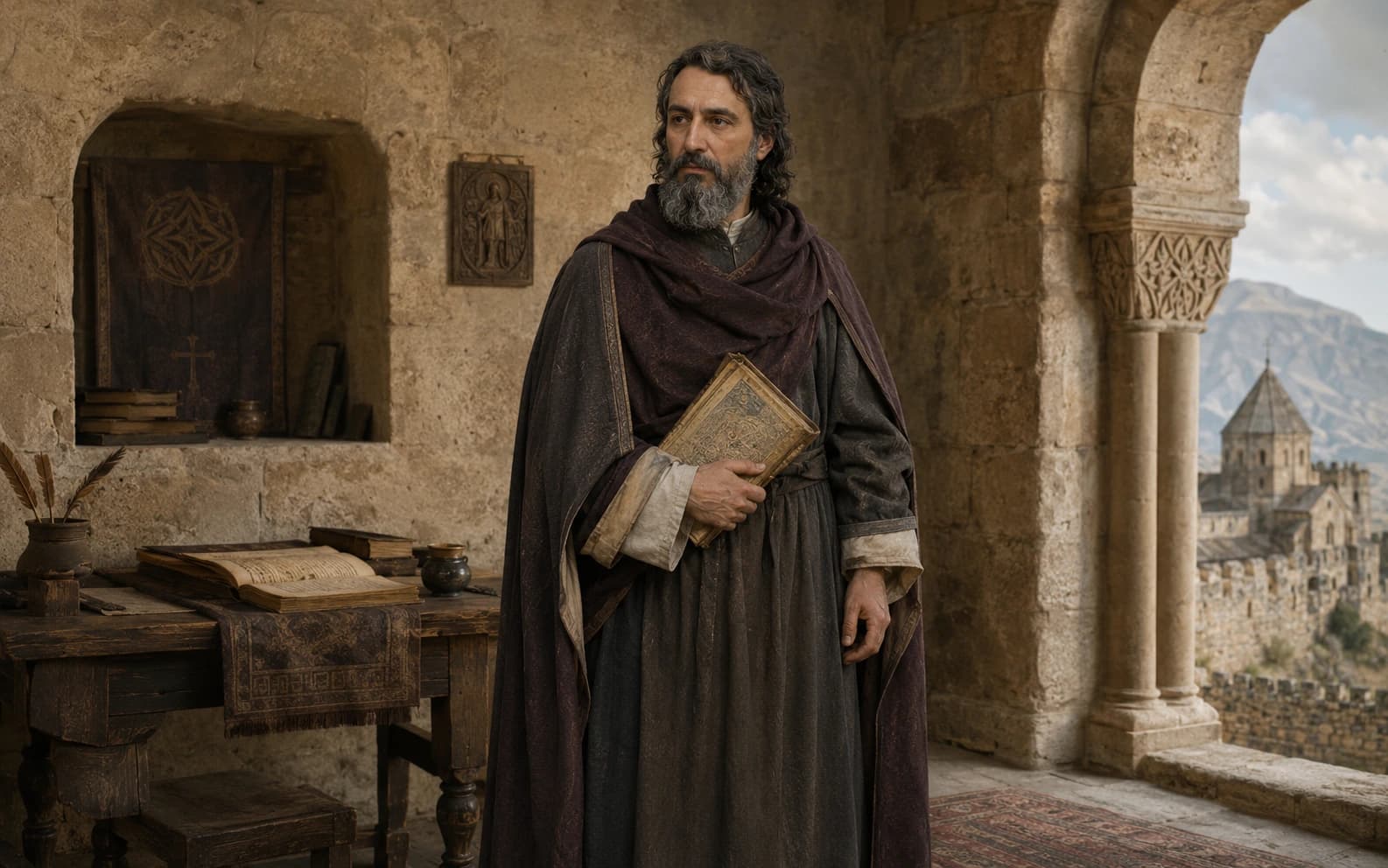
Nerses Shnorhali (about 1102 to 1173) was a twelfth-century Armenian poet, hymn writer and letter writer, and Catholicos of the Armenian church from 1166 until his death. He wrote a verse history of Armenia more than a thousand lines long in which every line carries the same rhyme. He also wrote a long lament on the fall of Edessa, a book-length poem called Jesus the Son, a prayer of twenty-four stanzas that is still recited, and hymns that entered the Armenian liturgy. He is called Shnorhali, meaning graceful or full of grace, an epithet he was given, not one he inherited.
Key facts
- Lived
- About 1102 to 1173; the birth year is approximate, the death date is not
- Where
- Born at the fortress of Tsovk; died at Hromkla on the Euphrates
- Wrote in
- Classical Armenian (grabar), with a plainer register in some minor verse
- Best known for
- The Lament on Edessa, Jesus the Son, and the prayer I Confess with Faith
- Also called
- Nerses the Graceful, Nerses IV, Nerses Klayetsi
- Church office
- Catholicos of the Armenian church, 1166 to 1173
Who Nerses Shnorhali was
Nerses Shnorhali was a twelfth-century Armenian poet, hymn writer and correspondent. From 1166 until his death in 1173 he was also Catholicos, the head of the Armenian church. Both descriptions are accurate, but this article does not give them equal weight. He wrote for roughly half a century and held the office for seven years, and the writing is why he belongs in a section about writers.
His work covers more ground than the label religious poet suggests. It includes a verse history of Armenia written for students, a lament on the destruction of a city, a long poem retelling scripture and church history, a prayer in twenty-four stanzas, hymns for the church year, riddles and short teaching pieces, an encyclical letter, and a large correspondence with the Byzantine court. That range matters. He wrote to teach, to mourn, to argue and to be sung, and each kind of writing has its own register.
He is also a saint of the Armenian Apostolic Church, and most English-language writing about him focuses on that and on his negotiations with Constantinople. Both belong to his life and are covered below. But a reader who knows him only as a holy man and a church diplomat has met the smaller part of him. The poems are why his name survived.
The name, and what Shnorhali means
His birth name is not known. Nerses is the name he took when he was ordained a priest. That was ordinary practice, but it means the name on all his work was chosen in adulthood, not given at birth.
Shnorhali is not a surname either. It is an epithet built on the Armenian word for grace. English usually renders it as the Graceful or the Gracious, though full of grace is closer to the sense. Why it attached to him is not settled. Some explain it as an honorific given to graduates of the school where he trained, others as a description of his character, his speech and his writing. The sources offer both and do not decide between them. Neither does this article: the meaning of the word is clear, but the reason it was given to him is not.
Two more names appear in the literature. Nerses IV is his number as Catholicos and belongs to the office, not to the poet. Nerses Klayetsi means Nerses of Kla, after Hromkla, the fortress that was the seat of the catholicosate, where he lived and died. It is the same place-adjective habit that gives Grigor Narekatsi his name. He should not be confused with Nerses of Lambron, a different and later Cilician writer who outlived him by twenty-five years.
A family that held the office, and a literary inheritance
He was born into the Pahlavuni family, which supplied the Armenian catholicosate more or less continuously from 1066 to 1203. His father was the prince Apirat Pahlavuni. His elder brother became Catholicos Gregory III, and his mother's uncle had been Catholicos Gregory II. Listed like this, the family sounds like a dynasty of officeholders, and in part it was. It also means he grew up in a household where books, letters and church politics were part of everyday life.
For this article the more important ancestor is Grigor Magistros, the eleventh-century prince, scholar and writer from whom the family descends, remembered for his letters and his verse. Sources differ on exactly how many generations separate the two men. What matters is that Nerses inherited a family tradition in which a nobleman was expected to write, and not merely to pay for writing.
He and his brother were sent as boys to Karmir Vank, the Red Monastery, in the region of Kesun and Shughr. There they were taught by the monk Stepanos Manuk, whom the sources describe as a respected scholar and theologian. He was ordained priest at about seventeen and consecrated bishop at about thirty-five. His education was the standard monastic one of the period: scripture, the church fathers, grammar and the mechanics of verse. That is where he gained the technical command his poetry shows.
Tsovk, Hromkla and the Cilician world
He was born at a fortress called Tsovk, and where exactly it stood is disputed. Some place it in the district of Tlouk, toward Cilicia; others further east, in the historic province of Sophene near modern Elazığ. Either way, he was born in the upper Euphrates country, not in Cilicia proper. The difference matters, because the whole world he grew up in moved west, not only him.
The catholicosate itself was on the move. It settled at Tsovk in 1125 under his brother, and around 1149 to 1151 it moved again, to Hromkla, a fortress above the Euphrates (Rumkale in Turkish, Հռոմկլա in Armenian, sometimes written Hromgla in English). His brother established it there, so Nerses inherited a seat that was already fixed. It remained the centre of the Armenian church until Hromkla fell in 1292, after which the seat went to Sis. Hromkla is where he lived as Catholicos, where he received the imperial embassy of 1171, where he wrote, and where he is buried.
One term needs care. In his lifetime the Armenian presence in Cilicia was a principality under the Rubenid house, not a kingdom. It became a kingdom only in 1198, when Levon was crowned, twenty-five years after Nerses died. Calling him a poet of the Kingdom of Cilicia, as people often do, places him in a state that did not yet exist. The Armenian Cilicia he knew was a rising lordship among crusader counties, Byzantine claims and Turkish emirates, and his generation was still building its cultural confidence, not inheriting it.
From priest to Catholicos
For most of his adult life he worked beside his brother, not in his own right: as priest, as secretary, and from about 1137 as bishop. Nearly all the poetry was written in these years, which reverses the usual shape of such a career. He was not a churchman who took up writing late. He had been a writer for thirty years before the office came to him.
His public work in those years was diplomatic and pastoral. He took part in a synod at Antioch in 1138. In 1165 he was asked to mediate between Thoros II, the Rubenid prince, and Oshin of Lambron in a quarrel between Armenian lords. The episode is a reminder that Cilician Armenian politics was fractious, and that a bishop known for his tact was a useful instrument in it.
He succeeded his brother as Catholicos in 1166 and held the office until he died on 13 August 1173. The sources are firm on that death date but not on his birth year, which is given as about 1100, 1101 or 1102; Armenian tradition names 4 June 1102. This article uses about 1102 and keeps the approximation visible, because a confident single birth date would be an invention.
The range of his writing
The work that is securely his falls into a few clear groups. There is narrative and historical verse, the largest piece of which is the verse history of Armenia. There is poetry for particular occasions and in memory of events, above all the Lament on Edessa. There is long devotional verse, chiefly Jesus the Son. There are prayers and hymns, including the twenty-four-stanza I Confess with Faith and a body of sharakans that entered the liturgy. And there is prose: an encyclical letter, statements of doctrine, and a large correspondence.
A commentary on Genesis is credited to him but has not survived, a reminder that what survives is not everything he wrote. Shorter pieces, such as riddles and brief teaching verse, are also attributed to him. This is the part of the corpus where attribution is least secure, so they are named here as attributed rather than counted as certain.
No total is given in this article for the number of works or hymns, because the reliable literature does not supply one. His hymns, and hymns attributed to him, entered the Armenian hymnal gradually and were fully part of it only by the fourteenth century, two hundred years after his death. A process like that makes a confident number impossible, and the round figures that circulate deserve suspicion.
A thousand lines in one rhyme
His first substantial work, usually dated to about 1121, is a history of Armenia in verse, over a thousand lines long, written for students. Its striking feature is technical: every line ends on the same syllable. A single rhyme is sustained across the whole poem.
That is a real fact about the text that anyone can check, and it tells us more than any adjective could. It shows what the poem was for: the rhyme is a memory aid, holding a long run of unfamiliar names and events in a shape a student can carry. It also shows what he could do. Keeping one rhyme going for a thousand lines in Classical Armenian is a feat of vocabulary before it is a feat of feeling.
Here this article parts company with the popular summaries. Nerses Shnorhali is often credited with introducing rhyme to Armenian poetry, or with inventing Armenian rhymed verse. No standard reference consulted for this article makes that claim, and rhyme in Armenian verse is older than he is. The better-supported claim is narrower: he used rhyme with unusual ambition and consistency, and his practice helped shape the tradition later Armenian poets worked in.
The Lament on Edessa
Edessa, a city with a large Armenian population that had become the seat of a crusader county, fell in December 1144. Nerses wrote a long verse lament on its fall, the Ողբ Եդեսիոյ, usually dated to the following year. In this work he comes closest to being a public poet, writing about an event of his own lifetime.
The lament is an established Armenian genre with its own conventions, not a spontaneous outpouring, and reading it as reporting misses what it does. The poet personifies the city and speaks to it, and gives grief a formal structure. This article does not describe the destruction in detail, because the poem's interest lies in how a literary form was used to hold a catastrophe, not in the atrocity itself.
It is also the one work of his tied directly to a piece of history that many non-Armenian readers already know something about. That makes it a natural bridge between his poetry and the twelfth-century Near East. It does not make it a Crusades text. It is an Armenian poem about an Armenian loss, written by a man who was about forty when it happened.
Jesus the Son
Յիսուս Որդի, Jesus the Son, dated to about 1152, is his largest devotional work. It is a long poem that moves through scripture and church history and ends in eschatology, the teaching about the end of time. English versions of the title vary, and Jesus the Only Son of the Father also appears; this article uses Jesus the Son as the plainest equivalent of the Armenian.
It is better described as a teaching poem than as a devotional lyric. It aims to cover everything, putting the substance of Christian teaching into sustained verse that could be read and remembered. In that respect it belongs with the verse history, since both use poetry to carry a large body of material.
Prayers and hymns
Հաւատով խոստովանիմ, I Confess with Faith, is a prayer in twenty-four stanzas, one for each hour of the day. It is the most widely circulated thing he wrote: it has been translated into more than thirty languages and is still in everyday use. Its structure is what makes it interesting. The day is divided into hours, each with its own stanza, so the text is designed to be entered at any point, not read straight through.
Առաւօտ լուսոյ, Morning of Light, is a hymn and one of the best known in the Armenian repertoire. It is sung rather than read, and its life has been musical as much as literary. Other hymns, among them Նորահրաշ պսակաւոր, belong to the same group.
Studies of Armenian chant credit him with reforming it: simplifying both the words of liturgical poetry and their melodies, and bringing the result closer to Armenian folk song. That is a claim about accessibility, and it fits everything else we can see in his work, from the rhyme that aids memory to the hour-by-hour prayer and the verse written for students. He wrote to be remembered.
The language he wrote in
His major works are in Classical Armenian, grabar, the literary language of Armenian writing since the fifth century. But that alone misses what was happening in the twelfth century. Armenian was changing. The spoken language had moved far from grabar, and the forms now grouped under the label Middle Armenian were emerging, especially in Cilicia, where they would soon carry law codes, medicine and chronicles.
To be precise, his literary works are grabar, while a plainer, more popular register, closer to the Middle Armenian taking shape around him, appears in some of the minor verse, including the fables and riddles. That is a difference between kinds of writing, not a change of mind. It is also why the flat statement that he wrote in Middle Armenian, which does circulate, is not adopted here.
Precision matters because scholars dispute the terminology, and his century sits right on the boundary. The description the evidence supports is this: a grabar writer with an ear for a plainer register, working in the setting where Middle Armenian was taking shape.
Letters, and the negotiations with Constantinople
From about 1165 he corresponded with the Byzantine emperor Manuel I Komnenos about the differences between the Armenian and Byzantine churches. In 1171 an imperial delegation led by the theologian Theorianos came to Hromkla to negotiate in person. Constantinople eventually presented nine conditions. They included accepting the Council of Chalcedon, changing Armenian liturgical practice, aligning the calendar, and giving the emperor authority over future appointments to the Armenian catholicosate.
He did not accept them, objecting that they were too severe, and the negotiations were still unfinished when he died in 1173. The episode belongs in this article for a literary reason as much as a doctrinal one: it produced letters, and the letters are part of his work. He wrote prose as well as verse, and the correspondence is where the prose is.
Modern accounts often call him a pioneer of ecumenism. The word brings a twentieth-century movement with it and needs care. What he actually did was negotiate and correspond with another church in search of reconciliation, under an emperor who had political interests in the outcome. Describing that in its own terms is more accurate than borrowing later vocabulary, and it takes nothing away from him. Whatever the origin of his epithet, the patience and courtesy it is often taken to describe show clearly in these very letters.
Reception, and his place in Armenian literary history
He has been read without a break. His hymns entered the Armenian hymnal over the two centuries after his death. His works were among the earliest Armenian books printed, beginning with the Amsterdam press in 1661, and were reprinted in Constantinople, Venice, St Petersburg and Yerevan. I Confess with Faith is still recited. Few medieval Armenian writers have been in use so continuously.
In literary history he stands between two things. Behind him is Grigor Narekatsi, whose Book of Lamentations had made the long first-person religious poem the great Armenian form. Narekatsi was being actively copied in Nerses's own Cilicia: the most famous illuminated manuscript of that book was made there in 1173, the year Nerses died. Ahead of him lies the Cilician flowering of the following century. His own contribution was to turn Armenian verse outward, toward teaching, narrative, congregational singing and the events of the day.
His religious standing is part of his reception, not evidence of his literary importance, and neither should stand in for the other. He is venerated as a saint in the Armenian Apostolic Church and commemorated on the Feast of the Holy Translators, which honours Armenian writers and translators. Fittingly, that is the company the church itself puts him in.
Important dates
about 1102
Born at the fortress of Tsovk; the year is approximate, and about 1100 or 1101 is also given.
about 1119
Ordained priest at around the age of seventeen; Nerses is the name taken at ordination.
about 1121
Writes the verse history of Armenia, over a thousand lines in a single rhyme.
1125
The catholicosate settles at Tsovk under his brother, the future Gregory III.
1138
Takes part in a synod at Antioch.
about 1145
Writes the Lament on Edessa, after the city falls in December 1144.
about 1149–1151
The catholicosate moves to Hromkla on the Euphrates, where he will spend the rest of his life.
about 1152
Completes Jesus the Son.
1165
Mediates between Thoros II and Oshin of Lambron; correspondence with Manuel I Komnenos begins.
1166
Succeeds his brother as Catholicos of the Armenian church.
1171
A Byzantine delegation under Theorianos comes to Hromkla to negotiate church union.
13 August 1173
Dies at Hromkla, where he is buried.
Why Nerses Shnorhali matters
He made Armenian verse do more jobs. Before him, the great achievement of Armenian poetry was inward and singular: one voice, at enormous length, addressing God. Nerses wrote that kind of poem too. But he also wrote verse to teach history to students, to mourn a city in public, to be sung by a congregation, and to be said at a set hour of the day. That range is his achievement.
He also shows something about the twelfth-century Armenian world that is easy to miss. A community that had lost its kingdoms and was rebuilding itself among crusader states and Byzantine claims produced, almost at once, a literature confident enough to be technically ambitious. A thousand-line poem in a single rhyme is not the work of a culture in retreat.
Interesting facts
- 01His birth name is unknown; Nerses is the name he took when he was ordained.
- 02Shnorhali is an epithet, not a surname: it means graceful, or full of grace.
- 03His first big poem runs to over a thousand lines, and every one of them ends on the same syllable.
- 04He is often said to have introduced rhyme to Armenian poetry; the standard references do not make that claim, and rhyme in Armenian verse is older than he is.
- 05I Confess with Faith has twenty-four stanzas, one for each hour of the day, and has been translated into more than thirty languages.
- 06He is not Nerses of Lambron, a different Cilician writer of the next generation.
- 07Cilician Armenia was a principality in his lifetime; it became a kingdom in 1198, twenty-five years after he died.
Sources
- Nerses IV the Gracious — Wikipedia Visit sourceThe fullest English-language overview consulted, and the source of record here for the family (Apirat, Gregory III, Gregory II, descent from Grigor Magistros), the schooling at Karmir Vank under Stepanos Manuk, the ordination and consecration ages, the 1138 Antioch synod, the 1165 mediation, the 1171 embassy under Theorianos and the nine conditions from Constantinople. Also the source for two negatives the article depends on: that his birth name is unknown and Nerses was taken at ordination, and that the reason the epithet Shnorhali attached to him is not settled. It makes no claim that he introduced rhyme to Armenian verse, which is why this article does not either.
- Ներսես Դ Կլայեցի — Armenian Wikipedia Visit sourceThe Armenian-language counterpart, and materially better than the English one on two things. It carries the Armenian tradition of 4 June 1102 for the birth and 13 August 1173 for the death, and it carries a long bibliography of printed editions — Amsterdam 1661, Constantinople 1746 and 1824, St Petersburg 1785, Venice, Yerevan 1981, 1982 and 1991 — which is what the article's claim about continuous printing rests on. Cited for the editions and the dates, not for interpretation.
- Հեղինակ:Ներսես Շնորհալի — Armenian Wikisource Visit sourceThe texts themselves, in public-domain Armenian editions, used to verify titles and the shape of works rather than to quote them: Ողբ Եդեսիոյ, Յիսուս Որդի, Հաւատով խոստովանիմ, Առաւօտ լուսոյ. The article reproduces no passage from any of them, and no modern translation, which is the copyright position the section has held since §54.
- Nerses IV Shnorhali, patriarch of Armenia — Encyclopaedia Britannica Visit sourceOrientation only, and used as a check on the chronology of the catholicosate rather than as an authority on the poetry. Encyclopedias are where this article starts and not where it stops; where Britannica and the Armenian sources disagree in emphasis, the Armenian ones were followed on the works and the English ones on the Byzantine negotiations.
Related articles
Grigor Narekatsi
A tenth-century monk of Narek whose Book of Lamentations stands at the centre of medieval Armenian literature. He is the first medieval writer in this section.
Hovhannes Tumanyan
The village-born poet whose ballads, fairy tales and quiet moral authority earned him the title Poet of All Armenians.
Yeghishe Charents
A restless modernist poet whose bold experiments and fierce love of Armenia made him the defining literary voice of his generation.