
Grigor Narekatsi
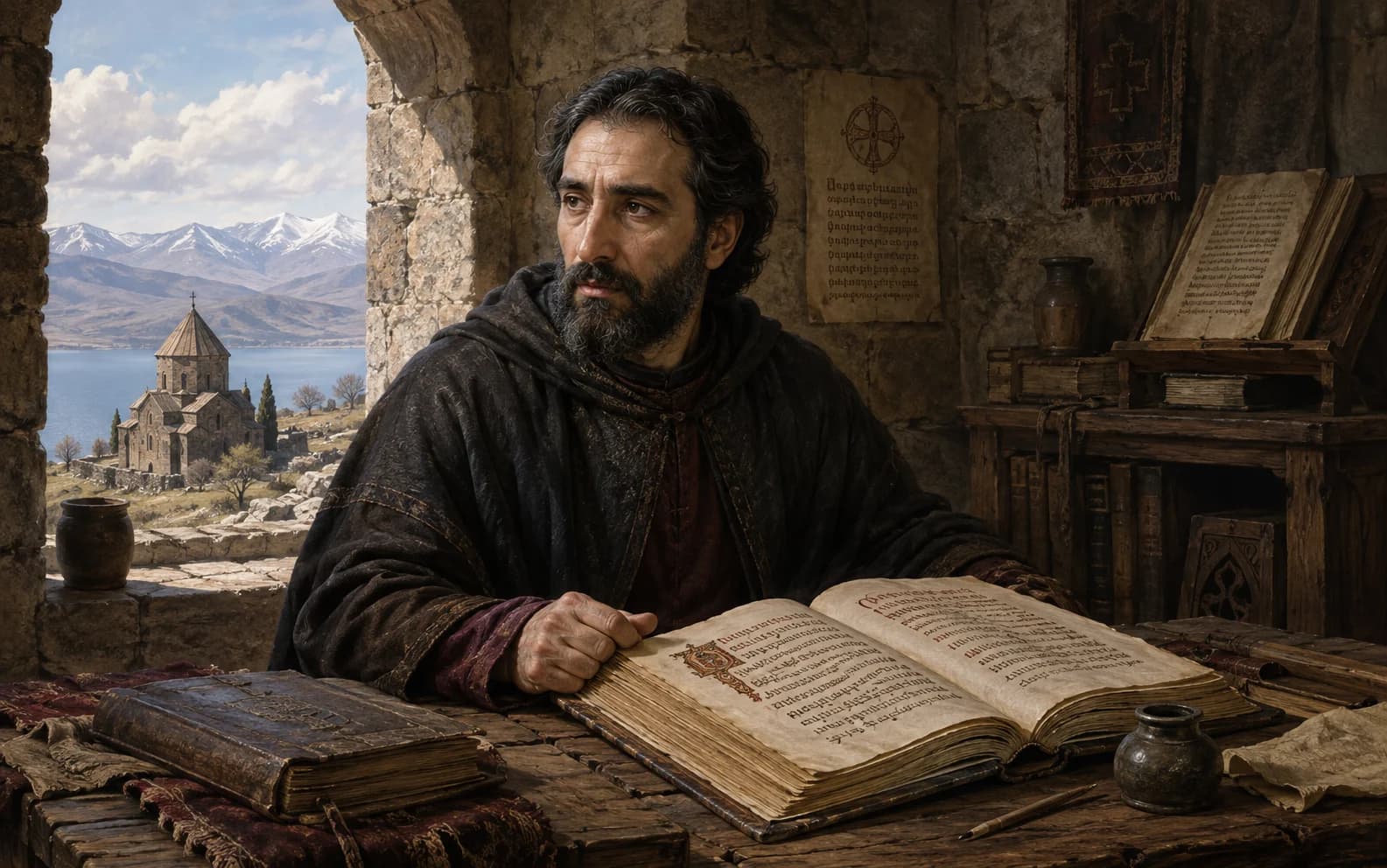
Grigor Narekatsi is the first writer in this section who lived before print, newspapers and the nation state. He was a monk in a monastery above Lake Van in the tenth century. He wrote in Classical Armenian for other monks, and the book he is remembered for is addressed to God, not to readers. Even so, it became the most copied book in Armenian after the Bible. People kept it in their homes even when they could not read it, and it is still the work Armenians name most often when asked what their literature has produced. This article explains how that happened: what he actually wrote, what we can and cannot know about his life, and how a private monastic text became a national one.
- Author
- Armat Editorial Team
- Updated
- Reading time
- 18 min read
In brief
Grigor Narekatsi, known in English as Gregory of Narek, was a monk, priest and poet who spent almost his whole life at the monastery of Narek on the southern shore of Lake Van. He wrote biblical commentary, odes, panegyrics and letters. Around 1002 he completed the Book of Lamentations: ninety-five chapters of first-person address to God that became the most widely copied and most widely read work of classical Armenian literature. His dates are approximate and disputed. He did not work alone, since his family and his monastery belonged to a working scholarly tradition. The religious honours that came later, including the Roman Catholic title of Doctor of the Church in 2015, belong to the story of his reception, not his life.
Key facts
- Lived
- About 951 to 1003 — both dates are approximate and disputed
- Where
- Narekavank, a monastery in Vaspurakan on the southern shore of Lake Van
- Wrote in
- Classical Armenian (grabar)
- Best known for
- The Book of Lamentations, Մատեան ողբերգութեան, completed about 1002
- Also called
- Gregory of Narek in English; Նարեկացի in Armenian
- Literary period
- Tenth-century monastic literature of Vaspurakan
Who Grigor Narekatsi was
Grigor Narekatsi was a monk, priest and writer who lived in the tenth century in Vaspurakan, in what is now eastern Turkey. In English he is usually called Gregory of Narek, and both forms name him the same way. Narekatsi is not a surname but an adjective meaning of Narek, after the monastery where he studied, taught, wrote and died. Armenian writers of this period are often known by their place like this, so the name itself tells part of his story.
He wrote biblical commentary, liturgical odes, panegyrics on saints, homilies and letters, and one long book that overshadows all the rest. The Book of Lamentations (in Armenian Մատեան ողբերգութեան, Matean oghbergutean) is ninety-five chapters of first-person address to God, completed around 1002. It is the work that makes him a major figure, and not just one capable monastic author among many.
This is a literary biography, and that matters more for Narekatsi than for anyone else in this section. He is a saint of the Armenian Apostolic Church and has been venerated for close to a thousand years. In 2015 the Roman Catholic Church named him a Doctor of the Church. These facts are real and interesting, but they belong to the story of how he was received, not of what he wrote. The order matters: he was read first and honoured afterwards.
Vaspurakan and the monastery of Narek
Vaspurakan was one of the historic provinces of Armenia, curving around the eastern and southern shores of Lake Van. In Narekatsi's lifetime it was not part of anything larger. It was a kingdom in its own right, ruled by the Artsruni house, which had taken a crown in 908. Through the tenth century it was a rival, and at times a partner, of the Bagratid kingdom to the north. This matters for two reasons. The tenth century is often described as if there were only one Armenian kingdom, and Narekatsi's monastery depended on Artsruni patronage.
The monastery, Narekavank, stood near the southern shore of the lake. It was founded in the second half of the tenth century, and it functioned as a school as much as a religious house: its monks copied books, taught, and wrote original theology. So when sources say Narekatsi spent almost his whole life at Narek, they are describing a scholar's career as well as a monk's.
Nothing of it survives. The monastery was emptied of Armenians during the genocide of 1915, stood in ruins for decades, and was demolished around 1951. A mosque now stands on the site, in the Gevaş district of Van province in Turkey. No one can visit the place that gave Narekatsi his name, and that is partly why the book has carried its memory.
A family of scholars, and the school of Narek
His father was Khosrov Andzevatsi, a churchman and writer who became bishop of Andzevatsik after he was widowed. The sources describe him as connected to the Artsruni house. That link should be reported carefully, not stretched. It shows that the family moved in circles where books were owned and written, and it does not establish princely rank for Grigor himself. What we know for certain is that Khosrov was an author. His commentary on the liturgy survives, and that is the inheritance that matters here.
Khosrov's career also ended badly, and people often confuse his trouble with his son's. He was suspected of Chalcedonian, pro-Byzantine positions, and the Catholicos Anania Mokatsi excommunicated him. The dispute turned partly on how Khosrov interpreted the rank of Catholicos. This is a different controversy from the one later attached to Grigor, and the two are best kept apart.
Grigor and his brother were brought to Narekavank and educated there by Anania Narekatsi. Anania was their kinsman on their mother's side, the monastery's founder, and a substantial theological writer himself. This is the most useful correction to the way Narekatsi is usually introduced. As specialists have noted, he is often presented as a lonely mystic with no Armenian forerunners, as if his book fell out of the sky. The evidence shows instead that he was formed inside a working intellectual tradition, and scholars describe the three men, Khosrov, Anania and Grigor, as a school of Narek. He was ordained priest in 977.
What can and cannot be dated
His dates are approximate, and they are usually printed with more confidence than the evidence allows. Different sources place his birth at about 945, about 950 and about 951, and his death at 1003 or else around 1010 to 1011. The pairing 951 to 1003 is the usual one in Armenian reference works, and this site uses it too. But it should be read as a convention rather than as a record, and the alternative dating is held by serious scholars rather than by careless ones.
The vagueness comes from the sources. There is no contemporary biography. What survives is his own writing, which is not autobiography even when it speaks in the first person; a few near-contemporary references; and later accounts by writers whose aim was devotion, not documentation. From that material you can rebuild the outline of a tenth-century monastic life, but not a timeline.
Two dates are firmer than the rest, because they come from the works themselves. He wrote the Commentary on the Song of Songs in 977, at the request of a prince of the Artsruni house, and he completed the Book of Lamentations around 1002 to 1003. When this article gives a year, it keeps that difference in view. When it says about or around, the word is there for a reason, not to dress up a guess.
The works
The work that is securely his is varied but not large. The Commentary on the Song of Songs, written in 977 for the Artsruni prince Gurgen-Khachik, is his first substantial book, and it already shows the manner of the later one. There is a commentary on part of the Book of Job, surviving in a single manuscript. There are homilies and panegyrics on saints, a collection of letters, and roughly two dozen tagher: odes, or sung liturgical poems, several of which are still performed.
Two points about the edges of this list. First, the tagher are the part of his output most likely to be over-counted. Liturgical poems travel without names, get attached to famous authors and are easy to credit generously, so estimates of how many he wrote vary. Second, his treatise against the Tondrakians, written in the 980s, belongs to the corpus. It is discussed below, because it tells us about his position as well as being a text in itself.
Everything else is the Book of Lamentations, and the imbalance is real, not an accident of what survived. The book is longer than the rest of his writing put together. He was working on it at the end of his life, and it is the only one of his works that left the monastery.
The Book of Lamentations
The book has ninety-five chapters and runs to more than ten thousand lines. Each chapter is headed as a speech from the depths of the heart to God, and each is one continuous address in the first person. It tells no story, follows no sequence of events and gives no instructions. Nothing happens in it the way things happen in a poem by Tumanyan. What it holds is a single voice examining itself before God, at enormous length and with enormous inventiveness.
Its genre is genuinely unsettled, and it is more useful to explain why than to pick a label. It is called a prayer book, because that is how people have used it for a thousand years. It is called a poem, because it is metrical and its effects are poetic. It is called a lament, which is what its Armenian title says. It is also called a mystical or meditative work, and a theological one, and both describe real features of the text. Its Armenian title, Մատեան ողբերգութեան, means roughly book of lamentation or book of tragedy, and it also circulated under the plainer name Գիրք աղօթից, book of prayers. Different traditions have needed different things from it, and the labels show that.
The book is driven by a problem it cannot solve. The speaker wants to be reconciled with a perfect God and knows he is not capable of it. Instead of resolving that tension, the book stays inside it for ninety-five chapters, going deeper instead of moving on. That is why it can be read as theology and as literature without either reading distorting it. It is also why it is so hard to summarise. The argument matters less than the sustained pressure.
How the writing works
The most immediately visible technique is accumulation. Narekatsi rarely names a thing once. He names it eight or twelve times over, piling synonym on synonym and epithet on epithet, so that one sentence can run for half a page without arriving anywhere. Read impatiently, this looks like padding. Read the way it was meant to be read — aloud, slowly, in the voice of someone who cannot stop — it is the formal equivalent of the state the book describes: a mind that cannot let a subject go.
The second technique is parallelism and repetition inherited from biblical Armenian. The Psalms are the obvious model, and the book is full of scriptural allusion. But what he borrows is structure: he takes the paired, balanced verse of the Psalter and stretches it far beyond its natural length. The third technique is metaphor, and in particular metaphor that never settles. Images of wounds, storms, debt, disease, shipwreck, courtrooms and darkness follow one another quickly, and each is dropped before it can become comfortable.
For literary history, the voice is his most important innovation. This is a first-person text of self-accusation. The speaker insists that he is worse than everyone, and then that in speaking for himself he speaks for everyone: the sinner as representative rather than as exception. That double move, extreme individuality used as a way of being universal, is what later readers responded to. It explains how a monk's book of self-examination could reach people whose lives had nothing in common with a tenth-century monk's.
The Armenian he wrote
He wrote in grabar, Classical Armenian, which by the tenth century was already a learned written language and nobody's everyday speech. Even within grabar he is a difficult, high-register author. He uses dense compounds, unusual coinages, long chains of near-synonyms, and a syntax stretched to hold sentences longer than the language was built for. Armenians who read the Book of Lamentations today usually read it in a modern Armenian translation, and it has been translated into modern Eastern Armenian many times for exactly that reason.
One claim needs care here, because it is repeated constantly. It is often said that Narekatsi coined more than two and a half thousand new Armenian words. The figure is everywhere, even in cautious reference works that hedge it with may have, and no study is ever named as its source. We can still say something substantial without inventing precision. He formed new compounds freely, he pushed grabar's word-building resources harder than earlier writers had, and words that first appear in his writing entered the language. That is a real contribution to Armenian, and it does not need a number to be one.
More broadly, his effect on the language came through the book's popularity. A text copied in hundreds of manuscripts, read aloud at home and learned by heart in fragments does not need a lexicographer to pass on its vocabulary. It passes it on by being used.
What the word Narek came to mean
Three related things are called Narek, and readers meet them in a confusing order. Narek is a place: a village and the monastery beside it. Narekatsi is a person, the man of Narek. And Narek on its own is what Armenians have long called the Book of Lamentations itself. A household would own a Narek, read from the Narek and keep the Narek by a sickbed.
That third use is the one that surprises people, and it shows how completely the book absorbed the name. No other work of Armenian literature is usually called after the place its author came from. In practice the word became an ordinary noun for a particular object: a thick book, often the only one in the house.
The distinction still matters, because the shorthand is still in use. A modern Armenian who says he is reading Narek means the book. A medieval colophon saying a manuscript was copied at Narek means the monastery. A name in a chronicle means the man. This article is about the man.
Manuscripts, printing and readers
The Book of Lamentations became one of the most heavily copied books in the Armenian manuscript tradition, so its transmission is unusually well documented. The best-known early copy was made in 1173 in Cilicia for the theologian Nerses of Lambron and illuminated by the painter Grigor Mlichetsi. It carries four painted portraits of the author, and it is held today in the Matenadaran in Yerevan, the national repository whose collection grew out of this same monastic copying tradition. A book survives in such numbers because people wanted it, not because an institution kept it.
It reached print early by Armenian standards. The first printed edition appeared in Marseille in 1673, and new editions and translations have followed ever since. The work now exists in French, English, Russian and other major languages. Thanks to the modern English versions, it is the one medieval Armenian text that non-specialists are likely to have come across.
Alongside its scholarly and liturgical use, the book had a place in the home, and that should be described plainly. Copies were kept in ordinary houses, including houses where nobody could read grabar, and communities attributed protective and healing power to the physical book, placing it with the sick and opening it in times of need. This is a documented pattern of popular belief and practice, recorded here as cultural history. It is not a medical claim, and this article makes none.
Accusation and orthodoxy
A tradition of suspicion surrounds Narekatsi, and it needs careful handling because it is easy both to sensationalise and to erase. The Tondrakians were a dissenting Armenian movement, condemned as heretical and active in this period and region. Narekatsi has been linked with them at different times. In his own century the link was an accusation. In twentieth-century Soviet Armenian scholarship it was closer to a compliment, since a writer at odds with the feudal church made a more usable national figure.
What the texts show is a man defending orthodoxy. He wrote a treatise against the Tondrakians in the 980s, and his Commentary on the Song of Songs explicitly condemns positions attributed to them. One reading is that he wrote the treatise partly to clear his own name; that is a plausible inference and is offered as one. A work can answer an accusation without recording that anyone made it.
The safest summary is the narrow one. Accusations existed, and they were common in a period when the Armenian church was policing its boundaries hard. His father had already been excommunicated in an unrelated Chalcedonian dispute. And the only direct evidence of Narekatsi's own position is a body of writing that argues against the heresy in question. The sources go no further than that, and confident versions in either direction read later interests back into very thin evidence.
Recognition and afterlife
The Armenian Apostolic Church venerated him as a saint long before any of the modern honours: the evidence for his sainthood goes back at least to the twelfth century. He is commemorated on 27 February. This is the recognition that actually shaped how the text was passed down, because it put the book in churches and homes.
The Roman Catholic recognition is recent and has two distinct stages, which are often merged into one. On 21 February 2015 Pope Francis, in an audience with Cardinal Angelo Amato, confirmed the proposal of the Congregation for the Causes of Saints to give Narekatsi the title of Doctor of the Church. The Holy See press office announced it days later. The formal proclamation followed on 12 April 2015, at a Mass in St Peter's Basilica marking the centenary of the Armenian Genocide. He is the thirty-sixth Doctor of the Church and the first Armenian.
Judgements of his place in Armenian literature have their own history, and one label should be credited to its authors, not adopted. Soviet-era Armenian scholarship regularly described him as the founder of an Armenian literary renaissance and the summit of Armenian renaissance thought, importing a European periodisation to make a claim about a tenth-century author's stature. That is an interesting judgement by identifiable scholars working in a particular intellectual climate. It is not a neutral description, and this article reports it as theirs. The claim this article makes without borrowing anyone's categories is narrower and firmer: no Armenian book before the modern period was copied more, read by more people, or held in comparable regard.
Important dates
about 951
Born in Vaspurakan. The year is approximate; dates from about 945 onward are also given.
977
Ordained priest, and writes the Commentary on the Song of Songs for the Artsruni prince Gurgen-Khachik.
980s
Writes a treatise against the Tondrakians.
about 1002
Completes the Book of Lamentations at Narekavank.
about 1003
Dies at Narek; a death around 1010 to 1011 is also argued.
1173
An illuminated copy is made in Cilicia for Nerses of Lambron; it is now in the Matenadaran.
1673
The Book of Lamentations is printed for the first time, in Marseille.
2015
Confirmed as a Doctor of the Church on 21 February and formally proclaimed on 12 April.
Why Grigor Narekatsi matters
For the modern reader, he is the point where Armenian literature stops being a subject and becomes a body of work. A great deal of Armenian writing comes before him — history, theology, translation, hymnody — and specialists read much of it today. The Book of Lamentations is read by everyone, and has been for a thousand years. That makes it the earliest Armenian text with a continuous popular life, and not only a scholarly one.
Technically, he showed that the first person could carry the whole weight of a book. Medieval literature is full of narrators, but a text this long, built entirely on one voice examining itself with no plot to lean on, was an extraordinary thing to attempt. It is the reason later Armenian poets kept coming back to him. He appears in this section as a writer, and the case for him is literary before it is anything else.
Interesting facts
- 01Narekatsi is not a surname but a place-adjective: it means of Narek, the monastery where he studied and wrote.
- 02Armenians call the Book of Lamentations simply Narek, so the same word can mean the place, the man's name and the book.
- 03His dates are unsettled: birth is given as about 945, 950 or 951, and death as 1003 or around 1010 to 1011.
- 04He is often introduced as a solitary mystic, but his father and his teacher were both theological authors, and scholars describe the three of them as a school of Narek.
- 05The claim that he coined more than 2500 Armenian words is everywhere, yet no study is ever named as its source.
- 06Narekavank was emptied in 1915 and demolished around 1951; a mosque stands on the site today.
Sources
- A. J. Hacikyan, G. Basmajian, E. S. Franchuk and N. Ouzounian (eds.). The Heritage of Armenian Literature, Volume II: From the Sixth to the Eighteenth Century — Wayne State University Press, 2000 ISBN 9780814330234The section's backbone series, at the volume that actually covers a tenth-century author — the other six writers cite Volume III, which begins where Narekatsi's period ends. Carries the literary-historical placement this article is built on: Narekatsi inside medieval Armenian letters rather than beside them, and the Book of Lamentations as a work of literature before it is anything else.
- Abraham Terian. From the Depths of the Heart: Annotated Translation of the Prayers of St. Gregory of Narek — Liturgical Press, 2021 ISBN 9780814684641An annotated scholarly translation by an Armenologist rather than a devotional edition, and the source of record here for the shape of the text: ninety-five chapters, the first-person address, the biblical saturation and the refusal of the book to resolve what it opens. Cited for what the work is and how it is built, and not for the biography, which it is not a biography of.
- Thomas J. Samuelian (translator). Speaking with God from the Depths of the Heart: The Armenian Prayer Book of St. Gregory of Narek — VEM Press, Yerevan, 2001 ISBN 9789993085317The bilingual translation that put the text in front of English readers, and the reason the article can say that this is the one medieval Armenian work a non-specialist is likely to have met. Cited for the reception and for the modern English title of the work; the article quotes neither this translation nor any other, which is deliberate — §33 of the commission, and the reason the literary section describes technique rather than reproducing lines still in copyright.
- Գրիգոր Նարեկացի — Հայկական սովետական հանրագիտարան (Armenian Soviet Encyclopedia), via Armenian Wikisource Visit sourceThe Armenian-language reference entry, and the source of the conventional 951–1003 dating this article uses while flagging it as a convention. It also supplies the works list, the education under Anania Narekatsi, and — usefully — two things it did not intend to supply. It records that Grigor and his teacher faced accusations of Tondrakian sympathy, which is the accusation half of that question; and it describes him as the founder of an Armenian literary renaissance and the summit of Armenian renaissance thought, which is the Soviet-era interpretive frame the article attributes rather than adopts. Cited as evidence of a scholarly position, including where the position is the thing being reported on.
- Pope Francis. Apostolic Letter for the proclamation of Saint Gregory of Narek as a Doctor of the Church — Holy See, 12 April 2015 Visit sourceThe primary document for the second of the two 2015 events, and the reason the article can date the proclamation exactly. Cited for the Catholic recognition and for nothing else: a Vatican document is authoritative about what the Vatican did in 2015 and is not a source for tenth-century chronology, and the article keeps those on opposite sides of the same section.
- St. Gregory of Narek, Doctor of the Church — Holy See Press Office, Vatican Information Service bulletin, 23 February 2015 Visit sourceThe first of the two events, which almost every account merges into the second. The bulletin records that on Saturday 21 February 2015 the Pope received Cardinal Angelo Amato, prefect of the Congregation for the Causes of Saints, and confirmed the proposal to grant the title; the announcement followed days later, which is why 23 February also circulates as the date. Cited to keep the confirmation and the proclamation apart. The bulletin as published also carries an obvious slip in its biographical line, giving both birth and death as 1005, which is a useful reminder that a primary source is primary about its own subject and not about everything it mentions.
Related articles
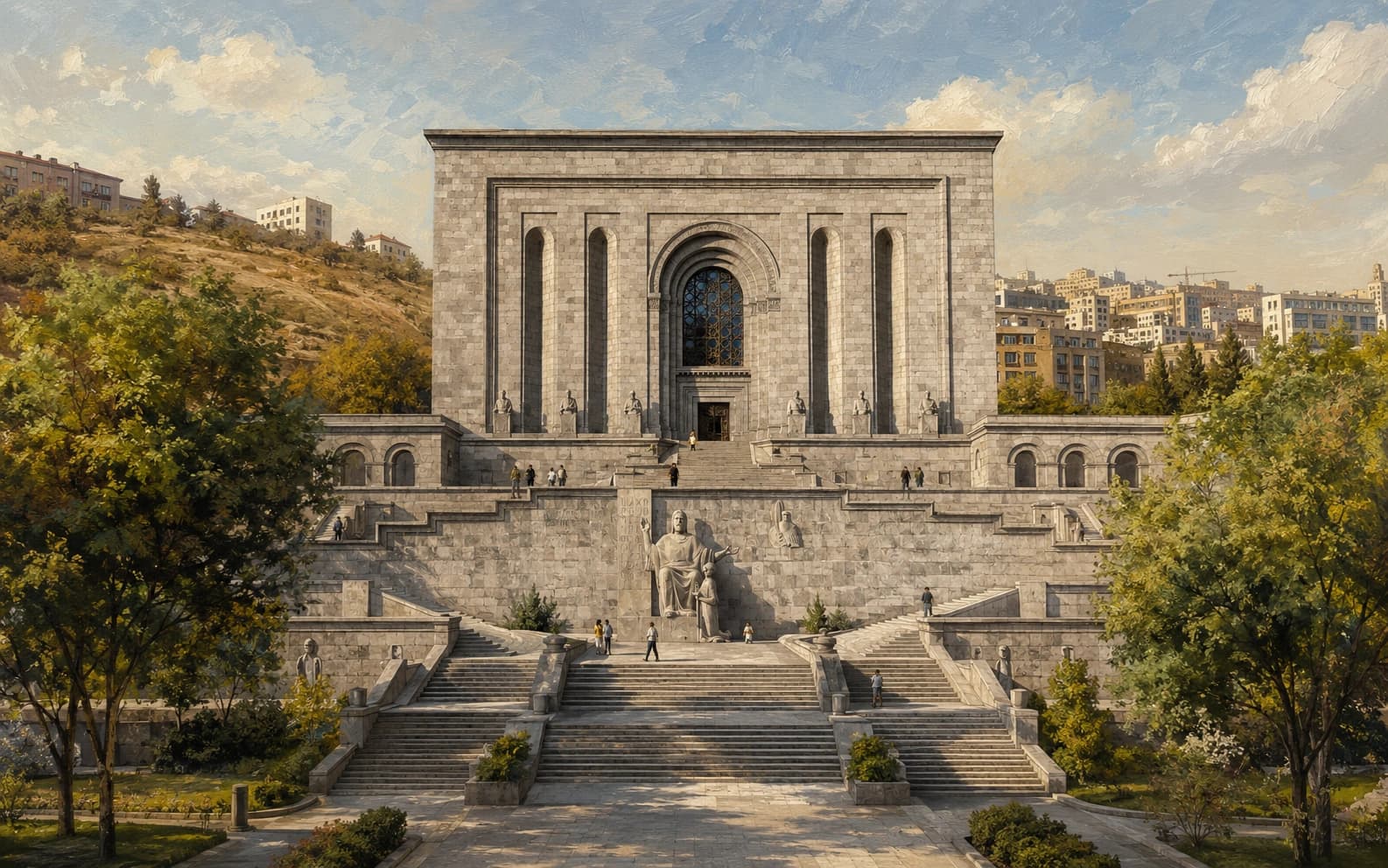
Matenadaran
The national repository of ancient manuscripts in Yerevan: an archive, a research institute and a museum in one. Its collection was built up in monasteries over centuries and brought here in the twentieth.
Bagratid Armenia and the City of Ani
The Bagratid kings restored Armenian statehood after two centuries of foreign rule and built Ani into one of the great cities of the medieval world.
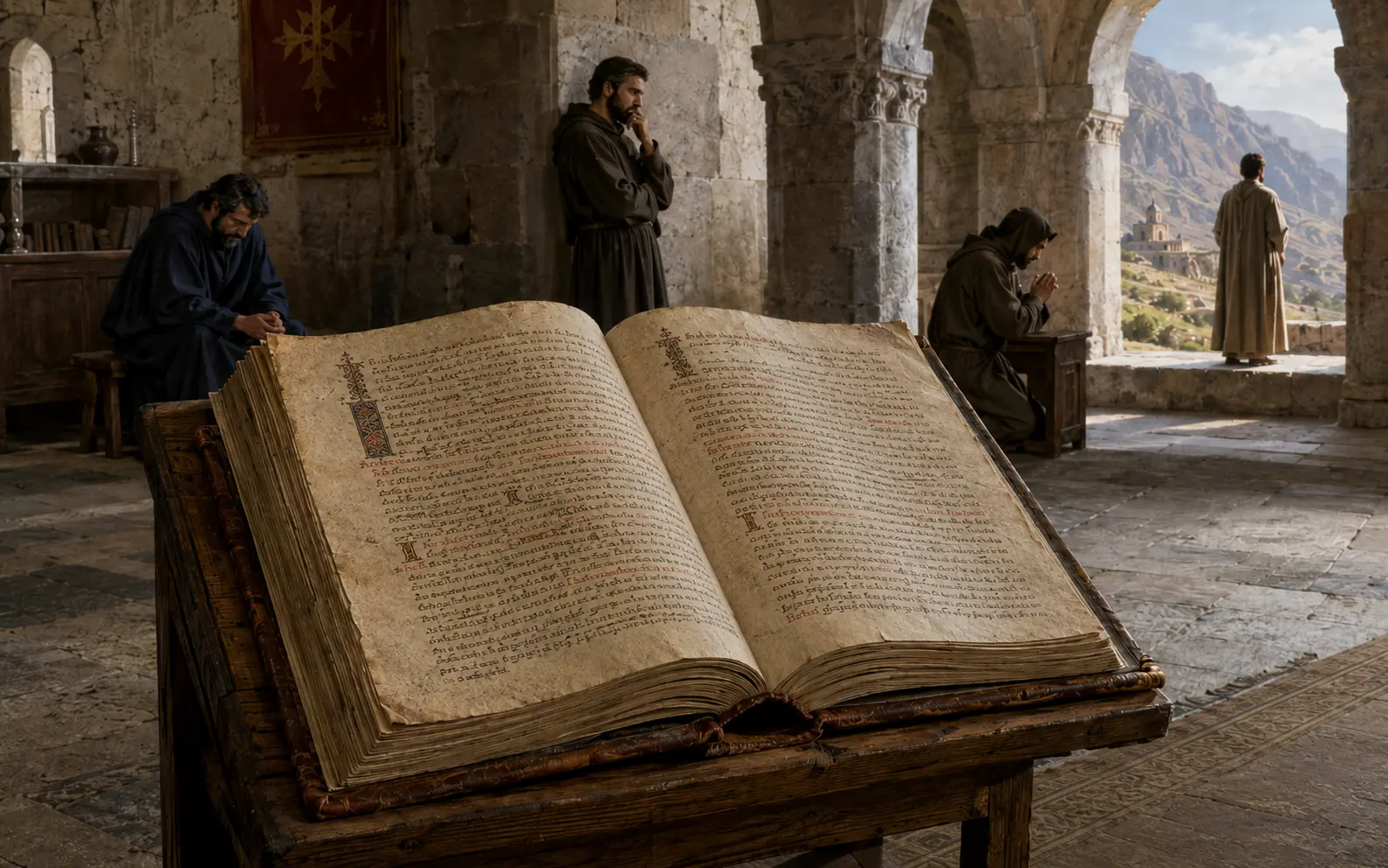
Book of Lamentations
Ninety-five discourses addressed to God, written at the monastery of Narek about 1002. Armenians simply call it the Narek, and it is not the biblical Lamentations.