
David of Sassoun
David of Sassoun, known in Armenian as Sasna Tsrer or the Daredevils of Sassoun, is the national epic of the Armenian people. It grew out of oral storytelling in the mountainous district of Sassoun and was first written down in 1873, after circulating by word of mouth for roughly a thousand years. The epic follows four generations of a heroic family and their struggle to remain free.
- Author
- Armat Editorial Team
- Updated
- Reading time
- 8 min read
Key facts
- Author
- Anonymous, composed collectively by generations of oral storytellers
- Written
- Oral core from roughly the eighth to tenth centuries; first recorded in 1873
- First published
- 1874, in Garegin Srvandztiants's collection Grots u Brots
- Genre
- Oral heroic epic in four branches
- Setting
- The mountain district of Sassoun in the Armenian highlands and neighbouring lands
- Main characters
- Sanasar and Baghdasar, Mher the Elder, David, Khandut, Mher the Younger
Historical context
The epic took shape in the centuries after the Arab conquest of Armenia, and scholars generally place its historical core in the resistance of the mountain district of Sassoun to Arab tribute demands during the eighth and ninth centuries. Over time the storytellers absorbed older material, including pre-Christian myth, and later layers reflecting Byzantine, Seljuk and other encounters.
Sassoun itself was a rugged region in the Armenian highlands whose geography favoured local autonomy. Its inhabitants had a long reputation for refusing outside authority, and the epic celebrates exactly that reputation, turning stubborn mountain independence into a heroic ideal.
For centuries the poem existed only in performance. Village storytellers, often illiterate, recited or half-sang episodes at gatherings, adapting them to their audience. In 1873 the scholar and bishop Garegin Srvandztiants recorded a full version from a peasant named Krpo in the Mush region, saving the tradition just as it was beginning to fade.
Summary of the story
The epic is usually divided into four branches. In the first, the Armenian princess Tsovinar drinks from a sacred fountain and conceives the twin brothers Sanasar and Baghdasar before she is taken to the caliph of Baghdad; that is where their more than human strength comes from. They found the fortress of Sassoun, establishing the line of heroes.
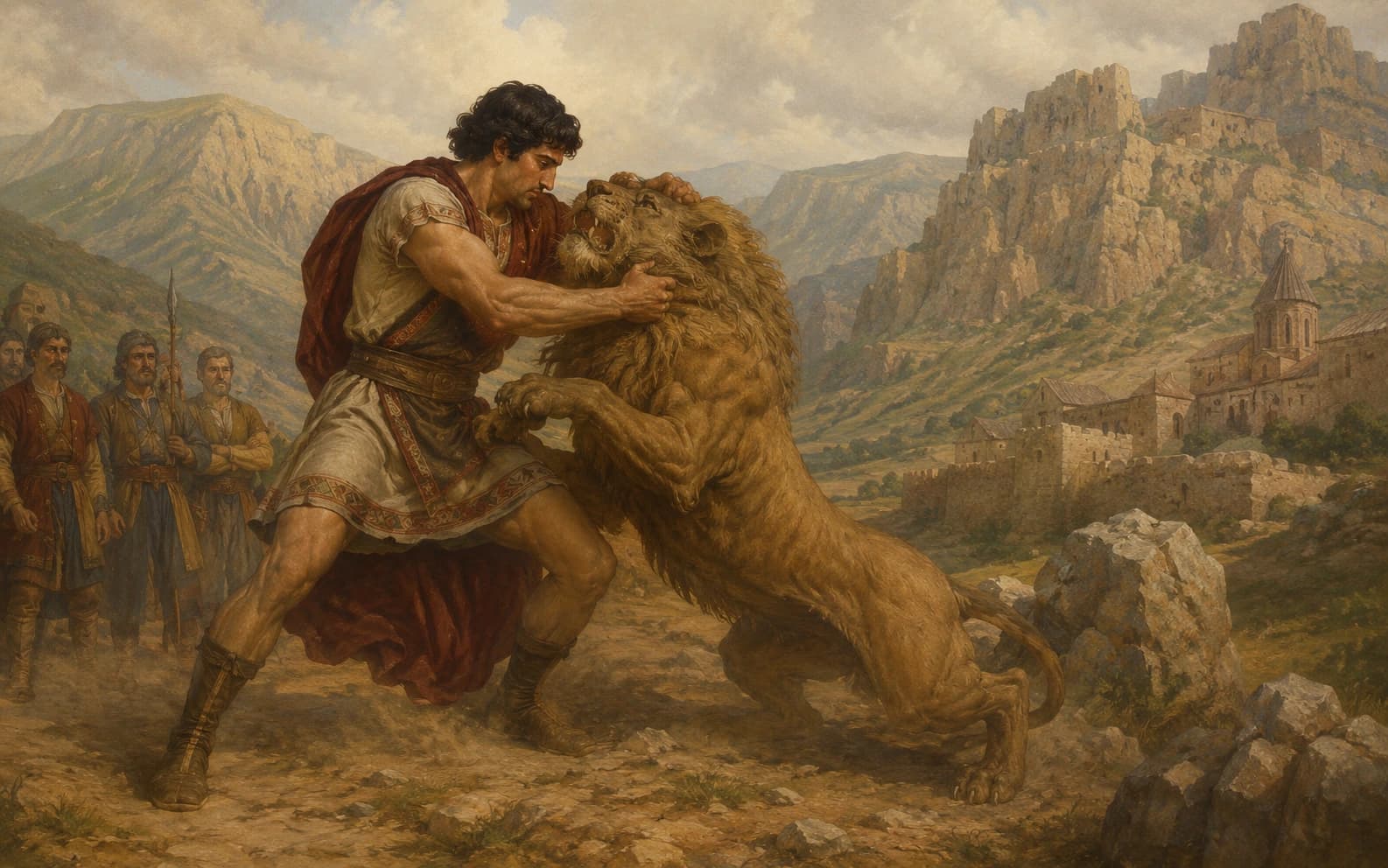
The second branch centres on Mher the Elder, Sanasar's son, who kills a lion with his bare hands and earns the name Lion Mher. He defends Sassoun and its people but is drawn into an entanglement with the ruler of Egypt that ends in his death and leaves his homeland exposed.
The third and most famous branch belongs to David, Mher's son. Raised in ignorance of his origins, David grows into a giant-hearted, impulsive hero who rebuilds his father's monastery, refuses to pay tribute to the invading Msra Melik — who is, unknown to Sassoun at first, his own half-brother — and defeats him in single combat. David himself is later killed by a poisoned arrow shot by his own daughter, at the urging of the Sultana of Akhlat. The fourth branch follows David's son Mher the Younger, who finds a world too corrupt for his strength and is finally sealed inside the Raven's Rock, to emerge only when the earth is just enough to bear him.
Main characters
The four branches are held together by a single family line, and each generation embodies a different aspect of heroism: founding, guarding, liberating and waiting. The women of the epic are unusually strong figures who often drive the plot.
Alongside the human characters stand David's horse Kurkik Jalali, a speaking, flying steed inherited across generations, and the Lightning Sword, both of which behave almost as characters in their own right.
- Sanasar and Baghdasar: the twin founders of Sassoun, born miraculously and strengthened by a magical spring.
- Mher the Elder: the lion-slaying second-generation hero who defends Sassoun and dies through a foreign entanglement.
- David of Sassoun: the central hero, generous, hot-tempered and honest, who frees Sassoun from tribute by defeating Msra Melik.
- Khandut: the noblewoman of Tabriz who sets out to win David and becomes his wife.
- Mher the Younger: David's son, too strong for a corrupted world, shut inside the Raven's Rock until justice returns.
- Msra Melik: the ruler of Msr who demands tribute from Sassoun and is defeated in single combat by David.
Themes and key ideas
The central theme is resistance to unjust demands. The heroes of Sassoun are not conquerors; they fight when tribute collectors arrive, when their land is invaded or when the weak are abused. David repeatedly gives warning before he strikes and refuses to attack an unprepared opponent, and this insistence on fair fighting is presented as the mark of a true hero.
A second theme is the tension between strength and wisdom. Every hero in the line is immensely powerful, yet each is undone or endangered by impulsiveness. Mher the Elder is trapped by a foreign alliance, David is careless about oaths, and Mher the Younger cannot find a use for his strength at all. The epic admires courage while showing that courage alone is not enough.
The ending of the fourth branch introduces a theme of deferred justice. Mher the Younger enters the rock because the earth cannot hold him, and he will return only when wheat grows to the size of a rosehip and barley to the size of a walnut, that is, when the world becomes fair. This image of a hero waiting inside a mountain has become one of the most powerful symbols in Armenian culture.
Language and style
The epic was composed and transmitted orally, and its style shows it. Lines are rhythmic and often chanted rather than spoken, formulas and set phrases repeat to help the reciter remember, and episodes are built to a predictable shape that an audience can follow across a long evening. Different reciters produced different versions, and around a hundred and sixty variants have now been recorded, of which some fifty have been published.
The language is dialectal and vivid, full of village humour, boasting matches, insults and comic exaggeration. The heroes are not solemn; David in particular is often funny, careless and childlike, which makes his moments of moral seriousness more effective.
A unified literary text was assembled in 1939 by a team of Armenian scholars who combined the collected variants into a single readable version for the epic's celebrated millennium. Most modern readers, including students, encounter that consolidated text, while researchers work with the individual recorded variants.
Legacy and adaptations
Since its recording in 1873 the epic has become the central reference point of Armenian folk culture. Hovhannes Tumanyan retold the David branch as a long poem in 1902, and Yeghishe Charents, Avetik Isahakyan and many others produced their own versions, bringing the material to readers throughout the diaspora.
Yervand Kochar's equestrian statue of David of Sassoun, unveiled in 1959 in front of the Yerevan railway station, is one of the best known monuments in Armenia. The epic has also inspired operas, films, animations, paintings and school pageants, and it was inscribed on the UNESCO list of intangible cultural heritage in 2012.
It is often compared with the Iliad, the Song of Roland and the Shahnameh. For students it offers an accessible entry point into medieval Armenian history, oral tradition and the way a community turns memory into story.
Important dates
8th-9th centuries
Resistance in Sassoun to Arab tribute forms the historical core of the epic.
1873
Garegin Srvandztiants records a complete version from the storyteller Krpo near Mush.
1902
Hovhannes Tumanyan publishes his literary retelling of the David branch.
1939
A unified scholarly text is published for the epic's millennium celebrations.
2012
UNESCO inscribes the performance of the epic on its intangible cultural heritage list.
Why David of Sassoun matters
David of Sassoun is the closest thing Armenian culture has to a founding story told by the people themselves. Unlike the medieval chronicles, which were written by clerics and nobles, the epic was made and kept by villagers, and it preserves their view of what makes a life admirable: fairness, hospitality, courage and refusal to pay for the right to exist.
Its survival is itself part of its meaning. The epic was recorded in the 1870s, just decades before the communities that carried it were destroyed, and the versions collected from survivors afterwards carry an additional weight. Studying it means studying both a medieval story and the modern effort to save an oral tradition on the edge of disappearance.
Interesting facts
- 01Around a hundred and sixty variants of the epic have been recorded from different reciters since 1873.
- 02The recorded variants together fill several thousand pages, though any single telling is far shorter.
- 03David's horse Kurkik Jalali can speak, fly and reason, and is passed down through the generations.
- 04Mher the Younger waits inside the Raven's Rock until wheat grows as large as a rosehip.
- 05Yervand Kochar's 1959 statue in Yerevan replaced an earlier version he had made in 1939 that was later destroyed.
Sources
- Leon Z. Surmelian (trans.). Daredevils of Sassoun: The Armenian National Epic — Alan Swallow, Denver, 1964 Visit sourceThe standard English translation, made from the 1939 consolidated text.
- M. Abeghyan and K. Melik-Ohanjanyan (eds.). Սասնա ծռեր (Sasna Tsrer) — Academy of Sciences of the Armenian SSR, Yerevan, 1936–1951 Visit sourceThe critical edition of the recorded variants, in three parts.
- Performance of the Armenian epic of Daredevils of Sassoun — UNESCO Representative List of the Intangible Cultural Heritage of Humanity, no. 00743, inscribed 2012 Visit source
Related articles
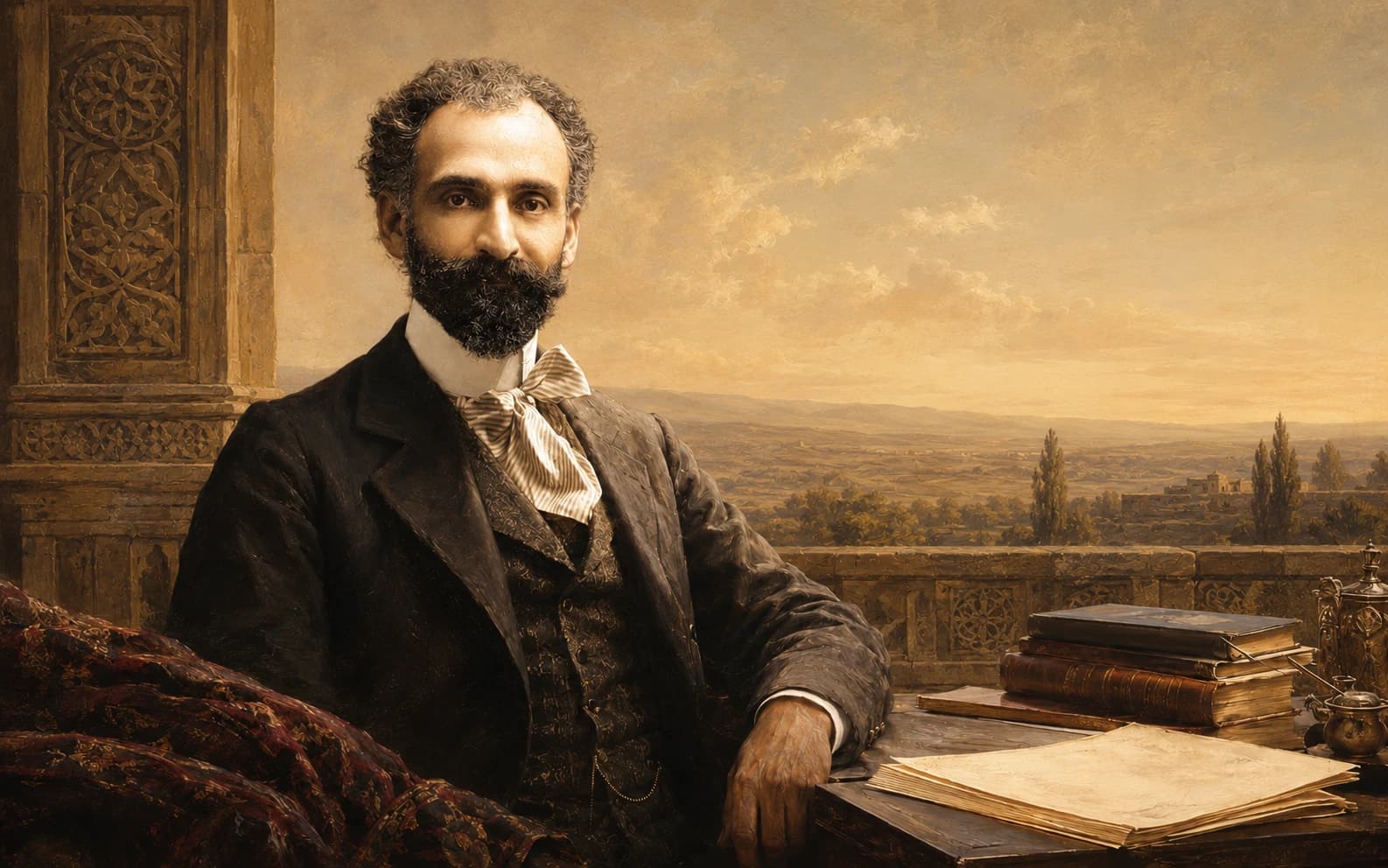
Hovhannes Tumanyan
The village-born poet whose ballads, fairy tales and quiet moral authority earned him the title Poet of All Armenians.
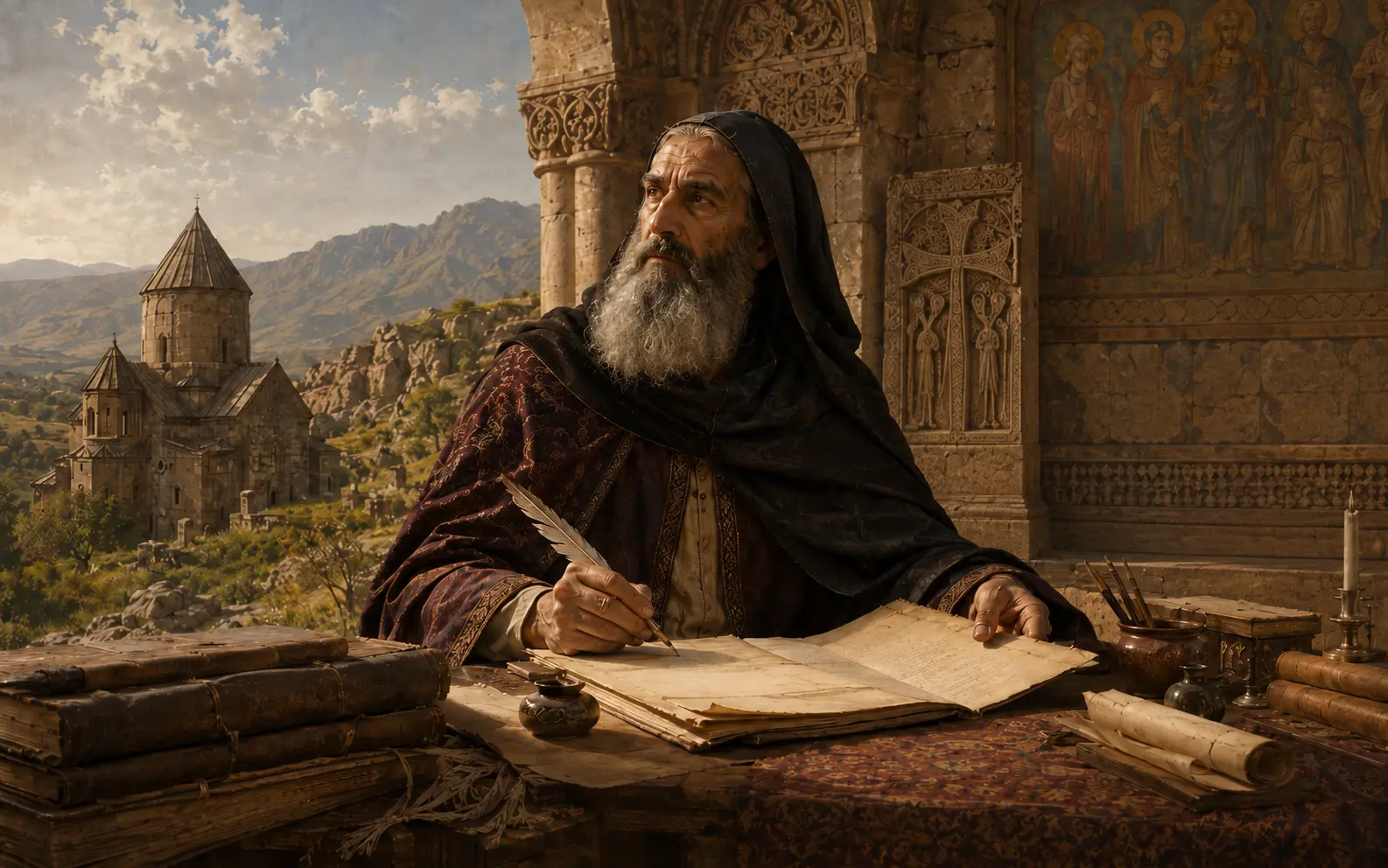
Mesrop Mashtots and the Armenian Alphabet
Around 405 the scholar and monk Mesrop Mashtots created an alphabet that gave Armenian its own written voice and reshaped the nation's culture.
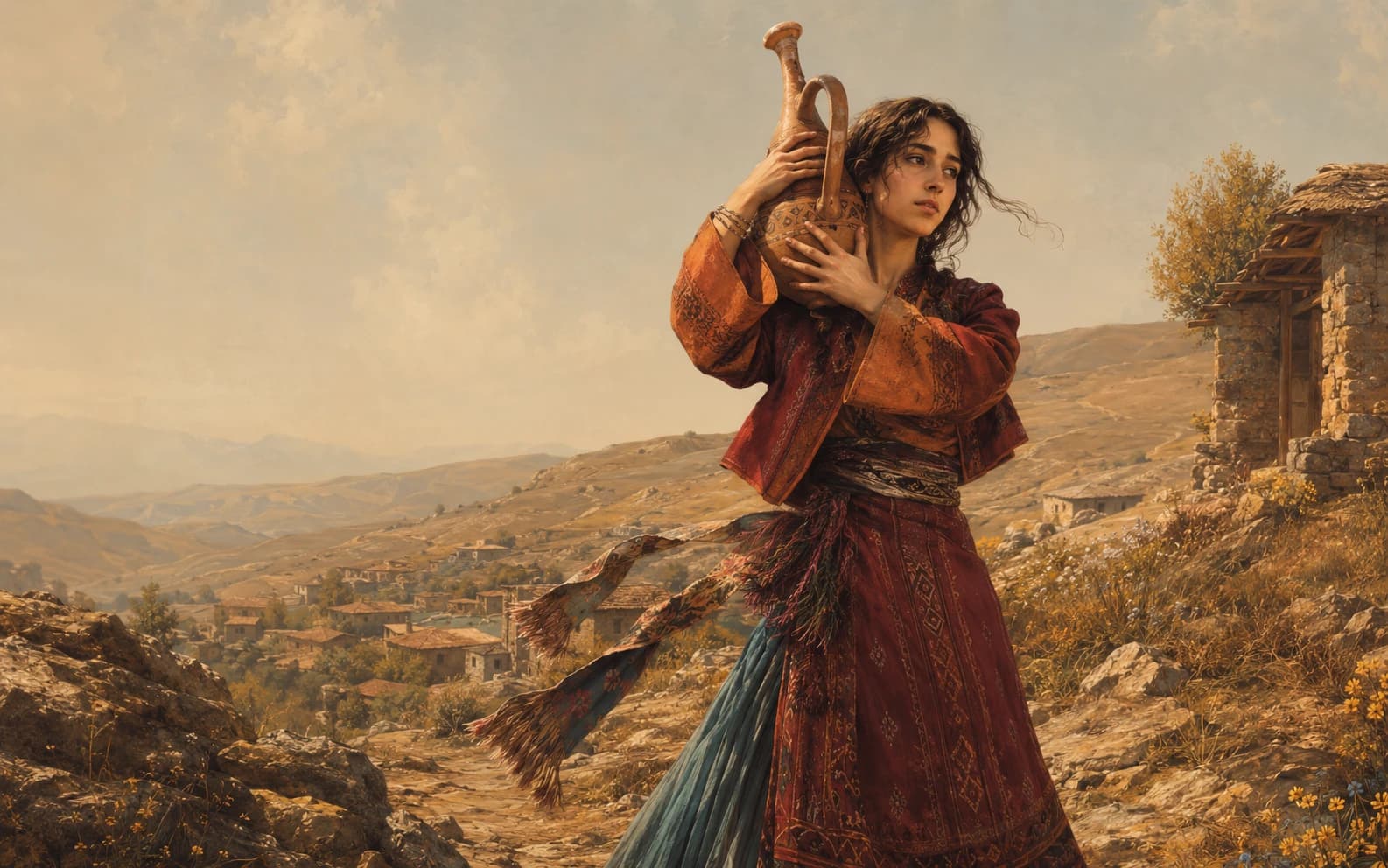
Anush
Hovhannes Tumanyan's mountain love poem follows two young villagers destroyed by pride, custom and the harsh code of honour.