
Khorovats
Khorovats is meat cooked over an open fire — the word is a form of the Armenian verb meaning to roast or grill, and it names the method rather than a single recipe. In practice it is also an occasion: a fire lit outdoors, one person tending the skewers while everyone else waits, and a table assembled around whatever comes off. It is among the dishes the Smithsonian Folklife Festival presented in 2018 as a staple of the Armenian feast, and it sits close to, but is not the same as, the older communal meat meal called madagh.
- Author
- Armat Editorial Team
- Updated
- Reading time
- 6 min read
In brief
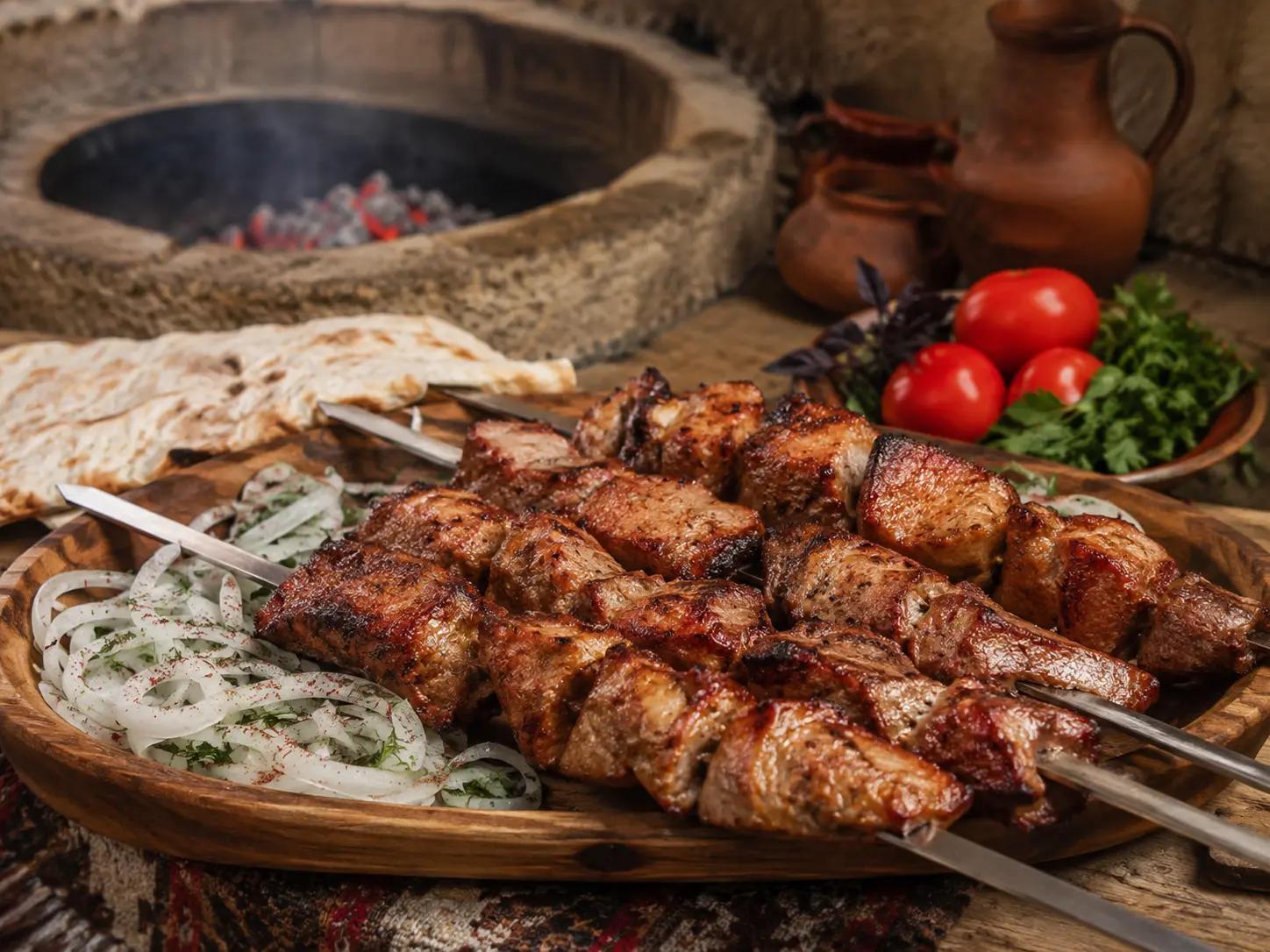
Khorovats is meat cooked over an open fire; the word is a form of the Armenian verb meaning to roast or grill, so it names a method rather than a recipe. Large pieces of pork, lamb, beef or chicken are salted and left with onion and herbs, threaded onto long flat skewers and cooked over embers rather than flame, the seasoning kept deliberately restrained. Aubergine, sweet pepper and tomato grill alongside and are then peeled and chopped into a dish of their own, usually called khorovats salad; the meat is often slid straight off the skewer onto lavash. The occasion matters as much as the food — a fire lit outdoors and an afternoon spent around it — and it survives strongly in the diaspora because it needs no tonir. It is not madagh, though the two share a shape.
Key facts
- Kind of dish
- Meat grilled over open embers
- Name
- From the Armenian verb meaning to roast or grill
- Common meats
- Pork, lamb, beef, chicken, according to region and community
- Cooked on
- Long skewers over wood or vine embers
- Usually eaten
- Outdoors, in company, straight off the skewer
- Not the same as
- Madagh, the communal meal from an animal offered and shared
The dish at a glance
- Common ingredients
- Pork, lamb, beef or chicken in large pieces, Onion, salt and herbs, Aubergine, sweet pepper and tomato for the accompanying grill, Lavash, to take the meat off the skewer
- Traditional preparation
- Meat is salted and left with onion and herbs for some hours, threaded onto long skewers and cooked over embers rather than flame, turned by hand until done; vegetables are grilled beside it.
- Occasions
- Family gatherings and outings, Holidays and celebrations, Meals following commemorations
- Known regions
- Throughout the Republic of Armenia, Armenian communities of the Middle East, more often with lamb, Diaspora gatherings, where it needs no special equipment
- Serving traditions
- Slid off the skewer onto lavash and eaten immediately, with raw onion, herbs and the grilled-vegetable salad alongside.
What khorovats is
Khorovats is meat cut into large pieces, threaded onto long flat skewers and cooked over embers rather than flame. The meat is usually salted and left with onion, herbs and sometimes wine or sparkling water for some hours beforehand; the seasoning is deliberately restrained, because the point of the dish is the fire.
Vegetables go on alongside — aubergine, sweet pepper, tomato — and are often peeled once blackened and chopped together into a dish of its own, commonly called khorovats salad.
Because the name is a method, it stretches: the same word covers a skewer of lamb over vine cuttings in a village and a portion cooked on a metal grill on a city balcony.
Its place in Armenian life
Khorovats is the outdoor counterpart to the tonir. Where the ethnographic literature describes bread-baking at the hearth as women's ground, the fire and the skewers at a family gathering are conventionally handled by men, and the person tending them holds a recognised position for the afternoon.
The occasion is more elaborate than the food. A khorovats is an excuse to be somewhere — a garden, a riverbank, a mountain road — for several hours, with the cooking spread across the whole of it rather than confined to a mealtime. Much of the eating happens standing up, as each batch comes off.
In the diaspora it is one of the most durable Armenian practices, because it needs no special equipment and no tonir. A grill, skewers and lavash are enough.
Documented background
Grilling meat over fire is not a tradition that can be dated, and no serious source tries. What can be described is the practice as it is documented now, and its relationship to older ritual forms of eating meat together.
The relevant scholarship here is on madagh. In her study of the practice among Armenians, the anthropologist Susan Paul Pattie describes madagh as a meal from an animal offered and shared — often glossed in English as "sacrifice", a translation she shows to be misleading — and traces how differently it is understood across communities. In the Republic of Armenia and in the Middle East the public slaughter of the animal remains ordinary; in much of the diaspora it is treated as backward, and the meal survives without it.
Khorovats is not madagh. But the two share a shape — meat cooked in quantity and eaten together, in the open, by a group larger than a household — and the modern secular gathering has absorbed some of what the older ritual carried.
Ingredients and preparation
Meat is cut into pieces large enough to stay juicy, salted, and left with sliced onion and herbs. Many families add nothing else; others use wine, sparkling water, or a little pepper and paprika.
The fire is built and allowed to burn down; the skewers go on only once there is a bed of embers and no flame. Vine cuttings and fruitwood are prized where they are available, for the smoke.
Skewers are turned by hand and judged by eye. When the meat comes off it is frequently slid straight onto lavash, which takes up the juices and is eaten with it.
Occasions and traditions
Khorovats belongs to holidays, family outings, weekends and any occasion where a group of people has an afternoon. It is the default form of celebration for a birthday or a visit home, and it is portable in a way that few other dishes here are.
It also appears at gatherings with a religious frame — after a baptism, a commemoration or a pilgrimage — where the boundary between an ordinary grill and a madagh can be indistinct, and where families themselves describe the difference in different ways.
Regional variations
The most visible difference is the meat. In the Republic of Armenia pork is very common; lamb is more usual in Armenian communities of the Middle East, where it also carries the associations of the ritual meal. Beef and chicken are ordinary everywhere.
In some regions the meat is cooked in large pieces on the bone; in others it is cubed. Some cooks grill the vegetables first and hold them warm; many families do the reverse.
There is also a version cooked in a covered pot with vegetables rather than over a fire, and it takes the same name in ordinary speech — a reminder that the word describes what is being done to the meat more than where it is being done.
Important dates
2018
Khorovats is cooked in Washington as one of the staples of the Armenian feast, in the Smithsonian Folklife Festival's Armenia programme.
2022
Susan Paul Pattie's study of madagh appears in Food, Culture & Society, setting out how differently the communal meat meal is understood in Armenia and in the diaspora.
Why khorovats matters
Khorovats is the least ceremonious dish in this section and, for that reason, one of the most revealing. It has no heritage inscription, no fixed recipe and no origin story worth defending, and it is nonetheless the form an Armenian celebration most often takes.
It also shows how a ritual practice can leave its shape behind after the ritual itself has thinned out. The communal meat meal of a madagh and an afternoon of grilling in a garden are different things, and confusing them would be an error — but the second is recognisably descended from a world in which the first was ordinary.
Interesting facts
- 01The word is the past participle of the Armenian verb for roasting: it names a method, not a recipe.
- 02The grilled vegetables cooked beside the meat are peeled and chopped into a separate dish, usually called khorovats salad.
- 03Skewers go on only after the flame has died down; cooking over embers rather than fire is the part of the technique cooks argue about least.
- 04Meat is often slid off the skewer directly onto lavash, which is then eaten with it.
- 05Madagh, the communal meal from an animal offered and shared, is a different practice — and Susan Paul Pattie's study found the visible slaughter it involves is ordinary in Armenia and the Middle East but widely rejected in the diaspora.
Sources
- Armenia: Creating Home — Foodways — Smithsonian Folklife Festival, Center for Folklife and Cultural Heritage, 2018 Visit source
- Susan Paul Pattie. This is not a sacrifice: interpretations of the Madagh among Armenians — Food, Culture & Society, vol. 25 no. 5, pp. 783–794, 2022 Visit sourceThe anthropological account of madagh, the communal meat meal, and of how differently it is understood in Armenia and in the diaspora.
- Levon Abrahamian and Nancy Sweezy (eds.). Armenian Folk Arts, Culture, and Identity — Indiana University Press, Bloomington, 2001 ISBN 9780253337047
- Irina Petrosian and David Underwood. Armenian Food: Fact, Fiction & Folklore — Yerkir Publishing, 2006 ISBN 9781411698659
Related articles
Harissa
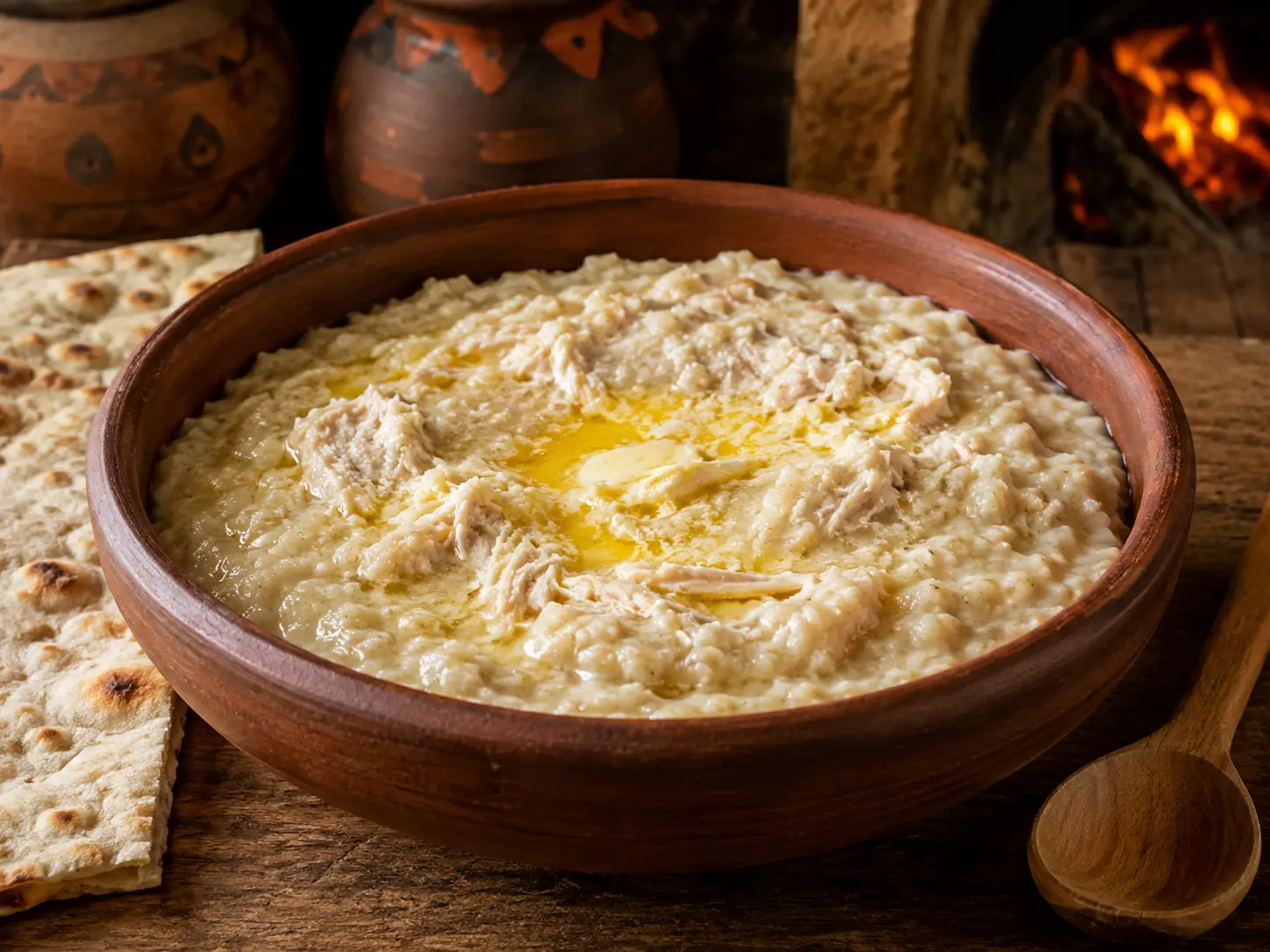
Wheat and meat stirred together for hours until they become one substance — a dish recorded in a tenth-century Baghdadi cookbook, and the food around which the Musa Dagh resistance is commemorated every September.
Lavash
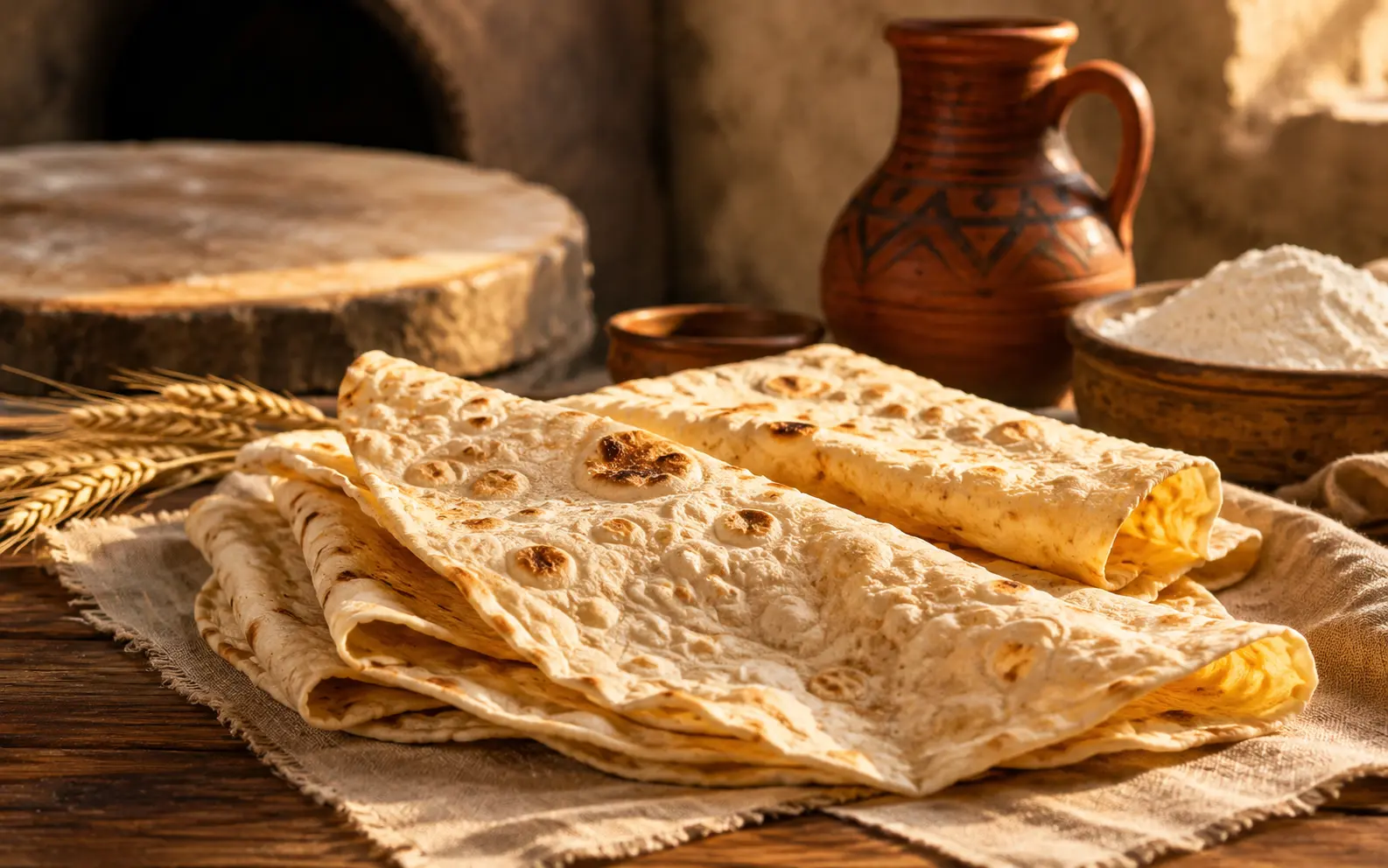
The thin flatbread baked against the wall of a clay tonir, inscribed by UNESCO in 2014 for the way it is made, shared and used in Armenian life — and inscribed again in 2016 for five other countries.
Dolma
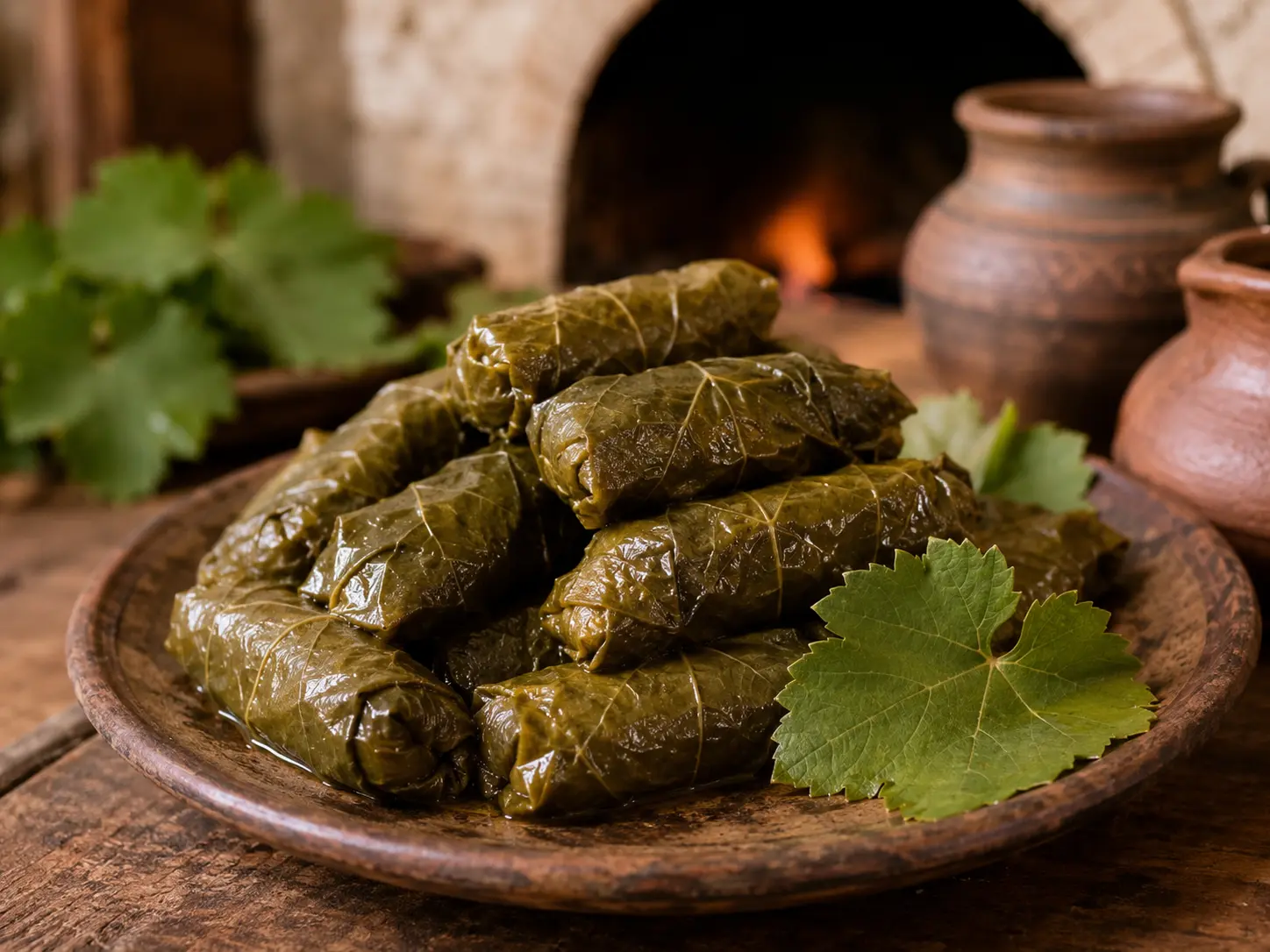
Vine leaves and hollowed vegetables filled with rice, herbs and often meat — a dish made across the whole region, and one of the clearest examples of why this section does not assign dishes to a single owner.