
Harissa
Harissa is hulled wheat and meat cooked together for many hours and stirred until neither can be told from the other. It is not a delicate dish and was never meant to be: it feeds a great many people from very little, and it can be kept going in a large pot through a night. Its written history reaches back to a tenth-century Baghdadi cookbook, where harīsa appears as a pounded wheat-and-meat dish. Its best-known Armenian occasion is far more recent — the September commemoration at Musaler, in Armavir, of the 1915 resistance on Musa Dagh.
- Author
- Armat Editorial Team
- Updated
- Reading time
- 7 min read
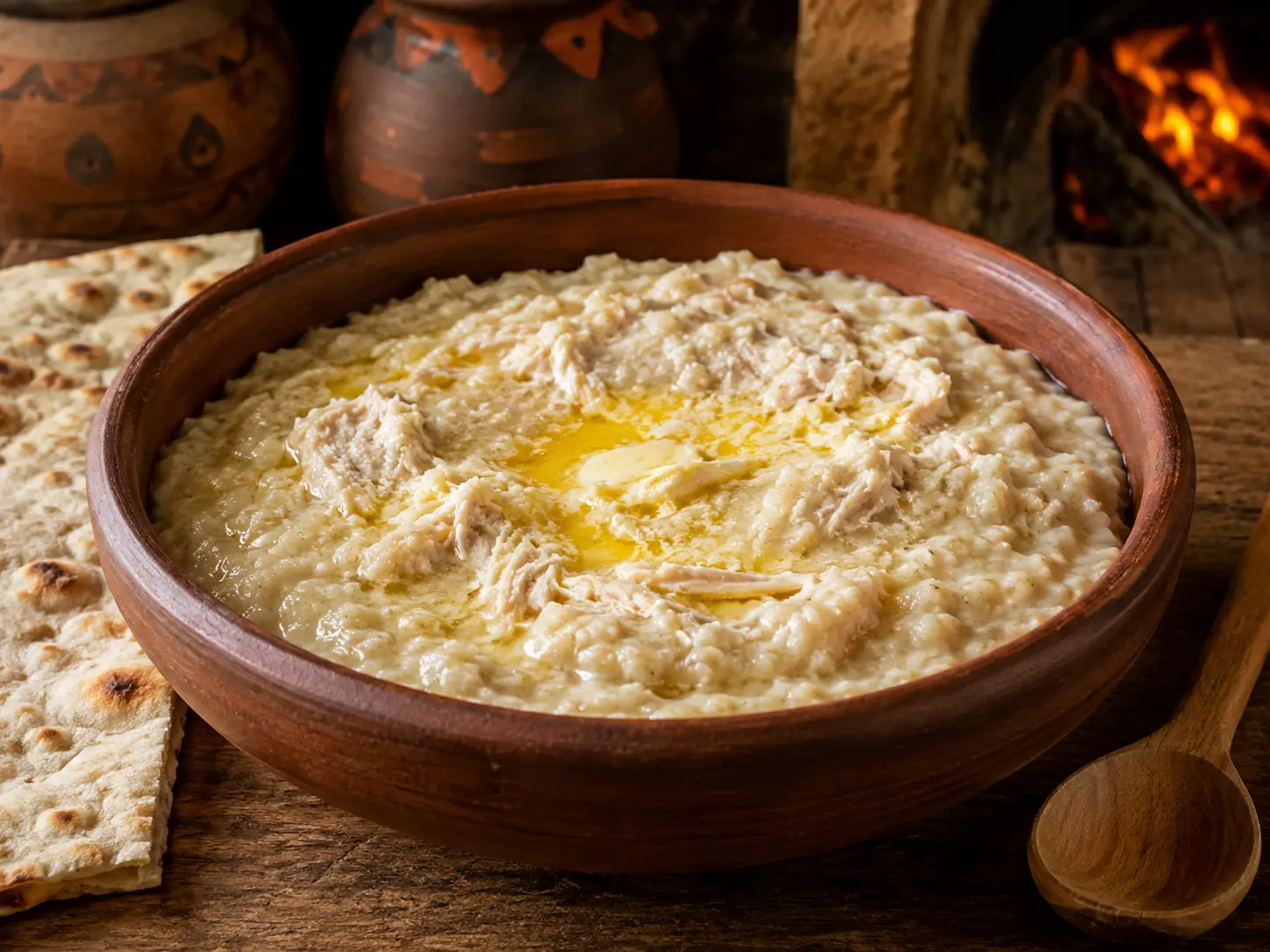
In brief
Harissa is hulled wheat — korkot in Armenian — cooked with chicken or lamb for many hours and stirred until the meat has broken down and the wheat has burst, so that the dish becomes a single heavy mass rather than a stew. The consistency is the test of it: properly made, it pulls away from the spoon. Melted butter is poured over before serving, with cumin or pepper offered separately. It feeds a great many people from very little, which is why it belongs to communal and church occasions. Its written history reaches back to a tenth-century Baghdadi cookbook, and related versions are made across the Middle East. Its best-known Armenian occasion is far more recent: the September commemoration at Musaler, in Armavir, of the 1915 resistance on Musa Dagh.
Key facts
- Kind of dish
- Wheat and meat cooked to a thick porridge
- Ingredients
- Hulled wheat (korkot), chicken or lamb, butter, salt
- Method
- Long, slow cooking with continuous stirring
- Earliest written record
- A tenth-century Baghdadi cookbook
- Best-known Armenian occasion
- The September commemoration at Musaler
- Served
- From a communal pot, with melted butter poured over
The dish at a glance
- Common ingredients
- Hulled wheat (korkot), Chicken or lamb, Butter, Salt, Cumin or pepper, optionally
- Traditional preparation
- Soaked hulled wheat and meat are simmered together for many hours and stirred continuously with a long paddle until the meat breaks down and the two become a single smooth mass; melted butter is poured over before serving.
- Occasions
- The September commemoration at Musaler, Church and community gatherings, Winter family meals and death anniversaries
- Known regions
- Musaler and Armavir Province, Armenian communities of the eastern Mediterranean, more often with lamb, Diaspora commemorations
- Serving traditions
- Ladled from a communal pot into shallow bowls, with melted butter poured over and cumin or pepper offered separately.
What harissa is
Harissa is made from two things: hulled wheat, known in Armenian as korkot, and meat — most often chicken, sometimes lamb. They are cooked together in a large pot with water and salt for a long time, and stirred until the meat has broken down completely and the wheat has burst, so that the finished dish is a single smooth, heavy mass rather than a stew with pieces in it.
The consistency is the dish. A harissa that has not been stirred enough is a wheat soup with meat in it; one that has been stirred properly pulls away from the spoon. Melted butter is poured over at the end, and pepper or cumin offered separately.
It is filling out of proportion to what goes into it, and that is not incidental. Harissa is a dish for feeding a crowd, a monastery, a village or a column of refugees.
Its place in Armenian life
For most Armenians today harissa is a dish of commemoration, and specifically of one commemoration. Every September, at the Musa Dagh memorial in the village of Musaler in Armavir Province, harissa is cooked in quantity and distributed. The pots are set going in the evening and stirred through the night, with music and dancing around the fires, and the food is handed out the following day.
What is being remembered is the 1915 resistance on Musa Dagh, when the Armenians of several villages on the mountain refused deportation, held out, and were eventually taken off by French warships. The Armenian National Institute's record of the memorial at Musaler credits it to the architects Rafael Israelian and Ara Harutyunyan, gives its opening as 1976, and notes that the village below it took the mountain's name in 1972.
Beyond that, harissa remains a communal and church dish: cooked for a parish, for a saint's day, for a gathering too large for anyone to cater individually. The scale is part of what it means.
Documented background
The oldest evidence is textual and not Armenian. Harīsa — pounded wheat cooked with meat — is recorded in the tenth-century Baghdadi cookbook of Ibn Sayyār al-Warrāq, translated into English by Nawal Nasrallah and published in 2007. The dish therefore has a written history of more than a thousand years, and belongs to a shared culinary tradition across the Middle East, where versions under closely related names are still made.
Its attachment to Armenian commemoration is a twentieth-century development, and a specific one. The Musa Dagh episode of 1915 is documented in detail in Raymond Kévorkian's history of the Armenian Genocide. The link that survivors and their descendants drew between that event and this dish — that wheat and meat were what they had, and that harissa was what could be made from it — is preserved as community memory rather than as an archival record, and is presented here on that footing.
A legend repeated in Armenian food folklore attaches the dish instead to Gregory the Illuminator. It is a story told about harissa, not a record of where it came from, and it is worth knowing as folklore rather than as history.
Ingredients and preparation
Korkot is wheat that has been hulled and usually parboiled and dried, so it collapses under long cooking. It is soaked, then simmered with the meat and plenty of water.
The work is in the stirring. As the pot thickens it must be worked constantly with a long paddle or spoon, both to prevent catching and to break the meat down; in a communal cooking, people take this in turns through the night.
Butter is poured over the surface before serving. Many families add nothing else at all; some finish with cumin, and others serve pepper on the side rather than in the pot.
Occasions and traditions
The September gathering at Musaler is the occasion most people associate with harissa, and it is a commemoration rather than a food festival: the cooking, the all-night vigil at the pots and the distribution are its form.
Elsewhere it is cooked for church and community events, and in winter as a family dish, where the same long cooking is simply spread over an afternoon. In some households it is made on the anniversary of a death.
Regional variations
The main variable is the meat. Chicken is now the most usual in the Republic of Armenia; lamb is common in Armenian communities of the eastern Mediterranean, and gives a heavier dish.
Wheat varies too — coarser or finer korkot, and in some places barley — which changes how long the cooking takes and how smooth the result is.
Closely related dishes are made across the Middle East and beyond under names descended from the same word, with different grains, different meats and different finishing fats. They are relatives of this dish rather than versions of it, and Armenian harissa is one member of that family.
Important dates
1915
The Armenians of the Musa Dagh villages refuse deportation, hold out on the mountain, and are taken off by French warships.
2007
Nawal Nasrallah's English translation of Ibn Sayyār al-Warrāq's tenth-century Baghdadi cookbook is published, making the earliest written harīsa recipes generally available.
Why harissa matters
Harissa is the clearest example in this section of a dish whose meaning has been rewritten by history. Its written record is a thousand years old and regional; its emotional weight for Armenians today comes from a single event in 1915 and from the commemoration that grew out of it.
It is also a reminder of what a dish of scarcity is. Wheat, meat, water, salt and many hours of stirring will feed a very large number of people, which is why it appears wherever a community has had to eat together with little — and why it is still cooked in a pot too big for one family to have any use for.
Interesting facts
- 01Harīsa is recorded in a tenth-century Baghdadi cookbook, centuries before it was attached to any modern national cuisine.
- 02At Musaler the pots are lit in the evening and stirred through the night, with singing and dancing around the fires until the food is given out the next day.
- 03Franz Werfel's novel fixed "forty days" of resistance in the public imagination; historical accounts of the Musa Dagh episode count rather more.
- 04A legend repeated in Armenian food folklore attributes the dish to Gregory the Illuminator — a story about harissa rather than a record of its origin.
- 05The dish's texture is the test of it: properly made, it pulls away from the spoon in one mass rather than behaving like a soup.
Sources
- Nawal Nasrallah (trans.). Annals of the Caliphs' Kitchens: Ibn Sayyār al-Warrāq's Tenth-Century Baghdadi Cookbook — Brill, Leiden, 2007 ISBN 9789004158672The earliest written record of harīsa as a pounded wheat-and-meat dish, in a tenth-century Baghdadi collection.
- Raymond Kévorkian. The Armenian Genocide: A Complete History — I.B. Tauris, London, 2011 ISBN 9781848855618The scholarly account of the 1915 Musa Dagh resistance, to which the September commemoration is attached.
- Musa Dagh Memorial, Musaler, Armavir Province — Armenian National Institute, Washington DC Visit sourceThe institutional record of the memorial at which the commemoration is held.
- Irina Petrosian and David Underwood. Armenian Food: Fact, Fiction & Folklore — Yerkir Publishing, 2006 ISBN 9781411698659
Related articles
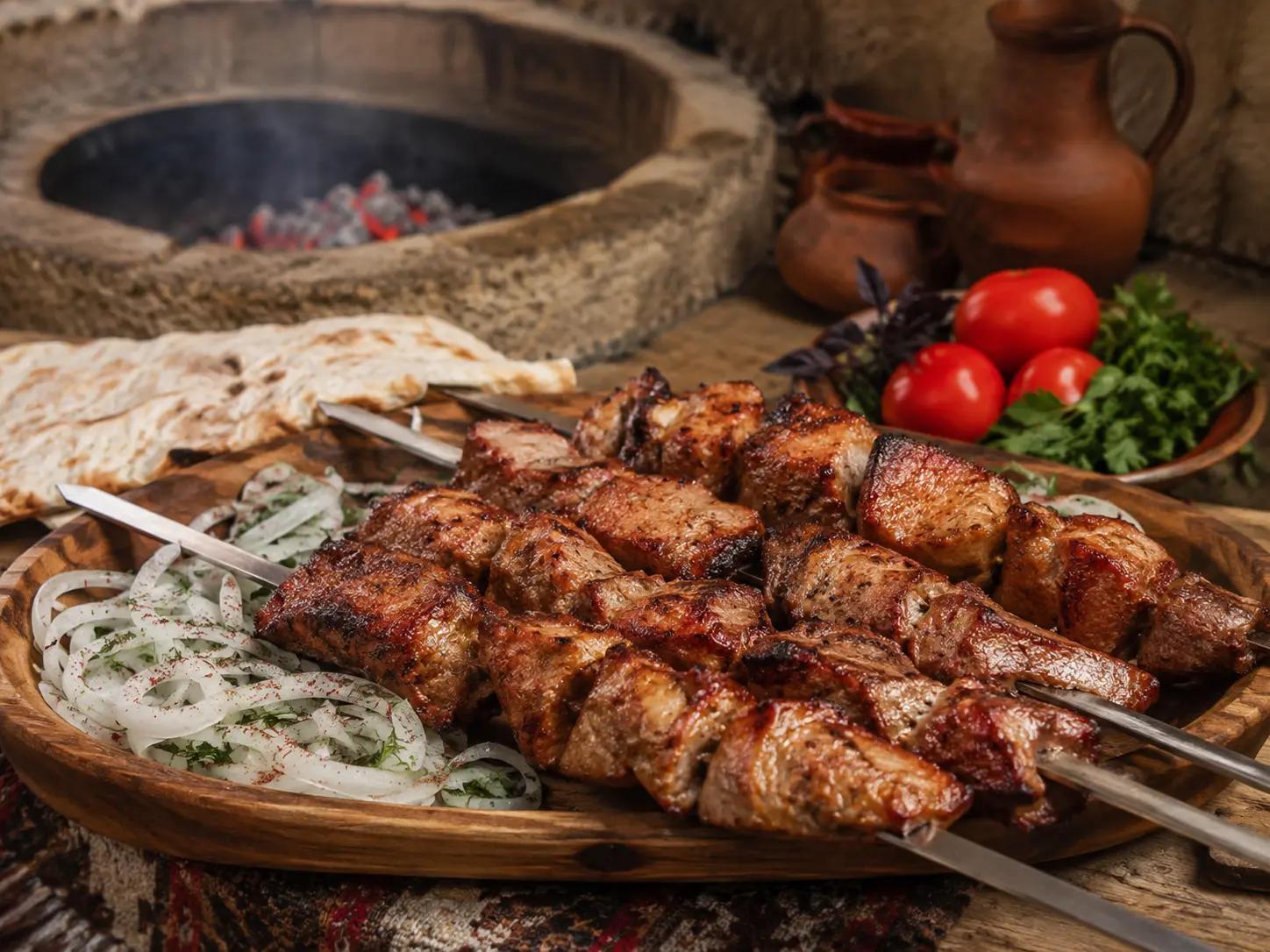
Khorovats
Meat grilled over open embers, and the social occasion built around it: who lights the fire, who tends it, and how it differs from the communal meal of a madagh.
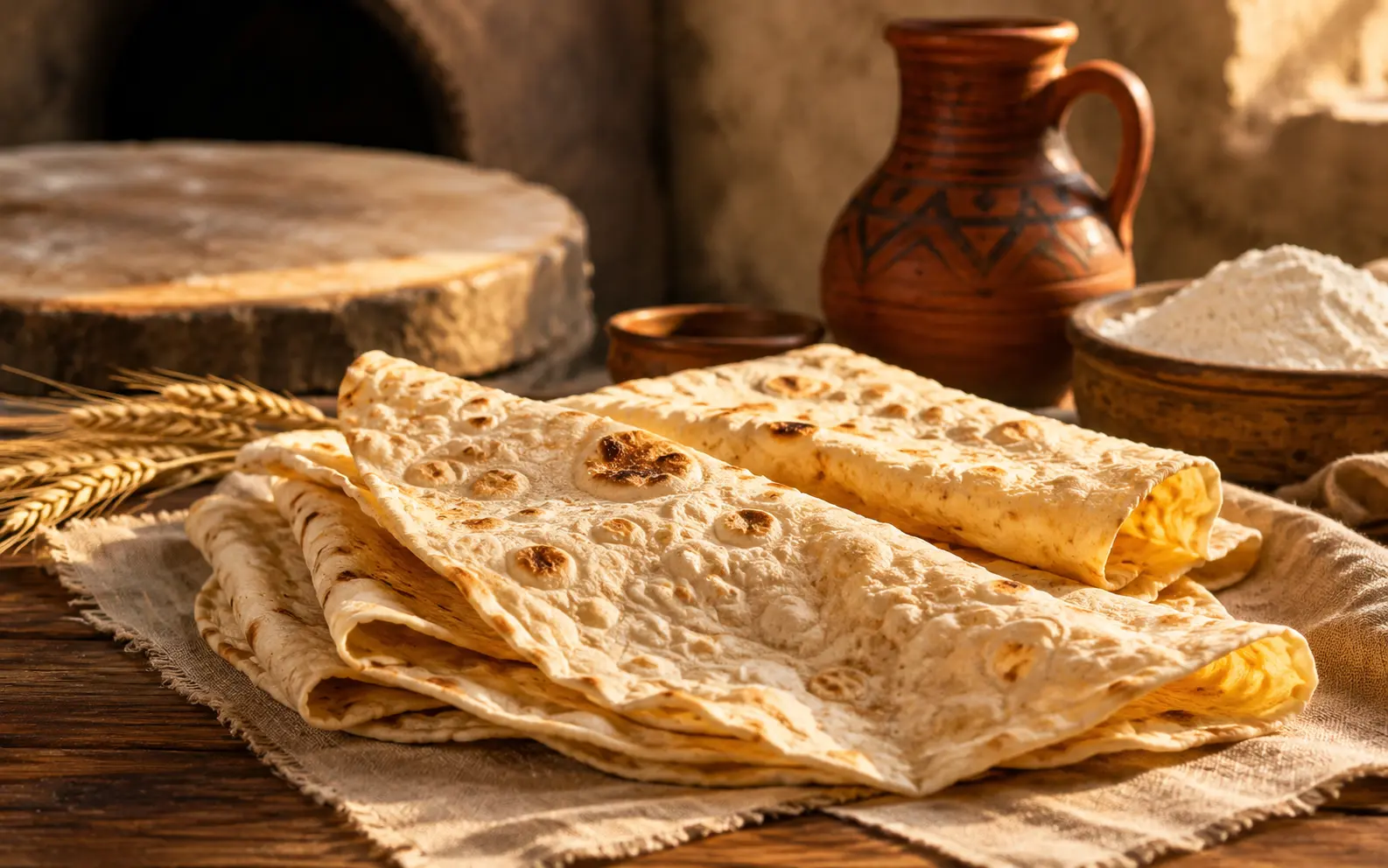
Lavash
The thin flatbread baked against the wall of a clay tonir, inscribed by UNESCO in 2014 for the way it is made, shared and used in Armenian life — and inscribed again in 2016 for five other countries.
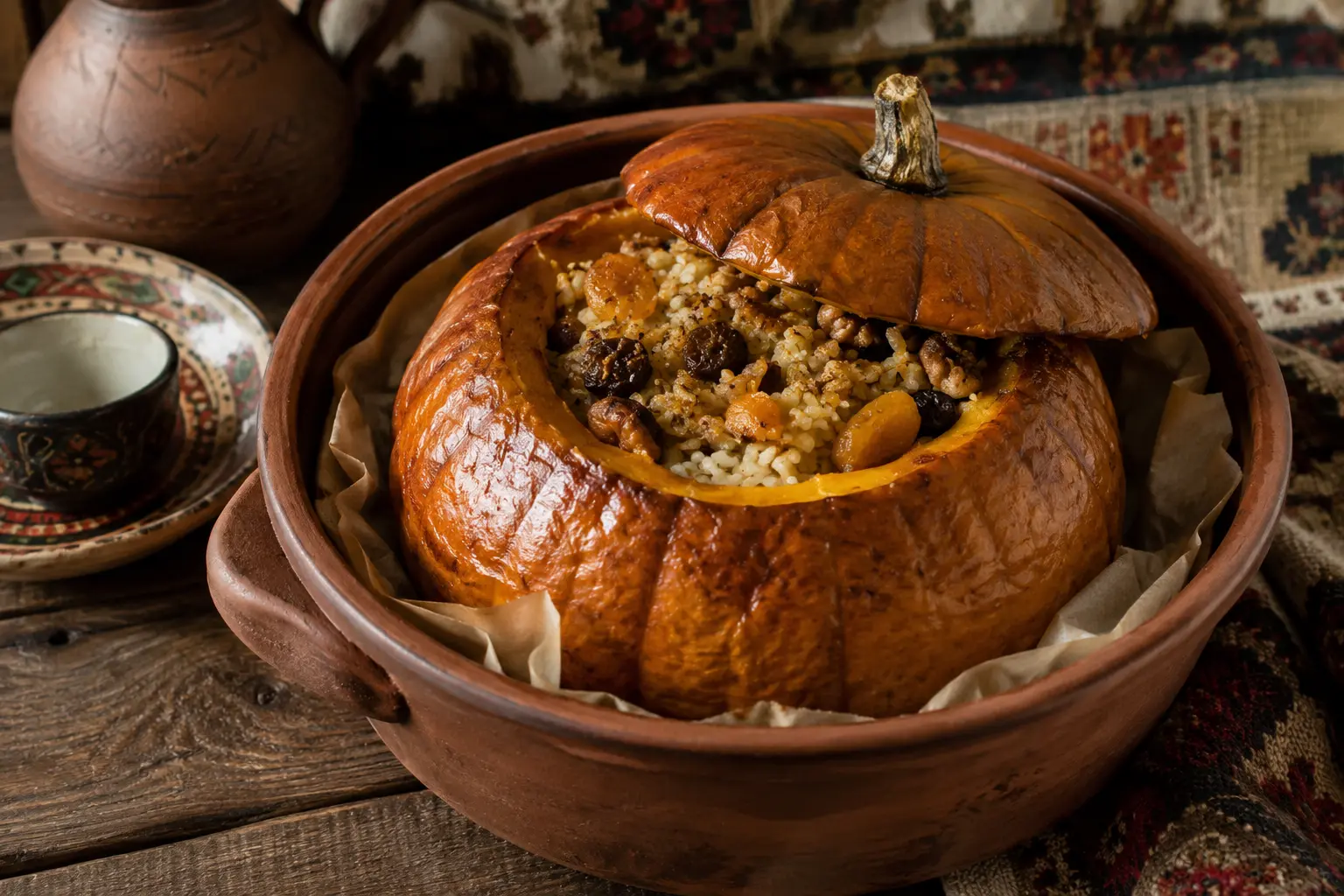
Ghapama
A whole pumpkin filled with rice, dried fruit and nuts and baked until it can be opened at the table — a festive dish whose ingredients place it firmly in the modern era.