
Khash
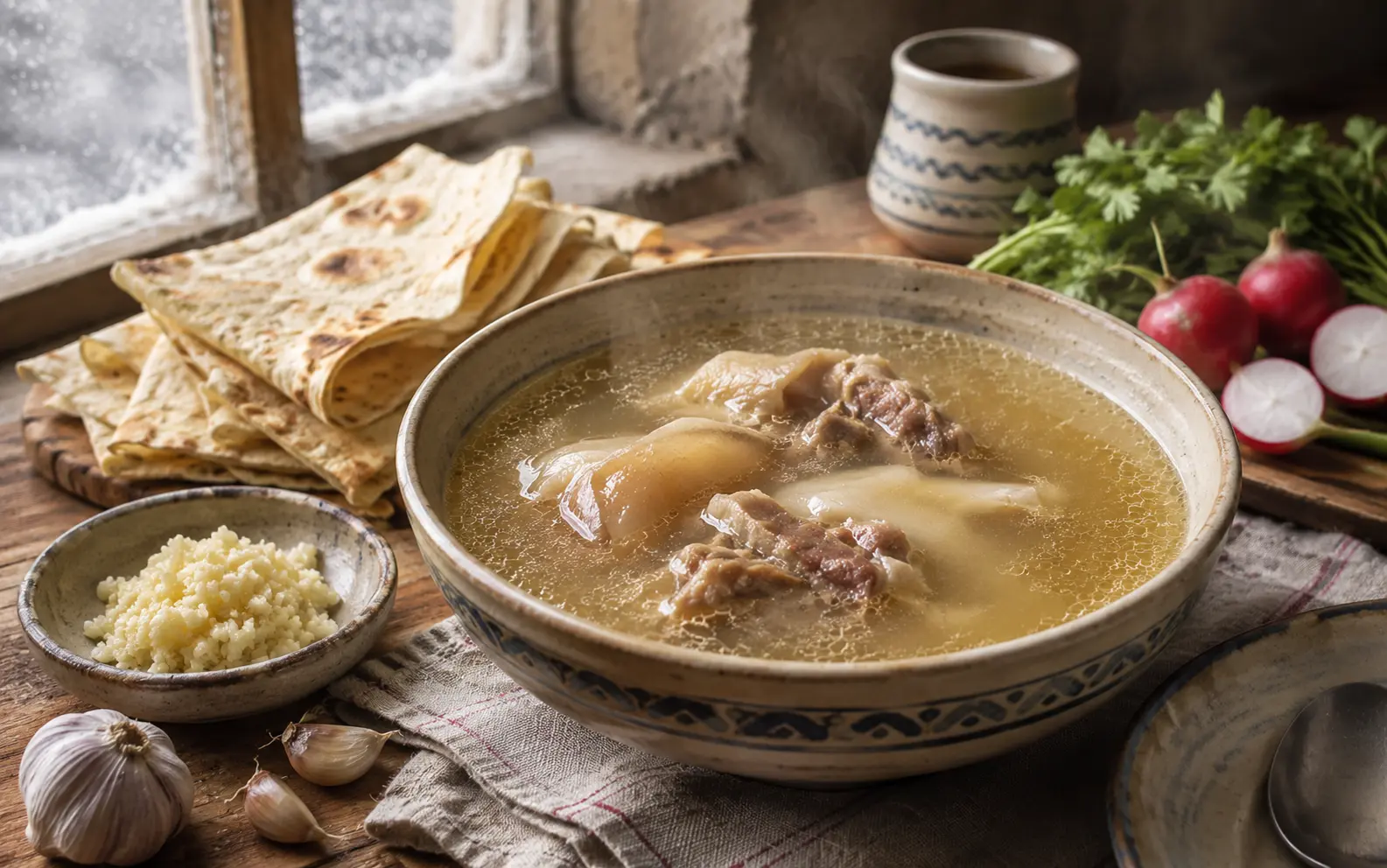
Khash is what happens when the toughest parts of an animal get enough time. Cattle feet are cleaned, soaked in cold water for many hours, then simmered in nothing but water until the broth grows thick with what the feet release and the meat falls off the bone. That takes most of a night, for something eaten at dawn. The broth reaches the table boiling and unseasoned, and everyone finishes their own bowl with garlic, salt and crumbled dried bread. The food itself is that simple. What surrounds it — the season, the hour, the toasts and the company — is what this article is mostly about.
- Author
- Armat Editorial Team
- Updated
- Reading time
- 15 min read
In brief
Khash is a broth made by boiling cattle feet in plain water for most of a night. It is served scalding and unsalted on winter mornings, and each person finishes their own bowl with garlic, salt and crumbled dried lavash. So the dish is really a whole table, not a single plate. Custom ties it to the cold months and the early hours, and every account agrees on one thing first: nobody eats it alone. The two claims most often repeated about khash in English are that it is ancient and unchanged, and that it cures hangovers. The evidence supports those two least.
Key facts
- Kind of dish
- A broth of long-boiled cattle feet, served scalding
- Season
- The cold half of the year: by custom, the months whose Armenian names contain the letter ր
- Time of day
- Early morning, before the usual breakfast and not alongside it
- In the pot
- Feet and water, nothing else. The cook adds no salt, because salt darkens the broth
- At the table
- Garlic, salt, dried and fresh lavash, radish, fresh greens and pickles, added by each person
- Eaten
- In company, the one thing every account of the dish agrees on
The dish at a glance
- Common ingredients
- Cattle feet (trotters), the defining part, The head and the stomach, in some accounts and some households, Water, and nothing else in the pot, Garlic, crushed and often pounded with salt, added at the table, Dried and soft lavash, radish, fresh greens and pickles, Salt, which each person adds to their own bowl
- Traditional preparation
- The feet are cleaned and soaked in cold water, changed again and again over many hours. They are then simmered in plain, unsalted water for most of a night, until the collagen breaks down and the broth has body. It is served scalding and unseasoned, and each person finishes it at the table.
- Occasions
- Winter mornings, and weekend mornings in particular, Gatherings of family, friends and neighbours, with customary toasts, In Gyumri, the morning after a wedding
- Known regions
- Throughout Armenia, as a cold-season custom rather than a regional dish, Gyumri and Shirak, where people are most attached to it, Part of a wider regional family of boiled head-and-trotter dishes
- Serving traditions
- Served boiling and unsalted in a deep bowl. Garlic, salt and the accompaniments are passed round so that each person can season and thicken their own portion.
What khash is
Khash is a broth together with the parts of the animal that made it. In Armenia today those parts are cattle feet, boiled until the liquid is dense with everything that has dissolved out of them. Some accounts add the head and the stomach, and Armenian cooks say that in the past lamb was used more often than beef. Every version picks the same kind of cut: parts that are useless cooked quickly and good cooked slowly.
It is not a soup in the usual English sense, and calling it one is the first thing that misleads a reader. Nothing goes into the pot except the feet and water: no vegetables, no stock, no aromatics, not even salt. Nothing is added to thicken it either. The body of the broth comes from the feet alone, which is why this section files it as a meat dish and not among the soups.
The strangest thing about khash comes last, and the rest of this article follows from it. The bowl arrives at the table unfinished on purpose. It is scalding, plain and unseasoned, and the person about to eat it is the one who completes it.
A dish made by time
The long cooking is not tradition for its own sake. The ingredient demands it. Feet and shanks are mostly connective tissue, which is made of collagen, and collagen is tough and does not soften in a short cooking. Kept long enough in water just below a rolling boil, it breaks down into gelatin, which dissolves and thickens the liquid. The parts that resist a quick fire are exactly the ones that give a broth its body, once they are given a night.
The hard work happens before the pot. The feet are cleaned of hair and soaked in cold water, changed again and again, for anywhere from ten to forty-eight hours depending on the source. The sources really do disagree. It depends on the animal, the water and the household, and none of the sources consulted here gives a single correct figure.
One detail matters more than any timing, and it shapes the whole table: the cook does not salt the broth. Sedrak Mamulyan, who heads an Armenian association for the preservation of culinary traditions, gives a plain reason: salt darkens it. The Encyclopaedia Iranica gives the same instruction, for the same reason, in its account of a related Persian dish. That detail will matter again later in this article.
The months with an R
Khash is cold-weather food, and Armenians traditionally put that as a spelling rule: it is eaten in the months whose names contain the letter ր. In Armenian this works out exactly. September through April all have it, and the four warm months — մայիս, հունիս, հուլիս, օգոստոս — do not.
The usual explanation is practical. Khash is heavy and rich, and people are thought to want that in the cold half of the year. Armenian cooks interviewed by the investigative outlet Hetq add that livestock-keeping was concentrated in the mountain districts, where those months really are cold. Whatever you make of the reasoning, the seasonal custom itself is well recorded.
The rule itself, though, cannot be old, and the reason why is more useful than the rule. It depends entirely on the modern Armenian month names, which were borrowed from Latin and brought the r with them. The older Armenian calendar used quite different names — Նավասարդ, Հոռի, Սահմի, Տրե and the rest. Those names do not split into a cold set and a warm set by any letter. They also drifted through the seasons, because that calendar ran three hundred and sixty-five days a year with no correction added. The saying is a handy way to remember a real custom. It is no evidence of the custom's age, and it is not followed strictly now either: restaurants serve khash outside those months.
The morning table
Nobody doubts that khash is a morning food. Armenian sources describe it eaten early, in place of breakfast and not alongside it, and often at weekends. Accounts written for visitors describe gatherings starting at eight or nine. Every kind of source consulted for this article agrees on the custom.
Why it is eaten in the morning is another matter, and no source consulted gives a firm answer. The most concrete explanation is practical: a dish that needs most of a night is ready by morning. The writer Benjamin Kemper, describing khash for the Smithsonian's folklife programme, notes that a gathering at nine means the cook has to start overnight. The same logic appears independently in Iran, where the related dish is also eaten in the morning and also cooked overnight.
Other explanations circulate: the dish is too heavy for later in the day, it warms up a cold start, it belongs to the morning after an evening of eating and drinking. Each is plausible, and none is documented as the cause. The custom is certain; its origin is not. Offering a confident reason here would mean making one up.
The bowl you finish yourself
Since the pot cannot be seasoned, the table has to be. Round comes the garlic — crushed, often pounded with salt or loosened with a little hot broth — along with salt, radish, fresh greens and pickles. Each person seasons their own bowl to taste, in whatever amounts they like. Photographs rarely show the key point about khash: it is a table rather than a plate, and each diner does something to the dish, not just with it.
Lavash plays two parts at that table, which makes it more than a side dish. Dried lavash is crumbled into the broth until it thickens almost to a porridge, and soft lavash is used to scoop and wrap. Some accounts also describe a sheet laid over the bowl to keep the heat in. Dried lavash exists at all because the bread keeps for months and softens again with a sprinkle of water, as the UNESCO listing for lavash describes. So a winter dish has bread on hand in a form that works like an ingredient.
The garlic is not modest. One account puts it at up to eight cloves a portion, which should be read as an observation, not a rule. Some things here are widely recorded and some are one-offs. Garlic, salt, lavash, radish, greens and pickles come up again and again, in Armenian-language reporting and in writing from cultural institutions alike. Lemon and vinegar belong to one particular modern recipe. One restaurant table is not a national custom, and marking that difference is what this article is for.
Never eaten alone
Every source consulted for this article agrees on one thing first. Rafik Nahapetyan, surveying the Armenian food system for the Historical-Philological Journal in 2019, states it as a plain ethnographic fact: khash, today as in the past, is almost never enjoyed without guests. One of the chefs Hetq interviewed puts it in everyday words. Nobody gathers for khash to stop being hungry, since a bowl of sorrel soup would do that; people gather to sit down together.
The gathering has a customary shape. Hetq records three toasts in order: a greeting, then one to whoever cooked, then a wish that the khash turns out well. Kemper gives the sequence as the day, the cooks and the guests, and one of the Hetq chefs objects that fixing a number at all misses the point. Some modern accounts describe vodka or fruit spirit as part of these adult gatherings. This article records that only as a documented custom, and it is neither required by the dish nor recommended here. The gathering has also been strongly gendered. It was historically a male occasion, and the ethnographer Ruzanna Tsaturyan has said that women's khash parties, hard to imagine a decade before she spoke, are now unremarkable.
What the table means has changed with the times around it. The cultural scholar Hrach Bayadyan, also speaking to Hetq, describes how khash took on a quiet edge among the Soviet-era intelligentsia. It was an occasion outside the state's calendar of organised public events, a morning spent deliberately not working, and in that sense a mild form of refusal. The city most attached to the dish makes the same point from another angle. Gyumri claims to love khash more than anywhere else in Armenia, and Mamulyan reports that the custom of eating it the morning after a wedding has survived there in particular.
What the record can say
The word itself tells us less than it seems to. Khash is the Armenian verb meaning to boil, used as a noun, and the same root gives khashlama, which is a different dish altogether. So the dish is named after its method. That is a fact about naming, not about age. This article does not try to date the word, because the Armenian dictionaries that could do so properly were not available to consult.
A list of medieval authorities appears in nearly every English-language account: Grigor Magistros in the eleventh century, Mkhitar Heratsi in the twelfth, Yesayi Nchetsi in the thirteenth, with the dish under an older form of its name. Heratsi's medical encyclopedia of 1184 is a real and much-studied work, and secondary writing reports that it describes khash as having healing properties. None of those texts was consulted here. The attributions pass from one popular account to the next with no passage quoted. And even taken at face value, a medieval physician recommending a boiled preparation does not show that today's dish and today's table descend from it. The claim is reported here as a claim, and that is as far as this article can honestly take it.
The ethnographic record points somewhere less expected. Tsaturyan reports that the few historical references that exist describe khash as a wedding food, the same link that survives in Gyumri. Nahapetyan places it among a small group of ritual dishes: Harissa dedicated to the grain harvest, milk soup to plentiful dairy, khash to success with livestock. That grouping is reconstructed from later practice, not from a dated record, and should be read that way. One official fact is also worth noting. Khash is not on Armenia's national inventory of intangible cultural heritage, though lavash, gata, matsun, tolma, winemaking and fruit-spirit distilling all are.
The story about poor people's food
One story about the origin of khash is repeated more than any other. Khash, it says, was the food of the poor. The good cuts went to the wealthy, the feet and offal were thrown out or handed down, and the people who got them made something remarkable out of what nobody else wanted.
Its mirror image circulates too: a king tastes the villagers' dish, likes it and makes it fashionable. When two stories explain the same thing in opposite directions, both are usually just stories. Mamulyan rejects the class account outright, arguing that foods in the past were not clearly tied to one social group. His colleague Grisha Antinyan does not rule it out, but compares it to what people say about the origins of pizza. In effect, he recognises it as a familiar kind of folk tale, not documented history.
What survives a closer look is smaller and duller than the story. A household that has slaughtered an animal uses all of it. That is ordinary practice, needs no explanation in terms of class, and is well recorded as plain economic sense. Nothing consulted for this article establishes khash as documented social history of the poor. And the earliest link the ethnographic record actually offers, a wedding, is hardly an ordinary weekday in a poor household.
A dish with relatives
Boiled head-and-trotter dishes are made across a wide region, sometimes under the same word and sometimes not: khashi in Georgia, xaş in Azerbaijan, pacha and kalla-pāča in Iran, kelle paça in Turkey, and relatives further afield in the Balkans and Central Asia. Armenian khash belongs to that family, and describing it does not require deciding who had it first.
Comparing them is more useful than any claim of ownership, because the practices match so closely. The Encyclopaedia Iranica's entry on kalla-pāča describes a sheep's head and trotters cooked over low heat, usually overnight. The dish is kept for the colder days of the year and served in the morning. It is salted only at the end, because salt blackens the meat. It is made in specialist shops with their own guild, not at home, and a nineteenth-century account has it served with vinegar, onion or crushed garlic. Almost every basic feature of the Armenian practice appears there, in a tradition that arrived at it separately.
That overlap is best read as evidence about the food rather than about influence. A dish that takes a night is ready in the morning. A heavy, gelatinous broth suits cold weather. A pot that cannot be salted leaves the seasoning to the table. A dish that is hard to make at home becomes a reason to gather. The most interesting difference is in the names. Persian names the parts, head and trotter; Armenian names the method. Two traditions describe the same dish by different halves of it, and neither this article nor its sources needs to turn that into a competition.
The hangover reputation
In English, khash usually comes with one claim attached. Headlines call it a hangover cure, and anyone who searches for the dish meets that label before they meet the dish. It is the most repeated thing said about khash outside Armenia.
Where it comes from is no mystery. Khash is eaten in the morning, in company, and Armenian descriptions note that it often follows a festive evening. A food eaten the morning after picks up a reputation as a remedy for the morning after. Once that link exists, food writers repeat it because it makes a good line.
What matters is what kind of claim it is. It is a popular belief and a line of modern food writing: a social association rather than a medical conclusion. Nothing consulted for this article shows any therapeutic effect, and this article makes no claim about one. It is covered here because most English-language pages lead with it, and readers coming from those pages deserve to know the difference.
Important dates
1184
Mkhitar Heratsi completes his medical encyclopedia, the work later accounts most often cite when they date khash to the Middle Ages. The text itself was not consulted for this article.
2012
Khash becomes the subject of peer-reviewed anthropology, studied as a male gathering and a national story rather than as a recipe.
2019
Rafik Nahapetyan's survey of the Armenian food system places khash among the ritual dishes tied to livestock-keeping, and notes that it is still almost never eaten without guests.
Why khash matters
Khash is the second meat dish in this section, and the first that is far more interesting as a custom than as a recipe. The recipe is two lines long and has one ingredient. Everything else worth knowing is the season, the hour, the table and the company. That makes it an unusually good subject for an archive that treats food as culture, not instruction.
It is also the clearest case so far of a dish whose popular history and documented history do not match. The two things said about it most often in English are the two the evidence supports least. Most of this article's work is separating them from what named scholars actually say.
Interesting facts
- 01The rule that khash belongs to the months with an r works in Armenian only because Armenian borrowed its month names from Latin, r and all. With the older Armenian month names it would not work at all.
- 02The cook never salts the broth, because salt darkens it. In Iran, an entirely separate tradition gives the same instruction for a related dish, for the same reason.
- 03Dried lavash is crumbled into the bowl until the broth thickens. That only works because lavash keeps for months and softens again with water.
- 04The name is simply the verb to boil used as a noun. The same root gives khashlama, a different dish that should not be confused with this one.
- 05Khash is not on Armenia's national inventory of intangible cultural heritage, although lavash, gata, matsun, tolma and fruit-spirit distilling are.
Sources
- Ռաֆիկ Նահապետյան. Հայոց ավանդական ուտեստի էթնոմշակութային բնութագրության շուրջ — Պատմա-բանասիրական հանդես, Երևան, 2019 Visit sourceThe strongest source here and the one that answers the question the popular accounts cannot: why khash is never eaten alone. Nahapetyan, an ethnographer at Yerevan State University, groups khash with harissa, milk soup and matagh as ritual dishes dedicated to the powers over farming and livestock — harissa to grain, khash to the success of animal husbandry — and observes that khash and matagh are, in his words, still almost never enjoyed without guests. He also lists khash and khashlama separately among the respected meat dishes, which is the scholarly warrant for keeping the two apart. Read directly, pages 175–199; the ritual passage is on page 191. His antiquity statement is a reconstruction argued from later practice rather than a dated attestation, and the article marks it as one.
- Kaitlin Fertaly. Khash, history and Armenian national identity: reconsidering post-socialist gender, food practices and the domestic — Identities: Global Studies in Culture and Power, 19(1), 81–102, 2012 Visit sourceThe only peer-reviewed study devoted to khash that could be identified. Cited for one thing only, which its published abstract carries: that khash is analysed in the scholarship as a male gathering and as a vehicle for national narratives of resourcefulness, rather than as a recipe. The full text is behind a paywall and was not consulted; the bibliographic record was verified through Crossref. Nothing in the article's prose is attributed to it beyond the scope of that abstract.
- Խաշ. պատրաստվում է հեթանոսության ժամանակներից — Հետք, 22 November 2010 Visit sourceThe richest single source for practice, and unusual in that it prints a disagreement rather than a consensus. It carries: the letter-ր rule with the reason offered for it; that the cook adds no salt because it darkens the broth; the three toasts in order and one chef's objection that fixing a number misses the point; the Gyumri attachment and the custom of khash on the morning after a wedding; and the alcohol custom. It is also the source for the article's class-history section, because it records Sedrak Mamulyan rejecting the poor-man's-food account outright and Grisha Antinyan comparing it to the story told about pizza. Hrach Bayadyan, a scholar of culture, supplies the Soviet-era reading and — against Mamulyan's claim of unchanged pagan-era continuity — the argument that the rites around the dish change even where the dish does not.
- Benjamin Kemper. How to Cure a Hangover in Armenia? With Cow-Foot Soup — Smithsonian Center for Folklife and Cultural Heritage, 21 March 2018 Visit sourceQuotes Ruzanna Tsaturyan of the Institute of Archaeology and Ethnography of Armenia's National Academy of Sciences on the two claims the article leans on hardest: that no evidence has been found for today's khash ritual being widespread before the Soviet period, and that the few historical references that exist characterise khash as wedding food. Also the source for the gendered history and its recent change, for the two kinds of lavash at the table, for the garlic quantity, and for the observation that a nine o'clock gathering obliges the cook to start overnight. Chosen over the same author's magazine piece because this is the institution's own folklife programme.
- Etrat Elahi. KALLA-PĀČA — Encyclopaedia Iranica, 15 December 2010 Visit sourceThe regional comparison rests entirely on this, and it is a scholarly reference work rather than a food page, which is why the comparison could be made at all. It supplies: head and trotters cooked over low heat, usually overnight; reserved for the colder days of the year; served in the morning; salted only at the end because salt blackens the meat; made in specialist shops with their own guild rather than at home; and served with vinegar, onion or crushed garlic in a nineteenth-century account. The salt detail arriving independently here and in Hetq is what let the article treat the shared features as consequences of the food rather than as borrowing in either direction.
- Intangible Cultural Heritage — Ministry of Education, Science, Culture and Sport of the Republic of Armenia, consulted 2026 Visit sourceCarries one claim, and it is a claim about an absence: khash does not appear on Armenia's national inventory of intangible cultural heritage, although lavash, gata, matsun, tolma, winemaking and fruit-spirit distilling do. Checked twice and in two languages, against the ministry's own page and against the published enumeration of the inventory, because an absence stated from a single reading of a single list is not a checked fact.
- Lavash, the preparation, meaning and appearance of traditional bread as an expression of culture in Armenia — UNESCO Representative List of the Intangible Cultural Heritage of Humanity, no. 00985, inscribed 2014 Visit sourceReused from the lavash bibliography for one claim, as at §70: that lavash is dried, keeps for months and is brought back with water. That property is why dried lavash can be crumbled into a bowl of khash as though it were an ingredient, which is the link between the two articles and the reason the relation is authored rather than filled in.
Related articles
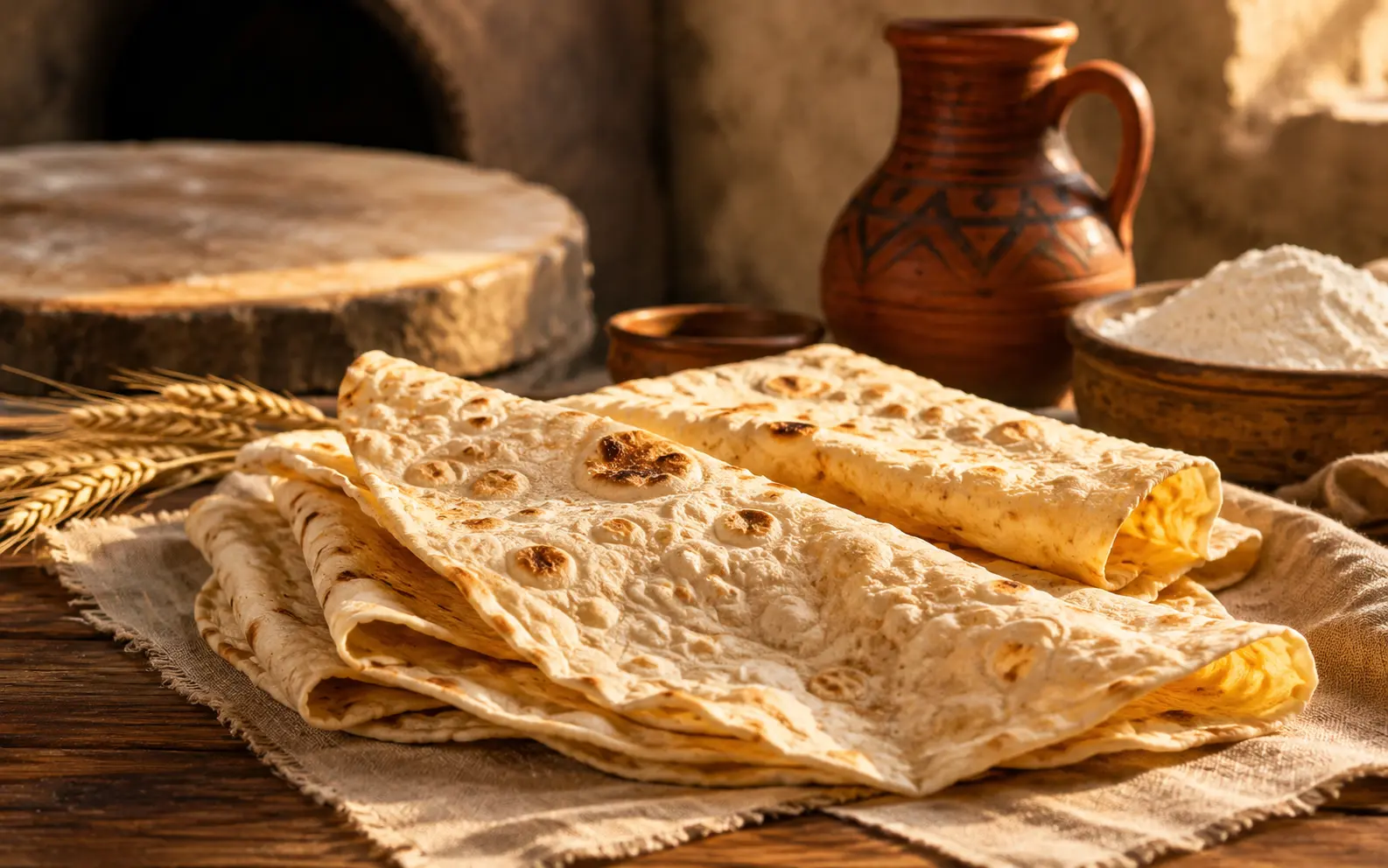
Lavash
The thin flatbread baked on the wall of a clay tonir. UNESCO listed it in 2014 for how Armenians make, share and use it, and listed it again in 2016 for five other countries.
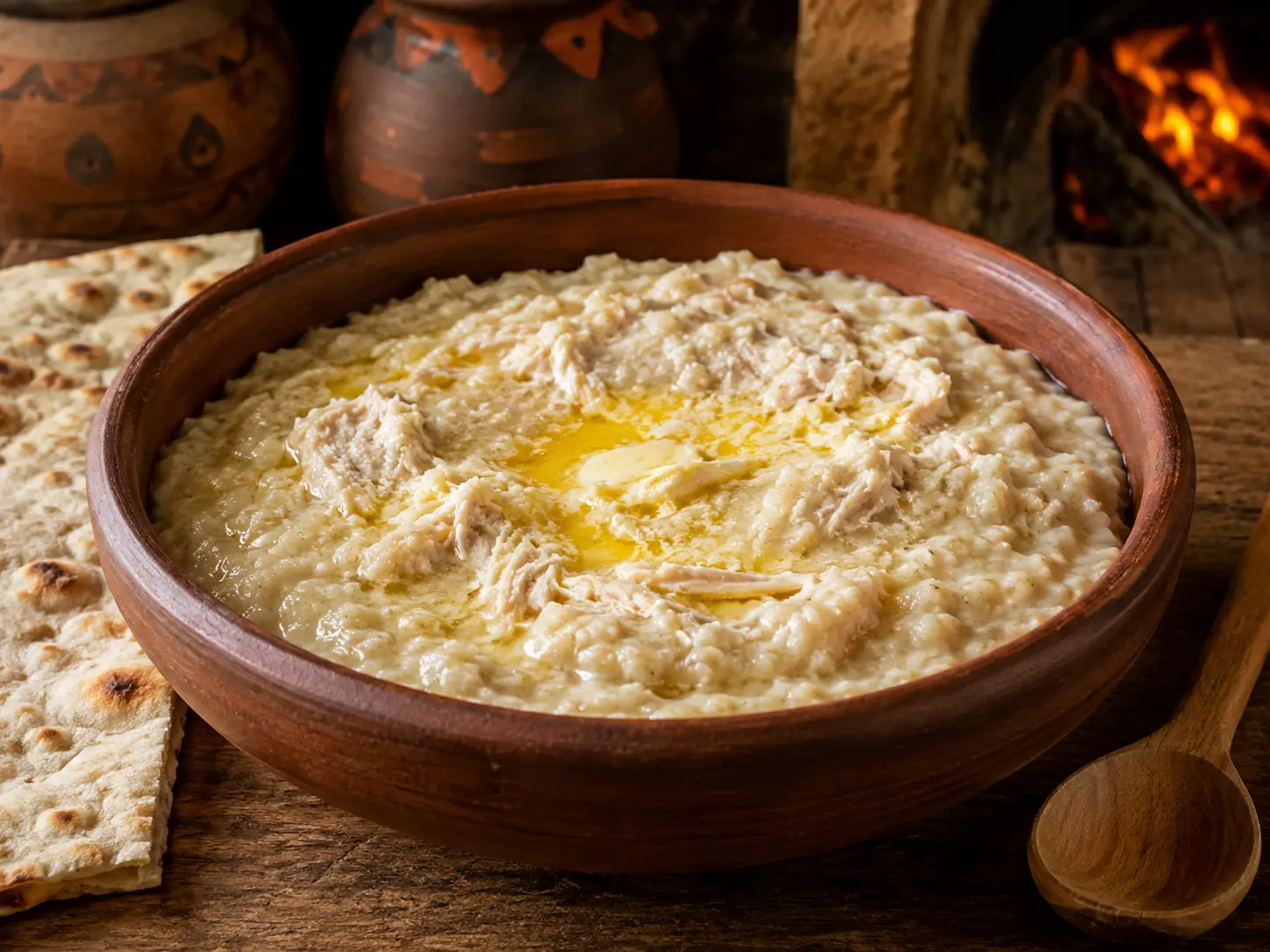
Harissa
Wheat and meat stirred together for hours until they become one. The dish appears in a tenth-century Baghdadi cookbook, and Armenians cook it every September to commemorate the Musa Dagh resistance.
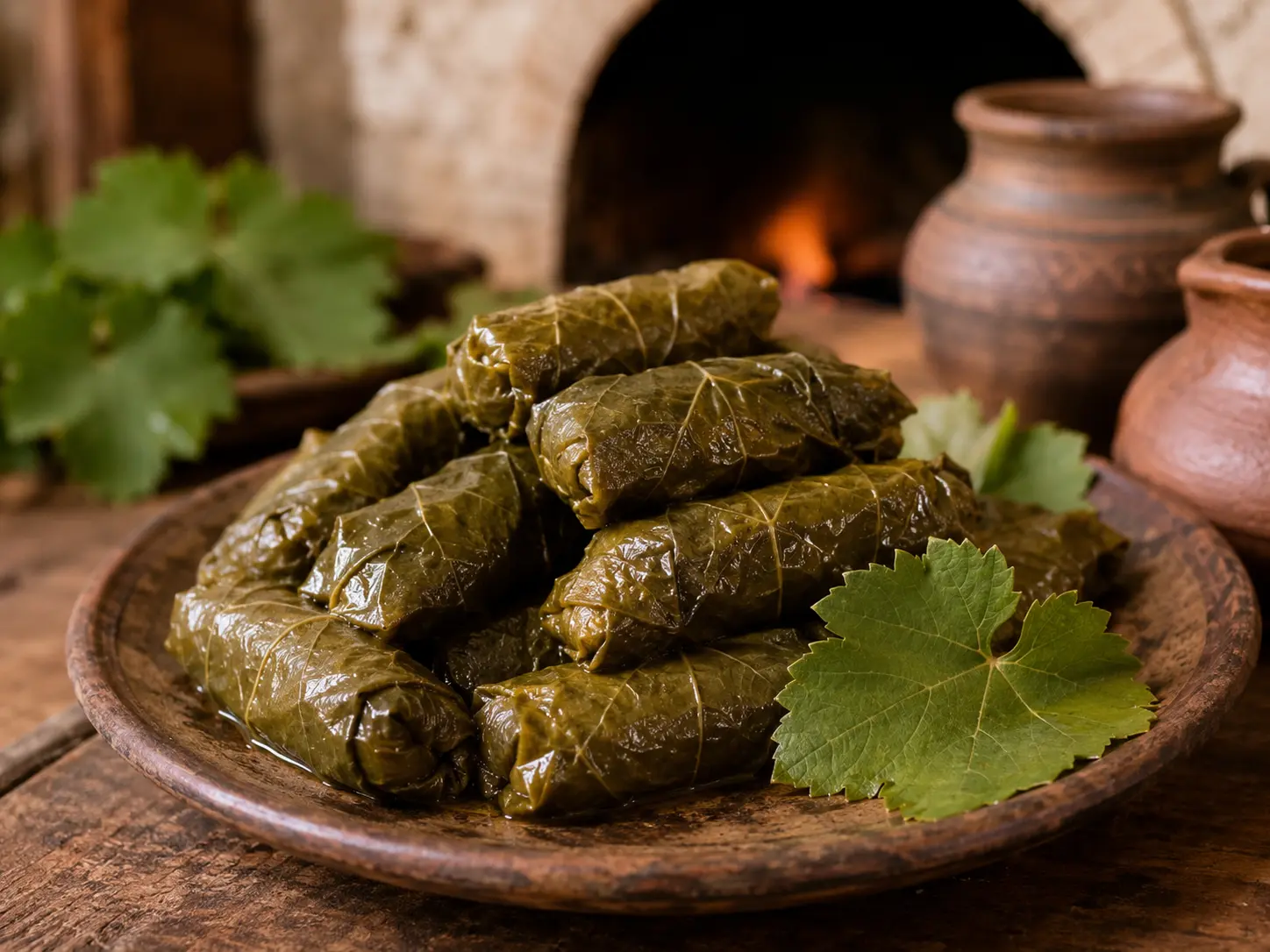
Dolma
Vine leaves and hollowed vegetables filled with rice, herbs and often meat. The dish is made across the whole region, which is exactly why this section does not name a single owner for it.