
Spas
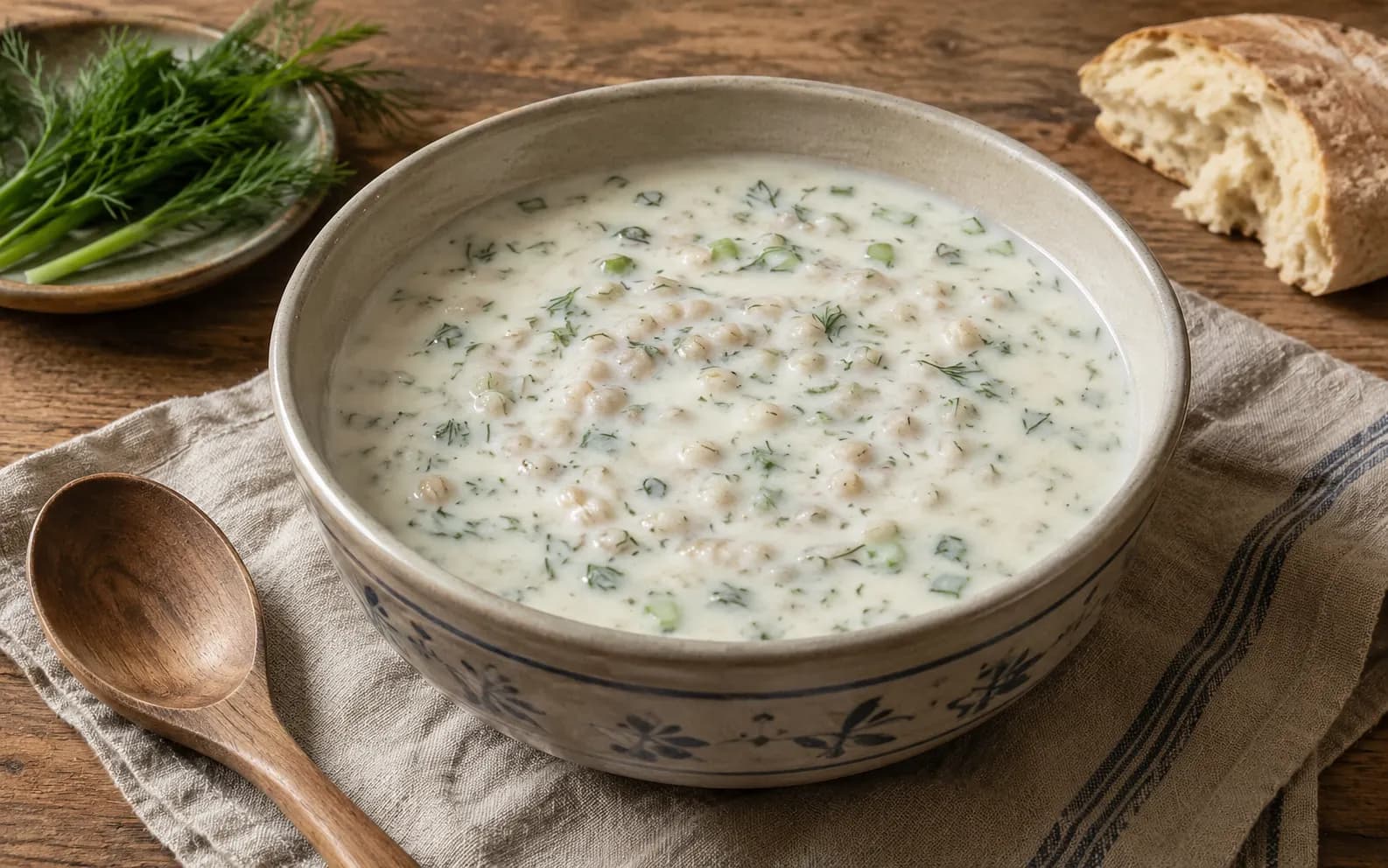
Spas is the everyday side of Armenian cooking. It is a soup of matsun, or fermented milk, thinned with water and cooked with a grain until it thickens, then finished with herbs. It is served hot or cool, and it is what a family eats on an ordinary evening, not something made for a feast. It also poses a real kitchen problem: heating fermented milk is exactly what makes it curdle. Most of what is special about making spas comes down to solving that.
- Author
- Armat Editorial Team
- Updated
- Reading time
- 9 min read
In brief
Spas is a soup made from matsun, or fermented milk, thinned with water and cooked with a grain, usually dzavar, then finished with herbs. What sets it apart is a kitchen problem. Matsun is acidic, and acidic milk curdles when heated, so cooks beat in egg or flour to stabilise it, then warm the pot slowly and keep stirring. It is eaten hot in cold weather and cool in warm weather, with bread, and it belongs to everyday home cooking, not to feasts. Its two names come from opposite directions: one from an old word for what is served, the other from the dairy itself. Neither word's age tells us how old the dish is.
Key facts
- Kind of dish
- Soup made with fermented milk
- Base
- Matsun thinned with water, or tan, which is matsun already diluted
- Grain
- Usually dzavar; also rice, wheat berries or barley
- Herbs
- Cilantro, mint, parsley or dill, depending on the household and season
- The kitchen problem
- Acidic dairy curdles when heated; a stabiliser and slow warming prevent it
- Served
- Hot in cold weather, cool in warm weather, with bread
The dish at a glance
- Common ingredients
- Matsun, thinned with water, Dzavar (hulled, cracked wheat), Egg or flour, as a stabiliser, Onion, Cilantro, mint, parsley or dill, Salt
- Traditional preparation
- Matsun is thinned and beaten smooth with egg or flour to stabilise it, then warmed slowly and stirred constantly so the acidic dairy does not curdle. The grain cooks in it until it softens and the soup thickens, and the herbs go in near the end. It is served hot, or cooled and served cold.
- Occasions
- Ordinary household meals, Winter, served hot, Summer, served cool
- Known regions
- Made throughout Armenia and in the diaspora, The grain follows what grows locally: wheat, or barley where barley was the local crop
- Serving traditions
- In a bowl with bread; hot in cold weather and cool in warm weather, as a meal in itself rather than a starter.
What spas is
Spas is built the other way round from most soups. There is no stock in it. The liquid is matsun, Armenian fermented milk, thinned with water until it pours. Everything else, from the grain to the herbs and salt, goes into that.
A grain cooks in it until it softens and the soup thickens a little. Dzavar, which is hulled and cracked wheat, is the classic choice. Rice is common in modern kitchens, and whole wheat and barley appear too. The herbs go in at or near the end.
The result is white and faintly sour. It is thicker than water but nothing like a purée. You can eat it straight from the pot or let it cool and eat it cold, and with bread it makes a whole meal, not just a starter.
Matsun as the base
Matsun is milk fermented by bacteria that turn its sugars into lactic acid. That acid helps it keep and gives it its taste. As the next sections explain, it also makes matsun tricky to cook.
In spas, matsun is not a spoonful stirred in at the table. It is the soup itself, and it is nearly always thinned. Some cooks use water. Others use tan, which is matsun already diluted and salted, and usually drunk as it is.
Matsun has a much bigger life than this one soup. People eat it plain or strained, serve it beside grain and meat dishes, and work it into dough, and that story belongs to an article of its own. Here the point is simpler: matsun is the liquid, it is acidic, and the whole method is built around that.
Grain and herbs
Dzavar is wheat hulled and cracked into groats, coarser than semolina and finer than a whole berry. It is the grain most linked with spas. It softens without falling apart, so the soup thickens while each grain stays whole.
Other grains are used too. Rice is widespread today and gives a smoother soup. Whole wheat berries make it chewier, and barley turns up where barley was the local crop. Calling any one of these the correct grain would describe one family's kitchen, not the dish.
The herbs vary even more. Cilantro, mint (often dried), parsley and dill all appear, alone or together. Which ones a cook uses depends on the season, the region and what is growing. The Smithsonian's Armenia programme noted that each region has its own favourite wild plants, and spas is a soup where that shows.
Keeping it from curdling
The most interesting thing about spas is a problem, not an ingredient. Milk copes unusually well with heat. Unlike egg or meat, its proteins do not set when cooked. But Harold McGee, explaining the chemistry, adds the exception that matters here: they do curdle once the milk has turned acidic. Matsun is acidic by definition, so heating it does exactly what heating fresh milk does not.
Left alone, the mixture splits into grains of curd in a thin liquid. You can still eat it, but it is not spas. To prevent this, cooks add a stabiliser: a beaten egg or yolk, some flour, or the starch the grain itself gives off. They also heat the pot slowly and stir the whole time, so no part of it gets hotter than the rest.
One piece of advice always comes with the dish: stir in one direction. It helps to be clear about what that is. Explanations of the chemistry talk about temperature, acidity, stirring and stabilisers, and none of them says the direction of the spoon matters. What the advice does ensure is steady, nonstop stirring, and that does matter. It is kitchen custom rather than a mechanism, and we pass it on here as custom.
Spas and tanapur
The dish has two names, and they come from opposite directions. Spas is the older and stranger one. The word was borrowed from Middle Iranian, where it meant service. In Classical Armenian its meaning stretched from service, to the vessels and dishes set out for a meal, to the food served in them. The standard dictionary of the classical language, published in Venice in 1836 and 1837, lists soup among its meanings.
Tanapur is plain by comparison. It simply joins tan, the diluted matsun, and apur, soup: the soup made of tan. The same dictionary gives an older meaning of tan that is closer to broth than to a drink, a reminder that these words have shifted over time.
Today the two names usually mean the same dish, and this article uses them that way. Whether they once meant different things, or split along regional lines, is not something the available sources settle. What the age of the words does not establish is the age of the soup. A name can be centuries older than the dish later attached to it, and no written record places this soup in the classical period.
Hot, cold and the season
Spas is often described as a winter soup served hot and a summer soup served cold, and many modern accounts put it that way. It is better seen as a range than a rule. The same soup works at either temperature, and households differ.
The cold version is simpler, since a soup that is never heated cannot curdle. The hot version needs all the stabilising, slow warming and constant stirring, yet people make it anyway. That says a lot about how much they want it in winter.
Either way, it comes with bread. Lavash torn into the bowl is the usual partner, and in the cold version, where the soup is thin and sharp, the bread is what makes it a proper meal.
Everyday cooking
Most dishes in this section belong, in one way or another, to an occasion. Harissa is cooked in huge pots for a commemoration, ghapama comes to the table at a feast, and khorovats gathers people around a fire. Spas is not an occasion. It is what gets made on an ordinary evening from whatever is already in the house.
The Smithsonian's Armenia programme of 2018 put it simply: a feast differs from daily meals in its ingredients, its cooking methods and the way it is served. Spas falls firmly on the daily side of that line.
That is also why it is thrifty in a way festive dishes are not. Matsun is made at home from milk that would otherwise spoil, the grain comes from the store cupboard, and the herbs are grown, gathered or dried. It is put together from what a household already has, with no shopping trip needed.
A wider family
Soups of grain and herbs, and cooking with soured or dried dairy, are not unique to Armenia. In his survey of Iranian cooking for the Encyclopædia Iranica, Bert Fragner describes porridge-like soups of grains, vegetables and herbs, the āsh family, as everyday town food by the fourteenth and fifteenth centuries. He also notes that milk products such as kashk were widely used to flavour them.
The same survey describes making yogurt, dried yogurt and white cheese as practices that spread early and widely across the Iranian plateau and Central Asia. So fermented-milk soups exist across a broad region under many names. They are related by method, not descended from one another.
None of that takes anything away from the Armenian dish. Spas has its own names, its own typical grain, its own herbs and its own place in the day, and those are what this article describes. Which cuisine first made soup from fermented milk is a question no evidence can answer, and not one worth asking.
Important dates
1836–1837
The Nor baṛgirkʻ haykazean lezui, the standard dictionary of Classical Armenian, is published in Venice. It lists soup among the meanings of the word spas.
Why spas matters
Nobody serves spas to mark an occasion, and that is exactly why it belongs here. If a cuisine is described only through its festive food, you see only the exceptions. The ordinary cooking that most people eat most of the time goes unrecorded.
It is also the clearest example in this section of a dish shaped by a technique more than by its ingredients. Everything about how it is made, from the stabiliser to the slow heat and nonstop stirring, exists to solve one problem. Understanding that problem explains the dish better than any recipe could.
Interesting facts
- 01There is no stock in spas. The liquid is fermented milk thinned with water.
- 02Milk proteins handle heat unusually well and do not set when cooked. But they do curdle once the milk has turned acidic, which is why matsun needs careful handling on the stove.
- 03The word spas was borrowed from Middle Iranian, where it meant service. It passed through the meaning of what is set out for a meal before it came to mean this soup.
- 04Tanapur explains itself: tan, the diluted matsun, plus apur, soup.
- 05The familiar advice to stir in one direction is kitchen custom. Explanations of the chemistry talk about temperature, acidity, stirring and stabilisers, not direction.
Sources
- G. Awetikʻean, X. Siwrmēlean and M. Awgerean. Nor baṛgirkʻ haykazean lezui (New Dictionary of the Armenian Language) — Mkhitarist Congregation, San Lazzaro, Venice, 1836–1837 · NorBagirkHaykazeanLezui1836The standard dictionary of Classical Armenian, compiled from the classical corpus. Cited for the sense-range of the word spas — service, the vessels set out for a meal, and soup — and for the older sense of tan closer to broth than to a drink. It records what the words meant, not when the dish was first made, and the article is careful to keep those apart.
- Harold McGee. On Food and Cooking: The Science and Lore of the Kitchen — Scribner, revised and updated edition, 2004 ISBN 9780684800011The source for the whole of the curdling section: milk proteins are unusually heat-tolerant and do not set when cooked, but they do coagulate once the milk has turned acidic. That exception is the entire technical problem of heating matsun, and it is also what licenses the article to describe stirring direction as custom rather than mechanism.
- Bert G. Fragner. ĀŠPAZĪ — Encyclopædia Iranica, 1987 Visit sourceCited for the regional context and for nothing else: porridge-like soups of cereals, vegetables and herbs as ordinary town food by the fourteenth and fifteenth centuries, the use of milk products such as kashk in flavouring them, and the wide early spread of yogurt-making. Deliberately a source from outside Armenian scholarship, so that the shared-family point is not made by an interested party.
- Armenia: Creating Home — Foodways — Smithsonian Folklife Festival, Center for Folklife and Cultural Heritage, 2018 Visit sourceTwo claims rest on it: that the menu of a feast differs from daily meals in ingredients, techniques and serving etiquette — the distinction the article is built on — and that each region has its own favoured wild plants, which is why the herbs are described as varying rather than fixed.
- Sonia Uvezian. The Cuisine of Armenia — Siamanto Press ISBN 9780970971678The standard English-language account of the Armenian repertoire, cited here for the ordinary range of the dish — the grains and herbs that recur — rather than for any historical claim.
Related articles
Harissa
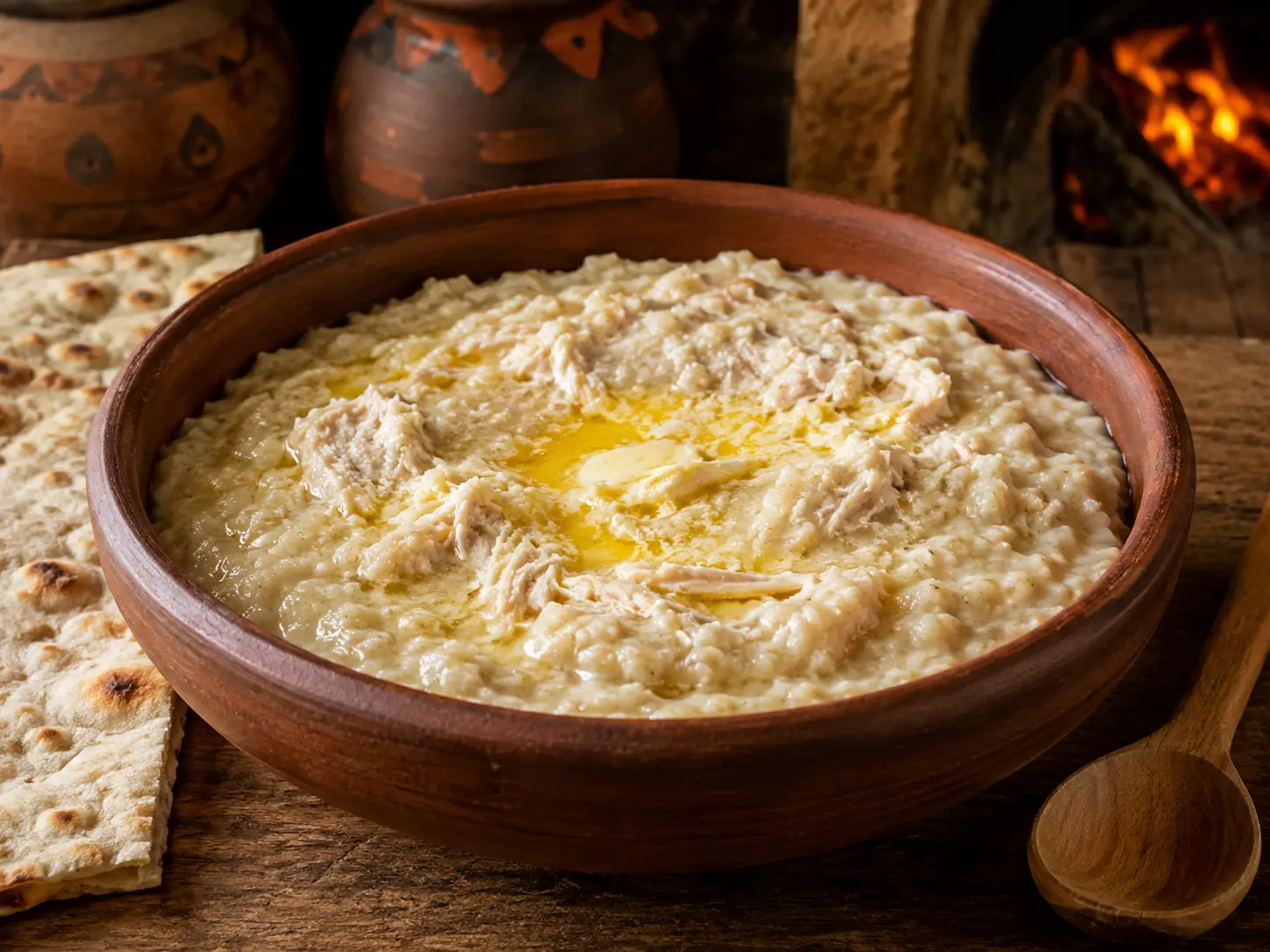
Wheat and meat stirred together for hours until they become one. The dish appears in a tenth-century Baghdadi cookbook, and Armenians cook it every September to commemorate the Musa Dagh resistance.
Lavash
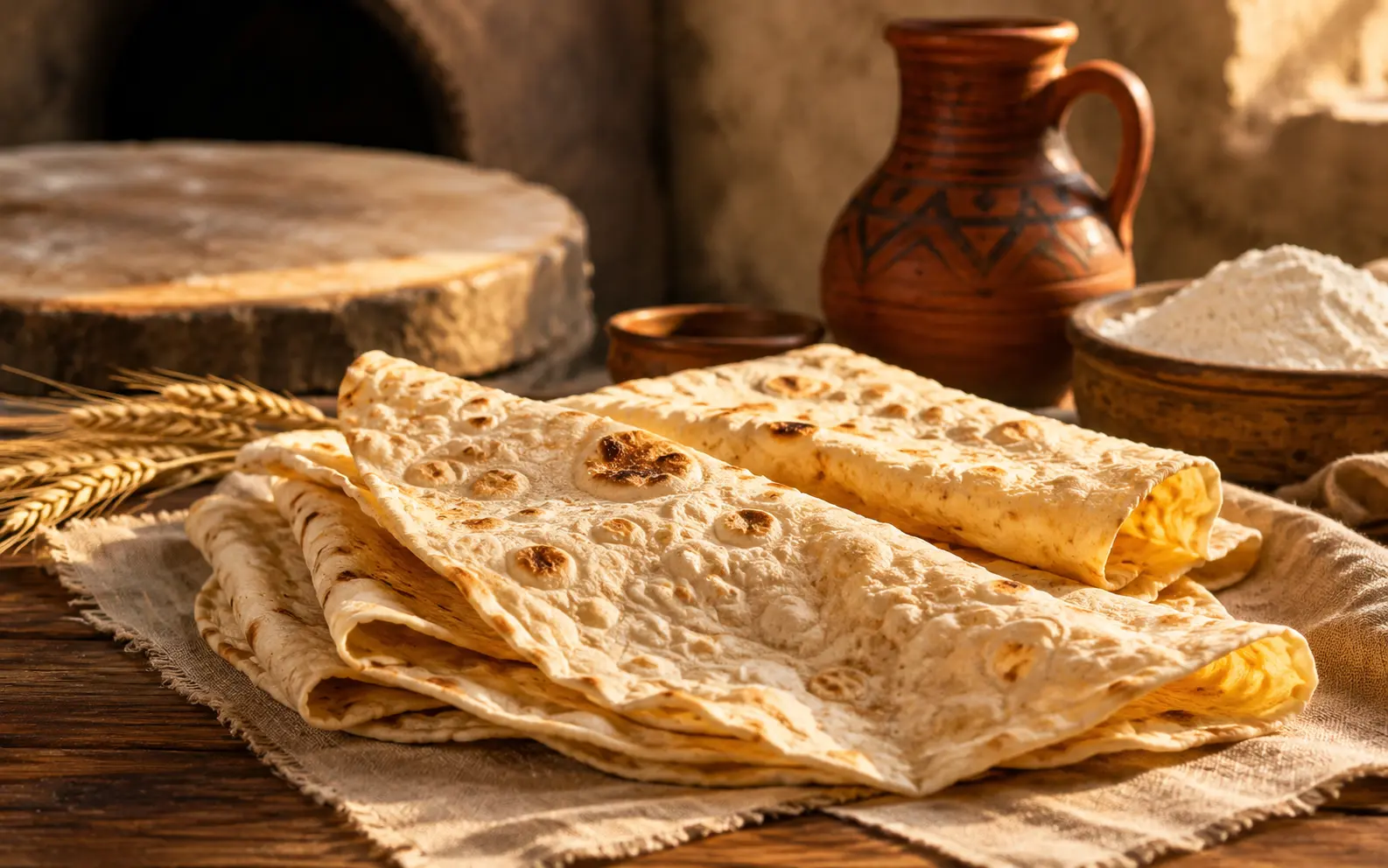
The thin flatbread baked on the wall of a clay tonir. UNESCO listed it in 2014 for how Armenians make, share and use it, and listed it again in 2016 for five other countries.
Dolma
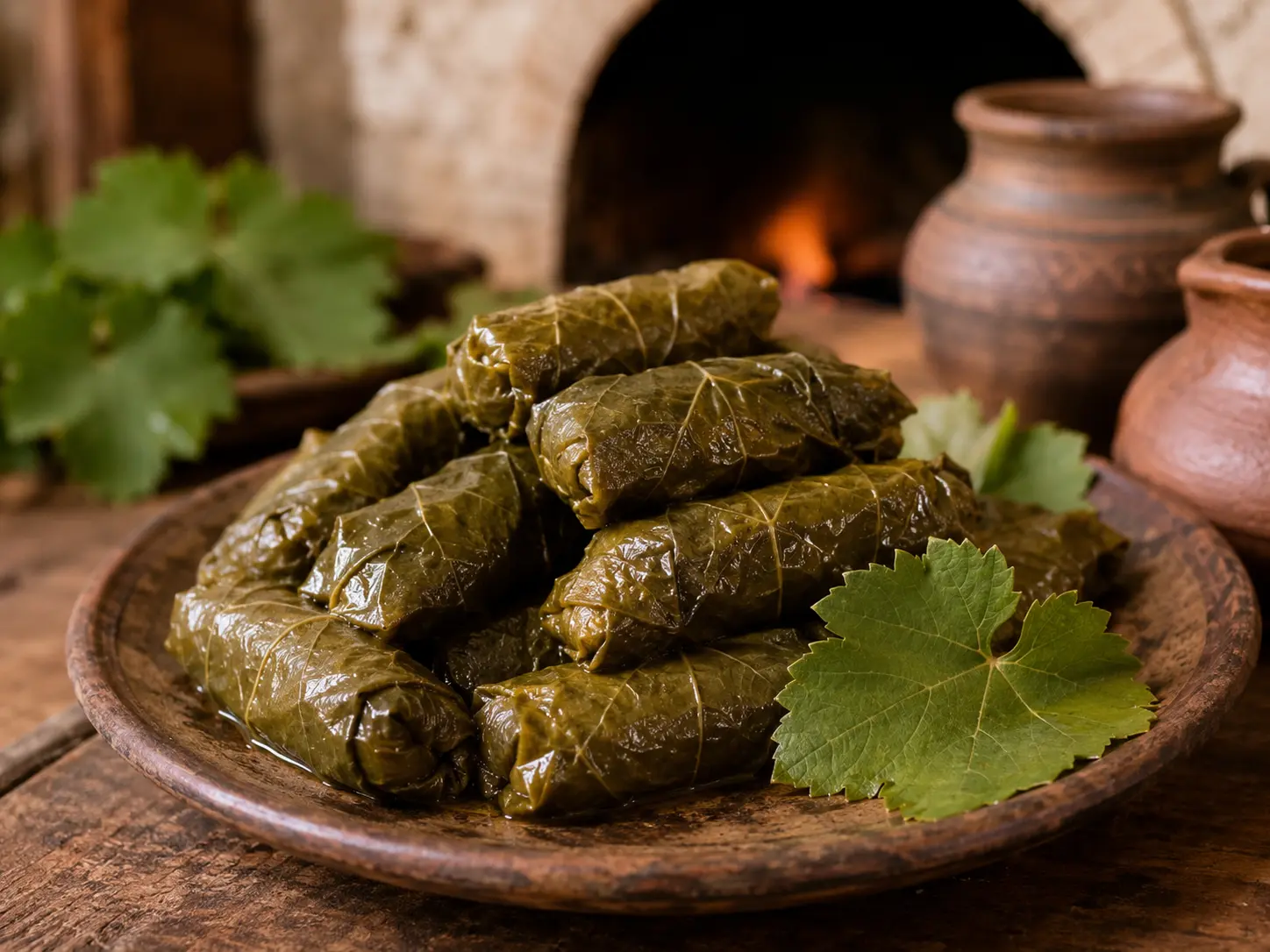
Vine leaves and hollowed vegetables filled with rice, herbs and often meat. The dish is made across the whole region, which is exactly why this section does not name a single owner for it.