
Erebuni Fortress
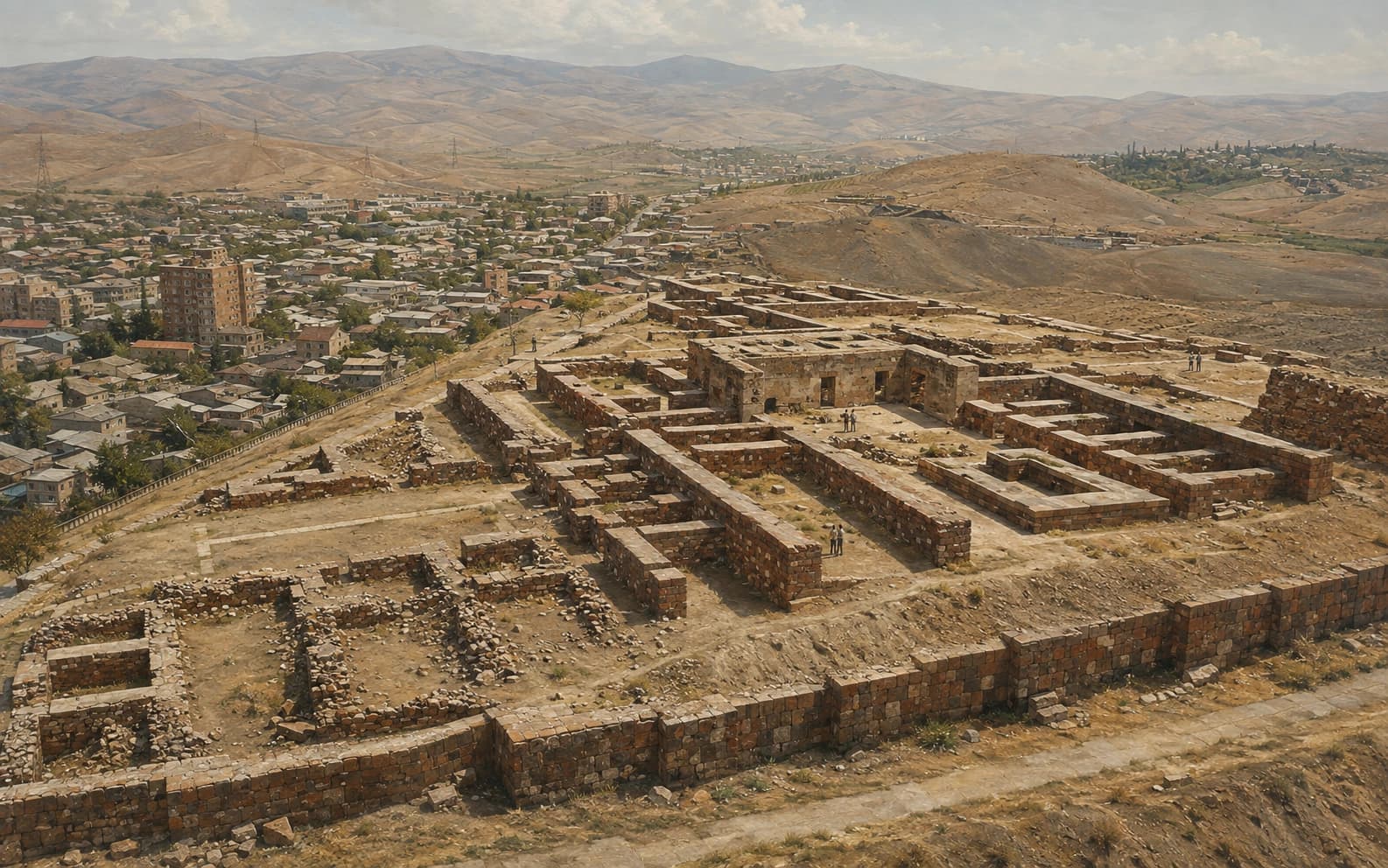
Erebuni is an Urartian fortress on Arin Berd, a hill at the south-eastern edge of Yerevan, and it is the reason the city counts its age from 782 BC. It was built by Argishti I, a king of Urartu, and a cuneiform inscription in his name records both the building and the name he gave it. What you walk through today is an excavated and partly restored archaeological site: stone footings, the stumps of mudbrick walls and a clear plan. The inscription and the finds are in the museum at the bottom of the hill. The first step here is to keep those two things apart: the text and the ruin.
- Author
- Armat Editorial Team
- Updated
- Reading time
- 12 min read
In brief
Erebuni is a fortified Urartian citadel on the hill of Arin Berd, at the south-eastern edge of present-day Yerevan. A cuneiform inscription found on the site records that Argishti I, son of Menua, built the fortress and named it Erebuni. The year usually given for this, 782 BC, is not written on the stone. It comes from placing the foundation within Argishti's reign, which is itself dated by cross-reference to Assyrian records. Inside its wall the citadel held a palace, two temples and long rows of storerooms, and it served the kingdom of Urartu as an administrative, military and religious centre on the Ararat plain. Today it is an excavated site, and the finds are in a museum at the foot of the hill.
Key facts
- Kind of place
- Urartian fortress and archaeological site, partly restored
- Where
- The hill of Arin Berd, Erebuni district, south-eastern Yerevan
- Built by
- Argishti I, son of Menua, king of Urartu
- Conventional date
- 782 BC, from the foundation inscription and Argishti's reign
- What survives
- Citadel wall, palace, two temples and storerooms, largely at foundation level
- At the site
- Erebuni Historical and Archaeological Museum-Reserve, opened 1968
Where Erebuni Fortress is
Erebuni stands on Arin Berd, a low hill at the south-eastern edge of Yerevan, in the city district named after the fortress. The hill rises on its own from the flat ground where the Ararat plain meets the city. From the citadel you can take in farmland, suburbs and the mountains beyond with one turn of the head.
The spot was chosen for the ground it commands. From the top you can see far across the plain and the routes that cross it, and on three sides the slopes are steep enough to do much of the defending on their own. This was the usual Urartian choice of site, and the same thinking put fortresses on similar outcrops across the plain.
One point is worth sorting out before you arrive. The Erebuni Historical and Archaeological Museum-Reserve stands at the foot of the hill and holds the inscription and the finds. The fortress is the excavated citadel on top. They are two parts of one visit but two different things, and a photograph captioned Erebuni may show either.
Argishti I and the foundation inscription
The fortress belongs to a single reign. Argishti I, son of Menua, ruled Urartu in the first half of the eighth century BC, and under him Urartian power reached furthest north, across the Ararat plain. Erebuni is what survives on the ground of that northward push.
The inscription spells this out. A basalt block carries a cuneiform text in the Urartian language. It states that Argishti, son of Menua, built this fortress by the greatness of the god Khaldi. It says he proclaimed it Erebuni for the might of the land of Biainili and to hold the lands of the enemy in awe, and that the ground had been waste before he built on it. The same foundation texts record that the king settled six thousand six hundred warriors here, brought from two conquered lands. Translations differ slightly in wording. The standard published edition of the Urartian royal inscriptions is Mirjo Salvini's corpus, and that is where the text should be quoted from, not from a display label.
What the inscription does not give is a year. The date 782 BC comes from placing the foundation within Argishti's reign, using his own annals and the links with Assyrian records on which Urartian chronology depends. Scholars broadly accept this reconstruction and the museum-reserve uses it, but it is not a figure you can read off the stone. Knowing this heads off the most common misreading of the site.
Erebuni and the kingdom of Urartu
Erebuni did not grow into a fortress; it was founded as one. The kingdom of Urartu, centred on Tushpa by Lake Van, pushed north under Menua and then Argishti I, and that expansion took the form of citadels built on the Ararat plain. A garrison, a grain store and a temple were placed on a hill, and the surrounding plain was governed from there.
The clause about bringing in settlers fits the same pattern. A new fortress needed a population, and that population was moved in, not recruited locally. This tells us something precise about how the Urartian state worked, and it is something the state recorded about itself without embarrassment.
Erebuni was one of several such sites. Argishtikhinili was founded further west on the same plain within a few years, and in the following century the main Urartian centre in the region was Teishebaini at Karmir Blur, a few kilometres from here. It is a mistake to see Erebuni as the only Urartian site on the Ararat plain. It was one point in a network, and the network is what matters.
Palace, temple and storeroom
The citadel follows the shape of the hilltop. Its defensive wall had stone footings with mudbrick above, buttresses at intervals and one main approach. Everything else sits inside that outline, which is why the plan is so clear from the air and so hard to make out on the ground.
Three functions shared the enclosure. The royal apartments and a courtyard with a colonnade made up the palace. A temple of Khaldi, the chief god of the Urartian state, stood beside a hall whose walls were painted in red, blue and white. A second, tower-like temple, of the type Urartian texts call a susi, was dedicated to another god. Fragments of the wall paintings were removed during excavation and conserved, so the colour a visitor sees on the walls today is a reconstruction, not the original.
The fourth function is the least glamorous and tells us the most. Long rows of storerooms held sunken jars for grain, wine and oil, far more than the people living on the hill could ever use. Storage on that scale says something about the state, not the garrison: the harvest of the plain was collected here, kept here and handed out again from here.
So the fortress was an administrative, military and religious centre all at once, and these roles could not be pulled apart. This mix was the normal Urartian pattern, not something peculiar to Erebuni, and it is the most useful idea to take with you up the hill.
What excavation found
People knew the hill was ancient long before anyone worked out what it was, and a small dig took place in the late nineteenth century. Systematic excavation began in 1950 under the archaeologist Konstantine Hovhannisyan, when the foundation inscription came to light and the identification became certain. Work has continued since, including a recent joint Franco-Armenian project whose published results have revised parts of the earlier chronology.
The digging produced two kinds of material. One is architecture: walls, floors, doorways and the plan of the whole citadel, mostly surviving at foundation level. The other is portable finds: pottery, bronze objects, weapons and helmets, seal impressions, further inscriptions, and the fragments of wall painting. Material from later periods also turned up on the hill, and that is the only reason the site's later history is known at all.
The line between record and interpretation runs through the names of the rooms. Calling one group of rooms a palace and another a temple is an archaeological argument, based on the plan, the contents and comparison with better-preserved Urartian citadels. The Urartians did not label them for us. The foundation inscription is a record; the room names are an interpretation. Both are sound work, but they are different kinds of statement.
After the kingdom
The Urartian state came to an end in the early sixth century BC, and Erebuni had already lost importance before then. In the seventh century the administrative weight of the plain lay with Teishebaini at Karmir Blur. Why this happened is debated. The evidence points more clearly to a shift of centre than to any single dramatic cause.
The hill was not abandoned when the kingdom fell. Building continued on the citadel in the Achaemenid period, when this region was a satrapy of the Persian empire, and a columned hall from that time was raised over earlier Urartian work. This is one reason the site matters to specialists well beyond Urartian studies. Later still, the district's settlement moved off the hill, and Erebuni became what it is now: a mound with a plan beneath it.
This is where popular versions of the story often go too far. Erebuni and Yerevan are linked by place and by name across a landscape, not by an unbroken town on this hilltop. Nobody has lived on Arin Berd for a very long time.
Erebuni, Yerevan and a birthday
The name written on the stone is Erebuni. The standard explanation, accepted in Armenian scholarship, is that the name Yerevan comes from it, through a plausible chain of sound changes and the survival of the name in this region. But this is a linguistic reconstruction, not a recorded series of spellings, and scholars have disagreed about what the Urartian word itself meant. It is safe to say that "the name of the city is generally derived from Erebuni"; anything more definite stands on thinner ground.
The modern use of the site is easier to pin down. Yerevan celebrated its 2750th anniversary in 1968, counting from 782 BC, and the museum-reserve at the foot of the hill opened for that anniversary. The name Erebuni now belongs to a city district, a museum and an annual city festival. The city's official age is a decision to count from an inscription. Unlike much of what capitals build their founding myths on, that inscription is a real object you can go and look at.
Both halves of this are worth keeping in mind. The document is genuine, and the date is a scholarly reconstruction. The symbolism is modern, and the object behind it is ancient. Neither fact weakens the other.
What to understand before seeing it
The first thing is what survives. This is a site at foundation level, not a standing fortress, and its interest lies in the plan, the setting and the view. A visitor expecting walls to walk between will find about a metre of stone and a good deal of restoration, and it is not always marked where the reconstruction begins.
The second is that the objects are in another part of the same site. The foundation inscription, the painted fragments, the pottery and the bronze are in the museum-reserve at the foot of the hill. Seeing the citadel without the museum is only half the visit.
The third is the habit this article has tried to practise throughout. People make four different kinds of claim about Erebuni, and they are not equally firm. The inscription records a builder, a name and a purpose. Archaeology reconstructs a palace, temples and a storage economy. Linguistics derives Yerevan from Erebuni. A modern city keeps a birthday. All four can be defended, but only the first was written down by the people who were there.
Important dates
782 BC
The conventional date for Argishti I's founding of Erebuni. The foundation inscription records the building and the name; the year is worked out from Argishti's reign and is not part of the text.
Eighth century BC
The citadel serves as an administrative, military and religious centre for Urartian control of the Ararat plain.
Seventh century BC
The main Urartian centre of the region is Teishebaini at Karmir Blur, and Erebuni's administrative importance declines.
Sixth century BC
The Urartian kingdom ends, but building continues on the hill: a columned hall of the Achaemenid period is raised over the earlier citadel.
1950
Systematic excavation of Arin Berd begins under Konstantine Hovhannisyan, and the foundation inscription comes to light.
1968
The Erebuni Historical and Archaeological Museum-Reserve opens at the foot of the hill, as Yerevan marks its 2750th anniversary.
Why Erebuni Fortress matters
At Erebuni, the written history of the Armenian Highlands meets the ground of a modern capital. Most of what is said about the deep past of any city is inference. Here there is a dated reign, a named king, an object carrying his words and an excavated fortress beneath them. That combination is rare, and it is why the site carries far more weight than its standing remains would suggest.
Erebuni is also the archive's clearest lesson in sorting evidence. Visitors hear several things at once: that the city is nearly three thousand years old, that the fortress was a palace and a temple, that Yerevan is Erebuni. These claims come, in turn, from a cuneiform text, from archaeological interpretation, from historical linguistics and from a civic anniversary. Separating them is not a way of doubting the site. It is the only way to see how much of it is actually documented, and that turns out to be a great deal.
Interesting facts
- 01The inscription that gives Yerevan its official age records the building of a fortress; it is not a city charter. It states who built it, what he named it and why.
- 02The date 782 BC appears nowhere on the stone. It comes from where the foundation falls within Argishti I's reign, which is itself dated by cross-reference to Assyrian records.
- 03The foundation texts record that six thousand six hundred warriors from conquered lands were settled here. The garrison was brought in, not raised locally.
- 04Yerevan marked its 2750th anniversary in 1968, and the museum-reserve at the foot of the hill was opened for the occasion.
- 05The wall paintings were removed from the citadel during excavation and conserved; the colour visible on the hill today is a reconstruction.
Sources
- Mirjo Salvini. Corpus dei testi urartei — CNR, Istituto di Studi sulle Civiltà dell'Egeo e del Vicino Oriente, Rome, 2008– ISBN 9788878900257The standard edition of the Urartian royal inscriptions, including the Erebuni foundation texts. Cited for what the inscription records — the builder, the name, the purpose and the settling of the garrison — and for the fact that it carries no year.
- Paul E. Zimansky. Ancient Ararat: A Handbook of Urartian Studies — Caravan Books, Delmar NY, 1998 ISBN 9780882060910Cited for Urartian chronology and for the reconstruction that places the foundation of Erebuni in 782 BC by way of Argishti I's reign and the Assyrian synchronisms it depends on.
- S. Kroll, C. Gruber, U. Hellwag, M. Roaf and P. Zimansky (eds.). Biainili-Urartu: The Proceedings of the Symposium Held in Munich 12–14 October 2007 — Peeters, Leuven — Acta Iranica 51, 2012 ISBN 9789042924383Thirty scholars on the current state of Urartian archaeology; cited for the fortress system of the Ararat plain, the citadel building types — palace, temple, susi tower, storerooms — and the end of the kingdom.
- Stéphane Deschamps. Erebuni in the context of Urartean fortresses in the Ararat plain: Sources and problems — Quaternary International 395, Elsevier, 2016 Visit sourceReports the Franco-Armenian excavations at Erebuni from 2008 onwards and reconsiders the chronology of the three Urartian fortresses of the plain — Erebuni, Argishtikhinili and Teishebaini. Cited for the excavation history and for what the site's archaeology does and does not establish.
- Boris B. Piotrovsky. The Ancient Civilization of Urartu — Cowles, New York, 1969 Visit sourcePiotrovsky directed the Karmir Blur excavations from 1939 to 1971. Cited here for Teishebaini, the neighbouring fortress that carried the administrative weight of the plain in the seventh century BC.
- Erebuni Historical and Archaeological Museum-Reserve — Erebuni Historical and Archaeological Museum-Reserve, Yerevan, founded 1968 Visit sourceThe institution that holds the foundation inscription and the finds from Arin Berd, and administers the site. Cited for the museum-reserve itself and for the date it uses for the fortress — an institution is a reliable source on its own holdings.
Related articles
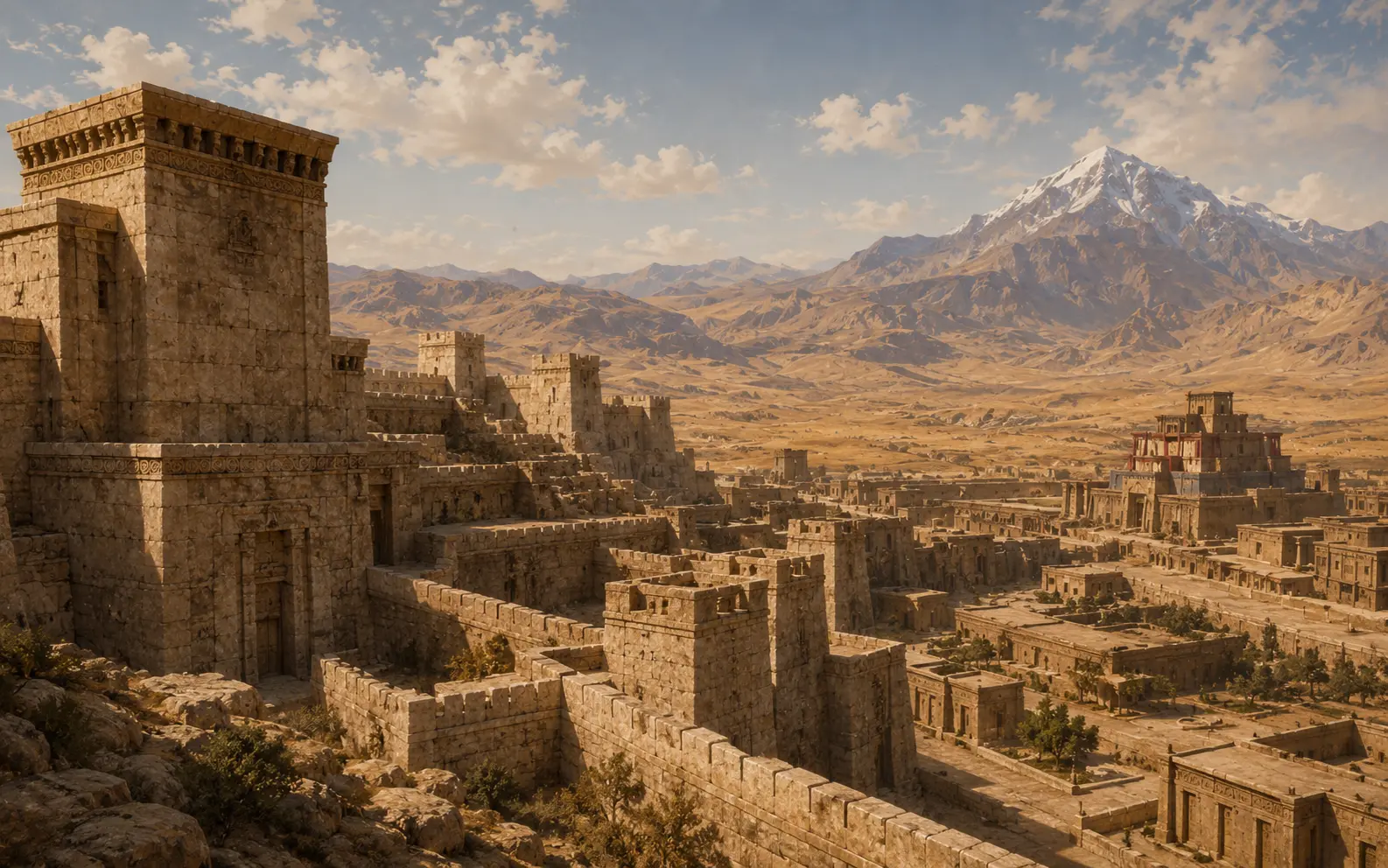
Urartu: the Kingdom of Van
Urartu was a powerful highland kingdom around Lake Van whose fortresses, canals and cuneiform records shaped the later history of the Armenian Highlands.
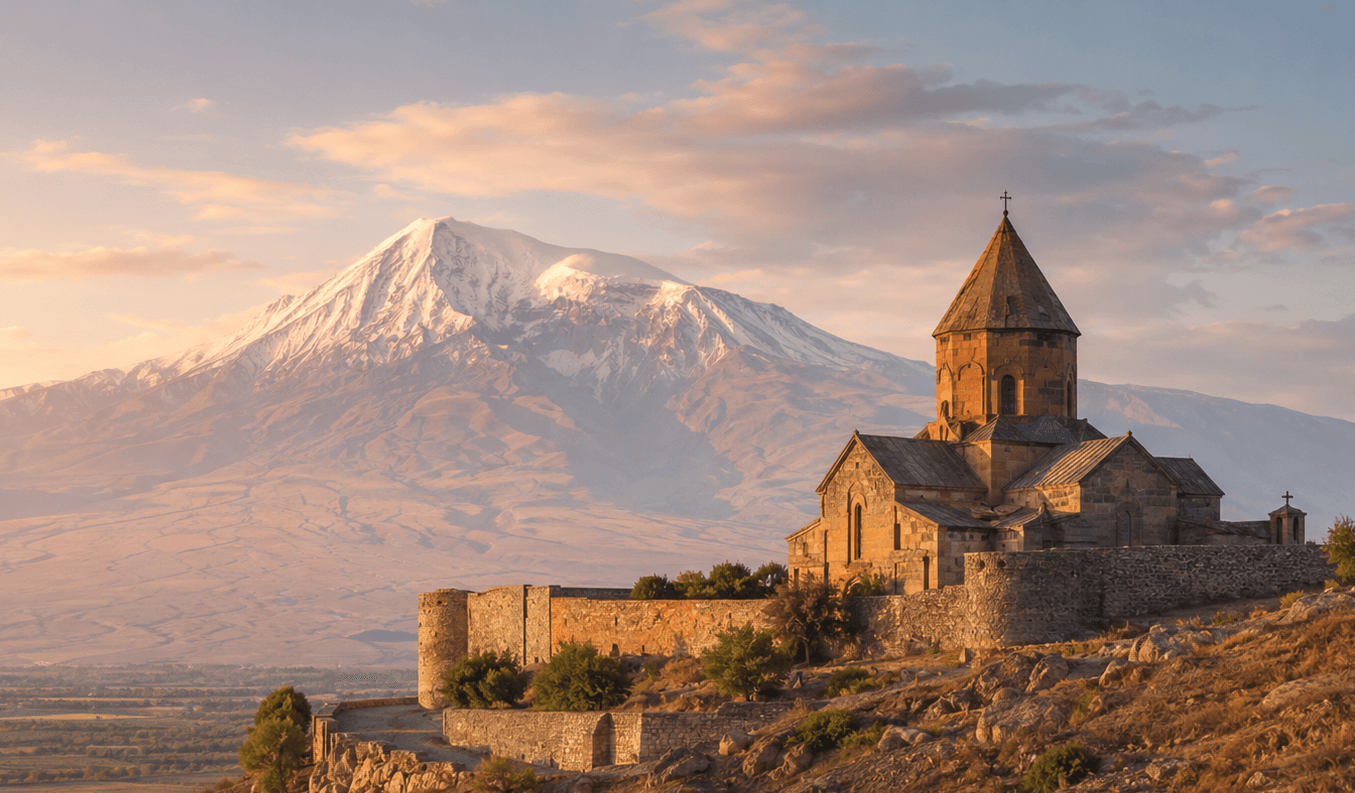
Khor Virap
A working monastery on a low hill above the Ararat plain, built over the pit where tradition says Gregory the Illuminator was imprisoned. It stands on the site of Artashat, an ancient Armenian capital.
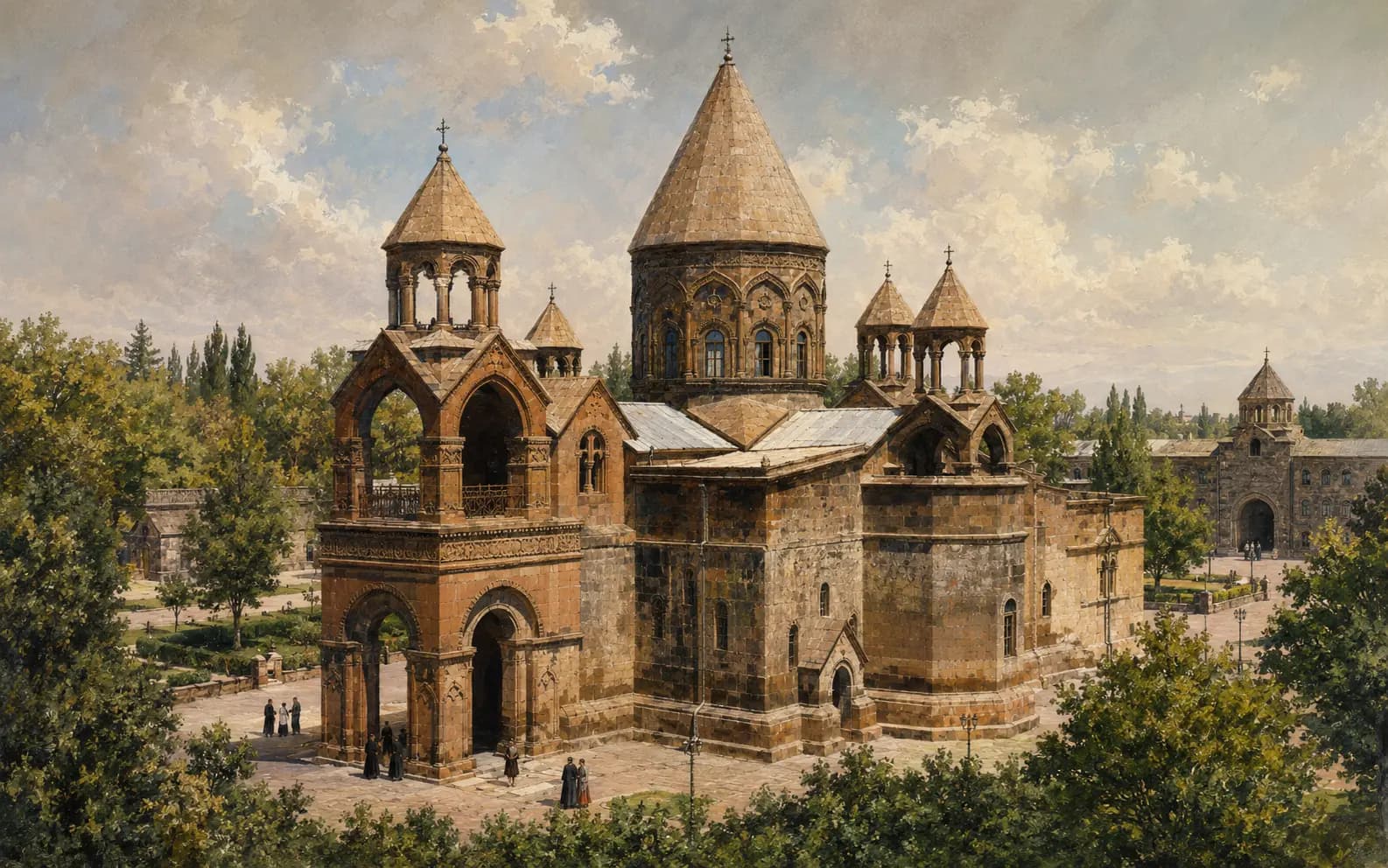
Etchmiadzin Cathedral
The principal church of the Mother See of Holy Etchmiadzin and the seat of the Catholicos of All Armenians. Its tradition reaches back to Armenia's conversion, but most of the building standing today does not.