
Matenadaran
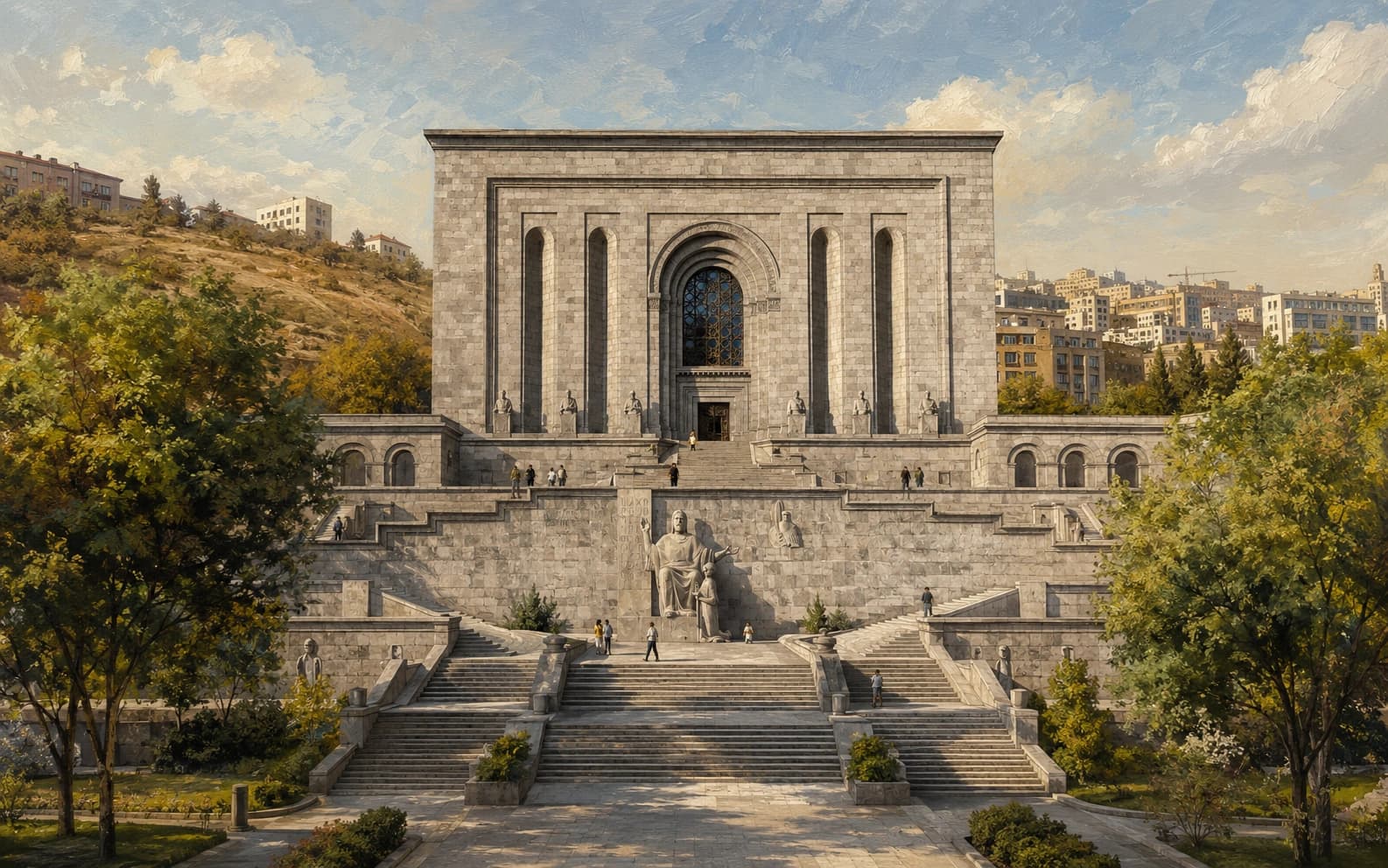
The Matenadaran stands at the top of Mesrop Mashtots Avenue in Yerevan: a dark stone building above a broad flight of steps, with a seated statue of Mashtots in front. Its formal name is the Mesrop Mashtots Institute of Ancient Manuscripts. Put simply, it is a library that became a museum while remaining a working archive. The manuscripts inside are medieval. The institution that looks after them is modern, and so is the building, which was begun at the end of the Second World War. It helps to keep these three ages apart from the start, because the site is often described as if the building were as old as the books inside it.
- Author
- Armat Editorial Team
- Updated
- Reading time
- 14 min read
In brief
The Matenadaran in Yerevan, formally the Mesrop Mashtots Institute of Ancient Manuscripts, is the national repository of ancient manuscripts. It is an archive, a research institute and a museum in one. At its heart is the manuscript library of Etchmiadzin, built up over centuries, nationalised by decree in 1920 and moved to Yerevan in 1939. The institution is far younger than its books. It became a research institute in 1959, when it moved into the familiar building on Mashtots Avenue, and it took Mashtots's name in 1962. Only a small selection of its holdings is ever on display.
Key facts
- Kind of place
- Manuscript repository, research institute and museum
- Where
- Top of Mesrop Mashtots Avenue, Kentron district, Yerevan
- Formal name
- Mesrop Mashtots Institute of Ancient Manuscripts
- The word
- Matenadaran — a depository of books, in Armenian
- Present institution
- Research institute since 1959; named after Mashtots in 1962
- Recognition
- Inscribed on the UNESCO Memory of the World Register, 1997
Where the Matenadaran is
The Matenadaran closes off the north end of Mesrop Mashtots Avenue, one of the main streets of central Yerevan. It stands on a terrace where the ground starts to rise towards the hills above the city. The avenue runs straight at it, so the building is visible along the whole street and acts as its full stop.
The building is deliberately unlike the offices around it. It is faced in dark basalt and set behind a flight of steps. Instead of the classicism of the surrounding blocks, its details borrow from medieval Armenian architecture: an arcaded front, carved figures of scholars and writers along the facade, and, at the foot of the steps, a seated statue of Mashtots with a pupil.
Two nearby landmarks are often mixed up with it. The Cascade complex, a few hundred metres to the west, belongs to a different institution entirely. The statue in front of the steps is a monument, not part of the collection. The real Matenadaran lies behind and beneath the facade: the reading rooms, the laboratories and the vaults.
What the institution is
The Matenadaran does three jobs that usually belong to three separate bodies. As a repository, it is the national archive of Armenian manuscripts and keeps them physically intact. As a research institute, it employs scholars to edit, catalogue and study its holdings. And as a museum, it runs an exhibition open to the public.
That mix explains most of what a visitor notices. The exhibition is small compared with the collection, because the collection was never mainly a display. Most of the manuscripts are in storage, in conservation or being studied, and were never meant to be on show all the time. Nothing is being hidden: a page of parchment simply cannot spend decades under light.
The formal name, the Mesrop Mashtots Institute of Ancient Manuscripts, refers to the research body. *Matenadaran* is what everyone actually calls it. Both names mean the same organisation, and signs, publications and catalogues use them side by side, which is useful to know before trying to match them up.
The word, and whose name it carries
*Matenadaran* is an ordinary Armenian compound word meaning a depository of books, and it is much older than this institution. Medieval Armenian monasteries had matenadarans of their own, and medieval sources use the word for those collections. The building in Yerevan simply took a common noun as its proper name, as a national library might.
The institute is named after Mesrop Mashtots, who devised the Armenian alphabet early in the fifth century. With Sahak Partev, he set up the schools and translation work that produced the first Armenian books. The name is more than decoration. Most of what the building holds is written in the script he designed, and the institution sees itself as heir to the copying tradition he began.
The name is also younger than the institution, a detail that is easy to get wrong. The collection was already in Yerevan, and already a research institute, when it was given Mashtots's name in 1962. That was a naming decision of the Soviet period, not a founding date, though the two are often reported as one.
How manuscripts were kept before there was an institute
For more than a thousand years, Armenian manuscripts were kept by the monasteries that produced them. Monastic scriptoria copied, bound and stored books, and monasteries across the Armenian lands held their own collections. Whether a manuscript survived depended on the roof over it, and on someone thinking it worth copying again when the parchment wore out.
The system worked, but it was extremely fragile. Manuscripts were burned, looted and scattered in every period of upheaval. Those that reached modern times did so through repeated rescue: carried from one monastery to another, buried, ransomed, and in several famous cases split between two carriers so that at least half would survive.
Over time the Mother See at Etchmiadzin built up the largest single collection. Its library grew from the fifteenth century onwards, after the Catholicosate was restored there in 1441, and it was catalogued several times in the modern period. An inventory in 1828 recorded about eighteen hundred manuscripts; by 1913 the count had passed four thousand. That library is the direct ancestor of the collection in Yerevan today.
How the collection came to Yerevan
The move happened in stages over about twenty years, and each stage has its own date. During the First World War the manuscript library of Etchmiadzin was evacuated to Moscow for safety and kept there from 1915 until 1922. In the same years, just before and during the Armenian Genocide, the Catholicos organised the rescue of manuscripts from Vaspurakan, Mush and Erzurum. Those that were saved joined the collection. Much of what was not saved is simply gone.
In December 1920 the new Soviet Armenian government nationalised the Matenadaran of Etchmiadzin by decree. The owner changed; the location did not. For most of the next two decades the books stayed at Etchmiadzin, now as state property instead of church property.
The physical transfer to Yerevan came in 1939, when just under ten thousand Armenian manuscripts and several hundred in other languages were moved to the state library in the capital. These three events (evacuation, nationalisation and transfer) are often squeezed into one sentence about the collection being "moved to Yerevan". Keeping them apart is what turns a slogan into a history.
The building, and the institute inside it
The building most people mean by "the Matenadaran" dates from the mid-twentieth century. It was designed by the architect Mark Grigoryan. Work began in 1945, stopped for years after the war, and was finished in the second half of the 1950s. Sources disagree on the exact completion year, as often happens when a project stops and restarts.
Its architecture quotes the Middle Ages without pretending to be medieval. The dark basalt, the arcades and the carved figures deliberately echo Armenian church building, but behind them is a modern museum and archive with vaults, reading rooms and laboratories. A visitor who takes the facade for an old building has read it just as the architect intended, and got it exactly wrong.
In 1959 the collection moved into the building and the organisation was reorganised as a scientific research institute. In institutional terms, that is when the modern Matenadaran begins. Three years later it was named after Mesrop Mashtots. Neither date is when the collection was formed, and neither is when the building was designed.
In 2011 a second, much larger research building opened behind the original, and most of the storage, conservation and research now happens there. The 1950s building remains the public face and the museum, while the working institute has largely moved behind it.
What it holds, and why the numbers differ
The collection is overwhelmingly Armenian, but not only Armenian. Alongside the Armenian manuscripts are books in Arabic, Persian, Greek, Syriac, Latin, Ethiopic and other languages, some of them acquired through the same monastic networks that produced the Armenian ones. The subjects go far beyond scripture, into history, law, medicine, mathematics, astronomy, philosophy, grammar and music.
Published totals do not agree, and it helps to know why. UNESCO's Memory of the World register entry, made in 1997, describes a collection of about seventeen thousand manuscripts. The institution's own figure is roughly twenty thousand. Counts that list fragments and scrolls separately run higher still. Archival documents, such as decrees, deeds and letters, are counted in a separate series altogether, running into the hundreds of thousands.
None of these figures is wrong; they count different things at different dates. So this article describes the collection instead of pinning it to one number, which is also the fairest answer to the question visitors usually ask first. What is certain is that it is one of the largest collections of Armenian manuscripts anywhere, and that no single visit shows more than a fraction of it.
Inside the manuscripts
An Armenian manuscript is a crafted object before it is a text, and the exhibition is laid out to show this. Most of the earlier manuscripts are written on parchment and the later ones on paper. The scripts changed enough over time that a specialist can date a hand to within a century. Bindings are usually wooden boards covered in leather, often blind-stamped, sometimes with metal fittings, and occasionally in silver.
The illuminated manuscripts are what most visitors come for. Armenian illumination has its own repertoire: canon tables framed as architecture, portraits of the evangelists, and margins decorated with birds and plant forms. It also had its own workshops, some tied to particular monasteries and recognisable by style. The pigments are mineral and organic, and the deep blues and reds are still remarkably strong on the page. The catalogue literature on the Morgan Library's 1994 exhibition, *Treasures in Heaven*, is a good introduction to what you are looking at.
The makers are usually named. A scribe wrote the manuscript and, if it was illustrated, an illuminator painted it, and these were often two different people. The colophon at the end, in Armenian a *hishatakaran* or memorial record, usually names them, along with the patron, the place and the date.
These colophons are why Armenian manuscripts matter even to historians who cannot read Armenian. Scribes wrote down what was happening around them: invasions, taxes, famines, prices, the death of a bishop. Avedis Sanjian's edition of the colophons of 1301 to 1480 gathered them as a historical source in their own right. Thanks to this habit, a collection of religious books doubles as a running record of everyday life across four centuries.
The work behind the exhibition
Most of the Matenadaran's work goes on out of sight. Staff catalogue and describe manuscripts, edit and publish texts, and produce scholarly editions, facsimiles and a journal. Cataloguing the collection is itself a project lasting decades, because describing a manuscript properly means recording its contents, handwriting, illumination, binding and colophons.
Conservation is the other half of the job. Parchment, paper, pigment and leather each decay in their own way, so the institute runs laboratories to stabilise and repair them, along with controlled storage. This is why the collection is not simply put on display. Digitisation is now part of the work too, so scholars anywhere can read a manuscript while the object itself stays in a vault.
Preservation is also the reason the institution exists at all. A collection scattered across a hundred monasteries survived by luck. A single repository, funded and professionally staffed, is an attempt to stop depending on luck. That is a modern idea, and the Matenadaran is one of the clearest examples of it applied to a medieval inheritance.
What to understand before seeing it
First, expect a gap between the collection and the display. The exhibition shows a curated selection, rotated for conservation reasons. A visitor who expects thousands of manuscripts will see dozens, and that is how it should be.
Second, keep the dates in their layers. The manuscripts are medieval; the collection was assembled over centuries at Etchmiadzin; the institution was created in the twentieth century; the building dates from the 1950s; the name from 1962. Each of these is sometimes given as "the Matenadaran was founded in…", and this article separates them because the squeezed version is so common.
Third, this is a working institute and not only a museum, and that shapes what you see. Behind the display cases, readers, conservators and cataloguers do the work that keeps the manuscripts legible. The manuscripts themselves are the survivors of a very long process of copying, hiding and rescue.
Important dates
Fifth century
Mesrop Mashtots devises the Armenian alphabet and the first Armenian books are written. This begins the copying tradition the institute descends from.
1441
The Catholicosate is restored at Etchmiadzin, and the manuscript library that becomes the core of this collection begins to form there.
1828
The first inventory of the Etchmiadzin manuscripts records about eighteen hundred items; later catalogues pass four thousand by 1913.
1915–1922
The collection is evacuated to Moscow for safety during the First World War. Meanwhile, manuscripts are rescued from Vaspurakan, Mush and Erzurum during the Armenian Genocide.
1920
The Matenadaran of Etchmiadzin is nationalised by decree in December. The books stay where they are; the owner changes.
1939
The collection is physically transferred from Etchmiadzin to the state library in Yerevan: just under ten thousand Armenian manuscripts and several hundred in other languages.
1945
Construction of the present building begins to Mark Grigoryan's design. Work is halted for years and finished in the second half of the 1950s.
1959
The collection moves into the new building and the organisation is reorganised as a scientific research institute. This is the start of the modern Matenadaran.
1962
The institute is named after Mesrop Mashtots.
1997
The manuscript collection is inscribed on the UNESCO Memory of the World Register.
2011
A large new research and storage building opens behind the original, and most of the institute's day-to-day work moves into it.
Why the Matenadaran matters
The Matenadaran is where a thousand years of Armenian writing ended up. It exists in one place because keeping manuscripts scattered had proved fatal again and again. Everything in the building came through sacked monasteries, evacuations, a genocide and two changes of ownership. The institution marks the point where that survival stopped being a matter of chance and started being organised.
Its value reaches beyond Armenian history. Fifth-century Armenian translators preserved Greek and Syriac works whose originals are lost, and colophons by ordinary scribes record events across the medieval Near East that no chronicle bothered with. A collection built by one people to keep its own books has become a source for the history of all its neighbours.
Interesting facts
- 01*Matenadaran* is not a proper name but an ordinary Armenian word for a depository of books; medieval monasteries had matenadarans of their own.
- 02The institution was nationalised in 1920, but the manuscripts did not physically leave Etchmiadzin until 1939. Ownership and location changed nineteen years apart.
- 03The institute was given Mashtots's name in 1962, years after it had become a research institute, so the name is not a foundation date.
- 04The collection was inscribed on the UNESCO Memory of the World Register in 1997. The register recognises documentary heritage, not buildings or sites.
- 05In the colophons at the end of their manuscripts, Armenian scribes recorded wars, taxes, prices and weather. Scholars of the wider medieval Near East use them as a historical source.
Sources
- Historical Review — Mesrop Mashtots Institute of Ancient Manuscripts (Matenadaran) — Matenadaran, Yerevan Visit sourceThe institute's own account of its history. Cited for the institutional chronology only — the Etchmiadzin library and its catalogues, the evacuation to Moscow, the nationalisation of 1920, the transfer of 1939, Mark Grigoryan's building, the reorganisation of 1959, the naming of 1962 and the research building of 2011.
- Mashtots Matenadaran ancient manuscripts collection — UNESCO Memory of the World Register, inscribed 1997 Visit sourceThe Memory of the World programme registers documentary heritage rather than buildings or sites, which is why this inscription is not comparable to the World Heritage listing cited for Etchmiadzin. Its entry describes a collection of about seventeen thousand manuscripts — the figure quoted in the article beside the institution's own, higher one.
- Thomas F. Mathews and Roger S. Wieck (eds.). Treasures in Heaven: Armenian Illuminated Manuscripts — Pierpont Morgan Library / Princeton University Press, 1994 ISBN 9780691037516Catalogue of the 1994 Morgan Library exhibition, and the standard English-language introduction to Armenian manuscript illumination. Cited for the making of the books — scripts, bindings, pigments, canon tables, workshops — rather than for anything about the institution.
- Avedis K. Sanjian. Colophons of Armenian Manuscripts, 1301–1480: A Source for Middle Eastern History — Harvard University Press, Harvard Armenian Texts and Studies 2, 1969 ISBN 9780674142855The work that established Armenian colophons as a historical source in their own right. Cited for what a hishatakaran records and for the claim that these manuscripts are read by historians who do not read Armenian. Also registered for Geghard. Harvard's digital edition of the same volume carries DOI 10.4159/harvard.9780674432635, checked against Crossref and confirmed as this work; the ISBN above is kept as the identifier because the 1969 print volume is the edition cited.
- Christina Maranci. The Art of Armenia: An Introduction — Oxford University Press, 2018 ISBN 9780190269005Already registered for the two monastery articles. Cited here for manuscript illumination in the wider development of Armenian art, which is what keeps the illumination section from reading as though the books existed apart from everything else made around them.
- Abraham Terian (trans.). The Life of Mashtots' by His Disciple Koriwn: Translated from the Classical Armenian with Introduction and Commentary — Oxford University Press, 2022 ISBN 9780192847416Already registered for the alphabet article. Cited here for the fifth-century starting point the institute takes its name from: Mashtots, the schools and the translation work that produced the first Armenian books.
Related articles
Mesrop Mashtots and the Armenian Alphabet
Around 405 the scholar and monk Mesrop Mashtots created an alphabet that gave Armenian its own written voice and reshaped the nation's culture.
Etchmiadzin Cathedral
The principal church of the Mother See of Holy Etchmiadzin and the seat of the Catholicos of All Armenians. Its tradition reaches back to Armenia's conversion, but most of the building standing today does not.
The Adoption of Christianity in Armenia (301)
Armenia is traditionally recognised as the first state to adopt Christianity as its official religion, a decision that reshaped its law, art and identity.