
Garni Temple
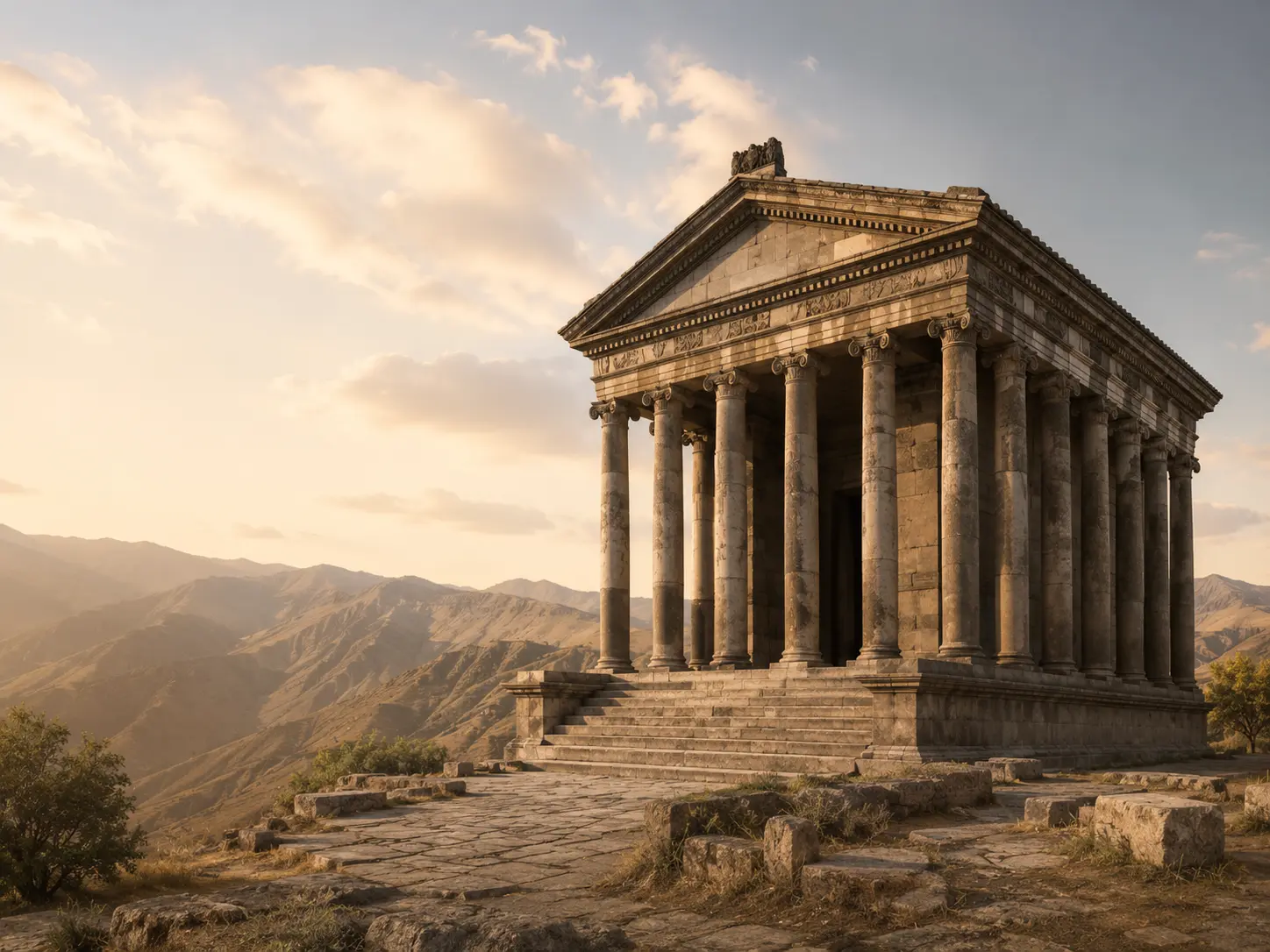
Garni is the one building in Armenia that looks as if it belongs somewhere else: a small Greco-Roman peristyle, with twenty-four Ionic columns on a high podium, standing on the rim of a basalt gorge in Kotayk Province. It is almost always introduced as Armenia's pagan temple, built by King Trdat I in AD 77 and spared at the conversion to Christianity. Every part of that sentence is either an inference or something good scholars disagree about, and the building becomes more interesting once the parts are pulled apart. It is also mostly a twentieth-century reconstruction, and that is no small detail: the colonnade came down in an earthquake and was rebuilt from its own fallen stone within living memory.
- Author
- Armat Editorial Team
- Updated
- Reading time
- 18 min read
In brief
Garni is a small colonnaded building in the classical style, standing on a fortified promontory above the Azat river gorge in Kotayk Province. A Greek inscription found on the site names Trdat I and his eleventh regnal year. Counted from his coronation by Nero, that year is AD 77; counted from his earlier installation, it is AD 63. The usual date is therefore an inference, drawn from a text about building a fortress, not this monument. Whether the building was a temple, and if so to which god, is disputed: the link with Mihr is traditional, and a serious minority view sees a royal tomb. The colonnade fell in the earthquake of 1679, and the building a visitor sees was re-erected from the fallen blocks by 1975.
Key facts
- Kind of place
- Classical building and fortified archaeological complex, largely re-erected
- Where
- A promontory above the Azat river gorge, Garni, Kotayk Province
- Named in the inscription
- Trdat I, in his eleventh regnal year
- Conventional date
- AD 77, or AD 63 on the other reckoning of that year
- Brought down by
- The earthquake of 1679, which felled the whole colonnade
- Standing today
- An anastylosis completed by 1975, roughly a third of it ancient stone
Where Garni is
Garni is a village in Kotayk Province, well under an hour east of Yerevan, and the archaeological complex sits at the edge of the village, not out in open country. The road runs through houses and then simply stops at a gate. That is part of why the site surprises people: there is no approach, no avenue, no long view building up to it.
The setting makes up for it. The complex occupies a triangular promontory where the Azat river has cut a deep gorge, so the ground falls away on two sides and the building stands against the sky instead of against the landscape. Downstream, the same gorge holds the columnar basalt formation known as the Symphony of Stones. Upstream, further into the Azat valley, is the monastery of Geghard.
Photographs often blur two things that are worth keeping apart. Geghard and the upper Azat valley are inscribed on the World Heritage list. Garni is not: it was placed on Armenia's tentative list only in 2025, as an archaeological complex together with the basalt columns. The two are neighbours in one valley with two different kinds of status.
The promontory and the fortress
The site was a fortress long before it was anything a visitor would photograph. On its two gorge sides the promontory is defended by geology alone, which leaves one landward approach to be walled, and that is exactly what was done. A wall of large blocks with towers along it closes the neck of the triangle, and its excavated line is visible on the ground today.
The ancient name of the place is Gorneas, and the classical sources mention it as a stronghold, not a sanctuary. Tacitus names it in his account of the Roman-Parthian struggle over Armenia. That is the earliest secure record of the place, and it puts a garrison here in the first century, before anything about the standing building is settled.
This is the first correction the site makes to its own reputation. Garni is a fortified royal site with a classical building inside it, not a temple with some walls nearby, and the enclosure also held a palace, a bath and living quarters. Seen the other way round, the classical building looks stranger than it is. It stood inside a working royal complex, not alone on a cliff.
The building itself
The building is a peripteral temple of Greco-Roman type: in plain terms, a single rectangular room surrounded on all four sides by columns. There are twenty-four of them, six across each end and eight along each side, carrying an entablature and a pediment. The whole structure sits on a podium some three metres high, reached by a single steep flight of steps on the entrance front.
The order is Ionic, with volute (scrolled) capitals, but it is not textbook Ionic. The details are handled freely, and specialists have generally read them as provincial workmanship in a broadly Roman style, not as a copy of any particular model. The room inside, the cella, is small. The contrast between a modest interior and an elaborate exterior is one of the arguments made about what the building was for.
The material is local. Garni is built of grey-blue basalt quarried nearby, cut and laid dry without mortar, with the blocks held together by iron clamps set in lead. This is a Roman building technique in Armenian stone, and it matters for two reasons: it is why the building is not simply a transplanted marble temple, and it is why it fell the way it did.
It is best not to think of Garni as a piece of Rome dropped into Armenia. The plan and the order are classical, but the stone, the quarry, the setting and the fortress around it are not. Armenia in this period was a kingdom that had been inside the Hellenistic world for centuries and was being fought over by two empires. A building in classical dress on an Armenian promontory is what that position looks like in architecture.
The kingdom in the first century
Armenia in this period was an Arsacid kingdom caught between the Roman empire and Parthia, and the two powers fought a long war over who would put a king on its throne. The settlement that ended the war was unusual, and every account of Garni hangs on it.
Trdat I (Tiridates in the Greek and Latin sources) was a Parthian prince installed in Armenia by his brother Vologases I, which Rome would not accept. After a war fought to a draw, the two sides agreed that Trdat would keep the throne but receive his crown from the Roman emperor. He travelled to Rome and was crowned by Nero in the year 66, in a ceremony that Roman writers describe at length.
That arrangement is why a classical building at Garni is no surprise. Roman sources record that Nero sent craftsmen back with him, and the reign that followed is exactly when Roman techniques, Roman construction and a Roman architectural vocabulary would have reached an Armenian royal site. This background supports a date in this period for the building, but on its own it does not date any particular stone.
The Greek inscription, and the date
A Greek inscription was found at Garni in 1945, and it is the only text that ties this site to a named king. It records that Helios Tiridates the Great of Greater Armenia, having subdued this city as its lord, founded for his sister the queen this impregnable fortress, for the safety of his kingdom, in his eleventh regnal year.
Two things in it are routinely overlooked. First, the text names a fortress, not a temple. Second, Helios (Sun) appears as part of the king's titles, in the slot where a Hellenistic ruler's epithet would go, and not as the name of a god being given a house. The inscription is a foundation record for the stronghold. It was also found at the cemetery, not in the building it is usually linked to.
The famous date comes from the last phrase. Counted from the coronation by Nero, the eleventh regnal year falls in AD 77; counted from the earlier installation by Vologases, it falls around AD 63. Both counts can be defended and both appear in the literature. AD 77 is the number everyone repeats because Armenian scholarship has generally preferred the coronation as the starting point.
The debate has recently moved again. A two-part study published in 2022 by Alain Bresson and Elizabeth Fagan argues that the Tiridates of this inscription is not Trdat I at all, but Trdat the Great, the king of the conversion, two and a half centuries later. That would detach the text from the first century altogether. It is a new argument, not a settled one, and it is included here because the date rests on a reading, and readings can be revised.
So the careful version runs like this. The building is commonly dated to AD 77. That date comes from a regnal-year calculation, not from anything written on the temple. The text behind it describes a fortress, and even the identity of its king has been questioned. None of this makes the usual date wrong. It makes it a reconstruction, which is a different kind of statement from a record. It is the same distinction this archive has had to draw at Erebuni, where the founding year is also not on the stone.
Temple of Mihr, or a tomb?
Tradition identifies the building as a temple of Mihr, the Armenian form of the Iranian Mithra, a solar deity. The chain of reasoning runs from the word Helios in the inscription to a sun god, and from there to a sun god's temple. This is the reading on every signboard and in most general accounts, and it has some basis: solar cult is well recorded in pre-Christian Armenia, and Mihr is a real and important figure in it.
As an identification of this particular building, though, it has no direct evidence behind it. Nothing found at Garni names Mihr. No dedication, cult image or altar inscription links the structure to him or to any other named god, and the whole argument depends on reading a royal epithet as the name of a god.
A minority view takes the building for a tomb rather than a temple. In a study published in 1982, R. D. Wilkinson argued that it is a monumental mausoleum of about AD 175. He compared it with the funerary architecture of western Asia Minor, and pointed to nearby graves of about that date and to fragments of sarcophagi in the Asiatic manner. James R. Russell, whose study of Zoroastrianism in Armenia is the standard work on the religious background, wrote that nothing supports the temple identification except the inscription, and that one cannot be certain the inscription refers to this building at all. He called Wilkinson's case convincing. Christina Maranci's survey of Armenian art likewise treats the building's function as unclear and raises the possibility of a royal tomb.
This article does not try to settle the question, but the outline of the disagreement is clear. The traditional identification is old, widely repeated and thinly supported. The tomb theory is a minority position, argued by serious scholars from comparisons with other buildings, not from anything found here. The building itself has so far refused to decide. A visitor told confidently that this is the Temple of Mihr is hearing the most popular answer, not the established one.
Palace, bath and mosaic
Behind the wall, mostly at foundation level, lies the rest of the royal site: ranges of rooms identified as a palace, service buildings, and a bath complex on the northern side of the enclosure. Excavation recovered enough of the plan to show the classical building for what it was: one part of a working residence, not an isolated monument.
After the temple, the bath is the part most worth seeing. It is a Roman-style building of the third century with the usual sequence of heated rooms over a hypocaust, a raised floor carried on brick piers with hot air circulating beneath it. It is a straightforward piece of Roman engineering at an Armenian royal seat.
Its floor carries a mosaic made from local stone in about fifteen natural shades. It shows a sea scene with figures labelled in Greek: sea deities, nereids and fishermen, with names such as Thetis, Glaukos and Eros beside them, and abstractions such as Seaside and Depth alongside. Accounts differ about which pair sits at the centre; the figures most often named there are Ocean and Thalassa (Sea). It is the finest surviving thing at Garni, and because it is a floor and not a wall, it is easy to walk past.
The mosaic also carries a short Greek line, μηδὲν λαβόντες ἠργασάμεθα, usually rendered as "we worked, having received nothing" or "without pay, we have been working". It is quoted everywhere as the complaint of unpaid craftsmen, and it may well be. But the sense is ambiguous in the original: it reads just as well as a boast of work done for its own sake. The line is certainly there, and its translation is not in doubt. What it meant to the men who set it is.
After the conversion
Armenia adopted Christianity as the religion of the kingdom in the traditional year 301. The estates of the pagan temples passed to the church, and the sanctuaries themselves were destroyed. Garni is the standing exception, and the usual explanation is that it was spared because it had been turned to secular use.
The evidence for that is thinner than the explanation suggests. Movses Khorenatsi records that a cool retreat was built within the fortress at Garni for Khosrovidukht, the sister of Trdat III. That refers to a building somewhere in the enclosure, not to this one, and the step from there to "the temple became a summer house" is a modern inference, if a reasonable one. A round church dedicated to Surb Sion stood just west of the building, and its foundations are still visible. It is dated anywhere from the seventh to the tenth century, not to a single year. One study has argued, from an early Armenian inscription inside the cella, that the room served as a baptistery. How the church and the classical building related to each other is not known.
This is also where the tomb theory deserves a second look, because it gives the simplest answer to the survival question: a mausoleum is a far smaller problem for a Christian kingdom than a working temple of a rival god. That argument rests on consequences, not evidence, and it is offered here as such. The plain fact is that no source explains why this building alone was left standing.
The earthquake, and putting it back
On 4 June 1679 a large earthquake struck this part of Armenia, with its epicentre close to the Garni gorge, and the colonnade came down. The building split and fell towards the north-east, throwing blocks tens of metres down the slope. The chronicler Zakaria Kanakertsi, a contemporary, describes the destruction. A modern re-analysis by Emanuela Guidoboni, Ruben Haroutiunian and Aleksandr Karakhanian puts the event at an equivalent magnitude of about six and three quarters, with an epicentral intensity of ten on the Mercalli-Cancani-Sieberg scale, and dates it in the Gregorian calendar to the fourteenth of that June.
One reason it fell so completely was human. The iron clamps and lead that held the dry-laid blocks together had been pulled out of the building generations earlier and melted down for shot during the wars of the period. When the earthquake came, the structure had already been stripped of its fastenings.
Work on the site then stretched across most of a century. Nikolai Marr, with Yakov Smirnov and the architect Konstantin Romanov, cleared and recorded it between 1909 and 1911. Later specialists judged that campaign closer to clearance and cataloguing than to excavation, and it was never published. In the early 1930s Nikoghayos Buniatian studied the fallen material and partly re-erected the lower courses, work that was later taken down again as mistaken. Systematic excavation of the fortress began in 1949 under Babken Arakelyan, with Alexander Sahinian taking charge of the classical building.
The re-erection is Sahinian's work. Approved in 1968 and begun the following year, it was an anastylosis: the fallen blocks were identified, sorted and put back in their own positions, and missing pieces were cut new from a local quarry in matching stone. By Sahinian's own account, roughly a third of the standing building is ancient material and two thirds is new. Only about forty per cent of the column shafts survived at all, and only two of them survived complete. The new pieces were deliberately left plain, so the join between antiquity and 1975 stays visible to anyone who looks. It is an honest reconstruction, but it is still a reconstruction.
What to understand before seeing it
First, the building is not a survival. Almost every description calls Garni the only standing Greco-Roman building in the former Soviet Union. That is true, but misleading: it stands because it was rebuilt, mostly in new stone, half a century ago. Knowing this takes nothing away from it, since the anastylosis is careful, documented work. But a reader who thinks these columns have stood since the first century has the central fact wrong.
Second, the temple is one building on a fortified site. The wall, the palace foundations and above all the bath with its mosaic are what turn Garni from a curiosity into a place, and they are easy to skip on the way to the photograph.
Third, keep the kinds of claim apart. Four different kinds are made about Garni at once. An inscription records a king building a fortress. A regnal-year calculation produces a date. A chain of associations produces a god. Comparative architecture produces a tomb. The first is a document, the second is arithmetic on a document, and the last two are arguments. All of them belong in an account of the site, but only one was written down by someone who was there.
Important dates
AD 66
Trdat I is crowned in Rome by Nero, ending the Roman-Parthian war over Armenia. Roman sources record that craftsmen returned to Armenia with him.
AD 77
The conventional date for the building: the eleventh regnal year named in the Greek inscription, counted from the coronation. Counted from Trdat's earlier installation, the same year falls around AD 63.
Second century AD
The date proposed by the minority view that the building is a royal mausoleum, based on comparable tombs in Asia Minor and on burials nearby.
Third century AD
The bath complex with its mosaic floor is built on the northern side of the enclosure.
301
Armenia adopts Christianity as the religion of the kingdom, by the traditional date. The pagan sanctuaries are destroyed; the building at Garni is not.
1679
A large earthquake with its epicentre near the gorge brings down the colonnade. The chronicler Zakaria Kanakertsi records the destruction.
1909
Nikolai Marr begins clearing and recording the site with Yakov Smirnov and the architect Konstantin Romanov. The work stops for lack of funds and is never published.
1945
The Greek inscription of Trdat I is found at Garni. It becomes the only text tying the site to a named king.
1949
Systematic excavation of the fortress begins under Babken Arakelyan, with Alexander Sahinian working on the classical building.
1969
Sahinian's anastylosis begins, approved the previous year. The colonnade is standing again by 1975.
2025
The archaeological complex of Garni, together with the basalt columns in the gorge, is placed on Armenia's tentative list for World Heritage nomination.
Why Garni matters
Garni is physical evidence for something Armenian history often states but rarely shows: that this was a kingdom inside the classical world, not merely next to it. A peristyle on a gorge in Kotayk is what you get when a court that dealt with Rome and Parthia as equals builds in the style of its age, from its own basalt, on its own defensible rock.
It is also this archive's hardest case for telling kinds of claim apart, because here the popular account is less wrong than over-confident. A date that is an inference, a dedication that is an association, and a building that is largely modern stone are all presented to visitors with the same flat certainty. Sorting them out is not scepticism about Garni. It lets the parts that are firmly documented (a king, a fortress, an inscription, an earthquake, a reconstruction) stand out as clearly as they deserve.
Interesting facts
- 01The inscription that dates the building is a foundation record for a fortress, and does not mention a temple at all.
- 02AD 77 and AD 63 are the same eleventh regnal year counted from two different starting points: a coronation in Rome and an earlier installation from Parthia.
- 03Nothing found at Garni names Mihr, or any other god. The dedication rests on reading Helios in a royal title as the name of a god.
- 04The clamps holding the blocks together had been stripped out for their metal before the earthquake of 1679, which is part of why the colonnade fell so completely.
- 05Only about forty per cent of the column shafts survived the collapse, and just two of them survived whole. The building standing today was completed in 1975.
Sources
- Emanuela Guidoboni, Ruben Haroutiunian and Aleksandr Karakhanian. The Garnì (Armenia) large earthquake on 14 June 1679: a new analysis — Journal of Seismology 7(3), 301–328, Kluwer Academic Publishers, 2003 Visit sourceThe whole of what this article says about the earthquake rests here: the epicentre near the gorge, the collapse of the colonnade, the equivalent magnitude and the epicentral intensity. The paper's title dates the event to 14 June and Armenian tradition to 4 June; the ten-day gap is the Julian-to-Gregorian difference, and both dates are given in the article rather than one being silently preferred.
- The Archaeological Complex of Garni and the "Basalt Organ" Columnar Joint — UNESCO World Heritage Centre, Tentative Lists, ref. 6808, submitted 2025 Visit sourceCited only for the designation, and for the distinction the article draws: Garni is on Armenia's *tentative* list, not the World Heritage list. Geghard and the Upper Azat Valley, eight kilometres up the same valley, are inscribed — and Garni is not part of that inscription, which is the commonest error made about its status.
- R. D. Wilkinson. A Fresh Look at the Ionic Building at Garni — Revue des Etudes Armeniennes, New Series 16, 221-244, Paris, 1982 Visit sourceThe tomb hypothesis at its source: a mausoleum of about AD 175 rather than a temple, argued from the funerary architecture of western Asia Minor, nearby graves of that date and sarcophagus fragments. Print-only, with no DOI and no digital edition, which is why the identifier here is a catalogue search rather than a link to the article. Two title forms circulate — Russell cites it as 'The Ionic Building at Garni' — and the longer one is used here. Not consulted directly; its argument is taken from Russell, who cites it approvingly, and from the summaries in the literature.
- James R. Russell. Zoroastrianism in Armenia — Harvard Iranian Series 5, Department of Near Eastern Languages and Civilizations, Harvard University, and NAASR, Cambridge MA, 1987 ISBN 9780674968509The standard treatment of Armenian pre-Christian religion, and the reason this article will not call the building a temple of Mihr outright. Russell writes that nothing supports that identification except the inscription, that one cannot be certain the inscription refers to the building, and that the only Armenian temple of Mihr known beyond doubt is the shrine at Bagayarich in Derjan. He endorses Wilkinson. Worth knowing that he is not wholly consistent: elsewhere in the same book he refers in passing to a temple built by Trdat I at Garni.
- Alain Bresson and Elizabeth Fagan. The Greek Inscription from Garni (Armenia) and King Tiridates the Great. Part I. Prolegomena — Vestnik drevnei istorii / Journal of Ancient History 82(3), Russian Academy of Sciences, 2022 Visit sourceThe recent revision, and the reason the dating section ends where it does: Bresson and Fagan argue that the Tiridates of the inscription is Trdat the Great rather than Trdat I, which would move the text to the early fourth century. Part II (82(4), DOI 10.31857/s032103910023594-6) carries the new critical edition. Cited as a live argument, not as a conclusion — the conventional attribution remains the majority view.
- Armenuhi Magarditchian. Garni: temple romain - baptistere chretien — Revue des Etudes Armeniennes 37, 173-211, Peeters, Leuven, 2016-2017 Visit sourceThe single claim this supports is the one made about it in the article: that a study has argued, from an early Armenian inscription inside the cella, that the room was used as a baptistery. One study, offered as a hypothesis.
- Christina Maranci. The Art of Armenia: An Introduction — Oxford University Press, New York, 2018 ISBN 9780190269005Cited for one thing only, and only because it is genuinely there: her survey treats the building at pages 26-27 as of unclear function and raises a funerary reading. A general history of Armenian art declining to call it a temple is a useful measure of how open the question is.
- Tacitus, trans. John Jackson. Annals: Books 4-6, 11-12 — Harvard University Press, Loeb Classical Library 312, 1937 ISBN 9780674993457The earliest secure notice of the place. Tacitus names the stronghold of Gorneas in his account of the Roman-Parthian struggle over Armenia, which is what puts a garrison on this promontory in the first century independently of anything argued about the standing building.
- Richard G. Hovannisian (ed.). The Armenian People from Ancient to Modern Times, Volume I: The Dynastic Periods, from Antiquity to the Fourteenth Century — Palgrave Macmillan, 2004 ISBN 9781403966360Already registered for several other articles. Cited here for the first-century political frame only — the Arsacid kingdom between Rome and Parthia, the war over the Armenian throne and the settlement that had Trdat I crowned by Nero. Not cited for anything about the building.
- Robert H. Hewsen. Armenia: A Historical Atlas — University of Chicago Press, 2001 ISBN 9780226332284Already registered for four other articles. Cited here for the historical geography of the Azat valley and for the dating of the round church of Surb Sion beside the temple, which Hewsen places across a range from the seventh to the tenth century rather than at the single early date usually quoted.
- Jona Lendering. Gorneae / Garni — temple, bathhouse and Greek inscription — Livius.org, Amsterdam Visit sourceA scholarly reference site rather than a peer-reviewed publication, and cited as such — for the text and translation of the inscription of Trdat I, for the reading of Helios as a royal title rather than a theonym, for the two possible counts of the eleventh regnal year, and for the bath, its hypocaust and the labelled figures of its mosaic. Where it advances the mausoleum reading it is reporting Wilkinson and Russell, and those are cited on their own account above.
Related articles
The Adoption of Christianity in Armenia (301)
Armenia is traditionally recognised as the first state to adopt Christianity as its official religion, a decision that reshaped its law, art and identity.
Tigran the Great
The Artaxiad king who expanded Armenia into the strongest state of the Near East, founded Tigranocerta, and met the Roman legions of Lucullus and Pompey.
Erebuni Fortress
An Urartian citadel on the hill of Arin Berd in south-eastern Yerevan. It was built by King Argishti I and named in a cuneiform inscription that the modern city treats as its own birth certificate.