
Geghard Monastery
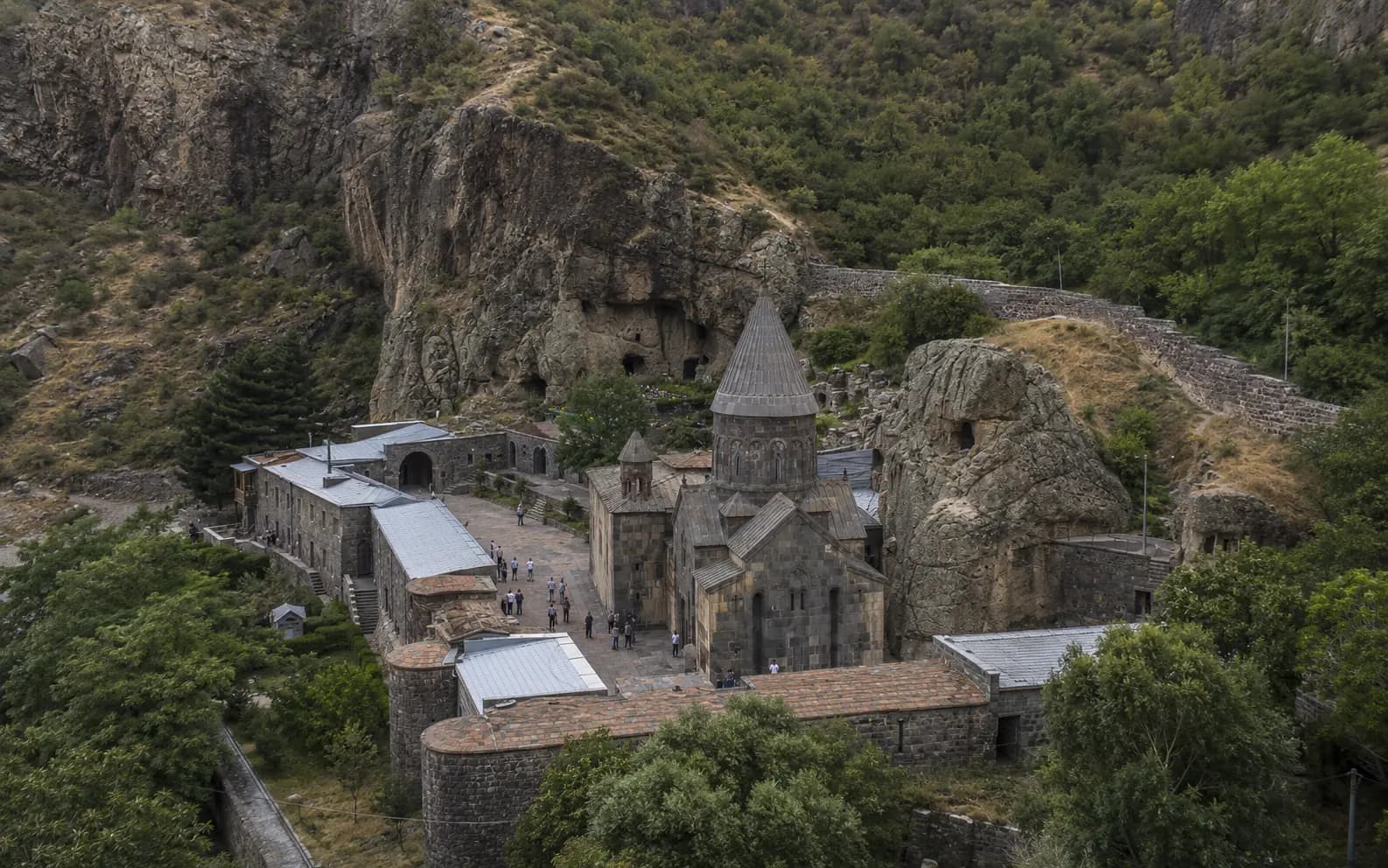
Geghard is usually described in one of two ways, and both are only half right. It is called a cave monastery, which suggests the whole thing is underground, yet the first building a visitor meets is an ordinary masonry church standing in the open. It is also called a fourth-century foundation of Gregory the Illuminator. That is a tradition, not a record: nothing standing at Geghard today is anywhere near that old. The buildings are medieval, most of them from a single century, and the oldest dated object on the site is an inscribed cross-stone of 1164. What makes the place remarkable is the join between its two kinds of construction, masonry in front and living rock behind. That join is the first thing to understand.
- Author
- Armat Editorial Team
- Updated
- Reading time
- 20 min read
In brief
Geghard is a monastery in a side gorge of the upper Azat valley, in Kotayk Province. It is two things at once: a group of masonry buildings, and a set of chambers cut straight into the cliff behind them. Tradition links its founding to Gregory the Illuminator, and its earlier name, Ayrivank, means the monastery of the cave. What stands today is medieval and unusually well dated, because the dates are carved into the buildings themselves: the main church carries an inscription of 1215, and the rock-cut church of the Proshyan princes one of 1283. The monastery takes its later name from a spear relic once kept here and now at Etchmiadzin. It was added to the World Heritage list in 2000.
Key facts
- Kind of place
- Working monastery of the Armenian Apostolic Church, part built and part cut from the cliff
- Where
- A side gorge of the upper Azat valley, near Goght, Kotayk Province
- Earlier name
- Ayrivank, the monastery of the cave
- Main church
- The Katoghike, by an inscription on its south portal, 1215
- Rock-cut church of the Proshyans
- Founded by Prince Prosh, 1283
- World Heritage
- Inscribed 2000, UNESCO list no. 960, criterion (ii)
Where Geghard is
Geghard stands at the head of a side gorge above the Azat river, in Kotayk Province, a short drive east of Yerevan through the village of Goght. The approach is the opposite of Khor Virap's open plain. The road leaves the valley floor and climbs, and the walls close in until the monastery appears at the point where the gorge stops being a valley and becomes a dead end of rock.
The cliffs are not a backdrop; they are part of the monastery. Grey volcanic rock rises straight up behind the courtyard, and several of the monastery's main spaces are cut into it rather than built in front of it. A visitor who photographs the front of the complex and leaves has seen perhaps half of it.
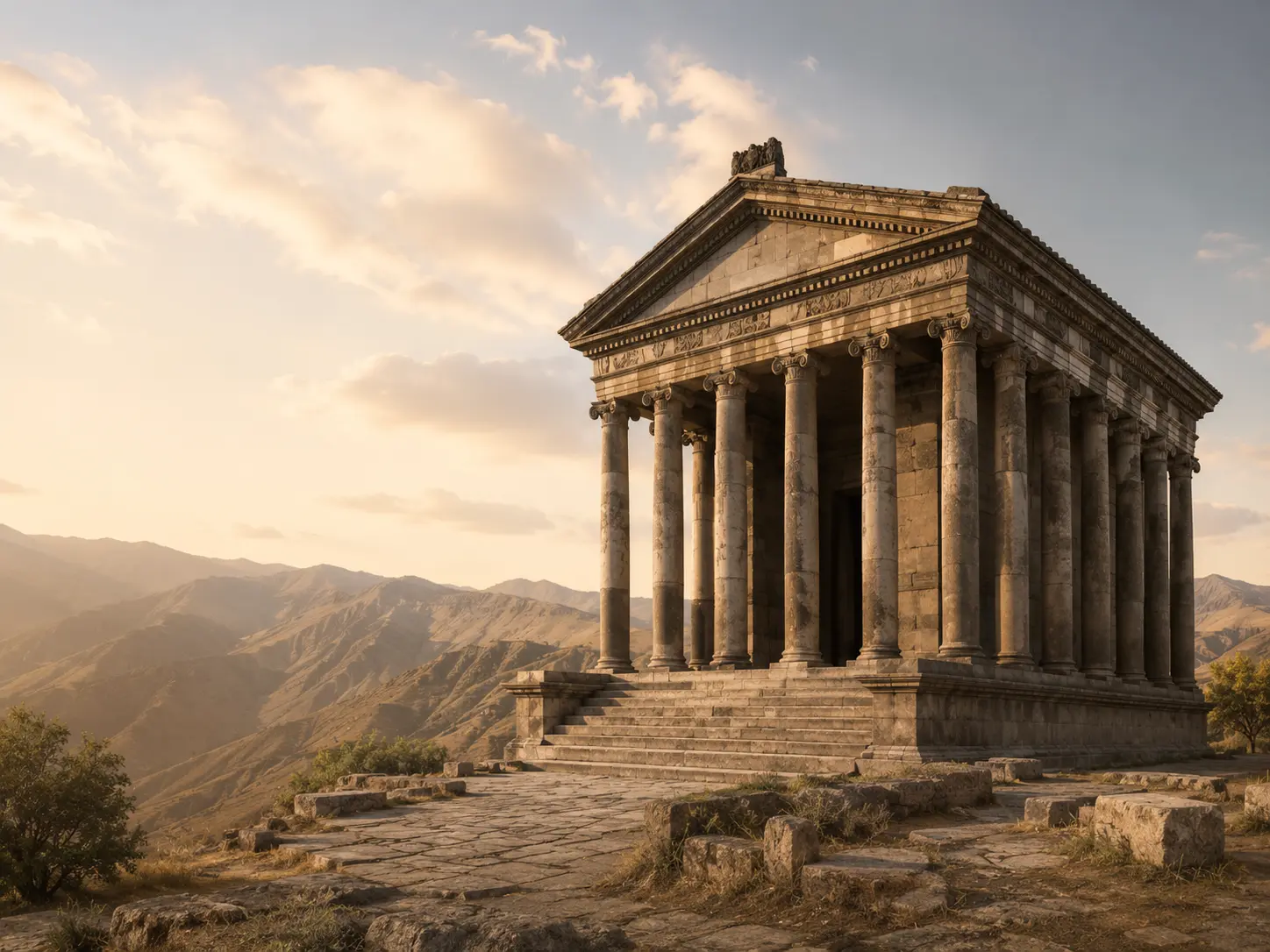
Downstream, at the mouth of the same valley, is the classical building at Garni, and most people visit the two in one morning. The pairing comes from geography before tourism: they share a river, a road and a province. The World Heritage property here, though, is named for the monastery and the upper valley together, not for the buildings alone, and Garni is not part of it. Mixing the two up is the commonest mistake people make about both sites.
The rock, and what it allowed
The rock made the monastery possible and shaped every decision its builders took. It is a volcanic stone soft enough to work with hand tools and hard enough to stand unsupported once cut, and that combination is uncommon. In granite, these chambers could not have been made at all. In a softer stone, they could not have held up their own roofs.
The gorge also gave the site its water and its defences. A spring rises inside the cliff and still runs through one of the rock-cut chambers, which is why that chamber has a channel cut across its floor. Some accounts describe the spring as an ancient pagan sanctuary taken over by the church. They are repeating a single, unsupported remark from a modern survey. No excavation has shown pre-Christian worship at this site, and this archive does not claim it.
What the cliffs do not do is make Geghard a cave monastery in the usual sense of the phrase. The complex has a wall, a gate, a courtyard, roofs, domes and windows, and the carved rooms open off it. Picturing it the other way round, as a warren in a hillside with a façade attached, gets the building history backwards. The masonry church came first, and the great carved halls were added to it later.
Ayrivank, and the tradition
The monastery's earlier name was Ayrivank, the monastery of the cave, and under that name it is much older than anything standing today. Tradition traces its founding to Gregory the Illuminator, in the generation of the kingdom's adoption of Christianity.
That is a tradition, and this archive treats it as one. No inscription, no excavated fourth-century layer and no contemporary text places Gregory here. What the tradition does preserve is the memory of a cave, a spring and a hermitage. That is a plausible shape for an early Armenian monastic site, but it is a very different claim from fourth-century buildings surviving.
The first firm written evidence comes later and is less romantic. Yovhannes Draskhanakerttsi, catholicos and historian, records taking refuge at Ayrivank during the Arab raids of about 923. It was a working monastery, defensible, and worth fleeing to. A thirteenth-century historian also mentions a monk of Ayrivank.
Between Gregory and Draskhanakerttsi lies a gap of six hundred years with nothing in it anyone can point to. A fair summary runs like this: the site is old, its name remembers a cave, it was a working monastery by the tenth century, and everything a visitor can actually see was built three hundred years after that.
Where the evidence starts
At Geghard the gap between the tradition and the surviving monastery is no technicality. It is roughly a thousand years wide, and the buildings themselves show where the written record begins.
Outside the defensive wall stands a small chapel, partly built and partly cut into the rock. It is the oldest datable structure on the site, and the inscriptions on its walls mark the start of Geghard's documented history: a cross-stone of 1164, then texts of 1177 and 1181, the second recording the Catholicos of the Aghvans donating relics. A further inscription of 1200 records work on the water supply and names Zakare and Ivane.
Two cautions about this chapel, because published sources disagree about it and readers will run into both versions. UNESCO's own two documents place it on opposite sides of the complex: the advisory evaluation puts it to the east, the later statement of value to the west. That later statement also gives the earliest inscriptions on the chapel as the pair above, while the survey it relies on records an even older cross-stone. Neither discrepancy changes the argument, but both are good reasons not to trust any single summary of this site.
So the monastery's documented history begins in the twelfth century, on a chapel outside the walls, with dated inscriptions cut by the people who paid for the work. Everything inside the walls is later. That does not diminish the tradition, since traditions are historical objects in their own right. It is simply the difference between something believed and something recorded, and at Geghard the recorded part happens to be unusually well dated.
The church and the gavit
The main church is the Katoghike, a masonry building of a type found all over medieval Armenia: a domed cross-in-square plan in dressed stone, standing free in the courtyard. An inscription on its south portal dates it to 1215, and the building inscriptions on the site run from about 1210 to that year.
The inscription names the patrons, and they were not local men. Zakare and Ivane were the Zakarid brothers who commanded Georgian armies and in practice governed much of northern Armenia at the time, and the text names their sons Shahnshah and Avag alongside them. Zakare himself died in 1212, before the church was finished. It is a small reminder of how these inscriptions work: they record an act of patronage, not an opening ceremony.
Against the church's west front stands the gavit, a large, square, dimly lit hall with four free-standing columns and an opening in the centre of its roof. A gavit is neither a nave nor a porch. It is an Armenian building type with no close western parallel, used for gatherings, for teaching, for burials and for the parts of the liturgy held outside the church proper. The earliest known example carries the name in an inscription of the eleventh century. Geghard's gavit was built in the decade after the church, and the chapels attached to its north-east corner are dated 1225.
Up to this point the complex is entirely conventional. A domed church, a gavit in front of it, a wall around both: nothing yet sets Geghard apart from a hundred other Armenian monasteries. What does set it apart was cut rather than built, and it was cut later.
Cut from the rock
At Geghard, rock-cut is an exact description. The chambers were dug inward and downward from the cliff face, working from the top. What remains is not a lined cave but a room whose walls, columns, vaults and dome are one continuous piece of the mountain. Nothing in them was assembled. There are no joints, because there are no blocks.
The result is a range of spaces that do not fit a single category. Some parts of Geghard are built: the Katoghike, the gavit, the defensive wall and the ruined seventeenth-century ranges along its inner face. Some are carved outright. Some are both. The chapel outside the walls has a masonry front and a hollowed-out back, and several of the monks' cells are recesses in the rock closed off with a built wall. Calling the whole monastery a cave flattens all of that.
The first of the great carved rooms was made before 1250, on a cruciform plan with equal arms. It is the one with the spring: the water rises inside it, and the room takes its usual name from the basin. An inscription in the complex names the architect as Galdzak and credits him with the rock-cut churches and the carved halls over a working life of some forty years. That makes Geghard one of the few Armenian monuments whose maker is known by name.
The builders' skill is easiest to see overhead. The carved halls are roofed with domes on squinches and, in one case, with a stalactite vault of the kind Armenian builders were developing at the time: a honeycomb of small carved cells stepping up to a central opening. In a masonry dome, that geometry is a building problem solved with cut blocks. Here it had to be reached by taking stone away from a single mass, with no way to correct a mistake.
The rooms are famous for their acoustics, which follow from their shape: a hard, seamless, closed stone space echoes. No medieval source says these halls were made for sound, and the modern habit of calling Geghard an acoustic masterpiece turns an observation into an intention.
The Proshyan princes
The carved rooms came with a change of ownership. The family involved was the Khaghbakian house, later called Proshyan after Prosh, son of Vasak. Prosh was a vassal of the Zakarids under Mongol overlordship, and by the middle of the century he was the effective lord of this district.
The Proshyans took Geghard over from the Zakarids in the decade before the death of Avag, son of Ivane, in 1250. This is usually described as a purchase from Avag, and one survey reads it that way from a later inscription. The UNESCO advisory evaluation does not mention a purchase at all, and no document of a sale has been published in a form readers can check. Accounts that give the year as 1215 have confused the transfer with the dated inscription on the main church. They also rest on a chronological error in a modern survey, one that the same volume contradicts in its own pages and that is still being reprinted.
What the Proshyans built is dated and substantial. Prosh founded a second rock-cut church in 1283, and it carries his name. The great carved hall beside it, used as the family's burial place, dates from the same year. An upper carved chamber of 1288 was made in the time of Papak, son of Prosh, and his wife Ruzukan. Tombs inscribed with two of the family's names survive in the lower hall; the tombs of Papak and Ruzukan themselves do not.
On the wall of the burial hall is the carving everyone photographs: an animal's head holding a ring, with two facing lions attached to it, and below them an eagle gripping a smaller animal in its talons. It is generally called the coat of arms of the Proshyan family. That identification is credited to Garegin Hovsepian, and specialists have passed it on for decades with the word probably attached every time. It deserves more caution than that. Published descriptions do not agree on which animal is at the top, or even on which chamber the carving is in. Patrick Donabédian has pointed out that motifs like these recur on monuments built for unrelated families, which, he argues, rules out reading them as dynastic emblems at all; a lion and an ox appear on the Zakarid church in this very courtyard. He prefers an apotropaic reading, seeing the carving as protection against harm. Medieval Greater Armenia has left neither seals nor coins, so the regulated heraldic system that did exist in Cilicia cannot simply be assumed here. No study devoted to this relief has ever been published, and the motto often quoted with it, about lions chained together and an eagle holding its prey, has no medieval source of any kind.
Inscriptions, khachkars and books
Geghard's inscriptions are neither decoration nor an afterthought. Cut into portals, columns and cliff faces, they are the documentary backbone of everything above: who paid, for what, in which year, and what they expected in return. An Armenian monastery of this period is a building that talks about itself, and Geghard talks more than most.
Khachkars, the carved cross-stones that are among the most characteristic works of Armenian sculptors, stand throughout the complex and are set into the rock around it, including on the slopes above, where some are cut straight into the cliff face. Several are dated, and one of them is the oldest object on the whole site.
Books were made here too. The clearest evidence is Mkhitar of Ayrivank, a scholar and chronicler whom the standard bibliography of Armenian literature places at this monastery specifically. An inscription of 1291 records him carving Prince Prosh's name on the wall of the chamber where he had long lived and worked, and a visitor in 1387 found his writings still there. Colophons, the notes scribes added at the end of the manuscripts they copied, record copying at Ayrivank in 1444 and repeatedly after that until 1476, with one scribe named at the monastery across a dozen of those years.
The usual account overstates this in two ways. First, the claim that Geghard held a library rests on no cited source. The monastery has no known curriculum, no faculty and no named graduates; it is not in the class of Gladzor or Tatev and should not be described as though it were. Second, the scholar usually named alongside Mkhitar, Simeon of Ayrivank, was not a thirteenth-century historian. The surviving notices place him around the turn of the fifteenth century and describe him as a teacher and a pupil of Grigor Tatevatsi. That error is UNESCO's own, and it has spread from there into a great many summaries.
The spear, and the name
The name Geghard is short for Geghardavank, the monastery of the spear, and it replaced Ayrivank at some point in the thirteenth century. The new name is often said to appear first in a document of 1250, but no source identifies that document, and the survey the claim goes back to says only that the change probably happened around then.
According to Armenian church tradition, the monastery held the spear used at the Crucifixion, brought to Armenia by the Apostle Thaddeus. The tradition first appears in the twelfth century, with a hymn of 1159 as the earliest reference, so it is a tradition of that date and not a record of the first century. The scholar who compiled the standard survey of the monastery's own documents wrote flatly that Thaddeus never reached Armenia, and noted that two rival spearheads were circulating in the medieval Middle East.
What is documented is the relic's later life as an object. Prince Prosh commissioned a reliquary for it in 1268, and the case that survives is a replacement of 1687 that copies his inscription. The French traveller Tavernier saw and drew the relic at Geghard in 1655. At some point it was moved to the treasury at Etchmiadzin, where it remains. The Armenian Church's own institutions give different centuries for the move, though, and the date of 1766 repeated online cannot be traced to any source at all.
Very little can be said with confidence about the object itself. It is an iron blade pierced by a cross, not shaped like a Roman spearhead. No scientific examination of it has ever been published, and the claim that foreign specialists have confirmed it as authentic matches no study in any database. Nothing in the evidence supports treating the relic as a first-century artefact. What this article uses it for is plain church history: it is the reason a monastery changed its name in the thirteenth century.
What to understand before seeing it
Geghard and the upper Azat valley were added to the World Heritage list in 2000 under a single criterion: that the complex shows an important interchange of human values in the development of architecture. Armenia had proposed two more criteria, and they were not adopted. That is worth knowing, because the rejected ones concerned unique artistic achievement and religious significance. The listing is about architecture.
Four things are worth carrying through the gate. First, the tradition and the buildings are about a thousand years apart, and both are real. Second, the monastery is not one kind of construction but three (built, carved, and both at once), and the carved parts came last, added to a conventional church. Third, almost every date here comes from an inscription on the thing being dated. That is rarer than it sounds, and it is why this article can be as specific as it is.
The fourth is everything this article has had to push back on. Much of what is told at Geghard, from the founding by Gregory and the spear of the Crucifixion to the meaning of the lions and the eagle, the library, and acoustics designed for chant, is tradition, attribution or observation presented as fact. None of it needs to be thrown away. It needs to be labelled, and those labels are the most useful thing a visitor can bring through the gate.
Important dates
About 923
Yovhannes Draskhanakerttsi, catholicos and historian, records taking refuge at Ayrivank during the Arab raids. It is the first firm written record of the site.
1164
The date on an inscribed cross-stone at the chapel outside the walls, the oldest dated object on the site.
1177
The earliest of the wall inscriptions on the same chapel, and the date usually given as the beginning of Geghard's documented history.
1181
A second inscription on the chapel records the Catholicos of the Aghvans donating relics to the monastery.
1200
An inscription recording work on the water supply names Zakare and Ivane. It is sometimes wrongly credited to the Proshyans, who had not yet arrived at the site.
1215
The Katoghike, the main masonry church, is dated by the inscription on its south portal, which names Zakare and Ivane with their sons Shahnshah and Avag.
1225
The date on the chapels attached to the north-east corner of the gavit, which was built in the decade after the church.
Before 1250
The first of the great rock-cut churches, on an equal-armed cruciform plan, is cut entirely from the living rock. An inscription names the architect as Galdzak.
1283
The second rock-cut church, founded by Prince Prosh, and the carved hall beside it used as the family's burial place.
1288
The upper carved chamber, made in the time of Papak, son of Prosh, and his wife Ruzukan. Their own tombs have not survived.
1291
An inscription records the scholar Mkhitar of Ayrivank carving Prince Prosh's name on the wall of the chamber where he lived and worked.
1655
The French traveller Tavernier sees and draws the spear relic at Geghard. It is the last firm evidence of the relic at the monastery named after it.
2000
The monastery and the upper Azat valley are inscribed on the World Heritage list under criterion (ii). Two further criteria proposed by Armenia were not adopted.
Why Geghard matters
Nowhere in Armenia shows more clearly than Geghard that architecture and geology can be the same decision. A domed church in a courtyard is a building. The halls behind it are the absence of a mountain, shaped by taking stone away, with the same vaults, columns and domes reached from the opposite direction. The site asks you to hold both in view at once, and that is why the World Heritage inscription names the valley alongside the monastery.
Geghard is also this archive's best example of what a dated inscription is worth. Most medieval sites are argued over; this one is largely signed. Almost every claim in this article rests on a text cut into the object it describes, by the people who paid for it, in a year they recorded themselves. That is exactly what makes the undated parts stand out: the founding tradition, the spear, and the meaning of the carving everyone photographs. The monastery documents itself so well that the places where the documents stop can be seen from a long way off.
Interesting facts
- 01The oldest dated object at Geghard is a cross-stone of 1164, and it stands outside the defensive wall rather than inside it.
- 02The great carved halls have no joints anywhere, because nothing in them was assembled: walls, columns, vaults and dome are one continuous piece of the mountain.
- 03The architect of the rock-cut churches, Galdzak, is named in an inscription, which is unusual for a medieval Armenian monument.
- 04UNESCO's two documents on Geghard place its oldest chapel on opposite sides of the complex, one to the east and the other to the west.
- 05The spear the monastery is named after has not been kept there for centuries. It is at Etchmiadzin, and the Armenian Church's own institutions disagree about when it left.
Sources
- Alexandr Sahinian, Armen Manoukian and T. A. Aslanian. G(h)eghard — Documents of Armenian Architecture / Documenti di Architettura Armena 6, Edizioni Ares, Milan, 1973 Visit sourceThe survey ICOMOS itself worked from, produced by the faculty of architecture of the Politecnico di Milano with the Armenian Academy of Sciences. Its inscription-by-inscription chronology carries most of the dates in this article: the cross-stone of 1164 and the texts of 1177, 1181 and 1200 on the chapel outside the walls, the 1215 south-portal inscription naming Zakare and Ivane with their sons, the chapels of 1225, the 1283 and 1288 inscriptions of the Proshyans, and the 1291 inscription of Mkhitar of Ayrivank. Two cautions, and they are why this article does not simply follow it. It has no bibliography, so it reports rather than argues; and its own chronology contains an entry dating Prince Prosh's work to about 1214, which is impossible and which the same volume contradicts in its 1283 entry. That error is the likeliest origin of the 1215 acquisition date still in print.
- Monastery of Geghard and the Upper Azat Valley — UNESCO World Heritage List, no. 960, inscribed 2000 Visit sourceCited for the designation itself and for criterion (ii) alone: Armenia proposed criteria (i), (ii) and (vi), and only (ii) was adopted, so the two concerning unique artistic achievement and religious significance are rejected nominations rather than UNESCO findings. It is deliberately not used as an authority on chronology or scholarship. Its Statement of Outstanding Universal Value dates Simeon Ayrivanetsi to the thirteenth century when the notices put him around 1400, places the oldest chapel on the western side where its own advisory evaluation places it east, and gives the spear five hundred years at the monastery without a source.
- Advisory Body Evaluation (ICOMOS), Monastery of Geghard, no. 960 — ICOMOS for the UNESCO World Heritage Committee, 2000 Visit sourceOlder and fuller than the Statement of Outstanding Universal Value, and the two disagree often enough that citing only one of them would be misleading. This is the document that carries the architect Galdzak and his campaign of some forty years, the 1288 date for the upper carved chamber, and the claim that the name Geghardavank was first recorded in a document of 1250 — a hardening of Sahinian, who wrote only that the change probably happened then, and no source names the document. Its attribution of the 1200 water-supply inscription to the Proshyans is an error: the inscription names Zakare and Ivane, and the Proshyans were not yet at the site. It does not mention a purchase of the monastery at all.
- Patrick Donabedian. Geghard Monastery — Grove Art Online, Oxford University Press, 2003 Visit sourceThe shortest scholarly reference entry devoted to the monument, by a standard authority on medieval Armenian architecture. Cited for the building history as a specialist states it, against the tourism accounts that dominate this subject online. Paywalled and not read directly.
- Patrick Donabedian. Armenia - Georgia - Islam: A Need to Break Taboos in the Study of Medieval Architecture — in Ferrari and Riccioni (eds), L'arte armena. Storia critica e nuove prospettive, Eurasiatica 16, Edizioni Ca' Foscari, Venice, 63-112, 2020 Visit sourceThe reason this article will not call the carving in the burial hall a coat of arms without qualification. Donabedian objects that motifs of this type - an eagle holding a small quadruped, a lion attacking another animal - recur on monuments sponsored by unrelated dynasties, which in his words excludes that they may have a function of dynastic symbols; he follows Eastmond and Blessing in preferring an apotropaic reading. Open access. It is also the source for identifying R. Matevosyan's Haykakan zinanshanner (Yerevan, 2002) as the standard modern statement of the heraldic view.
- Sirarpie Der Nersessian. L'Art armenien — Arts et Metiers Graphiques, collection Orient et Occident, Paris, 1977 ISBN 9782700400274The work later scholarship cites for reading the relief as the Proshyan family's arms, and worth citing precisely for how it is cited: the identification is passed on as probable and never as established. The identification itself originates with Garegin Hovsepian's Khaghbakeank' kam Prosheank' (Vagharshapat, 1928), which is not registered here because no digitised copy could be consulted and a page reference for it would be invented. English edition: Armenian Art, Thames and Hudson, London, 1978.
- Marco Carpiceci, Fabio Colonnese, Antonio Schiavo and Rachele Zanone. The rupestrian churches in the monastery of Geghard, Armenia — Hypogea 2023: Proceedings of the Fourth International Congress of Speleology in Artificial Cavities, Genoa, 251-260, 2023 Visit sourceA recent laser-survey campaign by a Sapienza University of Rome team, and the fullest published description of the relief: an ox head biting a ring holding two facing lions whose tails end in dragons, with an eagle below holding a lamb. Congress proceedings rather than a refereed journal, and it depends heavily on the 1973 volume - including reproducing its impossible date of about 1214 for Prince Prosh, which is how that error reached print again fifty years on. Cited here for the description and the survey, not for the chronology.
- Richard G. Hovannisian (ed.). The Armenian People from Ancient to Modern Times, Volume I: The Dynastic Periods, from Antiquity to the Fourteenth Century — Palgrave Macmillan, 2004 ISBN 9781403966360Already registered for several other articles. The chapter that earns it here is Robert Bedrosian's on the Seljuk and Mongol periods, cited for the political frame rather than the buildings: the Zakarid brothers Zakare and Ivane, Avag's submission to the Mongols, and the Khaghbakian house coming to be known as Proshian after Vasak's son Prosh. It is also what corrects the widespread description of Prosh as commander of the Zakarid army - the supreme office was the amirspasalar and no Khaghbakian held it.
- Avedis K. Sanjian. Colophons of Armenian Manuscripts, 1301–1480: A Source for Middle Eastern History — Harvard University Press, Harvard Armenian Texts and Studies 2, 1969 ISBN 9780674142855The documentary evidence that manuscripts were actually copied at this monastery, as against the assertion that a scriptorium existed. Sanjian indexes Ayrivank at 1444, 1447, 1452, 1459 and 1476, with a scribe named Mateos working there across a dozen of those years. The volume begins at 1301, so it cannot speak to the thirteenth century, and this article does not make it do so. Also registered for the Matenadaran. Harvard's digital edition of the same volume carries DOI 10.4159/harvard.9780674432635, checked against Crossref and confirmed as this work; the ISBN above is kept as the identifier because the 1969 print volume is the edition cited.
- Robert W. Thomson. A Bibliography of Classical Armenian Literature to 1500 AD — Corpus Christianorum, Brepols, Turnhout, 1995 ISBN 9782503504551The standard bibliography of Armenian literature, and what settles two separate questions here. It identifies Mkhitar Ayrivanetsi's monastery explicitly as Ayrivank, glossed Geghard, which rules out the other monasteries carrying that name. And Simeon Ayrivanetsi does not appear in it at all, which is one of the two reasons this article declines to call him a thirteenth-century historian.
- Michael E. Stone. Armenian Canon Lists III - The Lists of Mechitar of Ayrivank' (c. 1285 C.E.) — Harvard Theological Review 69(3-4), 289-300, 1976 Visit sourceCited for Mkhitar himself and for the disagreement about when he lived, which this article preserves rather than resolves: Stone dates him 1222-1307 and his canon lists to about 1285, where Thomson calls him a fourteenth-century writer whose chronicle runs to 1328.
- Edda Vardanyan. The Zamatun of Horomos and the Zamatun/Gawit' Structures in Armenian Architecture — in Edda Vardanyan (ed.), Horomos Monastery: Art and History, Monographies 50, ACHCByz, Paris, 207-236, 2015 ISBN 9782916716572Cited for the building type rather than for the site: what a gavit or zhamatun was for, and where it comes from - the earliest is at Horomos and is already called zamatun in an inscription of 1038. This is what lets the article explain Geghard's halls as an Armenian type with no close western parallel rather than as a local invention.
Related articles
Garni Temple
A colonnaded classical building on a promontory above the Azat gorge, the only one of its kind left in Armenia. An earthquake brought it down, and in the twentieth century it was put back up from the stones that fell.
The Adoption of Christianity in Armenia (301)
Armenia is traditionally recognised as the first state to adopt Christianity as its official religion, a decision that reshaped its law, art and identity.
Etchmiadzin Cathedral
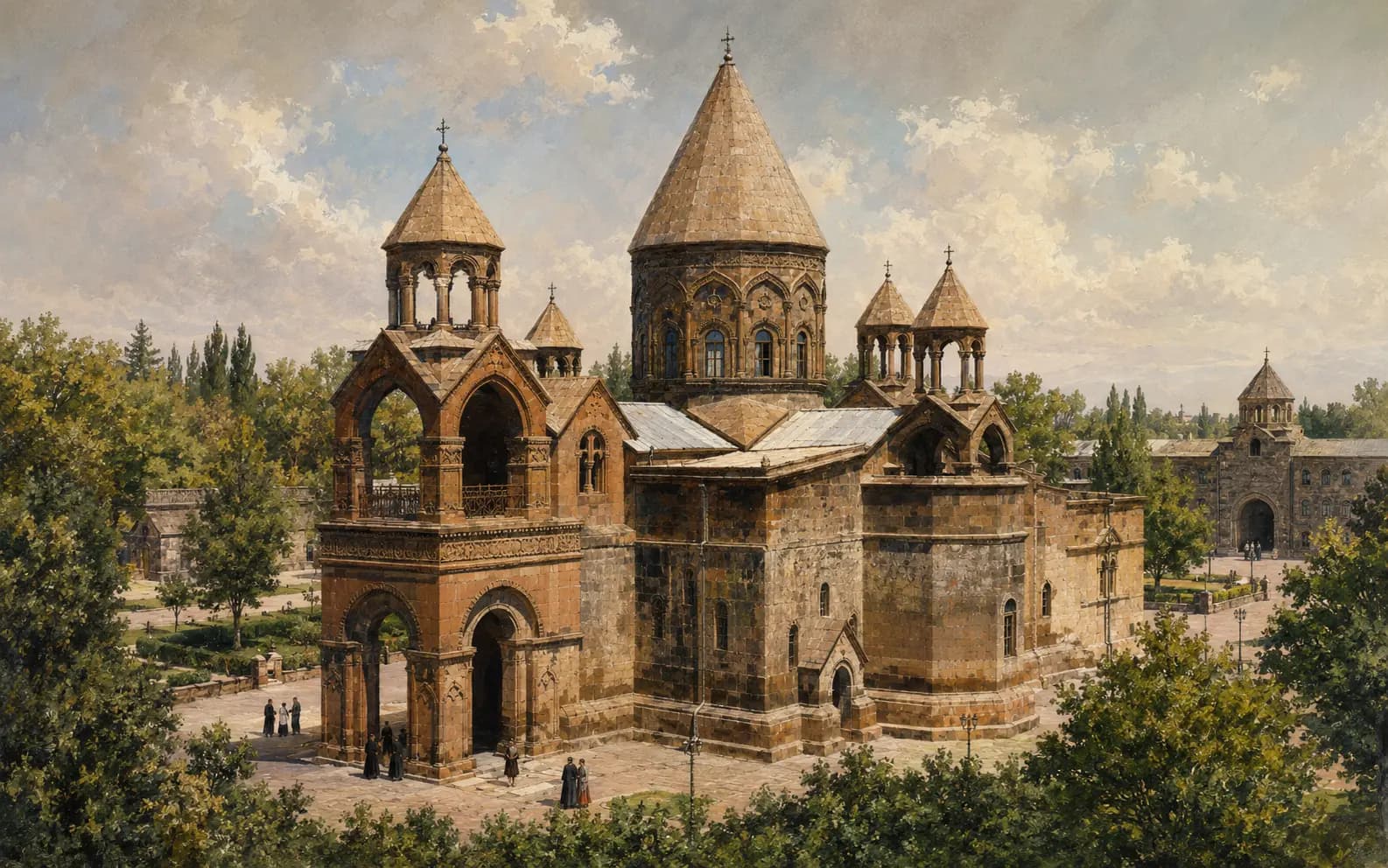
The principal church of the Mother See of Holy Etchmiadzin and the seat of the Catholicos of All Armenians. Its tradition reaches back to Armenia's conversion, but most of the building standing today does not.