
Tatev Monastery
Tatev is the rare Armenian monument whose founding date comes with a sentence attached. Most medieval Armenian buildings are dated by inference, by style, or by a tradition written down centuries later. At Tatev, the thirteenth-century historian Stepanos Orbelian read an inscription on the church wall and copied it into his history. In it, a named bishop says in the first person what he began and when. That firm footing makes the rest of the site easier to see clearly: what is documented, what is tradition, and what is a twentieth-century reconstruction standing where a medieval building fell.
- Author
- Armat Editorial Team
- Updated
- Reading time
- 20 min read
In brief
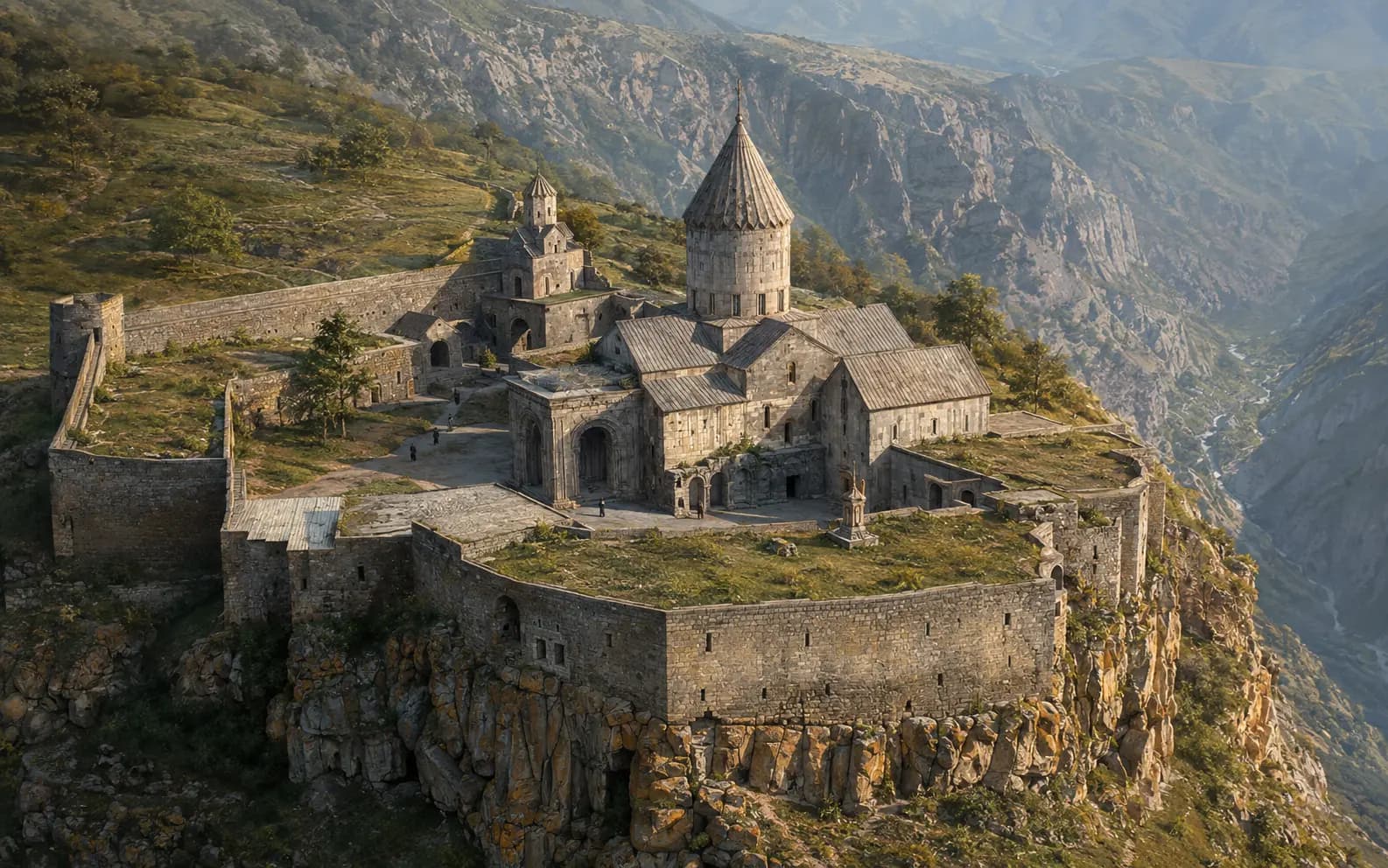
Tatev stands on a plateau above the Vorotan river gorge in Syunik, in southern Armenia. Its main church, Saints Paul and Peter, was begun in 895 under Bishop Yovhannes, according to a building inscription that the historian Stepanos Orbelian copied down. The same account says the work took eleven years, which puts its completion around 906. Beside the church stands the Gavazan, a stone column that rocks on its base and returns upright; it was recorded doing so in an earthquake of 1406. From about 1390 the monastery housed the school usually called the University of Tatev, led by Grigor Tatevatsi until his death in 1409. An earthquake in 1931 destroyed much of what stood, and every dome on the site today is a modern rebuilding.
Key facts
- Kind of place
- Monastery of the Armenian Apostolic Church, and the medieval episcopal seat of Syunik
- Where
- On a plateau above the Vorotan gorge, by the village of Tatev, Syunik Province
- Principal church
- Saints Paul and Peter, begun 895 by its own inscription; about eleven years in building
- Earlier church on the site
- Saint Gregory the Illuminator, built 848, rebuilt more than once since
- The school here
- Settled at Tatev about 1390; broken up in the 1430s
- World Heritage status
- Not inscribed as of 2026. On Armenia's Tentative List since 1995, with Tatevi Anapat
Where Tatev is
Tatev stands in Syunik, Armenia's southernmost province, on a shelf of basalt at the edge of the Vorotan river gorge. The nearest settlement is the village of Tatev. The nearest town of any size is Goris, roughly thirty-five kilometres away by a road that spends most of its length getting into and out of the gorge.
This is a long way from the other places in this section. Khor Virap, Etchmiadzin, Erebuni and the Matenadaran are all within an hour of Yerevan, and Geghard and Garni share one valley east of the capital. Tatev is several hours south of all of them, and that distance was part of the monastery's purpose. A bishop's seat in Syunik was not an outpost of somewhere else. It was the centre of its own region.
The setting is the first thing anyone notices and the last thing to understand properly. Orbelian, writing in the thirteenth century, described the site as standing like a lofty watchtower, level and healthful, ringed by mountain peaks as though drawn with a compass, with the river passing below through deep ravines with an awesome roar. He was describing a defensive position as much as a view.
The gorge, and what it is worth
The Vorotan gorge is the deepest in Armenia, but sources disagree about how deep it is. Armenia's own submission to UNESCO calls it eight hundred and fifty metres and the biggest gorge in the country; other accounts give seven hundred to eight hundred metres at Tatev itself. Part of the difference comes from where the measurement is taken, and no single figure should be quoted as if it settled the matter.
What the gorge did for the monastery is clearer. It made the plateau defensible on three sides without anyone building anything. That is why the site could hold a treasury, a library and several hundred people through centuries in which Syunik changed hands again and again. When the monastery's valuables were sent away for safekeeping in the twelfth century, they went to a fortress, but for most purposes Tatev already was one.
The same gorge now shapes how most visitors arrive. A cable car opened in 2010 crosses it from the village of Halidzor, and at 5,752 metres it holds the record for the longest non-stop double-track aerial tramway. It is modern access infrastructure and nothing more. It is not part of the monastery, which stood for eleven centuries without it.
What stood here before
There was a church on this rock before the one that dominates it now, and the best source for it is frank about how little he knows. Orbelian describes an obscure church of undressed stones set in lime, dating from very ancient times, from the period of Saints Nerses and Sahak (which would put it in the fourth or fifth century), with a few clerics living beside it in continual austerity.
He then says something most later retellings leave out. He could not discover who the first bishop here was, or when; as for the oldest of them, he writes, he knows nothing, since there are no memorials. In other words, the main source for Tatev's early history openly says that history is undocumented. That admission is the right place to start, and it is worth more than any confident date.
The name has its own tradition. The thirteenth-century writer Vardan Arewelts'i records that Tatev held the see of the apostle Eustathius, a disciple of Thaddeus. So the link between the name and a first-century figure is at least a medieval belief and not a modern invention, though it remains a tradition. The folk etymology that turns the name into the Armenian for give wings, spoken by a builder throwing himself from the roof, has no medieval source at all.
Documented history begins in the ninth century, and it begins with property. Under Bishop Dawit', Prince Philippe paid for adjoining land, by a deed dated to the Armenian year corresponding to 839. From this time Tatev was the episcopal seat of Syunik. That status, and no relic or miracle, is what made the building campaign of the following decades possible.
Building Saints Paul and Peter
The church that gives Tatev its silhouette was begun in 895, and we know because its founder said so on the wall. Orbelian transcribes the inscription: in the year 344 of the Armenian Era, at Easter, which fell on the fourth of Navasard, I, Lord Yovhannes, who succeeded Lord Saghomon as bishop of Syunik, began the construction of this church. Brosset, translating Orbelian in the nineteenth century, worked the date out to 20 April 895.
The patrons were the princes of Syunik. Prince Ashot, son of Philippe, was the chief donor, along with the bishop himself, who is said to have spent enormous sums and labours on the work. Gabur and Sahak, sons of Grigor Supan, and Prince Dzagik also contributed. The consecration lasted eight days and drew King Smbat of the Bagratid kingdom, the Catholicos Yovhannes, Gagik of Vaspurakan and the Catholicos of the Aghuans.
The often-quoted span of 895 to 906 needs one clarification, because it is regularly made to say more than it does. The 895 comes from a document: it is on the wall. The 906 is arithmetic. Orbelian says the work was finished in eleven years, and Brosset added those to 895 in a footnote. No inscription reads 906, and Orbelian gives no year for the consecration at all. Sources that call 906 the date of consecration have worked it out, not read it.
Orbelian describes the finished building as having a dome resembling the sky, standing a hundred cubits high, forty-eight long and twenty-four wide, with four altars besides the principal one and relics of Peter and Paul laid beneath its columns. Medieval writers also call the church Surb Arakelots, the Holy Apostles, and inscriptions record gifts made to it under that name. Most modern accounts of the monastery leave this detail out.
The rest of the complex
Nothing at Tatev belongs to a single century, and the buildings around the main church show it. The church of Saint Gregory the Illuminator is the oldest structure with a date. Prince Philippe built it in 848 next to the old church on the south side, and was buried by its door. It has been destroyed and rebuilt at least three times since, most substantially in 1295 by the historian Stepanos Orbelian himself, who was by then metropolitan of Syunik.
The gavit, the vaulted hall that Armenian monasteries place in front of a church, carries its own inscription: in the year corresponding to 1043, Lord Yovhannes recorded building these chambers. A small gate church of the Holy Mother of God went up on the north side in 1087. A west porch holds the tomb of Aruz-Khatun, wife of Prince Tarsayich, dated 1286. Each of these was a separate building campaign, and the earliest and latest are two centuries apart.
The belfry is the structure most often described with confidence and least often described accurately. A bell tower certainly existed by 1406, because a scribe working at Tatev mentions it. Whether the tower a nineteenth-century traveller described was that one is doubtful: an abbot demolished the medieval tower in 1890 and put up a new one, finished in 1897. What stands today is neither. It is the lowest stage of a reconstruction begun in 1987 and abandoned in 1998.
The monastery was also a working settlement, and Orbelian lists what that meant: a wall of polished stone, underground storerooms, dining rooms, workrooms, shops, repositories for sacred objects, and libraries. An oil press survives, restored in 2010 and now a small museum. It pressed sesame, mustard and linseed. It did not press olives, which will not grow at this altitude, and the correction is worth making because the mistranslation is common.
The Gavazan
South of the church stands an octagonal stone column about eight metres high, topped with a cross-stone. It is called the Gavazan, the staff. It is the most famous object at Tatev and the one most often described wrongly, so it helps to separate what is recorded, what is measured and what has been claimed.
Orbelian's record is short. Bishop Yovhannes, after the church was finished, erected a marvellous pillar in the name of the Holy Trinity, close to the church and opposite it on the south side, built of small and large stones, reaching thirty cubits. That is the whole medieval account of its making. It says nothing about the column moving, and nothing about it measuring anything. Thirty cubits is also a good deal more than the eight metres measured today, and nobody has explained the difference.
That the column moves, however, is not in doubt, and it has been reported for well over a century. A traveller's account of 1858 names it the Gavazan and says that it shakes if touched with the hand, which led people to say its foundation had been artfully laid on a chest. Brosset, writing in 1864, noted that it still stood and still moved when leant upon. He added that Hermann Abich, the founding geologist of the Caucasus, had examined it and could not explain the mechanism to him.
There is one medieval record of the column responding to an earthquake, and it is a good one. Tovma Metsopetsi, a scribe working at Tatev, wrote in a colophon dated 29 November 1406 of an astonishing earthquake that shook the monastery, the bell tower and the Gavazan. He was an eyewitness inside the building. His note shows that the column moved in a large earthquake. It does not show that anyone built it to do so.
The modern explanation is that the column sits on a hinged joint at its base and rocks like a pendulum before returning upright. That is how a seismological paper of 2004 describes it. The same paper says the column could serve to record seismic oscillations, and credits the idea to a Soviet-Armenian architectural historian writing in 1962. So the famous claim is a twentieth-century interpretation of an observed property, offered tentatively, and not a documented medieval purpose. The related stories, that it warned of approaching cavalry or that it is an astronomical instrument aligned to the stars, have no support of any kind and should be set aside.
The school called a university
Tatev's second claim on Armenian memory is intellectual, and it comes with a label that needs care. The institution is universally called the University of Tatev, while specialists writing about it in academic contexts generally call it the monastic school of Tatev. Both names describe the same thing, but the second is more careful.
The difference matters because the modern word brings the wrong furniture with it. There was no charter, no faculty structure and no degree in the Western sense. What did exist was rigorous and well organised in its own way: the vardapet system, a ladder of fourteen ranks given to celibate priests after specialised study, examination before a panel and the presentation of a thesis. Grigor Tatevatsi codified those ranks himself, and the Armenian Church still uses them. A vardapet rank is a church's licence to teach, which is a different thing from a university degree.
What was taught is reported consistently enough to summarise: scripture and its interpretation, the scriptural arts including manuscript illumination, and music. Reading extended to Plato, Aristotle, Philo and Porphyry and, more strikingly, to Latin scholastic authors. In 1363 Grigor Tatevatsi copied a manuscript containing Bartholomew of Bologna and Peter of Aragon at his teacher's request. The Armenian scholars most opposed to union with Rome were reading Rome's philosophers closely.
Two numbers should be treated with suspicion wherever they appear. Tatev is often said to have had five hundred or a thousand students. Both figures come from Orbelian, and neither describes the school. Five hundred is his count of the clergy around 906. A thousand is his description of the community in the eleventh century, some three hundred years before the school arrived. Neither is a student roll, and attaching them to the university is a plain error of chronology.
Vorotnetsi and Tatevatsi
The two names attached to the school are Hovhan Vorotnetsi and his pupil Grigor Tatevatsi, and the line of teachers behind them is well recorded: Esayi Nchetsi at Gladzor taught Vorotnetsi, and Vorotnetsi taught Tatevatsi for twenty-eight years. Much of what is said about Vorotnetsi, however, does not survive a look at the dates.
Vorotnetsi is regularly called the founder of the University of Tatev. He died in 1386 or 1388, and the school is generally thought to have settled at Tatev about 1390. On the best-supported chronology he was dead before it arrived, and his own teaching was done at Gladzor, at Vorotnavank and at Aprakunis. It is more accurate to say that he led and reorganised the higher monastic school of Syunik in the generation after Gladzor, and that the school moved to Tatev under his successor.
Grigor Tatevatsi headed the school at Tatev from about 1390 until his death in 1409, and he is the reason the monastery's name became attached to it. His Book of Questions, finished in 1397, runs to ten volumes and has been called a Summa; his Book of Sermons, finished in 1407, contains three hundred and forty-four sermons. Scholars often compare him to Aquinas, and just as often qualify the comparison. He is venerated as a saint of the Armenian Church, with a feast in Lent, and he was buried at Tatev, where a chapel of 1787 now stands over his grave.
He was also a painter. He is credited with the miniatures in a Gospel manuscript of 1378, and official Armenian institutions say he produced illustrated Gospels now held at Etchmiadzin and at the Matenadaran in Yerevan. The leading theologian of his church also illuminated books, and that one fact gives the clearest picture of what this kind of monastic school actually was.
Damage, loss and rebuilding
Tatev has been badly damaged many times, and the record of that damage is unusually specific. Orbelian reports that the dome of the great church collapsed onto the church of Saint Gregory and brought that down too, and he names the cause: an earthquake at Ganja, in the year corresponding to 1138. Modern seismology dates that earthquake to 30 September 1139. Ganja is about a hundred and forty-five kilometres away, far enough that the report should be flagged rather than simply repeated.
The best-recorded medieval earthquake here is the one of 1406, written down by the scribe who felt it. By far the most destructive was modern. The Zangezur earthquake of 27 April 1931, with its epicentre less than thirty kilometres away, struck Tatev hard enough to destroy its churches. The dome and drum of the main church came down, the belfry was reduced to three pylons of its lowest stage, and the gavit, Saint Gregory and the gate church were all wrecked. The Gavazan tilted and returned, as it had in 1406.
One famous loss belongs to Tatev only indirectly, and it is usually told wrongly. Orbelian describes the fall of the fortress of Baghaberd, where the monasteries of the region had sent their books and church vessels for safety, and says that more than ten thousand items were taken captive and scattered. This is commonly retold as ten thousand manuscripts burned at Tatev. They were not only manuscripts, they were not at Tatev, and the text says scattered, not burned. Orbelian's own date is the Armenian year corresponding to 1160, though 1170 is the figure usually printed.
Restoration has been continuous and is still incomplete. A Soviet campaign began in 1974, and the dome of the main church was designed in 1981 and finished in 1988. It was not, as is often claimed, the work of the modern Tatev Revival programme, which began in 2008. The gate church was badly restored in 1979 and corrected between 2016 and 2018. The belfry has stood unfinished since 1998. Of eighteen restoration projects drawn up between 2013 and 2016, four were carried out.
What to understand before seeing it
The most useful thing to know at Tatev is which surfaces are medieval. Broadly, the walls are and the roofs are not. Every dome and every roof on the site is a twentieth- or twenty-first-century reconstruction, and the belfry is a stump. The medieval fabric survives mostly at wall level, with seventeenth- and eighteenth-century work above and around it. None of this makes the place less worth seeing. It simply means that a photograph of the skyline is a photograph of modern engineering standing where medieval engineering fell.
The exception is the Gavazan, the one monument on the site that has not been substantially rebuilt, which is partly why it attracts the legends it does. Standing beside it is the closest you can come at Tatev to standing in front of something the tenth century made and left alone.
It also helps to arrive with the right expectation about status. As of 2026, Tatev is not a World Heritage Site. It has been on Armenia's Tentative List since 1995, together with the hermitage of Tatevi Anapat and the Vorotan valley. In 2025 Armenia announced that it had submitted a nomination, and a nomination is a different thing from inscription. The rock-cut monastery at Geghard, some distance north, is inscribed; Tatev, so far, is not.
Important dates
839
A deed records Prince Philippe buying land next to the monastery under Bishop Dawit'. It is one of the earliest written records of Tatev as an institution that owned property.
848
Prince Philippe builds the church of Saint Gregory the Illuminator beside the older church, and is later buried by its door.
895
Bishop Yovhannes begins the church of Saints Paul and Peter, recording the date in an inscription on the building. Brosset works the day out as 20 April.
About 906
The church is finished, eleven years after it was begun by Orbelian's account, and the Gavazan column is erected in the name of the Holy Trinity. No inscription gives this year.
1043
An inscription records Lord Yovhannes building the gavit, the vaulted hall along the south side of the church.
1139
The dome of the principal church collapses onto the church of Saint Gregory. Orbelian blames the earthquake at Ganja, which modern seismology dates to 30 September.
1160
The fortress of Baghaberd falls, and more than ten thousand items sent there for safekeeping by the monasteries of the region are scattered. The date is often printed as 1170.
1295
Stepanos Orbelian, metropolitan of Syunik and the historian on whom almost everything above depends, rebuilds the church of Saint Gregory.
About 1390
Grigor Tatevatsi settles the higher monastic school of Syunik at Tatev, four years or so after the death of his teacher Hovhan Vorotnetsi.
1406
Tovma Metsopetsi, a scribe at the monastery, records an earthquake shaking the church, the bell tower and the Gavazan. It is the only medieval account of the column moving.
1409
Grigor Tatevatsi dies and is buried at the monastery. The school does not long survive him, breaking up in the 1430s.
1931
The Zangezur earthquake of 27 April destroys the churches of Tatev, bringing down the dome of the principal church and all but the lowest stage of the belfry.
1995
Armenia submits Tatev, the hermitage of Tatevi Anapat and the adjacent Vorotan valley to the World Heritage Tentative List, where they remain.
Why Tatev matters
Tatev is the clearest surviving example of a medieval Armenian monastery that was also a seat of government, a treasury and a school. Its bishops bought land, its princes paid for its churches, its scribes copied Latin philosophy, and its most famous scholar illuminated manuscripts as well as writing theology. Institutions like this are usually pieced together from fragments. Tatev's story can be read almost without a break, because a thirteenth-century metropolitan of the province wrote its history and quoted the inscriptions he could still see.
Tatev also teaches how to read a monument. Almost everything most often repeated about it (the seismograph column, the ten thousand burned manuscripts, the five hundred students, the university founded by Vorotnetsi) is either an interpretation presented as fact or a real fact attached to the wrong century. The site rewards checking. What is actually documented here is more interesting than the folklore that has grown over it.
Interesting facts
- 01Tatev's foundation date is not inferred from its architecture. Bishop Yovhannes wrote it on the wall in the first person, and the historian Stepanos Orbelian copied the sentence into his history four centuries later.
- 02The often-cited span of 895 to 906 combines one documented year with one calculated year: Orbelian says the work took eleven years, and a nineteenth-century translator added them up in a footnote.
- 03Hermann Abich, the geologist who founded the scientific study of the Caucasus, examined the swinging column in the nineteenth century and told Brosset he could not explain how it worked.
- 04The five hundred often given as the university's student body is Orbelian's count of the monastery's clergy around 906, roughly three centuries before the school arrived.
- 05The monastery's oil press worked sesame, mustard and linseed. It is often called an olive press, at an altitude where olives cannot grow.
Sources
- Step'annos Orbelean. History of the State of Sisakan — trans. Robert Bedrosian, Sources of the Armenian Tradition, Long Branch, N.J., 2012 · HistoryOfTheStateOfSisakanThe primary source for almost everything in this article, and the reason Tatev can be dated at all. Orbelean was metropolitan of Syunik in the thirteenth century and transcribed inscriptions he could still read. Supports: the foundation inscription of 895 in the bishop's own first person (ch. 41); the eleven years of construction; the erection of the Gavazan in the name of the Holy Trinity at thirty cubits, with no mention of it moving; the church of St Gregory in 848; the pre-existing church of Sts Nerses and Sahak together with Orbelean's explicit statement that he could find no record of the early bishops (ch. 39); the 500 clergy about 906 and the thousand-strong community in the eleventh century (chs 41, 58); the dome collapse attributed to the Ganja earthquake (ch. 63); and the fall of Baghaberd with more than 10,000 items scattered (ch. 61).
- Marie-Felicite Brosset. Histoire de la Siounie par Stephannos Orbelian — Academie Imperiale des Sciences, St Petersburg, 1864 · HistoireDeLaSiounieParStephannosOrbelianThe French translation, cited where it differs from the English and where its notes carry evidence the text does not. Supports: the computation of 4 Navasard 344 of the Armenian Era as 20 April 895; the reading that the work was finished 'en 11 ans', footnoted 'En 906' - which is the whole basis of the commonly printed 895-906 span, and the reason this article calls 906 arithmetic rather than a documented date; the 1043 inscription on the gavit pillar; Sargis Jalaliants' 1858 report that the column shakes when touched; and Brosset's own note that Hermann Abich examined it and could not explain the mechanism.
- Arkady Karakhanian and Yelena Abgaryan. Evidence of historical seismicity and volcanism in the Armenian Highland (from Armenian and other sources) — Annals of Geophysics 47, no. 2/3, 793-810, 2004 Visit sourceThe load-bearing modern source for the Gavazan section, and the reason this article does not call the column a seismograph. Supports: the description of the column as rocking on a hinged connection with its stylobate and returning upright; the attribution of the seismic-recording interpretation to Khalpakhchian rather than to any medieval source, and its modal phrasing that the obelisk 'could serve' that purpose; Tovma Metsopetsi's colophon of 29 November 1406 naming the monastery, the bell tower and the Gavazan; and intensity 9 on the MSK-64 scale at Tatev in 1931 with the destruction of its churches. The same paper deletes the supposed 1658 Halidzor earthquake from the catalogues as a landslide.
- N. N. Ambraseys. The 12th century seismic paroxysm in the Middle East: a historical perspective — Annals of Geophysics 47, no. 2/3, 733-758, 2004 Visit sourceCited only for the date of the earthquake Orbelean blames for the dome collapse: 30 September 1139, with an explicit warning that later writers conflate it with events of 1137 and 1138. This is why the article's timeline gives 1139 where Orbelean's Armenian year converts to 1138.
- Sergio La Porta. Grigor Tat'evats'i et l'Ecole monastique de Tat'ev — in Valentina Calzolari (ed.), Illuminations d'Armenie, Fondation Martin Bodmer, Cologny-Geneve, 210-214, 2007 ISBN 9789994142705The source for the terminological point the article turns on: a specialist writing in an academic context calls the institution a monastic school, not a university. Cited for that designation rather than for any date.
- Ruth M. Gornandt. On Knowing and Unknowing God: Reason and Mysticism in the Armenian Theologian Gregory of Tatev — Journal of Theological Studies 74, no. 1, 306-339, 2023 Visit sourceSupports Tatevatsi's cautious dates, the completion of the Book of Questions in 1397, and the description of the school as one that eventually settled at Tatev - the phrasing that keeps the institution peripatetic rather than founded in one act. Gornandt also reports the frequent comparison of Tatevatsi to Aquinas and sets out its limits, which is why the article states the comparison and its qualification together.
- Mesrob K. Krikorian. Grigor Tat'evac'i: A Great Scholastic Theologian and Nominalist Philosopher — in T. J. Samuelian and M. E. Stone (eds), Medieval Armenian Culture, University of Pennsylvania Armenian Texts and Studies 6, Scholars Press, 1984 ISBN 9780891306429Cited for Tatevatsi's standing as a scholastic theologian and philosopher. No page range is given here because none was verified.
- H. Melkonyan, A. Harutyunyan and D. Davtyan. Excavations at Tatev monastery in 2014-2015 — ARAMAZD: Armenian Journal of Near Eastern Studies 11, no. 1-2, 305-321, 2017 Visit sourceThe archaeological work behind the recent restoration campaigns, and an independent report of Orbelean's account of the earlier church dedicated to Sts Nerses and Sahak.
- The monasteries of Tatev and Tatevi Anapat and the adjacent areas of the Vorotan Valley — UNESCO World Heritage Centre, Tentative Lists, Armenia, submitted 1995 Visit sourceThe source for the status statement, and for the gorge depth of 850 metres given as Armenia's own figure. Cited precisely because the distinction matters: this is a Tentative List entry submitted on 25 August 1995, not an inscription. Tatev is not a World Heritage Site, and Armenia's three inscribed properties are Haghpat and Sanahin, Echmiatsin and Zvartnots, and Geghard with the Upper Azat Valley. The entry's title, its submission date and its tentative status were confirmed against independent reporting; the site itself refuses automated requests, so the reference number that forms part of this URL was read once and is not repeated as a claim in the article.
- Longest non-stop double track cable car — Guinness World Records, 2010 Visit sourceThe single citation for the cable car, kept to the one fact the article states: 5,752 metres between Halidzor and the monastery, achieved 16 October 2010. No fares, hours or booking information are recorded here or in the article.
Related articles
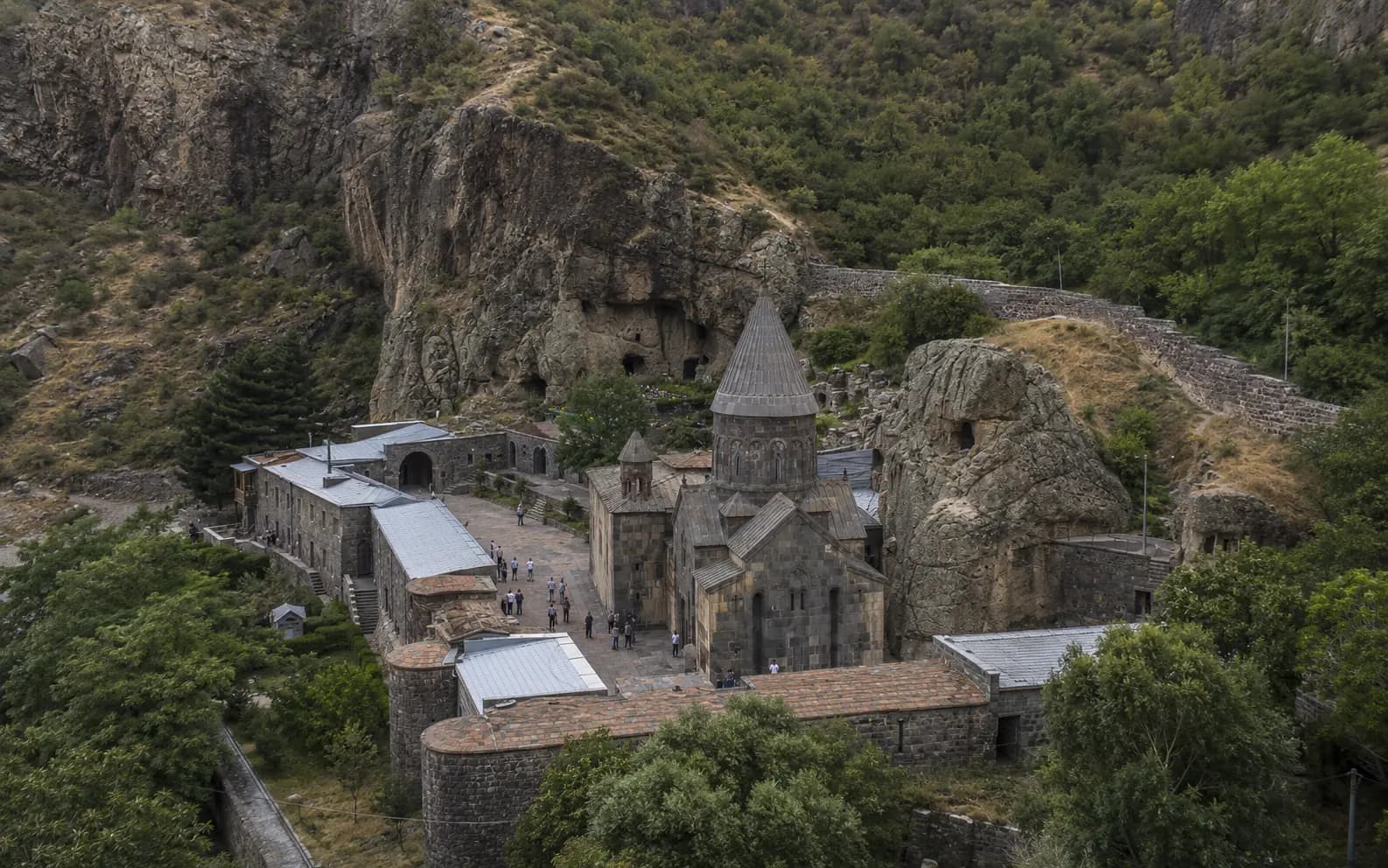
Geghard Monastery
A medieval monastery at the head of a gorge in the upper Azat valley. Half of it is built of masonry, half is cut into the cliff behind, and it is named after a spear it no longer holds.
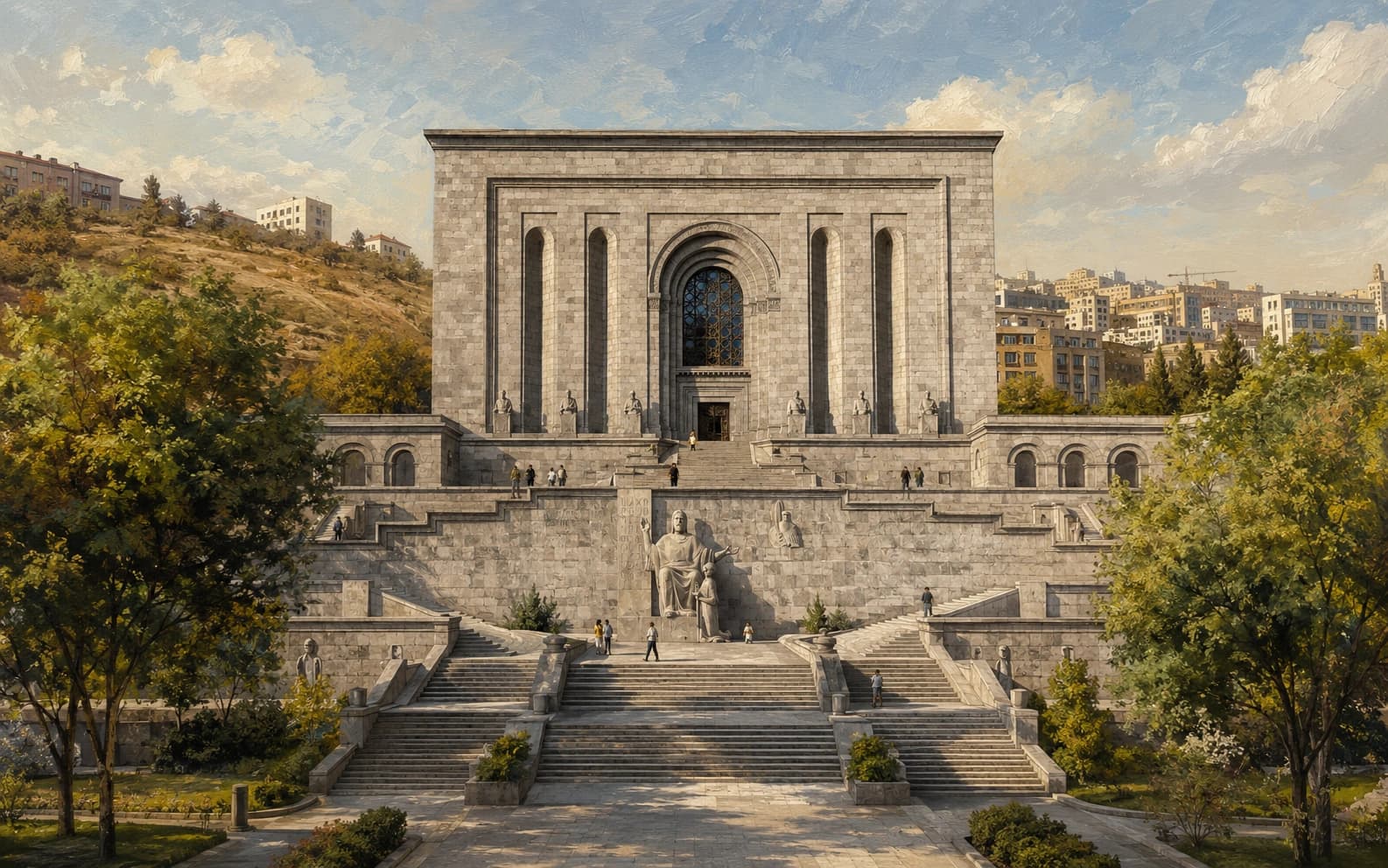
Matenadaran
The national repository of ancient manuscripts in Yerevan: an archive, a research institute and a museum in one. Its collection was built up in monasteries over centuries and brought here in the twentieth.
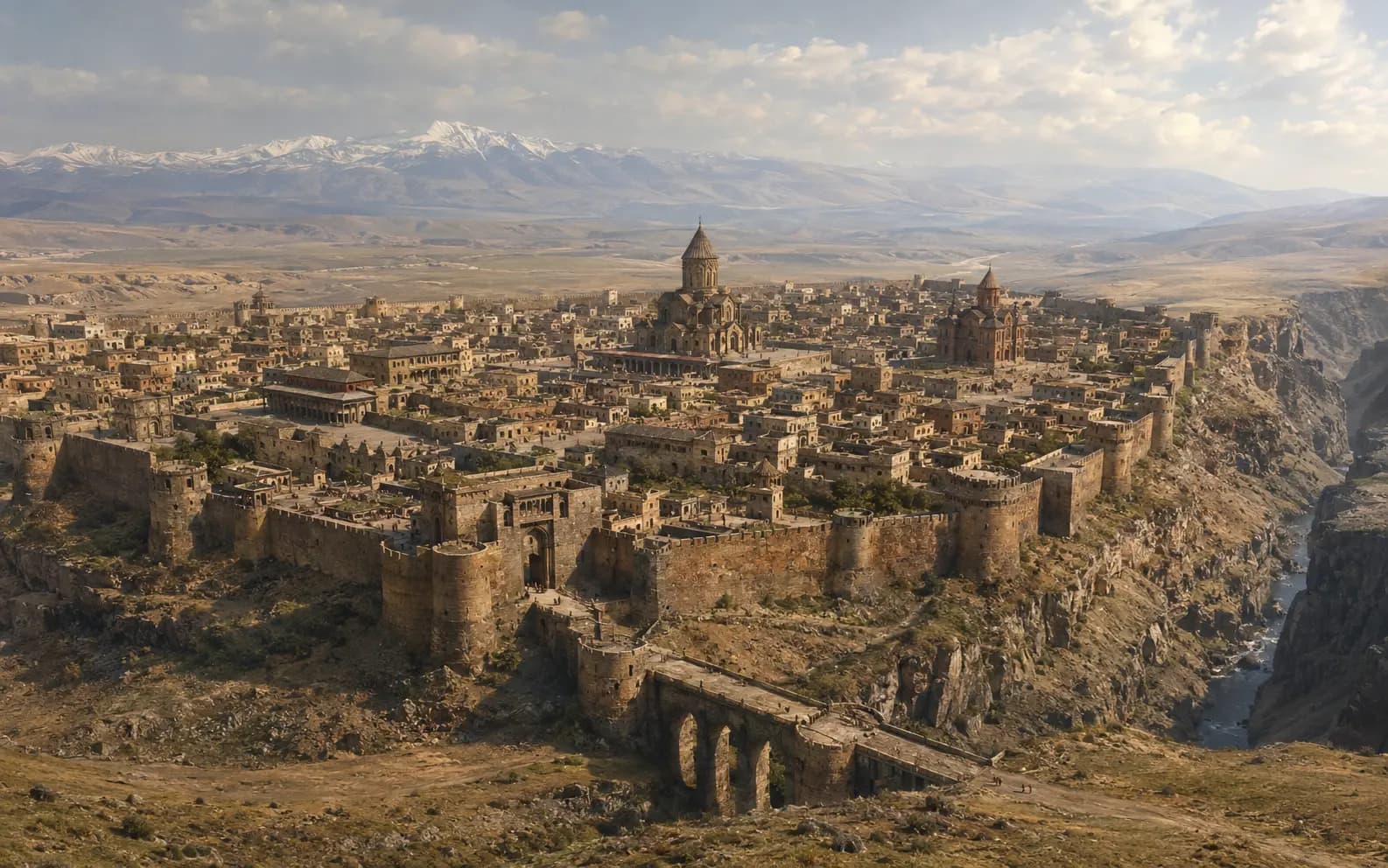
Bagratid Armenia and the City of Ani
The Bagratid kings restored Armenian statehood after two centuries of foreign rule and built Ani into one of the great cities of the medieval world.