
The Fool
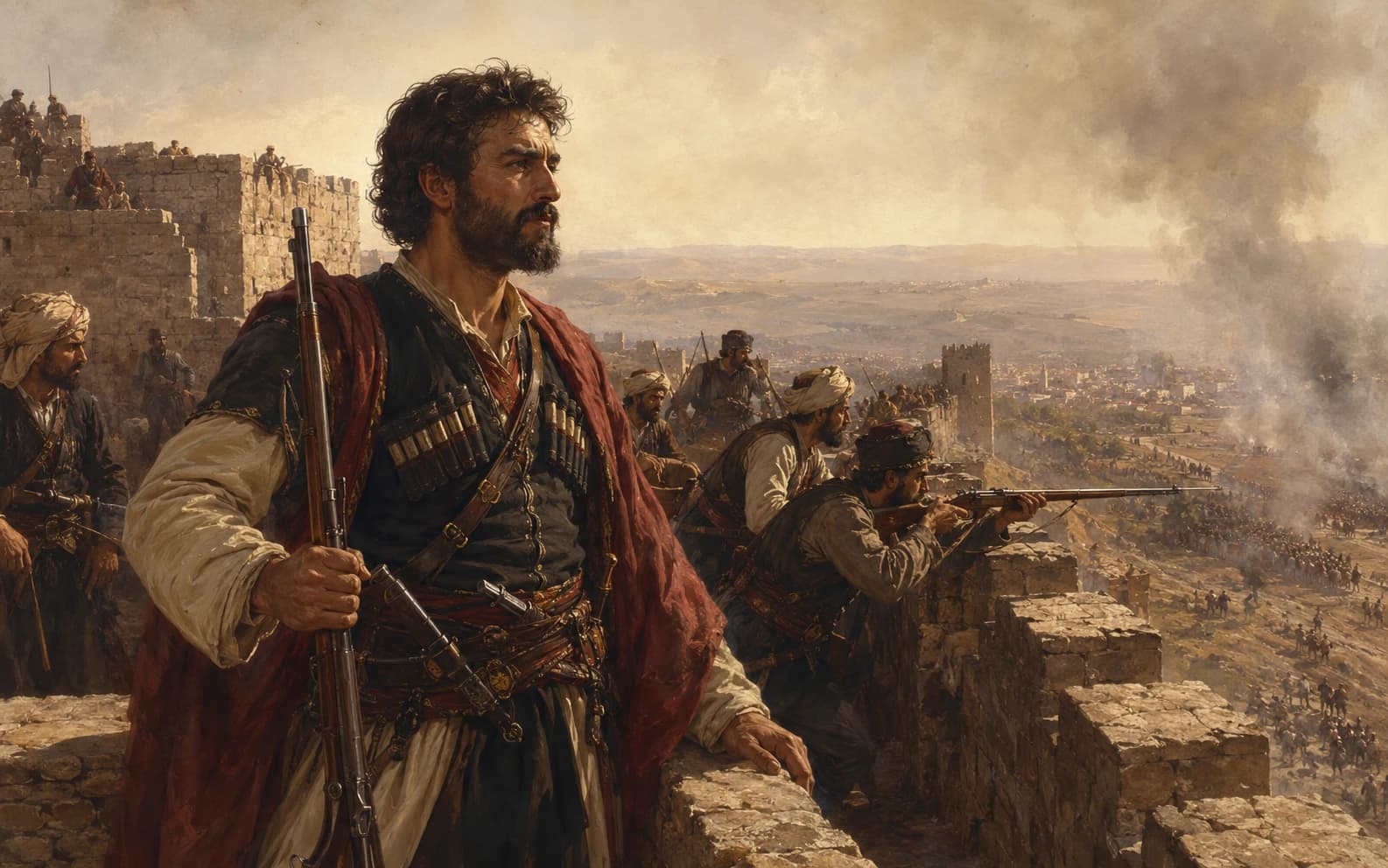
The Fool, published in 1880 under its Armenian title Khente, is one of Raffi's best known novels. It moves between the Ottoman districts of Bayazit and Alashkert and the Russian side of the border during the Russo-Turkish war of 1877 to 1878 and follows Vardan, a young man whom the villagers call a fool because he refuses to accept things as they are. The book combines love story, war narrative and political argument.
- Author
- Armat Editorial Team
- Updated
- Reading time
- 8 min read
Key facts
- Author
- Raffi, pen name of Hakob Melik-Hakobian (1835–1888)
- Written
- 1879–1880
- First published
- Serialised in Mshak in Tiflis in 1880; first book edition Shusha, 1881
- Genre
- Historical and political novel with romantic elements
- Setting
- Bayazit and Alashkert in the Ottoman Empire, and Vagharshapat across the Russian border, during the Russo-Turkish war of 1877–1878
- Main characters
- Vardan, Lala (Stepanik), Khacho, Thomas Effendi, Salman, Melik-Mansur
Historical context
The 1870s were a decade of crisis for Armenians living in the eastern provinces of the Ottoman Empire. Villages were subject to double taxation, to raids by armed Kurdish tribal groups and to a legal system in which their testimony carried little weight. The Russo-Turkish war of 1877 to 1878 raised hopes of protection and reform, and the Treaty of Berlin that followed contained a clause promising improvements that were never carried out.
Raffi, whose real name was Hakob Melik-Hakobian, travelled widely through these provinces as a teacher and journalist. What he saw convinced him that appeals to foreign powers would not save Armenian villagers and that they would have to organise their own defence, education and self-reliance.
The Fool was written directly out of that conviction and published in 1880, while the disappointment of the Berlin settlement was fresh. It was read as much as a political statement as a work of fiction, and it circulated widely among young Armenians who would later found the political parties of the 1880s and 1890s.
Summary of the story
Vardan is a young man who moves among the villages of the Armenian highlands trading and carrying messages. His plain speaking, his refusal to bow to local powers and his insistence that the villagers could defend themselves earn him the nickname Khente, the fool. He falls in love with Lala, the daughter of the village elder Khacho — a girl raised as a boy under the name Stepanik, so that neither the Kurdish chief Fattah Bey nor the tax collector Thomas Effendi would learn a marriageable daughter lived in the house. Their relationship becomes the emotional centre of the book.
As the Russo-Turkish war spreads, the villages are exposed to raids and reprisals. Raffi describes the destruction of homes, the flight of refugees over mountain passes and the helplessness of communities that have no weapons and no leadership. Vardan works to organise resistance and to move people to safety, while the notables hesitate and negotiate.
When the Ottoman army besieges Bayazit, Vardan volunteers to carry a message through the enemy lines to the Russian general Ter-Ghukasov, and the relief of the town turns on his success. Lala flees with the refugee column across the border to Vagharshapat, where she falls ill and dies. Vardan, reaching Vagharshapat at last, finds only her grave. The novel closes there with his vision of a future Armenia — free, with an elected parliament, equal rights for women, and its cities called by their Armenian names again — an ending that has been read ever since as either prophecy or wishful thinking.
Main characters
Raffi uses his characters to stage an argument about how a threatened community should behave. Each major figure represents a different answer, and the plot tests those answers against events.
Around them Raffi places a large cast of villagers, priests, merchants and soldiers, giving the novel a panoramic quality that was new in Armenian fiction.
- Vardan: the young man called a fool, clear-sighted, restless, and the one who carries the message through the siege lines at Bayazit.
- Lala, raised as a boy under the name Stepanik: gentle, and braver than her sheltered upbringing suggests.
- Khacho: Lala's father, a village elder who believes accommodation and quiet payments will keep his family safe.
- Thomas Effendi: a corrupt tax collector who profits from the villagers' fear and represents collaboration with power.
- Salman: the teacher and propagandist from Constantinople who travels between villages trying to found schools, and whose arguments with Vardan let Raffi debate strategy openly on the page.
- Melik-Mansur and Fattah Bey: the arms-supplier posing as a brigand, and the Kurdish chief whose demands hang over Khacho's household.
Themes and key ideas
The governing idea is that clear sight looks like madness in a frightened community. Vardan is called a fool because he says out loud what everyone privately fears, and Raffi uses that irony to attack the habit of accommodation. The novel argues that patience without preparation is not wisdom but a slow form of surrender.
Self-reliance is the practical programme behind the theme. Raffi repeatedly shows that appeals to distant empires, whether Russian or European, produce paper promises rather than protection. Education, organisation and the willingness to defend one's own village are presented as the only durable answers.
Raffi also examines class divisions inside Armenian society. The wealthy notables and the tax farmers in the novel often have more in common with the officials who oppress the peasants than with the peasants themselves. This critique from within was unusual and is one reason the book still provokes debate.
Language and style
Raffi writes accessible Eastern Armenian prose in the tradition Abovyan opened, but with a more controlled narrative technique. He handles a large cast, several parallel plot lines and long stretches of dialogue with confidence, and his descriptions of landscape and village interiors are precise enough to serve as historical evidence.
The style is frankly romantic. Heroes are noble, villains are greedy, and emotional scenes are pitched high. Raffi was writing to move a mass readership rather than to satisfy critics, and he was extremely successful at it; his novels were passed hand to hand and read aloud in villages and schools.
The most distinctive feature is the way argument is built into the fiction. Characters debate strategy at length, and whole chapters function as political essays in dialogue form. Readers should be aware that Raffi is persuading as well as narrating, which makes the novel a good text for practising critical reading.
Legacy and adaptations
The Fool had an immediate and lasting effect on Armenian political culture. Young readers of the 1880s took Vardan as a model, and figures involved in founding the Armenian political parties later described Raffi's novels as formative. The word khente itself acquired an admiring sense in Armenian usage, meaning someone whose refusal to be reasonable turns out to be right.
The novel has been repeatedly reprinted, translated into Russian, English and other languages, adapted for the stage and used as a school text. Raffi's collected works remain among the most widely owned Armenian books in both Armenia and the diaspora.
Modern scholarship reads the novel in more than one way: as an early nationalist manifesto, as a valuable ethnographic record of provincial Armenian life, and as a case study in how fiction can shape politics. All three readings can be pursued profitably in a classroom.
Important dates
1877–1878
The Russo-Turkish war, the historical background of the novel.
1878
The Treaty of Berlin promises reforms for Ottoman Armenians that are never implemented.
1880
The Fool is published and circulates rapidly among young Armenian readers.
1888
Raffi dies in Tiflis; his funeral becomes a large public demonstration.
1890
Political organisations founded in this period cite Raffi's novels as an inspiration.
Why The Fool matters
The Fool is the clearest example in Armenian literature of a novel that changed how its readers acted. It arrived at a moment of political disappointment, offered a diagnosis and a programme, and reached an audience far larger than any newspaper of the period. Historians of the Armenian national movement treat it as a primary source for understanding the mood of the 1880s.
As literature it also marks a step forward in craft. Raffi took the vernacular prose Abovyan had made possible and used it to build a long, structured, densely populated novel. Reading The Fool alongside Wounds of Armenia shows students how quickly modern Armenian fiction matured in a single generation.
Interesting facts
- 01Raffi's real name was Hakob Melik-Hakobian; he took the pen name around 1872, when he began writing for the newspaper Mshak.
- 02He earned his living as a teacher and merchant's agent, travelling the provinces he later described.
- 03The Armenian word khente shifted meaning after the novel, gaining a sense of admirable stubbornness.
- 04Raffi wrote several major novels in under fifteen years, including Samvel and Davit Bek.
- 05His funeral in Tiflis in 1888 drew crowds large enough to be reported as a political event.
Sources
- A. J. Hacikyan, G. Basmajian, E. S. Franchuk and N. Ouzounian (eds.). The Heritage of Armenian Literature, Volume III: From the Eighteenth Century to Modern Times — Wayne State University Press, 2005 ISBN 9780814332214
- Richard G. Hovannisian (ed.). The Armenian People from Ancient to Modern Times, Volume II: Foreign Dominion to Statehood, the Fifteenth Century to the Twentieth Century — Palgrave Macmillan, 2004 ISBN 9781403964229First published by St. Martin's Press, New York, 1997. For the Russo-Turkish war of 1877–78 and the Berlin reform clause the novel turns on.
Related articles
Raffi (Hakob Melik-Hakobian)
The novelist who invented the Armenian historical novel and used fiction to argue that a nation must act to save itself.
Wounds of Armenia
Khachatur Abovyan's novel of the Russo-Persian war is the first major work written in the living speech of the Armenian people.
Anush
Hovhannes Tumanyan's mountain love poem follows two young villagers destroyed by pride, custom and the harsh code of honour.