
Ghapama
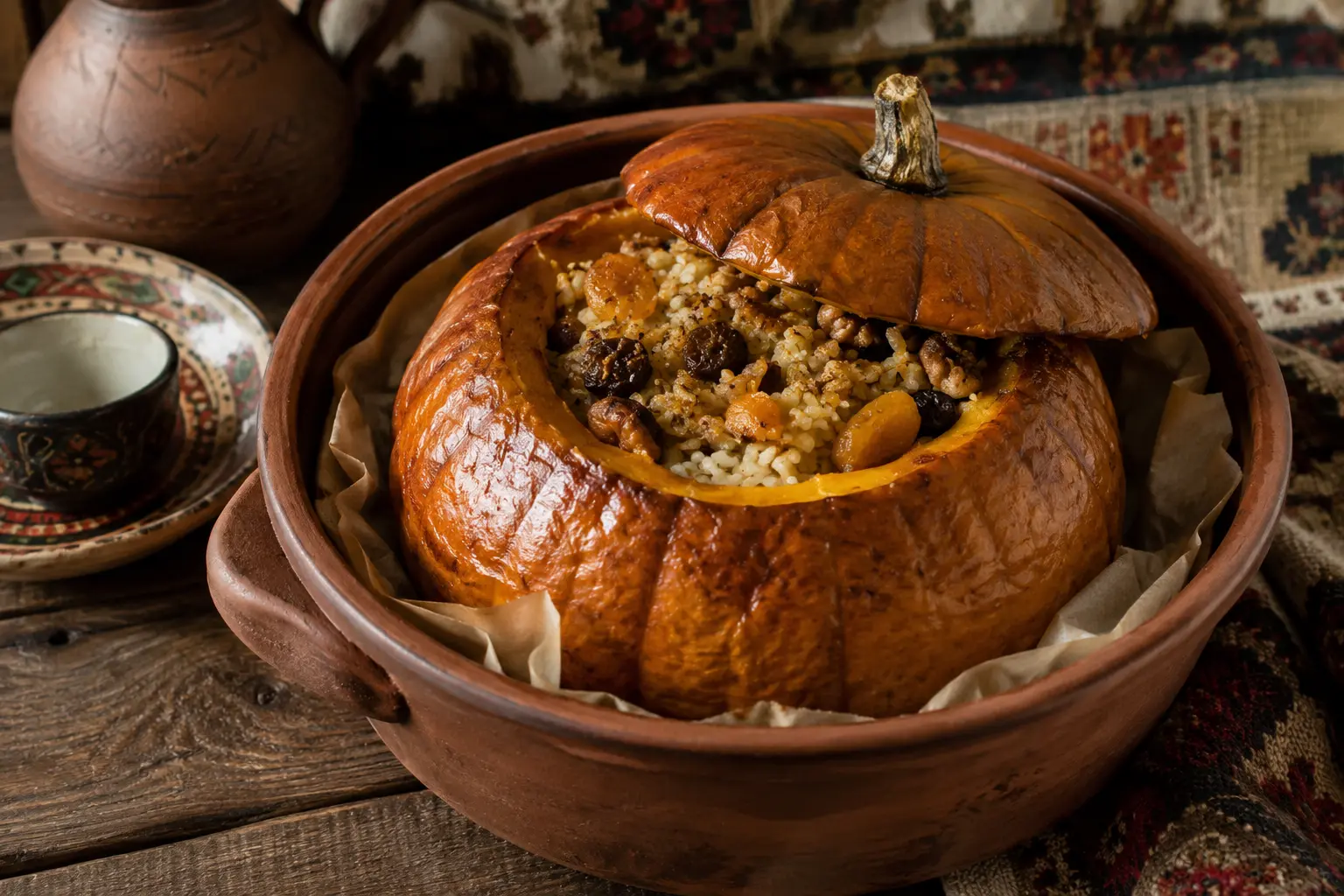
Ghapama is a whole pumpkin, hollowed and filled with rice, dried fruit, nuts, butter and honey, and baked until the flesh is soft enough to eat with the filling. It is brought to the table whole and cut down its ridges so that it opens outwards, which is a large part of why it is made. It is a dish for feasts rather than for weekdays — historically because dried fruit and nuts were expensive — and it is the one dish in this section whose age can be bounded, because the pumpkin it is built around is not an Old World plant.
- Author
- Armat Editorial Team
- Updated
- Reading time
- 6 min read
In brief
Ghapama is a whole pumpkin, opened at the stem and seeded, filled with part-cooked rice mixed with dried apricots, raisins, walnuts or almonds, butter, honey and cinnamon, then closed with its own lid and baked slowly until the flesh gives. It is carried to the table whole and cut along its natural ridges so that it opens outwards, which is a large part of why it is made. It belongs with the sweet dishes at the end of a meal and is associated in particular with Christmas and New Year tables; families reserved it for feasts because the nuts and dried fruit were costly. A folk song about ghapama is widely sung at Armenian gatherings. It cannot be ancient: every pumpkin of the genus Cucurbita is a plant of the Americas.
Key facts
- Kind of dish
- Whole filled pumpkin, baked
- Filling
- Rice, dried apricots, raisins, walnuts or almonds, butter, honey
- Seasoning
- Cinnamon, and sometimes other warm spices
- Served
- Whole, then cut open at the table
- Place in the meal
- Towards the end, among the sweet dishes
- Age
- Cannot predate the arrival of the pumpkin from the Americas
The dish at a glance
- Common ingredients
- A whole pumpkin, Rice, Dried apricots, raisins and prunes, Walnuts or almonds, Butter and honey, Cinnamon
- Traditional preparation
- The pumpkin is opened at the stem and seeded, filled with part-cooked rice mixed with dried fruit, nuts, butter, honey and cinnamon, closed with its own lid and baked slowly until the flesh is soft.
- Occasions
- Christmas and New Year tables, Weddings and large celebrations, Winter feasts
- Known regions
- Goris and southern Armenia, for the apricot and cornelian cherry version, Throughout the Republic of Armenia, Diaspora celebrations
- Serving traditions
- Carried to the table whole and cut open along its ridges in front of the guests; served towards the end of the meal, with the filling spooned out together with the flesh.
What ghapama is
A pumpkin is cut open at the stem to make a lid, seeded, and filled with rice that has been partly cooked and mixed with dried fruit, nuts, butter, honey and cinnamon. The lid goes back on and the whole thing is baked slowly until the flesh gives.
It is served whole and opened in front of the people eating it. The Smithsonian Folklife Festival's account of the dish describes the pumpkin being sliced along its natural indentations so that it falls open like the petals of a flower, revealing the filling.
In the order of an Armenian meal it belongs with the sweet dishes, towards the end, rather than as a main course — although the filling is substantial enough that it is not treated as a light finish.
Its place in Armenian life
Ghapama is a dish of display. It requires a large pumpkin, a long bake and expensive fillings, and it is designed to be revealed rather than served out of sight in the kitchen. That makes it a natural centrepiece for a table set for a celebration.
The Smithsonian's account notes that families reserved it for feasts and festivals precisely because nuts and dried fruit were costly, and that it is traditionally associated with Christmas. Its festive character is therefore economic in origin as much as ceremonial.
It is also unusually well known outside kitchens, because of a folk song about ghapama that is widely sung at Armenian gatherings — familiar enough beyond them that the Smithsonian's account of the dish introduces it by way of the Armenian-American rock band System of a Down.
Documented background
Ghapama is the one dish here that can be given an outer limit. Every pumpkin and squash of the genus Cucurbita is a plant of the Americas, and none was grown in the Old World before transatlantic contact. Whatever traditions of filling and baking vegetables preceded it, the dish as it now exists is therefore a comparatively modern one.
That is worth stating plainly, because ghapama is often described as ancient. The technique it uses — hollowing a vegetable and filling it — is old and is shared with the dolma family; the specific combination of that technique with a New World squash is not.
Its documentation, like gata's, is modern: cookbooks, ethnographic collection and, more recently, institutional programmes such as the Smithsonian Folklife Festival's Armenia season in 2018, which published an account of the dish and of a Goris version made with dried Armenian apricots and foraged cornelian cherries.
Ingredients and preparation
The pumpkin has to be sound, roughly spherical and large enough to hold the filling without being so thick-skinned that it will not cook through. It is opened at the top, seeded and scraped.
Rice is partly cooked and mixed with dried apricots, raisins, prunes, walnuts or almonds, butter, honey and cinnamon. Many families add more butter than seems reasonable; that is what keeps the rice from drying against the shell.
The filled pumpkin is closed with its lid and baked slowly for a long time. It is done when a skewer passes easily through the flesh, and it is left to settle before being carried to the table.
Occasions and traditions
Ghapama is a winter dish by ingredient and a festive one by cost. It is associated in particular with Christmas and New Year tables, and appears at weddings and other large celebrations where a centrepiece is wanted.
The cutting is part of the occasion. Because the dish is opened in front of everyone, it functions as a small ceremony of its own, and the song about it is commonly sung at exactly that point.
Regional variations
The most-documented regional version is that of Goris, in the south, which uses dried Armenian apricots and cornelian cherries gathered locally.
Elsewhere the fruit follows what a household dries: prunes, raisins, sour plums, apple. The nuts follow the same logic — walnuts most often, almonds where they are cheaper.
Meat versions exist, in which the rice is mixed with lamb or chicken and the dish moves from the sweet end of the meal to the savoury. In some regions no honey is used at all and the sweetness comes only from the fruit. All of these are ordinary; none is the standard against which the others should be measured.
Important dates
2006
Irina Petrosian and David Underwood publish Armenian Food: Fact, Fiction & Folklore, one of the few book-length attempts to separate what is documented about Armenian dishes from what is repeated about them.
2018
The Smithsonian Folklife Festival's Armenia programme publishes an account of ghapama, including the Goris version with dried apricots and cornelian cherries.
Why ghapama matters
Ghapama is the clearest demonstration in this section that a dish can be genuinely traditional without being ancient. Its ingredients place it after transatlantic contact, and it is nonetheless embedded in Armenian celebration, memory and song.
It is also a dish about abundance in a cuisine that is largely about making a great deal from very little. Harissa feeds a crowd from wheat and one animal; ghapama exists to look like more than a household can normally afford, and to be opened where everyone can see it.
Interesting facts
- 01The pumpkin is cut along its natural ridges so that it opens outwards like the petals of a flower when it reaches the table.
- 02Every pumpkin and squash of the genus Cucurbita comes from the Americas, which puts an outer limit on how old the dish can be.
- 03The Smithsonian's account records that families reserved ghapama for feasts because the nuts and dried fruit in it were expensive.
- 04A folk song about ghapama is sung at Armenian gatherings, and the Smithsonian's account of the dish opens by pairing it with the Armenian-American rock band System of a Down.
- 05The version documented from Goris uses dried Armenian apricots together with foraged cornelian cherries.
Sources
- Kathy Phung. Armenian Recipe: Ghapama, Stuffed Pumpkin — Smithsonian Folklife Festival, Center for Folklife and Cultural Heritage, 2018 Visit sourceWritten for the Festival's Armenia programme; the source for the dish's festive rather than everyday place, and for the Goris version.
- Alan Davidson, ed. Tom Jaine. The Oxford Companion to Food — Oxford University Press, 3rd edition, 2014 ISBN 9780199677337Cited for the botany: every Cucurbita squash, the pumpkin included, is a New World plant, which dates the dish in its present form.
- Sonia Uvezian. The Cuisine of Armenia — Siamanto Press ISBN 9780970971678
- Irina Petrosian and David Underwood. Armenian Food: Fact, Fiction & Folklore — Yerkir Publishing, 2006 ISBN 9781411698659
Related articles
Gata
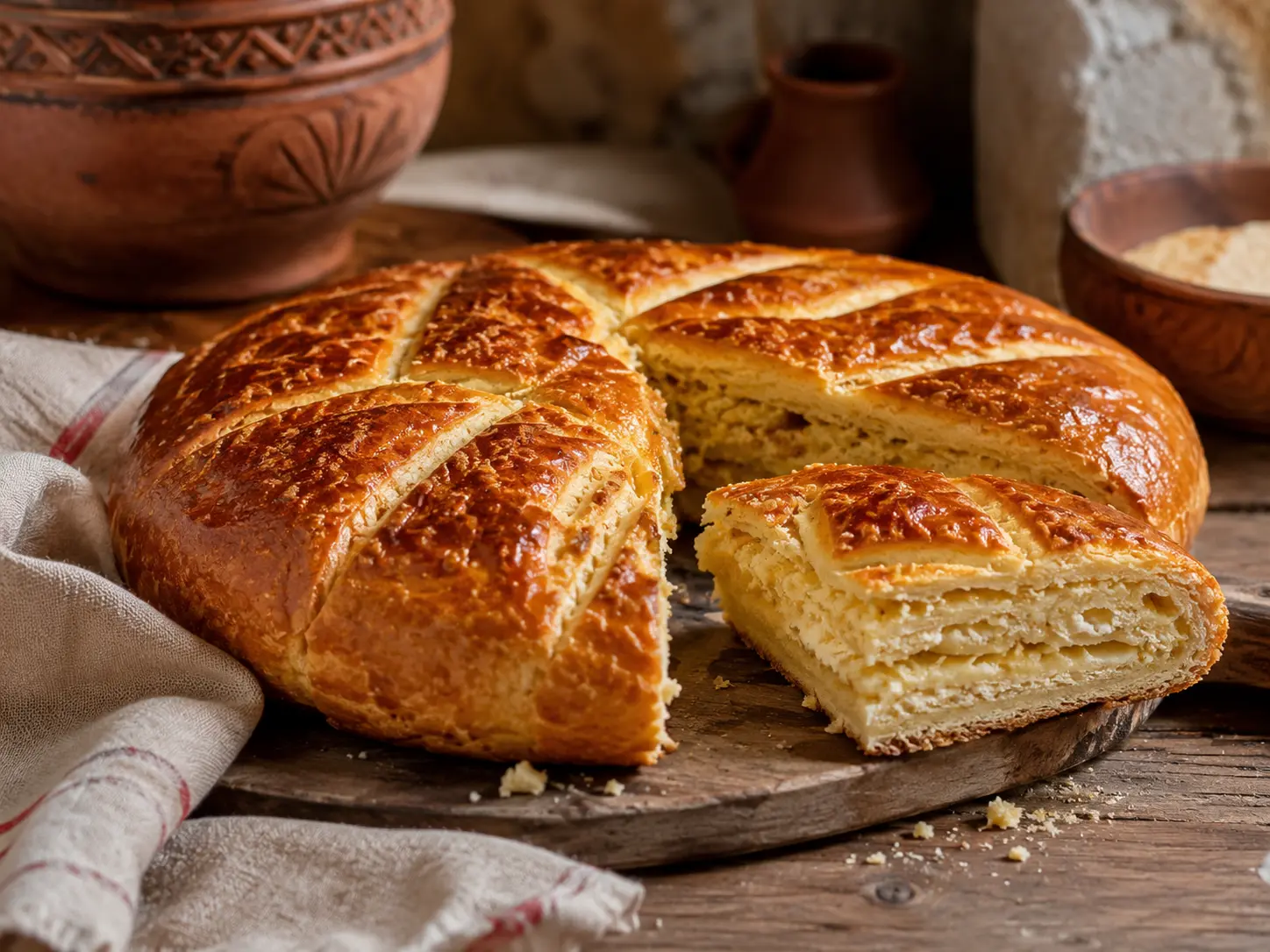
A sweet pastry built around khoriz — flour worked into butter and sugar — made in a different shape and marked with a different pattern in nearly every village that bakes it.
Dolma
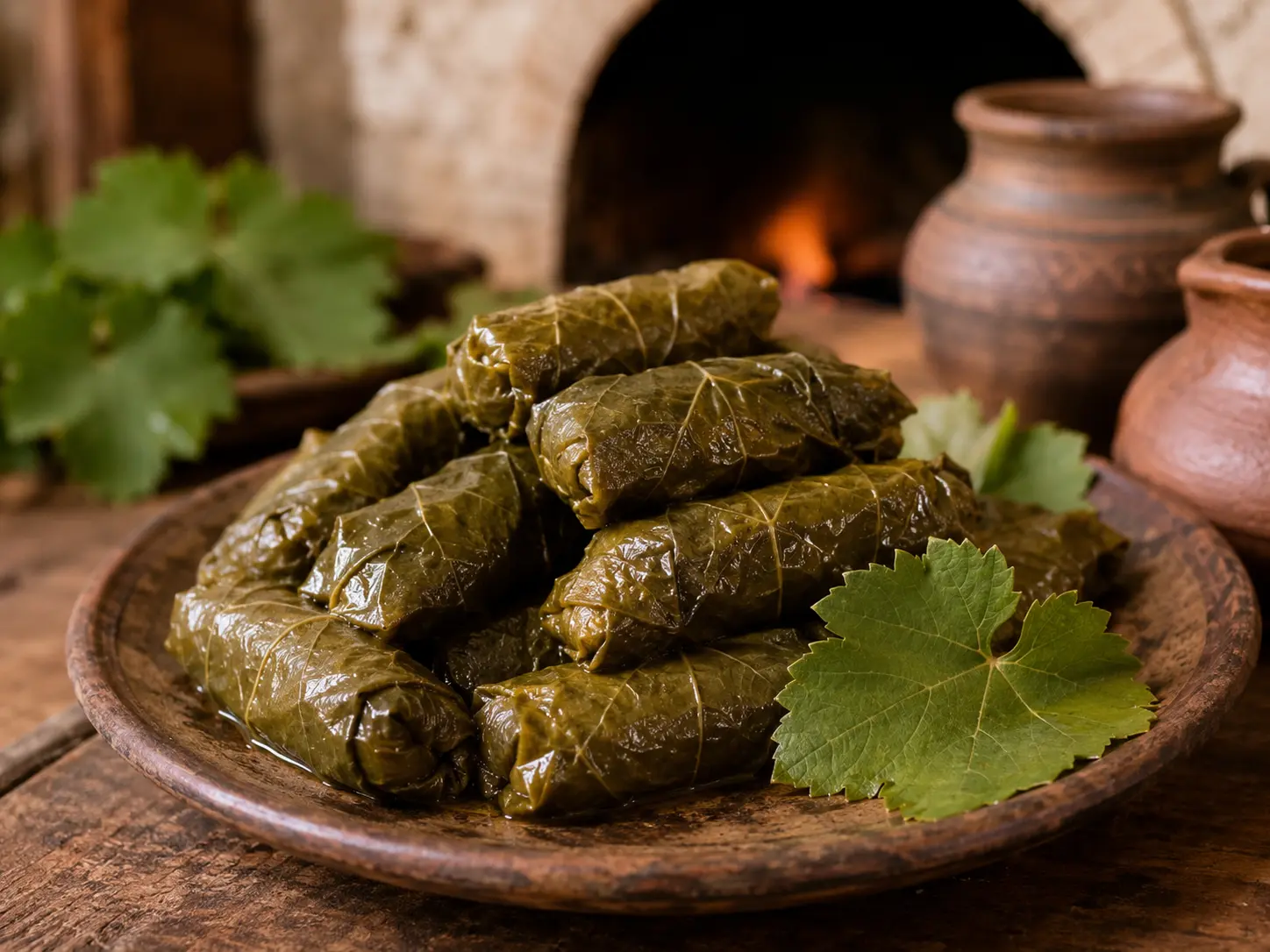
Vine leaves and hollowed vegetables filled with rice, herbs and often meat — a dish made across the whole region, and one of the clearest examples of why this section does not assign dishes to a single owner.
Harissa
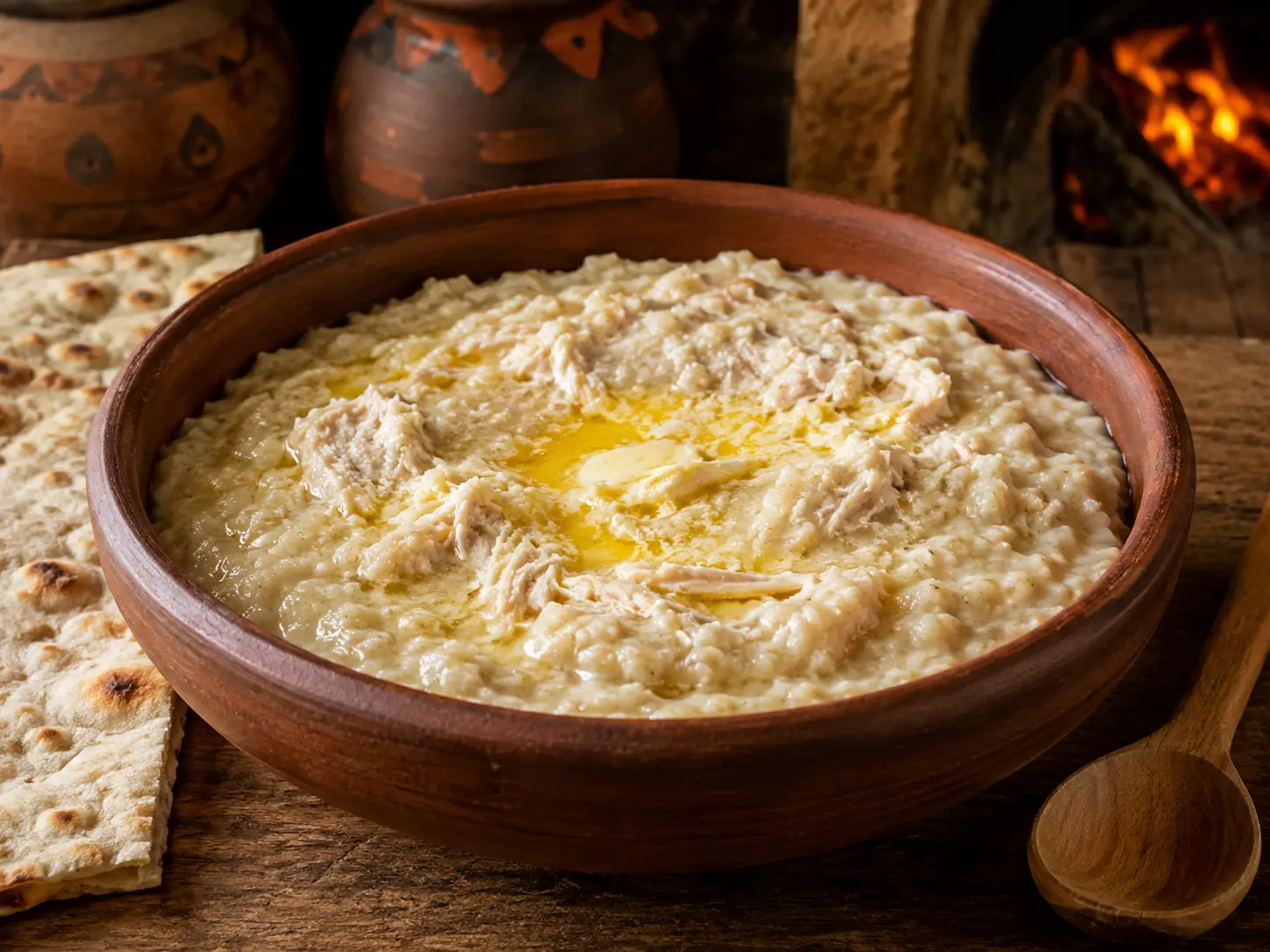
Wheat and meat stirred together for hours until they become one substance — a dish recorded in a tenth-century Baghdadi cookbook, and the food around which the Musa Dagh resistance is commemorated every September.