
Jingalov Hats
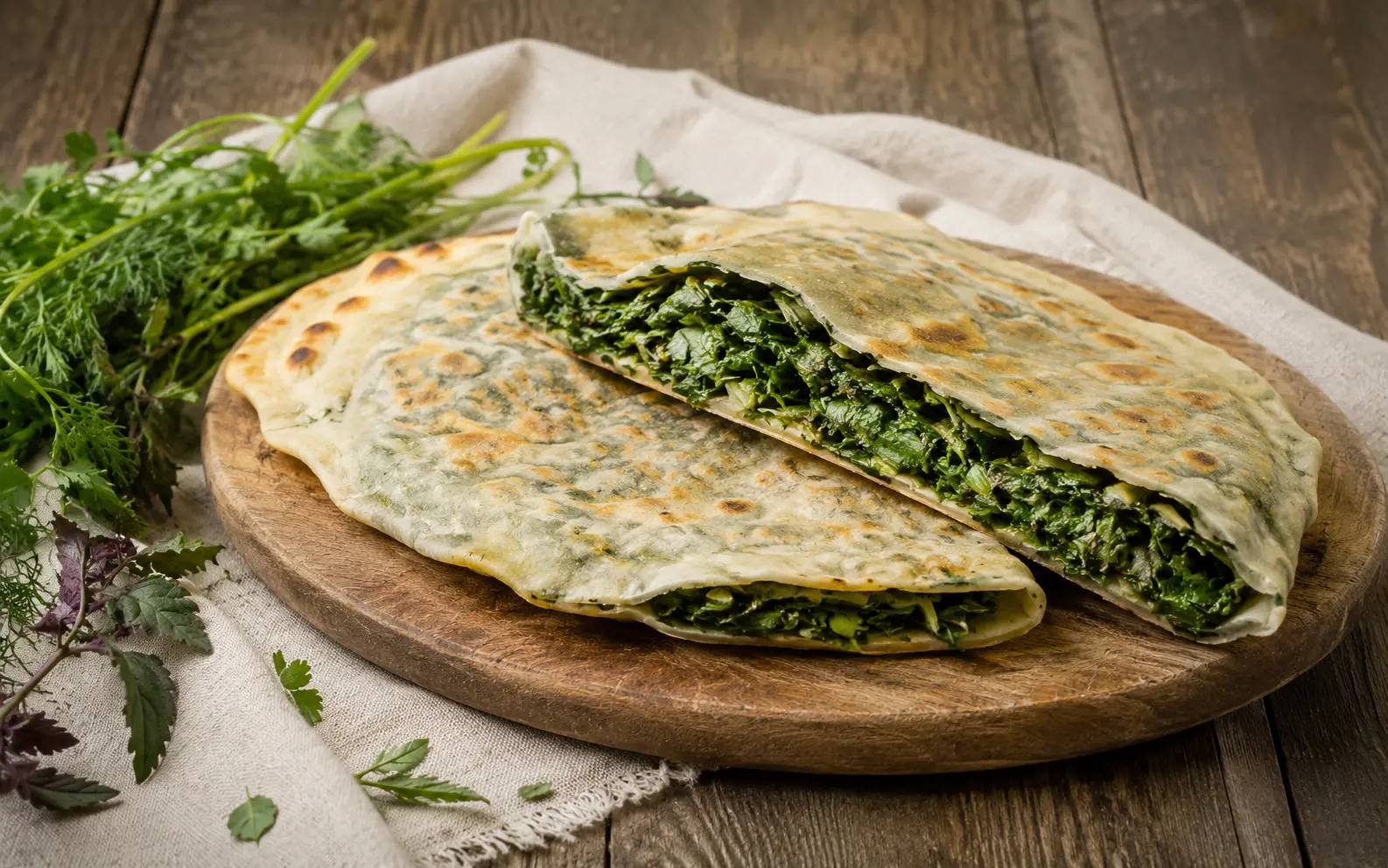
Jingalov hats is bread used as a wrapper. A round of unleavened dough is rolled until it is almost see-through, and a heap of finely chopped greens is spread over it. The dough is drawn up and sealed, and the parcel is flattened again and cooked on a hot metal plate until it blisters. It belongs to Artsakh and neighbouring Syunik, not to the whole Armenian world, which makes it one of the most strongly regional dishes in this section. Its filling is also why it resists being written down as a recipe: what goes in is whatever the season and the hillside offer.
- Author
- Armat Editorial Team
- Updated
- Reading time
- 11 min read
In brief
Jingalov hats is a flatbread from Artsakh and Syunik. Unleavened dough is rolled thin, piled with a large mix of finely chopped greens, sealed over the filling and cooked on a flat metal plate over a fire. The filling, not the bread, is what defines it, and it follows a pattern rather than a recipe: mild leafy greens for bulk, fragrant herbs for scent, and small amounts of sour and bitter greens for balance. Accounts disagree on how many kinds go in, and that is the point, because the mix follows the season and the hillside. The dish first appears in writing only in the nineteenth century, and since 2023 it has been made mostly far from the land whose plants define it.
Key facts
- Kind of dish
- Unleavened flatbread filled with chopped greens
- Where from
- Artsakh (Nagorno-Karabakh) and Syunik, not the Armenian world as a whole
- The filling
- Many greens at once: mild leaves for bulk, fragrant herbs, and a little sour and bitter
- How many greens
- Accounts range from about ten to twenty-six; the mix follows the season, not a count
- Cooked on
- A saj, a metal plate over a fire, in minutes; not against the wall of a tonir
- Season
- Early spring and autumn, when the wild greens are up
The dish at a glance
- Common ingredients
- Wheat flour, water and salt, for an unleavened dough, Mild leafy greens: spinach, chard, beet greens, lettuce and wild cousins, Fragrant herbs: cilantro, dill, parsley, mint, green onion, green garlic, Sorrel and other sour greens, Nettle and other wild greens, in smaller amounts, Oil and salt
- Traditional preparation
- Unleavened dough is rolled very thin and piled with finely chopped greens dressed with oil and salt. The edge is drawn up and sealed, and the parcel is pressed flat again so the filling forms a thin layer inside. It is cooked dry on a hot metal plate over a fire and turned once, until both sides are marked.
- Occasions
- Everyday eating, in the seasons when the greens are up, Made together, with several people chopping and shaping at once, Festivals devoted to the dish
- Known regions
- Artsakh (Nagorno-Karabakh), where it is the region's best-known dish, Syunik, the neighbouring Armenian province, Since 2023, made mainly in Armenia by displaced families
- Serving traditions
- Eaten warm and by hand, on its own, soon after it comes off the heat rather than kept.
What jingalov hats is
The dish brings together two opposites. The bread is as plain as bread gets: wheat flour, water and salt, unleavened and rolled thin. The filling is anything but plain. It is a dense mix of many different greens, finely chopped and dressed with oil and salt, in an amount that looks impossible until the dough closes over it.
It is cooked flat and dry. The sealed parcel is pressed out until the greens show dark through the dough. It then goes onto a hot surface and is turned once, so both sides char in spots while the filling steams inside. The whole thing takes minutes.
It is eaten warm, by hand, on its own. It is not a course, a side or a pastry. The dough is a skin thin enough to be just part of each bite, and what you taste is the greens.
A food of Artsakh
Jingalov hats belongs to Artsakh and to Syunik. Artsakh is the upland region between Armenia and Azerbaijan that Armenians call by that name and that is more often called Nagorno-Karabakh internationally. Syunik is the Armenian province along its western side. Both names appear in the sources used here, and we keep them separate. They are not interchangeable, and which one a source uses tells you something.
This regional tie needs saying first, because it is unusual in this section. Lavash, dolma, harissa and the rest are made wherever Armenians live. This one is not. It is the dish of one particular upland, for a practical reason, not a sentimental one: the filling depends on what grows there.
The region's Armenians speak their own dialect, and the dish's name comes from it. This article takes no position on the region's status. It does need to describe the dish as coming from a specific place with specific plants, because otherwise the most interesting thing about it disappears.
The language of greens
The filling works as a system, not a list. Cooks in Stepanakert, displaced families in Yerevan and a bakery in California all describe the same structure: a bulk of mild leafy greens, a smaller amount of strongly fragrant herbs, something sour and a touch of bitterness, all balanced against each other.
The mild greens provide the volume: spinach, chard, beet greens, lettuce and their wild cousins. The fragrant herbs are the ones most readers will know, such as cilantro, dill, parsley, mint, green onion and green garlic. Sorrel adds sourness. Dandelion and its relatives add a bitter edge, used sparingly, because a mostly bitter filling is a mistake, not a variation.
Nettle appears in many accounts and deserves a note of its own. It stings when raw and stops stinging once cooked, which is why a plant nobody would eat straight off the stem is perfectly normal inside this bread. Some cooks brighten the mix at the end with lemon, or with the purple powder of dried barberries.
How many greens
Almost every account of jingalov hats gives a number, and the numbers do not agree. Ara Zada, co-author of a book on Armenian cooking, told RFE/RL in 2024 that the original recipe called for twenty-six herbs and greens, and that around seventeen are usual today. The Smithsonian's account of displaced Artsakh families gives ten to twenty. Other totals circulate, some of them rounder than their sources justify.
This disagreement is not the sources' fault. It comes from the nature of the dish. A mix put together from whatever is growing on a particular slope in a particular week cannot have a fixed count. Even the same cook will not land on the same number twice in one season.
So the fair thing to say is that the filling is about abundance, not arithmetic. Many kinds go in, more than in any other dish in this section. Any specific total describes one recipe or one household, not a rule. When a round number is offered as the authentic count, it is a claim about authenticity, not a measurement.
Knowing what to pick
Ruzanna Tsaturian, a researcher at the Institute of Archaeology and Ethnography of Armenia's National Academy of Sciences, says the dish was traditionally made in early spring and autumn, when the wild herbs it needs are growing. The whole tradition works within that limit: the bread is there when the hillside is.
That also hints at where the dish came from. In the countryside of Nagorno-Karabakh, someone who knew which greens to pick could make a meal from flour, water and what they gathered, in seasons when there was little else. Tsaturian describes families turning back to it during the shortages of the war of the 1990s. In that setting, she calls it the forest bread of their ancestors.
The knowledge behind it is precise: which plants, which weeks, which parts, and which ones must be cooked before they can be eaten at all. It lives in households, not in books. This article describes that knowledge. It does not try to convey it: which wild plants are safe to eat is not something to learn from a page about food.
Dough and enclosure
The dough is the plainest part of the dish: wheat flour, water and salt, unleavened, rested and rolled out very thin. Nothing enriches it, and nothing is meant to.
The sealing is what makes the bread. The greens are spread over the round, the edge is pulled up over them and pinched shut, and the parcel is rolled or pressed flat again. The filling ends up as a thin layer between two thin layers of dough, not stuffed into a pocket. Keeping a very wet filling inside a very thin wrapper while flattening it is the real skill of the dish.
The proportions are the reverse of most filled breads. By volume there is far more filling than dough, and the dough is just a skin. That is why the finished bread looks green through its surface, and why it is a different thing from a pie.
The griddle, not the tonir
It is cooked on a saj, a metal plate set over a fire, and it is ready in minutes. Some accounts also allow a tonir, the clay pit oven. The plate is the characteristic method, and the two should not be run together just because both are Armenian and both involve fire.
This matters because of the obvious comparison. Lavash is the other thin Armenian wheat bread, and it is made quite differently. The sheet is slapped against the inner wall of a tonir and peeled off seconds later, as the UNESCO listing of 2014 describes. Lavash is thin bread served as bread. Jingalov hats uses a similar thin sheet of wheat dough to wrap something else.
The comparison is useful, up to a point. Both are unleavened wheat breads rolled thin by hand, and both belong to a wide regional family of such breads. Neither is a version of the other, and the cooking surface shows that most plainly.
What we know of its history
The written history is short, and it is better to say so than to fill the gap. Tsaturian dates the first written mentions of the dish to about two hundred years ago. An account published when the dish was listed as heritage puts it another way: it first appears in manuscripts of the nineteenth century, when Artsakh folklore was being collected.
Both point to the same period, and it is a moment of recording rather than of invention. Nineteenth-century collectors wrote down what people were already doing, so the dish is surely older than its first mention. But how much older is not something the available evidence establishes. No source consulted here places it in antiquity, and neither does this article. A living regional tradition does not need an ancient origin to be worth describing.
Its recent official life, though, can be dated. In 2013 the authorities in Artsakh added the dish to their register of intangible cultural heritage. In April 2015 the first festival devoted to it was held at Tsaghkashat, in the Askeran district, as part of a heritage-preservation programme. Tsaturian notes that over the twentieth century it had drifted from daily staple towards what she calls entertainment food. So the listing and the festival were recognising something that had already changed.
A food away from its place
In September 2023, after an Azerbaijani military offensive, almost the entire Armenian population of Nagorno-Karabakh, more than a hundred thousand people, left for Armenia. The dish went with them. Stalls and small businesses run by displaced families opened in Yerevan and in towns across the country, and by 2024 RFE/RL was describing jingalov hats as a street food as popular as pizza.
One thing could not make the journey. Writing in the Smithsonian's folklife magazine in February 2025, Aline Keledjian quotes a woman from Stepanakert on exactly this: the same herbs cannot be found in Armenia, because they grow in the mountains of Artsakh. You can carry a recipe in a suitcase, but not a hillside. Moving a dish defined by local plants changes it in a way that moving a dish defined by technique does not.
The tradition carries on in that changed form. Families displaced in the earlier war of 2020 opened restaurants in Yerevan to keep making it. A bakery in Glendale, California, that serves nothing else became in 2023 the first Armenian restaurant in the United States to be listed in the Michelin guide. None of that replaces the place. It is continuity, not recovery, and that is how this article reads it.
Important dates
2013
The dish is added to the register of intangible cultural heritage kept by the authorities in Artsakh.
2015
The first festival devoted to jingalov hats is held at Tsaghkashat, in the Askeran district of Artsakh, as part of a heritage-preservation programme.
2023
In September almost the whole Armenian population of Nagorno-Karabakh is displaced to Armenia. From then on the dish is made mainly outside the region whose plants define it.
Why jingalov hats matters
Jingalov hats is not made everywhere Armenians live, and that is why it is here. Describe a national cuisine only through dishes found everywhere and you edit out its regions, which is where most of the cooking actually happened.
It is also the clearest case in this archive of a dish that cannot be separated from a landscape. The technique can be taught anywhere and the dough made anywhere, but the filling is a set of plants that grow on particular mountains in particular weeks. That makes it an unusually rewarding article to write and, since 2023, an unusually hard one.
Interesting facts
- 01The filling has no fixed list. Accounts of how many kinds of greens go in range from about ten to twenty-six, because the mix follows what is growing.
- 02Nettle is a normal ingredient. It stings when raw and stops once cooked, which is why a plant nobody would eat straight off the stem belongs inside this bread.
- 03By volume there is more filling than dough, and the wrapper is so thin that the greens show dark green through it before it even goes near the heat.
- 04It is cooked on a metal plate over a fire, not against the wall of a tonir, and that is the clearest difference between it and lavash.
- 05Its first written mentions date from the nineteenth century, when Artsakh folklore was being collected. That dates when it was recorded, not when it began.
Sources
- Amos Chapple. Jingalov Hats: The Flatbread Creating A Lifeline For Armenia's Karabakh Refugees — RFE/RL, 5 March 2024 Visit sourceThe single richest source here, and the one that carries the ethnography. It quotes Ruzanna Tsaturian of the Institute of Archaeology and Ethnography of Armenia's National Academy of Sciences on the first textual mentions being about two hundred years old, on the early-spring and autumn seasonality, on the twentieth-century drift towards entertainment food, on the return to it during the shortages of the 1990s, and for the phrase forest bread. It separately reports Ara Zada's figures of twenty-six greens in the original recipe and around seventeen today, the named greens including nettle, and the street-stall economy that grew after 2020 and 2023.
- Aline Keledjian. "Who Are We?" Maintaining Artsakhtsi Identity After Forced Displacement from Nagorno-Karabakh — Smithsonian Center for Folklife and Cultural Heritage, 17 February 2025 Visit sourceThe source for the displacement context and for the article's central observation, which came from it rather than being imposed on it: a woman from Stepanakert saying the same herbs cannot be found in Armenia because they grow in the mountains of Artsakh. Also the source for the ten-to-twenty range, for the unleavened dough rolled flat, and for the continuation of the dish by displaced households in Yerevan. Chosen over general news reporting of the same events because it is a cultural-heritage institution writing about cultural continuity, which is the only aspect of 2023 this article discusses.
- Zhengyalov Hats Festival in Tsaghkashat on April 29 — Hetq, April 2015 Visit sourceTwo dated institutional facts rest on this and nothing else does: that the authorities in Artsakh entered the dish on their register of intangible cultural heritage in 2013, and that the first festival devoted to it was held at Tsaghkashat in the Askeran district in April 2015 under a heritage-preservation programme. It also states independently of Tsaturian that the first mention is in written manuscripts of the nineteenth century, when Artsakh folklore was being collected — two sources converging on the same century is what licenses the article to state it.
- Lavash, the preparation, meaning and appearance of traditional bread as an expression of culture in Armenia — UNESCO Representative List of the Intangible Cultural Heritage of Humanity, no. 00985, inscribed 2014 Visit sourceReused from the lavash bibliography, deliberately, for one claim: that lavash is baked by slapping the sheet against the inner wall of a tonir. That is the contrast the griddle section turns on, and it should come from the same record the lavash article uses rather than from a paraphrase of it.
- Armenia: Creating Home — Foodways — Smithsonian Folklife Festival, Center for Folklife and Cultural Heritage, 2018 Visit sourceReused from the spas bibliography for the same claim it supports there: each region has its own favoured wild plants. In spas that explains why the herbs vary; here it is the general statement of which this dish is the strongest single instance.
Related articles
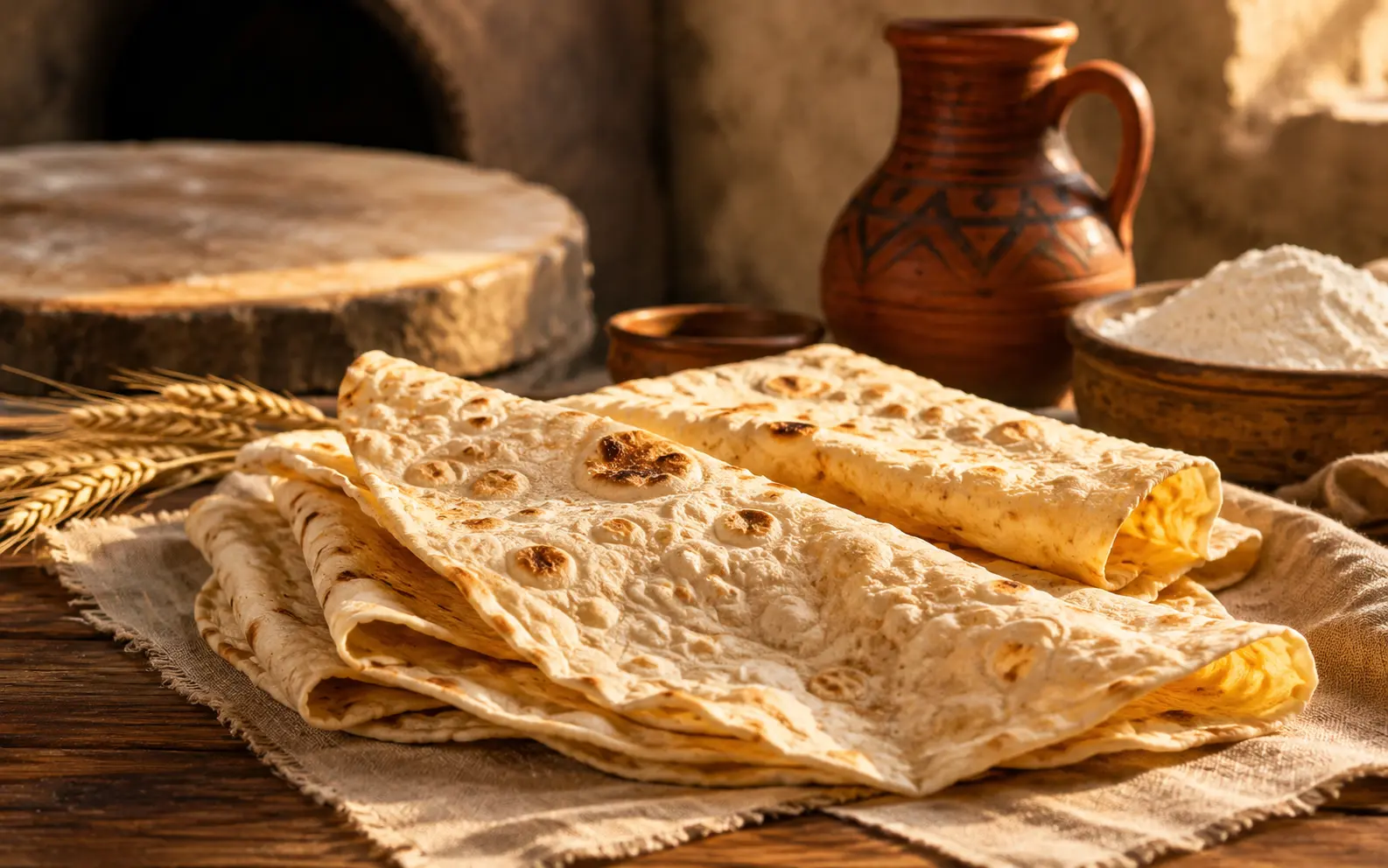
Lavash
The thin flatbread baked on the wall of a clay tonir. UNESCO listed it in 2014 for how Armenians make, share and use it, and listed it again in 2016 for five other countries.
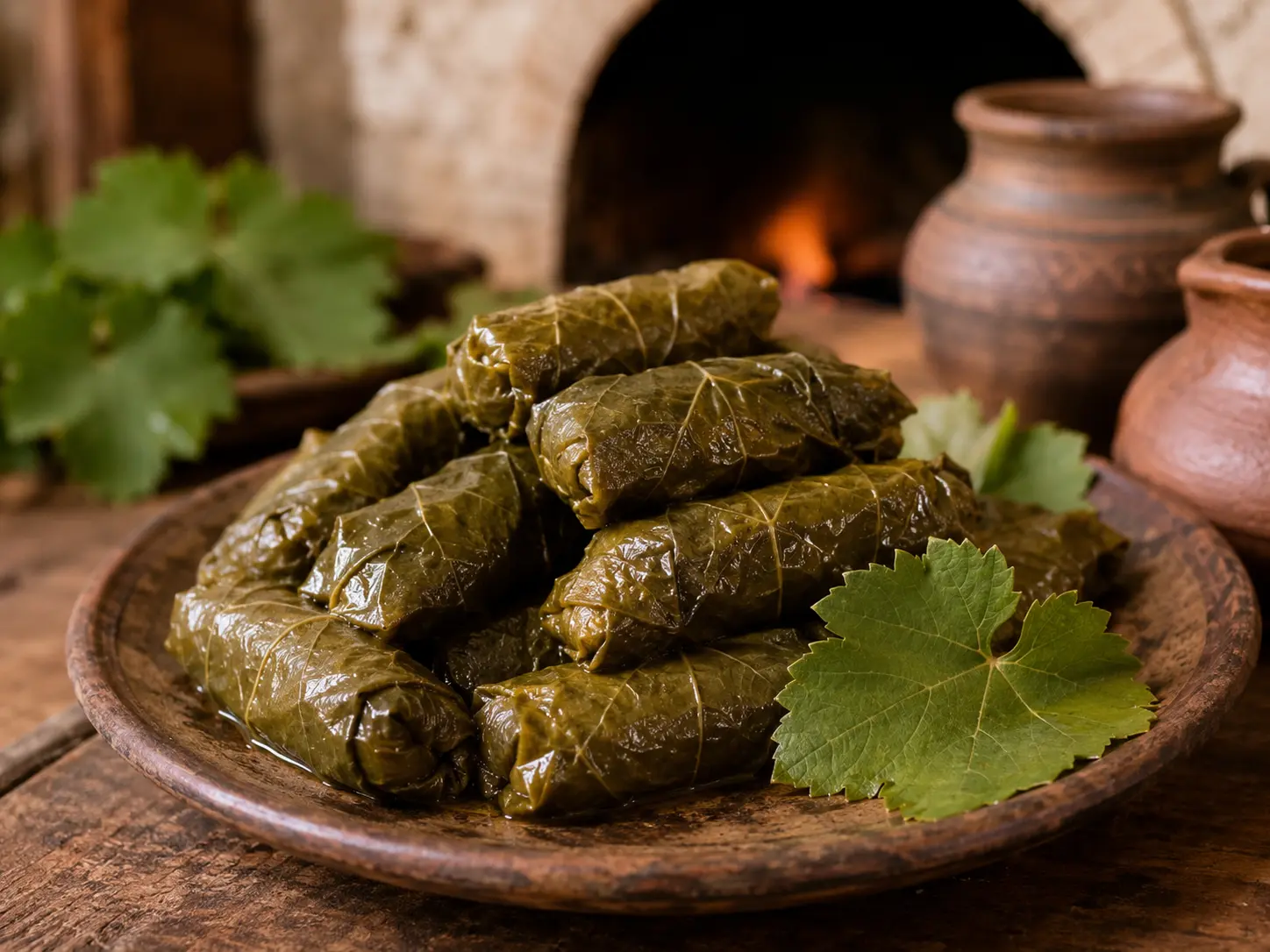
Dolma
Vine leaves and hollowed vegetables filled with rice, herbs and often meat. The dish is made across the whole region, which is exactly why this section does not name a single owner for it.
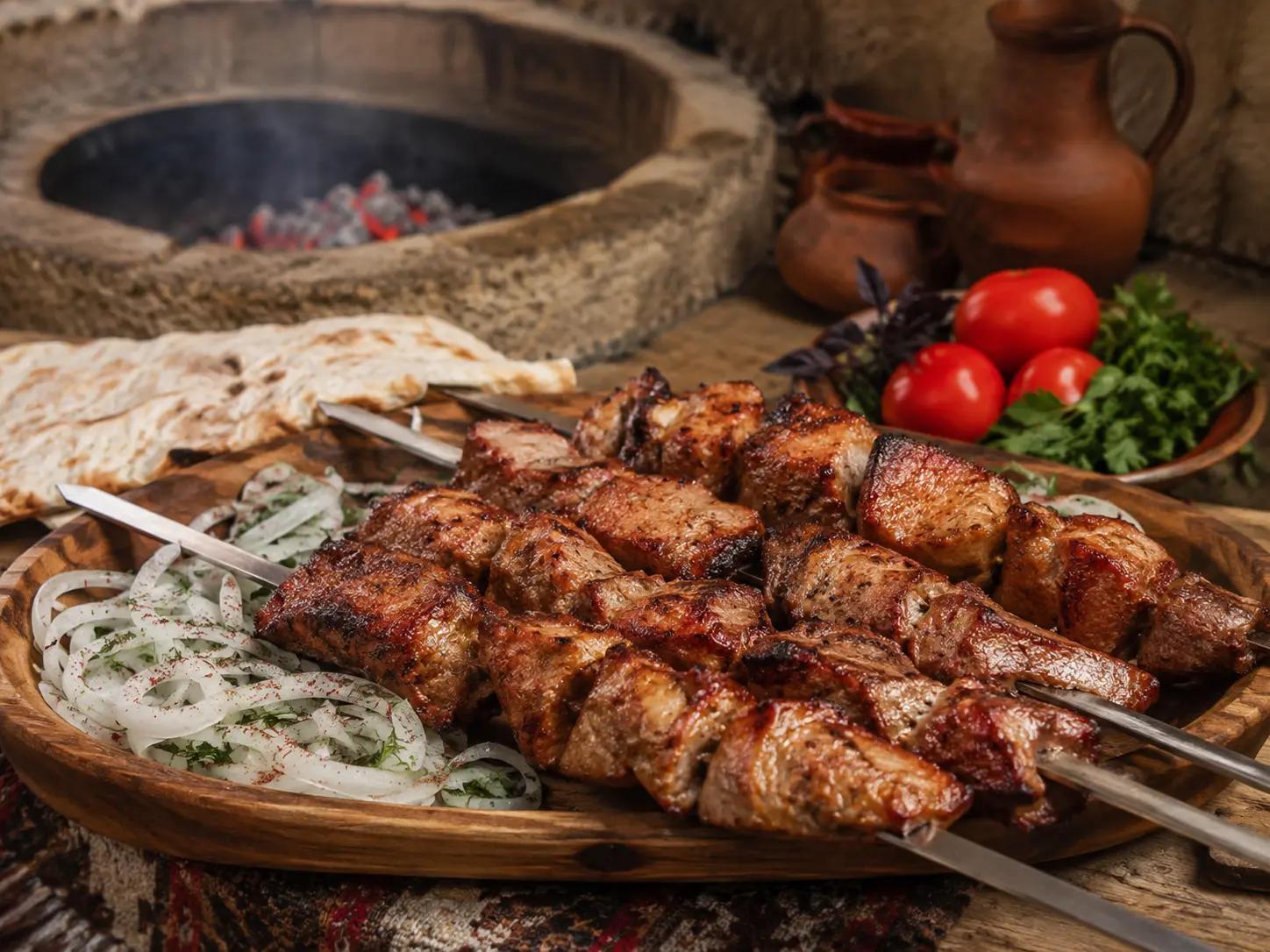
Khorovats
Meat grilled over open embers, and the gathering built around it: who lights the fire, who tends it, and how it differs from the communal meal of a madagh.